Dalmatian Cranesbill
Geranium dalmaticum
The Gardening Year
Best months in UK gardens · full planting calendar →
🖨 Printable care card (PDF)At a Glance
| Botanical name | Geranium dalmaticum |
|---|---|
| Common name(s) | Dalmatian cranesbill |
| Family | Geraniaceae |
| Plant type | perennial |
| Height × Spread | 10 cm × 10–50 cm |
| Position | Full sun, Partial shade, Full shade |
| Soil | Moist but well–drained or Well–drained; Chalk Loam Sand; pH Acid or Alkaline or Neutral |
| Flowering | May–July |
| Toxicity | — |
| Native range | Pelješac peninsula of Dalmatia on the west coast of Croatia |
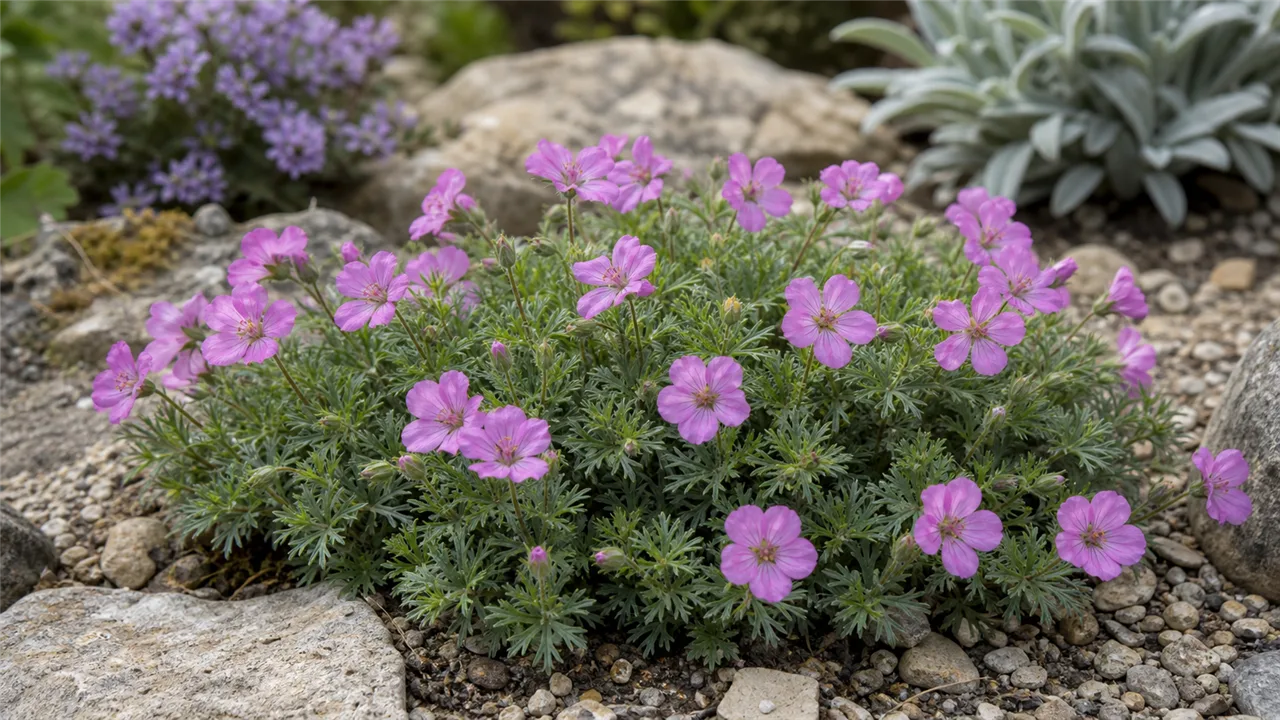
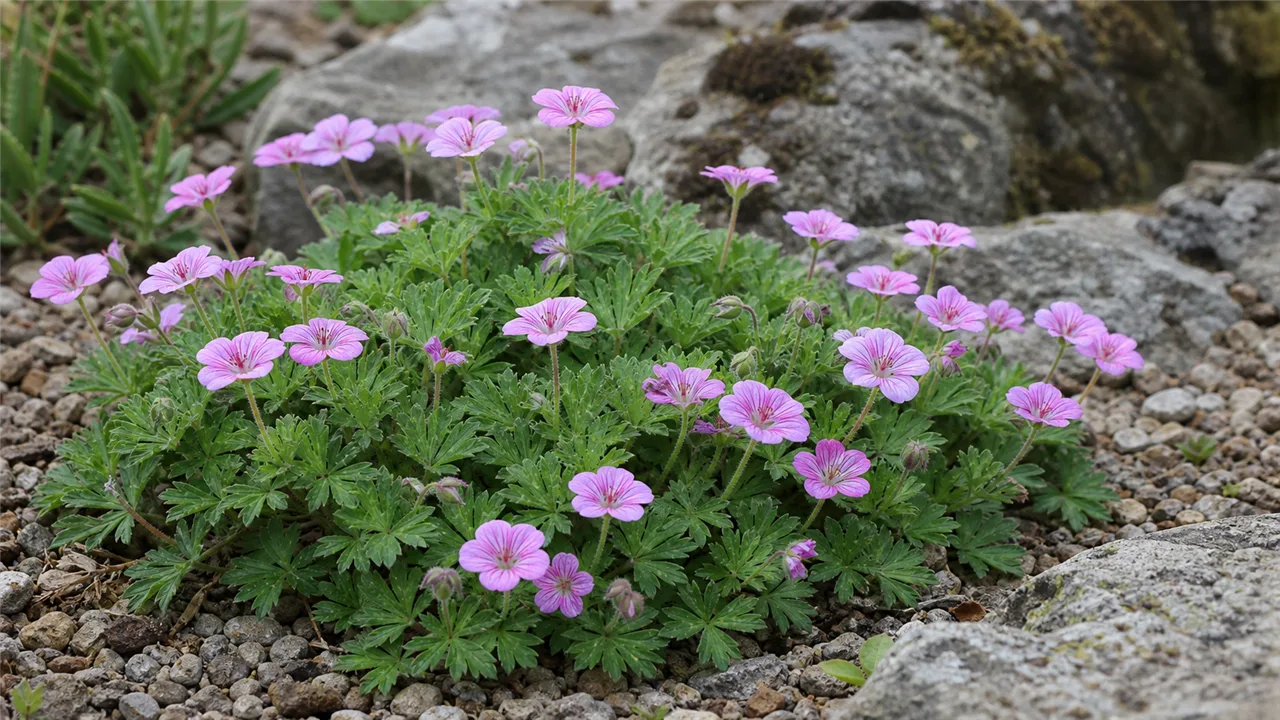
Geranium dalmaticum, the Dalmatian cranesbill, is a compact, mat-forming hardy geranium valued for aromatic foliage, soft pink summer flowers and warm autumn leaf colour. Its naturally low growth suits rock gardens, raised beds, gravel gardens, path edges and the front of a sunny border, where it spreads steadily without hiding smaller neighbours.
Overview
Native to the western Balkan Peninsula, including coastal parts of Croatia and Albania, Geranium dalmaticum grows as a low cushion of shallowly lobed leaves. It belongs to the Geraniaceae family and is a true hardy geranium, not a tender Pelargonium commonly sold as a summer bedding geranium. The common name cranesbill refers to the long, beak-like shape of the developing fruit.
This is one of the smallest useful garden geraniums. Mature plants normally remain below ankle height, but their short rhizomes and spreading stems can knit into a broad patch. The resulting cover softens the edge of paving, fills gaps among rocks and suppresses some annual weed seedlings once established. It is especially effective where a taller cranesbill would look coarse or overwhelm neighbouring alpines.
British gardens generally provide a suitable climate, provided the roots are not left in stagnant winter moisture. The plant tolerates cold weather well, while free drainage helps the crown and rhizomes remain healthy during prolonged rain. It performs in full sun across much of the UK and accepts light partial shade, although dense shade can produce looser growth and fewer flowers. In warm, dry districts, some afternoon shade can reduce stress without seriously diminishing the display.
The species is often evergreen or semi-evergreen in mild, sheltered gardens, but exposed plants may lose more foliage in winter. This variation is normal. New leaves appear in spring, followed by the main flowering display in early to midsummer. The foliage then often develops red, bronze or orange tints as nights cool in autumn. Plants are useful to pollinating insects when in bloom, and their modest scale makes them suitable for small urban gardens as well as larger rockeries.
Appearance
The foliage forms a dense, rounded mat. Individual leaves are glossy to softly lustrous, bright or mid-green and divided into rounded lobes with toothed margins. When rubbed, they release the resinous, aromatic scent associated with several rhizomatous geraniums. Stems remain short, so the plant usually looks like a compact cushion rather than an open clump. Established growth may thread between stones or spill slightly over the lip of a trough.
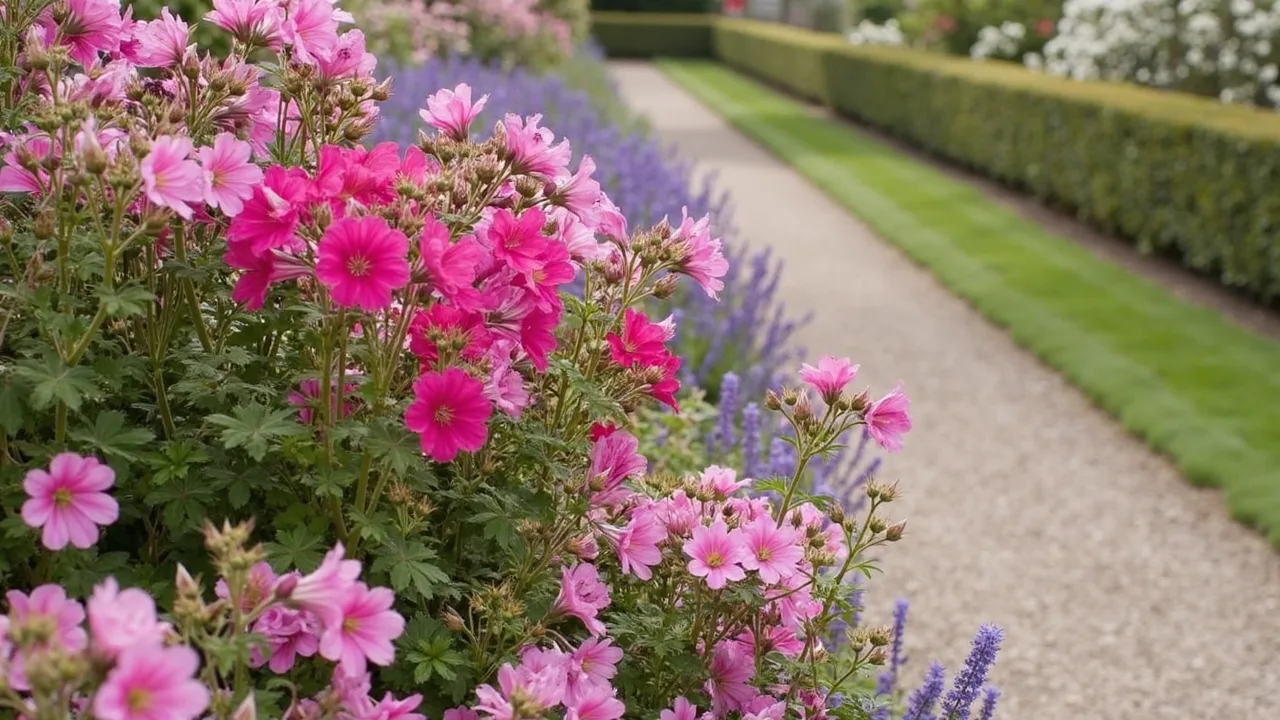
Five-petalled flowers rise just above the leaves on slender stems. The species commonly bears clear pink to soft mauve-pink blooms, often with fine deeper veins and conspicuous coloured anthers. Each flower is small in comparison with those of many border geranium hybrids, but numerous flowers distributed across a low mat create a light, even display rather than a few dominant blooms. The main season is usually June and July in the UK, with some flowers continuing into August where moisture and conditions remain favourable.
After pollination, the characteristic narrow cranesbill fruits may form. Removing spent flowering stems keeps a formal edging plant neater and can encourage fresh foliage; leaving some fruits is appropriate in a looser wildlife or gravel planting. Autumn colour is an important secondary feature. Cooler conditions can turn the leaves reddish or bronze before winter, so the plant remains ornamental after flowering has ended.
Its scale is central to good placement. Allow roughly 30–50 cm for an established patch, even though a newly purchased plant may look very small. Use it at the front of a bed, on a low bank, beside steps, in a crevice garden or in a wide alpine trough. It combines well with compact dianthus, thymes, small sedums and spring bulbs, provided none creates a wet, shaded canopy over its crown.
Growing Conditions
Choose an open site with full sun or light partial shade. Strong light promotes close growth, good autumn colour and abundant flowers. Partial shade is acceptable where it remains bright for much of the day. Avoid deep shade beneath dense evergreen shrubs, where flowering declines and surrounding roots may compete heavily for both moisture and nutrients.
Drainage is more important than extreme soil fertility. A moderately fertile loam with added grit suits the plant, as do sandy and chalky soils that retain enough moisture for establishment but release surplus water quickly. It accepts acid, neutral or alkaline conditions. On heavy clay, improve a broad planting area with well-rotted organic matter and coarse horticultural grit, or place the plant on a raised slope. A pocket of rich compost dug into an otherwise compacted hole can hold water like a sump, so drainage should be improved beyond the immediate root ball.
Although an established plant copes with short dry spells, it flowers and expands most evenly in soil that does not remain parched for months. Thin soil over a wall or in a container dries much faster than open ground and needs closer attention. Conversely, repeatedly saturated compost and winter waterlogging encourage weak roots and crown decline. Good air movement also reduces the humid, stagnant conditions in which foliar diseases become more troublesome.
For containers, use a pot with generous drainage holes and a peat-free, loam-based compost opened with horticultural grit. A broad, relatively shallow container displays the spreading habit better than a narrow pot. Raise the container slightly so rain can drain freely, and do not leave it standing in a water-filled saucer through winter. Repot or divide congested plants in spring when the centre has become woody or growth has reached the pot edge.
Planting and Care
Plant container-grown Geranium dalmaticum in March, April or May, when warming soil supports quick root growth, or in September while the ground remains warm. Spring is safer on cold, heavy soil. It may be planted at other times when the ground is workable, but summer planting demands regular watering and winter planting brings little immediate establishment. Water the pot before planting, set the crown level with the surrounding soil and firm gently without compacting the root zone. Space plants about 30 cm apart for eventual cover, adjusting the interval if a named cultivar has a documented wider spread.
Water thoroughly after planting and whenever the upper soil begins to dry during the first growing season. Deep, occasional watering is better than frequent surface sprinkling because it encourages roots to explore the soil. Once established in open ground, water mainly during prolonged dry weather. Containers require more frequent checks, especially in sunny, windy positions. Keep water off the foliage late in the day when mildew is already present.
Feeding should be restrained. In ordinary garden soil, a light spring mulch of well-rotted compost or leaf mould is usually sufficient. Keep mulch clear of the crown so it does not trap moisture against the stems. On very poor soil, apply a modest balanced feed in March or April. Excess nitrogen produces lush, lax leaves at the expense of the compact habit and can make plants more susceptible to mildew. Container plants benefit from a light controlled-release feed in spring rather than repeated high-nitrogen liquid feeding.
Pruning is limited to cutting back spent flower stems and tired leaves; no shaping of woody branches is needed. After the main flush, usually in July or August, remove faded stems and damaged foliage close to the base without cutting into the crown. Water if the soil is dry, and fresh leaves may follow. In February or March, clear away any winter-blackened growth before vigorous new leaves expand. Where attractive foliage remains sound, it can be left in place until spring.
Division is the most dependable way to increase an established plant and preserves the character of named cultivars. In March or April, lift the mat with a fork and separate vigorous outer sections, ensuring each piece has roots and several growing points. Replant immediately at the original depth, water well and keep evenly moist while new roots form. Small basal shoots can also be detached for cuttings in early to mid-spring and rooted in a free-draining medium. Seed is possible for the species, but seedlings from named cultivars may vary; division or basal cuttings are therefore preferable when an exact match is required.
Seasonal care is modest. Check newly planted specimens for drought in May and June, enjoy the principal flowers from June to August, and cut back untidy flowered growth after the main display. September is a useful month for planting where soil drains freely. Divide established mats in spring rather than during saturated or freezing weather. In autumn, remove leaves from neighbouring trees if they form a wet layer over the crown. During winter, protect container drainage rather than wrapping an otherwise suitable outdoor plant in moisture-retaining material.
Common Problems
The most serious avoidable problem is poor drainage. A plant that thins, yellows or collapses after a wet winter may be suffering from damaged roots or crown rot. Lift affected material, discard soft or blackened sections and replant healthy pieces into freer-draining soil. Do not compensate for wilting in saturated ground by adding more water.
Powdery mildew appears as a pale, floury coating, particularly when roots are dry but air around crowded foliage is humid. Improve air circulation, water the soil thoroughly during drought and remove badly affected leaves. Downy mildew can cause discoloured patches with growth beneath the leaves in cool, damp conditions. Clear infected debris, avoid overhead watering and reduce crowding. Persistent mottling, distortion or unexplained loss of vigour can indicate a virus; affected plants should not be used for propagation, and badly diseased specimens are best removed.
Vine-weevil larvae can damage roots, especially in containers, while adults notch leaf margins. Check roots when an apparently watered pot plant wilts, and use an appropriate biological control at the recommended season if larvae are found. Geranium sawfly larvae may make rounded holes in leaves, capsid bugs can distort shoot tips, and slugs or snails sometimes graze fresh spring growth. Regular inspection and hand removal are usually enough for a small planting. Encourage a balanced garden ecosystem and avoid routine broad-spectrum treatments, particularly while flowers are attracting pollinators.
Sparse flowering usually reflects excessive shade, rich feeding, recent division or drought during bud development. Move persistently shaded plants in spring and reduce nitrogen-rich feeds. A bare centre in an old mat is a sign to divide and retain the healthy outer portions. Unwanted spread is controlled by lifting rooted edges with a hand fork; dispose of surplus growth responsibly rather than allowing fragments to establish in unwanted places.
Popular Varieties
Named forms of Geranium dalmaticum are less numerous and less widely stocked than cultivars of larger hardy geraniums. Availability in the UK can be intermittent, so verify the full botanical name on the nursery label.
- Geranium dalmaticum is the species form, with aromatic green leaves, soft pink to mauve-pink flowers and red or bronze autumn tints. It is the standard choice for natural-looking rock and gravel gardens.
- Geranium dalmaticum 'Album' is a documented white-flowered selection. Its blooms may carry a faint pink tint, while the low, glossy-leaved habit remains close to that of the species.
- Geranium dalmaticum 'Bressingham Pink' is a compact, floriferous selection with pearly, clear pink flowers above aromatic foliage. It is useful where a stronger pink display is wanted without increasing plant height greatly.
- Geranium dalmaticum 'Bridal Bouquet' is an accepted pale-flowered cultivar, producing flowers shaded from pale pink towards white. It forms a dense, low patch suitable for raised beds, rock gardens and the front of a border.
Geranium × cantabrigiense cultivars are sometimes sold near this species and share G. dalmaticum parentage, but they are hybrids with G. macrorrhizum, not varieties of G. dalmaticum. They tend to make broader, more vigorous ground cover, so the distinction matters when choosing a plant for a small crevice or alpine setting.
Pests and Diseases
| Problem | Symptoms | Management |
|---|---|---|
| Powdery mildew | A white, dusty fungal growth appears on leaves and stems, often causing distortion. | Improve air circulation and apply a fungicide or bicarbonate spray at first sign. |
| Slugs and snails | Irregular holes chewed in foliage and silvery slime trails left on leaves and soil. | Use iron phosphate pellets, beer traps, or hand-pick at night to reduce populations. |
| Root rot | Stems become soft and mushy near the base while foliage wilts despite moist soil. | Ensure well-draining compost and avoid overwatering; remove affected plants immediately. |
| Aphids | Clusters of small green or black insects on new growth, often accompanied by sticky honeydew. | Spray off with a strong jet of water or treat with insecticidal soap or natural predators. |
| Leaf spot | Small brown or black spots develop on leaves, sometimes surrounded by yellow halos. | Remove infected leaves and avoid wetting foliage when watering to prevent spread. |
For step-by-step help, read Controlling Aphids Naturally, Dealing with Slugs and Snails, Treating Powdery Mildew and Tackling Black Spot on Roses. Or browse the full plant problem solver to diagnose an issue by symptom.
Recommended Products
GardenWizz earns a commission from qualifying purchases made through affiliate links on this page (including links within the article) — as an Amazon Associate, and from Thompson & Morgan via the Awin network. This does not affect the price you pay. See our disclaimer for details.