Mexican-Giant
Echeveria colorata
The Gardening Year
Best months in UK gardens · full planting calendar →
🖨 Printable care card (PDF)At a Glance
| Botanical name | Echeveria colorata |
|---|---|
| Common name(s) | mexican-giant |
| Family | Crassulaceae |
| Plant type | succulent (evergreen perennial) |
| Height × Spread | 10–50 cm × 10–50 cm |
| Position | Full sun, Partial shade |
| Soil | well-drained, sandy, light, cactus compost |
| Flowering | June–November |
| Toxicity | No reported toxicity |
| Native range | Mexico |
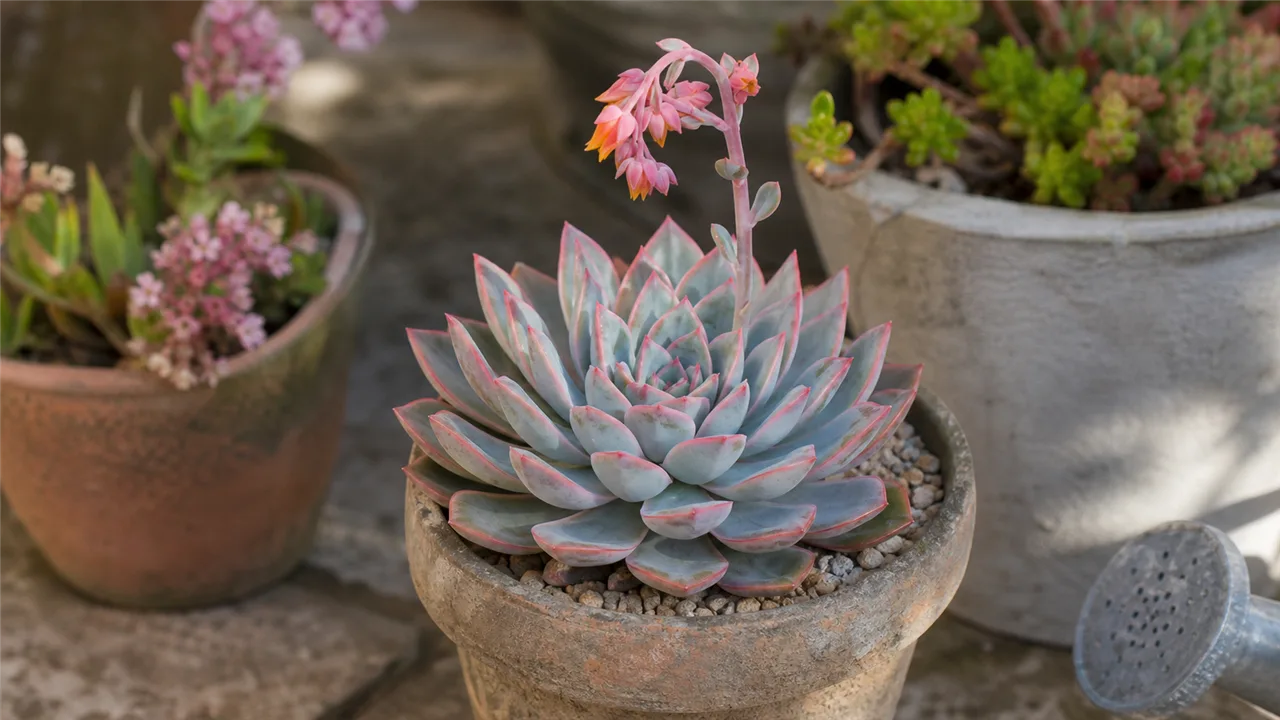
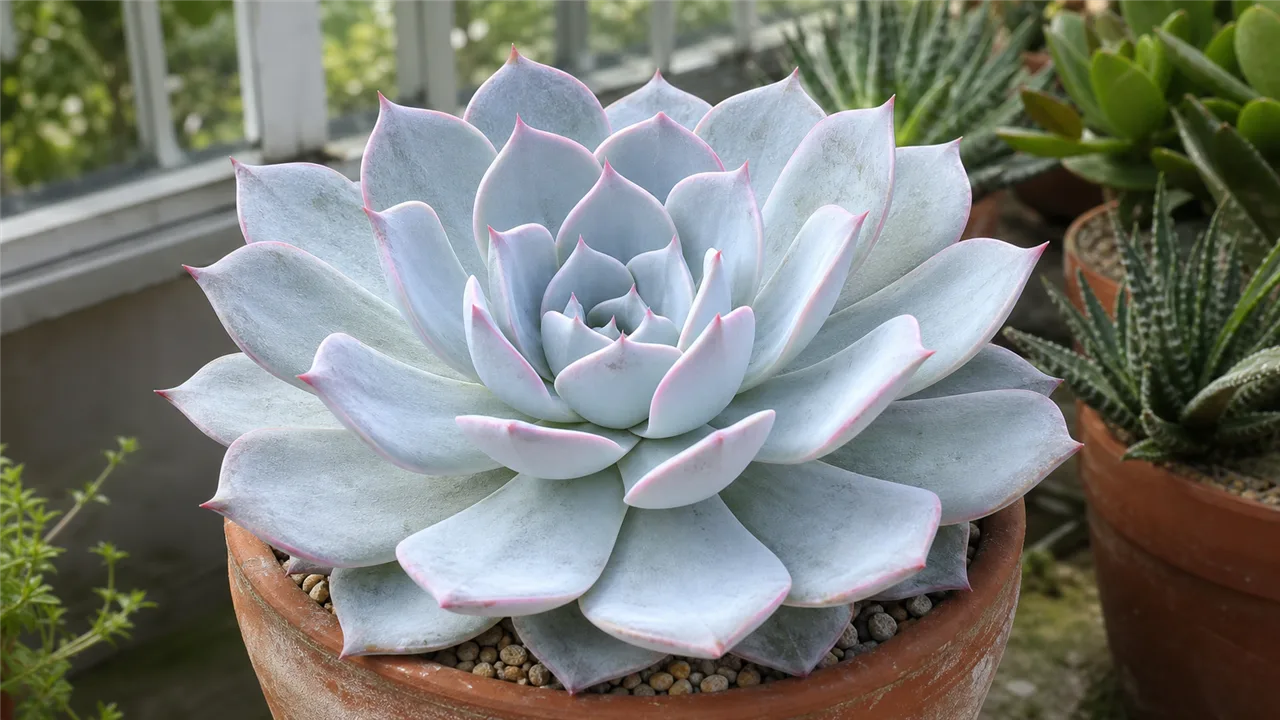
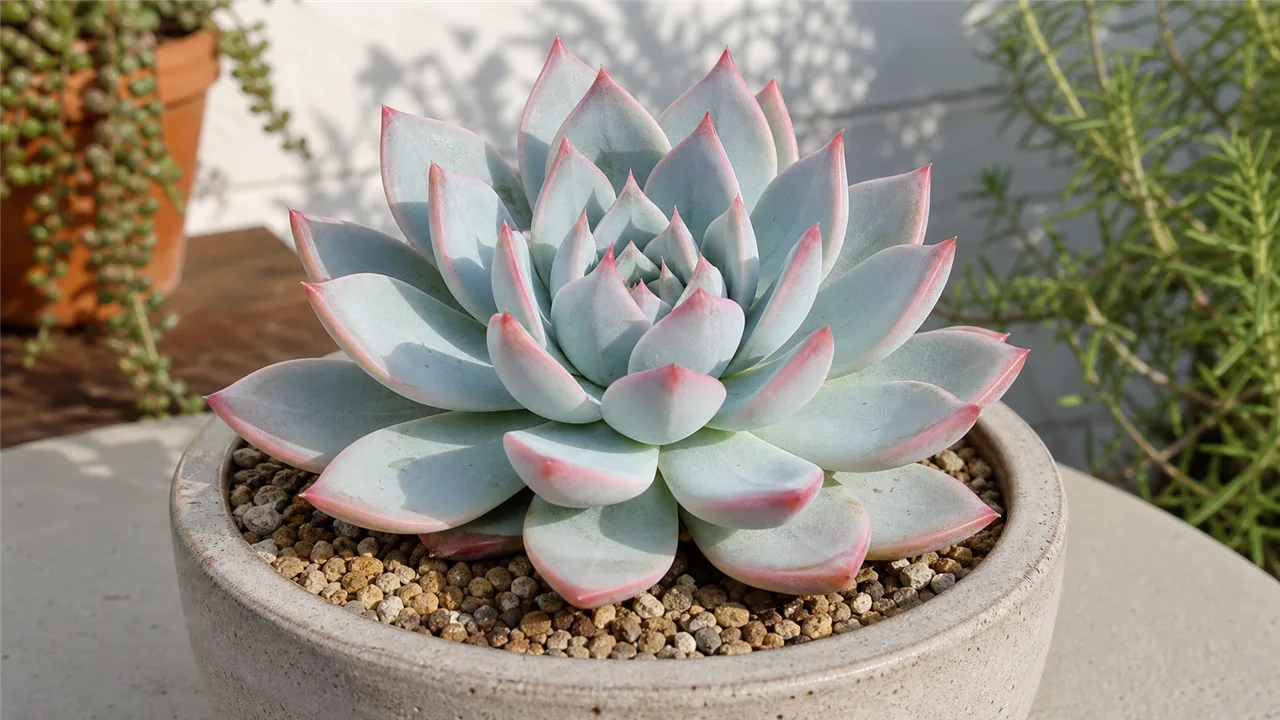
Echeveria colorata is a compact Mexican succulent prized for its almost geometric rosette of silver-blue leaves, each often finished with a pink or red point. In Britain it is best treated as a bright-window, conservatory or frost-free greenhouse plant, although it can spend warm, settled summer weather outdoors in a sheltered position.
Overview
Echeveria colorata belongs to the stonecrop family, Crassulaceae, and is native to Jalisco in western Mexico. It grows as a succulent subshrub in seasonally dry habitat. The leaves store water, while their pale, waxy coating reflects strong light and helps limit moisture loss. These adaptations make the plant tolerant of short dry periods but do not make it tolerant of poorly drained compost.
The species is usually sold under its botanical name, though “coloured echeveria” is sometimes used as an English common name. It makes a particularly effective specimen in a plain terracotta pot, where the symmetry and subtle leaf colours can be appreciated at close range. It also suits a mixed succulent display, provided its companions require the same bright light, sharp drainage and restrained winter watering.
UK conditions rarely provide the combination of warmth, intense light and dry roots that it receives in habitat. A sunny windowsill, bright conservatory or frost-free greenhouse is therefore more dependable than permanent outdoor planting. A plant may be moved to a sheltered patio in summer after gradual acclimatisation, but protection from prolonged rain is as important as warmth. The outdoor Gardening Year calendar is not applicable to this primarily indoor-grown succulent.
Appearance
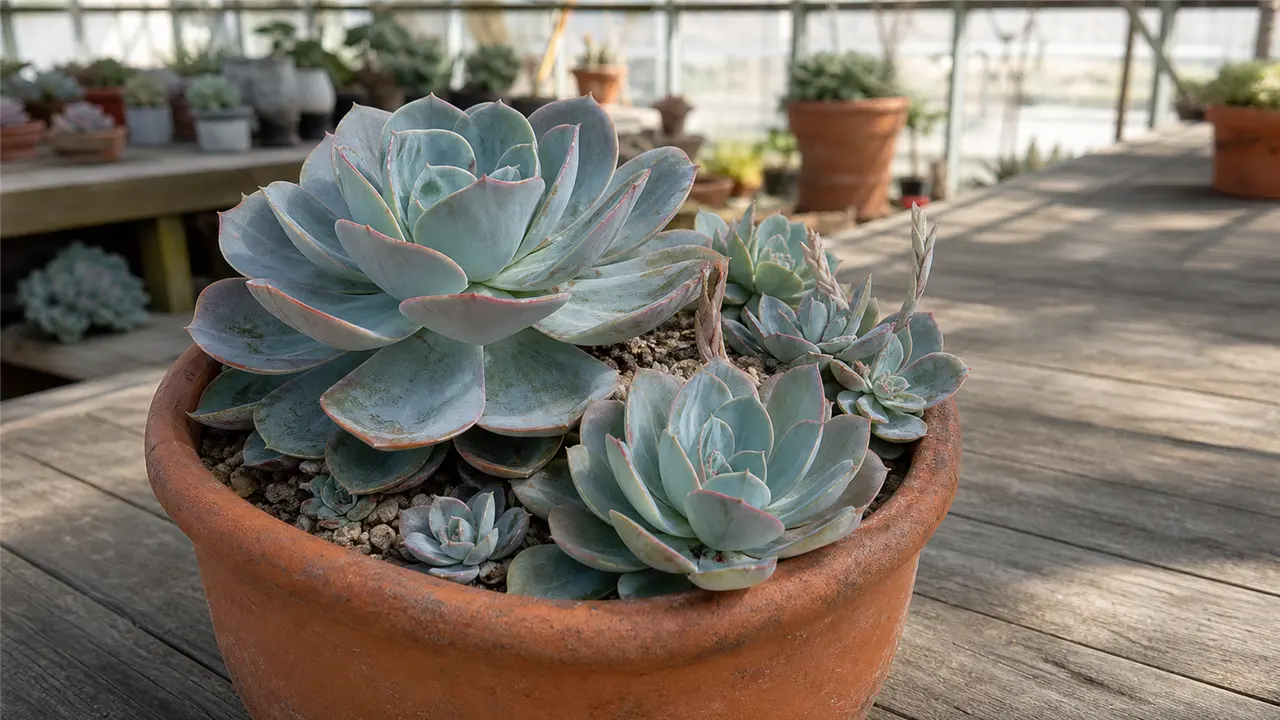
The plant forms a dense, usually stemless or very short-stemmed rosette. Broad, thick leaves overlap in orderly spirals and curve slightly upwards. Individual leaves are spoon-shaped to elliptic, widest above the base and narrowing to a distinct point. Young plants may remain solitary for some time, while older specimens can eventually form offsets around the base.
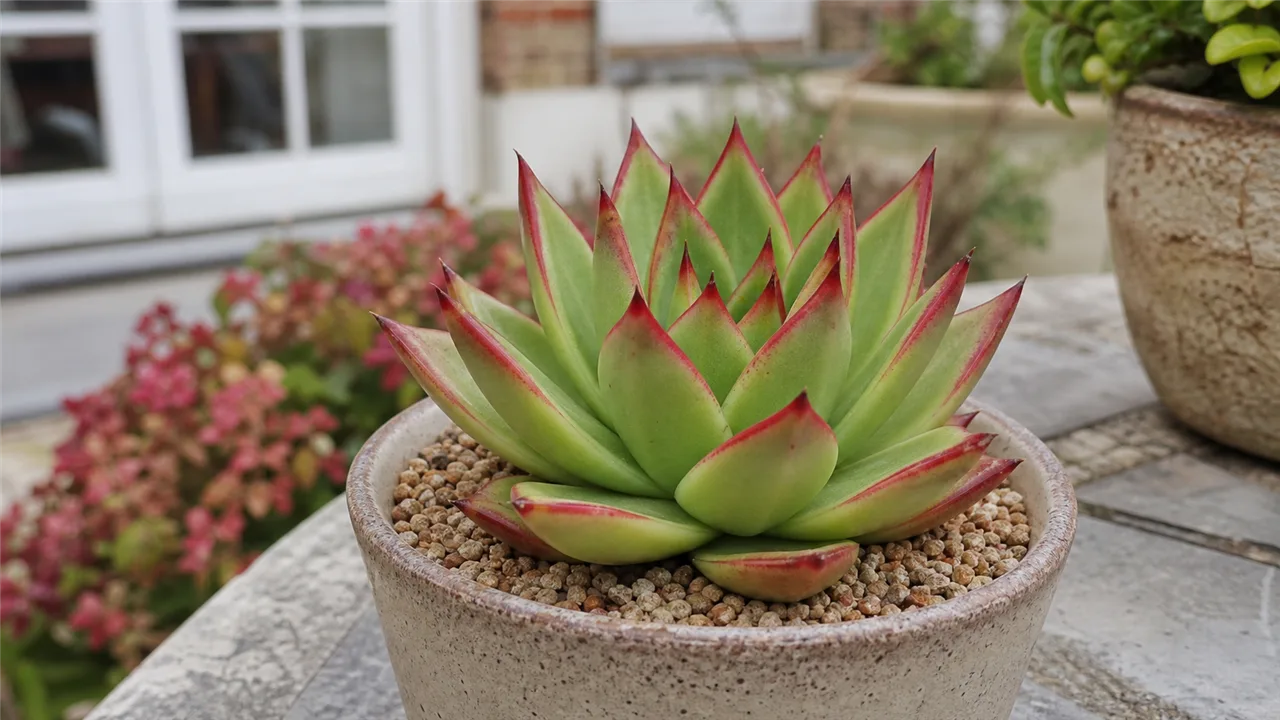
Its most recognisable feature is the layer of powdery epicuticular wax known as farina. This gives the foliage a glaucous blue-green, silver-grey or almost white appearance. Strong light can bring out pink to carmine colouring along the margins and at the pointed tips. Colour varies with the clone, season and growing conditions; a green, open rosette in weak winter light should not be expected to show the same intensity as a compact, well-lit summer plant.
The farina does not grow back where it has been rubbed away, so fingerprints and water spots remain visible until the marked leaf is naturally shed. Handle the plant by its pot or beneath the lowest leaves and avoid brushing the rosette during routine care.
Slender, arching flower stems rise above mature rosettes, commonly in spring or early summer. They carry hanging, urn- or lantern-shaped flowers in shades of coral, pinkish red or red, with yellow visible towards the mouth or within the flower. The warm flower colours contrast strongly with the cool-toned foliage. Flowering depends on adequate light and mature growth, and may be sparse where winters are very dim.
Growing Conditions
Provide the brightest practical position. A south- or west-facing windowsill is often suitable, as is a conservatory with good ventilation. Several hours of direct sun encourage a compact rosette and stronger edge colour. Plants kept behind glass can scorch if moved abruptly from subdued winter light into intense spring sunshine, so increase exposure over a week or two. Outdoors, choose a warm, sheltered site with some protection from persistent rain and harsh midday sun during the first days of acclimatisation.
Use a very free-draining growing medium with a high mineral content. A proprietary peat-free cactus or succulent compost can be improved with horticultural grit, pumice or perlite if it remains damp for long periods. Dense multipurpose compost is unsuitable on its own because it holds too much water around the fine roots. A drainage hole is essential; a decorative cover pot must be emptied after watering.
Terracotta is useful in cool or humid rooms because it allows the root ball to dry more readily, although it also means watering may be needed a little sooner in warm weather. Select a pot only slightly wider than the rosette or root system. An oversized container surrounds the roots with a large volume of slowly drying compost and increases the risk of rot.
Good airflow helps moisture evaporate from both compost and leaf axils. Avoid crowding the plant against cold glass or enclosing it in a humid, unventilated display. Ordinary indoor humidity is generally adequate. This is not a plant for a steamy bathroom unless the room is exceptionally bright and well ventilated.
Keep Echeveria colorata frost-free. In most of the UK it should return under cover before autumn nights become cold and wet. During winter, a cool but bright position can help the plant retain compact growth, provided the compost is kept much drier. If the only available room is warm, maximise light and watch carefully for stretching and pests.
Planting and Care
Repot in spring, and only when the roots have filled the container, the compost has broken down or drainage has deteriorated. Allow damp compost to become nearly dry first. Support the rosette from below, loosen circling roots gently and set the plant at its previous depth in fresh, free-draining mix. Keep the neck clear of compost and top-dress with grit if desired. After damage to roots, wait several days before watering so small wounds can dry.
Water thoroughly during active spring and summer growth, allowing excess to drain away, then wait until the compost has dried before watering again. Check below the surface rather than following a fixed weekly timetable: pot material, room temperature, light and root volume all change the drying rate. Water at compost level and do not leave liquid sitting in the central rosette or saucer. Repeated small splashes into already damp compost encourage shallow, unhealthy rooting.
Reduce watering sharply as light and growth decline in autumn. In winter, give only enough to prevent persistent severe shrivelling, and never combine cold conditions with wet compost. Some softening of the lowest leaves can indicate thirst, but translucent, mushy foliage or a darkened stem more often points to excess moisture and rot.
Feed sparingly from spring into summer. A balanced or low-nitrogen cactus fertiliser at reduced strength, applied to already moist compost about once a month during active growth, is sufficient. Do not feed a dry, dormant or recently repotted plant. Excess nitrogen produces soft, stretched leaves and makes the balanced rosette less attractive.
No structural pruning is needed. Cut spent flower stalks near their base with clean, fine secateurs once the display is over, taking care not to nick adjacent leaves. Gently remove fully dry lower leaves before they trap moisture or conceal mealybugs. Never cut the leaf tips simply to reshape the plant.
Propagation is possible from offsets, leaves or seed. Detach an offset in spring when it has some roots of its own, allow the cut surface to dry, then pot it into a small container of gritty compost. For leaf propagation, twist off a healthy whole leaf without tearing its base, leave it in a dry, airy place until the wound has callused, and lay it on barely moist succulent mix. Roots and a tiny rosette may form slowly; not every leaf succeeds. Seed can be sown on a fine, free-draining medium in spring, but seedlings are variable and take longer to reach specimen size.
Move indoor plants outside only in settled summer weather. Acclimatise them gradually, keep them away from slugs and heavy rain, and inspect the pot before bringing it back under cover. In winter, prioritise light, dryness and airflow rather than attempting to force active growth.
Common Problems
Root or crown rot is the most serious problem. Early signs include unexplained leaf drop, translucent lower leaves, a soft stem or a rosette that loosens from the compost. Remove the plant from its pot, cut away rotten tissue with a sterile blade and let sound tissue dry before attempting to re-root it. Prevention through sharp drainage and careful watering is far more reliable than rescue.
Mealybugs appear as white, cottony deposits in leaf axils, beneath dead leaves or around the roots. Isolate an affected plant, remove visible insects and inspect repeatedly because sheltered egg masses are easily missed. Root mealybugs may only become apparent during repotting. Glasshouse red spider mites can cause pale stippling, dull foliage and fine webbing in hot, enclosed conditions, while vine weevil larvae may eat container roots. Quarantine new purchases and keep the growing area clean.
Long gaps between leaves and a flattened, open rosette indicate insufficient light. Improve the position gradually; existing stretched growth will not become compact, but new leaves can form more normally. Conversely, bleached or brown patches after a sudden move into strong sun indicate scorch. Farina damaged by handling or overhead watering may look blotchy but is cosmetic rather than infectious.
Wrinkled leaves can result from simple thirst, but they can also occur when rotten roots can no longer absorb water. Test the compost and roots before adding more water. Persistent failure to flower usually reflects immaturity or inadequate light rather than a need for more fertiliser.
Popular Varieties
The species has fewer securely documented named selections than many hybrid echeverias, and nursery labels are not always consistent. The following names are encountered in botanical or horticultural use:
- Echeveria colorata f. colorata is the typical accepted form. Plants formerly called Echeveria lindsayana, and sometimes sold informally as “Lindsayana”, are now generally included here rather than treated as a separate species.
- Echeveria colorata f. brandtii is an accepted botanical form. It is associated with a more elongated, narrower-leaved appearance than the typical form, though plants should be bought from a knowledgeable supplier because names can be confused in trade.
- Echeveria colorata ‘Mexican Giant’ is a horticultural selection sold for a large, pale, heavily farinose rosette. Its trade identity can vary between suppliers, so the mature appearance is a better guide than a young unverified label.
- Echeveria colorata ‘Haage’ is another published horticultural cultivar name, valued for the species’ characteristic glaucous foliage and coloured tips. Availability in the UK is limited, and provenance should be checked when a correctly named plant is important.
Hybrids with E. colorata in their ancestry should not be labelled as varieties of the species. Whatever the name, retain the powdery coating by handling minimally and apply the same bright, dry, frost-free cultivation used for the typical plant.
Pests and Diseases
| Problem | Symptoms | Management |
|---|---|---|
| Root rot | Leaves become soft, mushy and translucent, often dropping off as the stem base turns black. | Use sharply draining cactus compost and water only when dry, keeping plants above 10°C in winter. |
| Vine weevil | Semi-circular notches on leaf edges indicate adult feeding, while grubs damage roots causing wilting. | Check new pots for grubs and use biological nematodes or systemic insecticides if infested. |
| Mealybug | White, cottony wax-like clusters appear in leaf axils and on stems, often accompanied by sticky honeydew. | Isolate the plant and dab insects with alcohol-soaked cotton buds or apply a suitable insecticide. |
| Leaf burn | Brown, necrotic tips or patches on leaves caused by chemical sensitivity or sun scorch. | Water with rainwater to avoid fluoride damage and acclimate plants gradually to bright light. |
| Etiolation | Stems become weak, spindly and elongated with spaced-out leaves due to insufficient light. | Provide bright, indirect light year-round and avoid keeping in warm, dark conditions. |
Or browse the full plant problem solver to diagnose an issue by symptom.
Recommended Products
GardenWizz earns a commission from qualifying purchases made through affiliate links on this page (including links within the article) — as an Amazon Associate, and from Thompson & Morgan via the Awin network. This does not affect the price you pay. See our disclaimer for details.