Chihuahua Echeveria
Echeveria chihuahuaensis
The Gardening Year
Best months in UK gardens · full planting calendar →
🖨 Printable care card (PDF)At a Glance
| Botanical name | Echeveria chihuahuaensis |
|---|---|
| Common name(s) | Chihuahua Echeveria |
| Family | Crassulaceae |
| Plant type | succulent (perennial) |
| Height × Spread | 10–25 cm × 10 cm |
| Position | Full sun |
| Soil | well-drained soil |
| Flowering | March–May |
| Toxicity | — |
| Native range | Mexico |
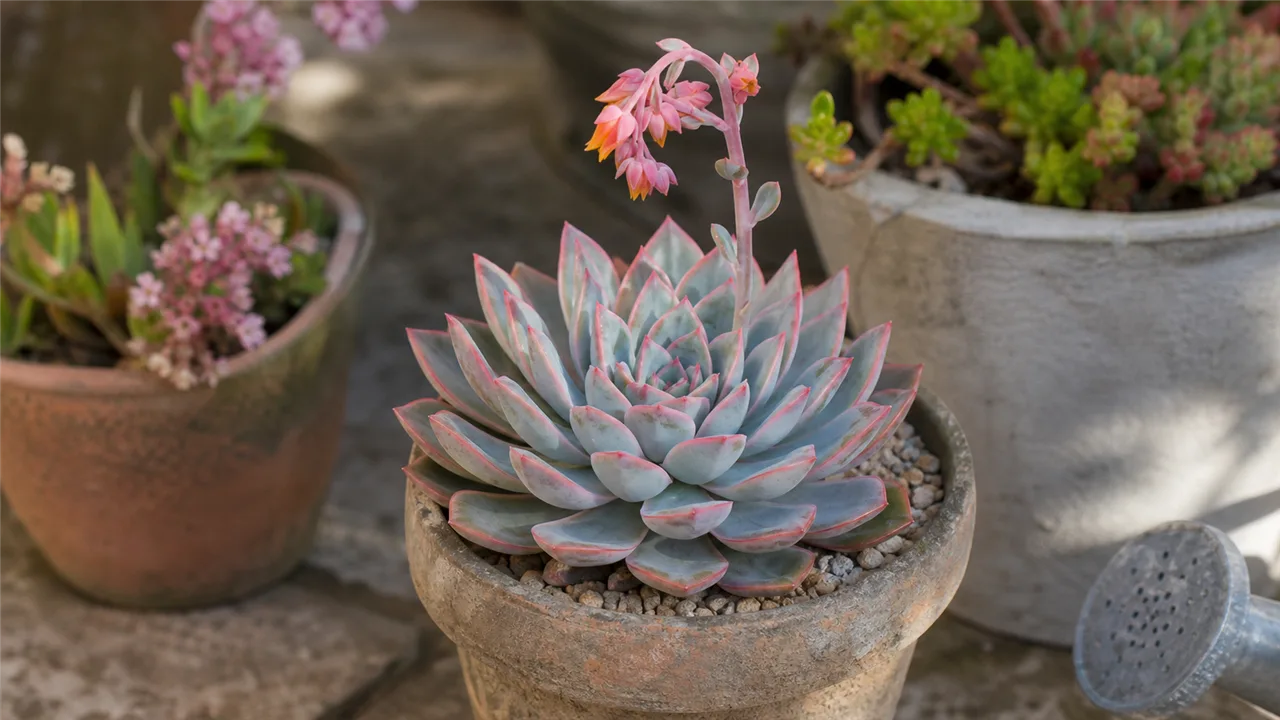
Echeveria chihuahuaensis, the Chihuahua Echeveria, is a small rosette-forming succulent native to the state of Chihuahua in northern Mexico. It is grown in the UK primarily as a houseplant or greenhouse specimen, valued for its compact form and its distinctive pale, powdery blue-grey foliage. In cultivation the plant is undemanding provided its two core requirements are met: bright light and a sharply drained, gritty compost. Its compact size makes it particularly suitable for bright windowsills, conservatories and frost-free glasshouses.
Overview
Echeveria chihuahuaensis belongs to the genus Echeveria, a large group of New World succulents placed in the family Crassulaceae. The genus is most diverse in Mexico, and E. chihuahuaensis is named after the Mexican state where it was first described. Like most of its relatives it is a tender perennial: in its native range it grows on rocky slopes and cliffs at altitude, where drainage is excellent and frost is rare. The species is acaulescent, meaning the rosette has no visible stem, and it tends to remain solitary or to form only small clusters of offsets.
In the United Kingdom the species is treated as a frost-tender indoor or under-glass plant. It is not hardy enough to spend the winter outside in any part of the country, and it is generally not grown as a year-round outdoor feature plant. Instead it is at home on a sunny windowsill, in a frost-free conservatory, or in an alpine house or cool greenhouse kept above freezing. Many UK growers bring plants onto a sheltered patio or balcony during the warmest months of summer and return them indoors before night temperatures fall.
Within the broader genus the species is appreciated by collectors for its clean, neat rosette and its pale, almost chalky foliage. It sits between the larger, more architectural echeverias and the smaller haworthia-like rosettes in scale, and it rewards careful watering and bright light with strong colour and a tidy shape.
Appearance
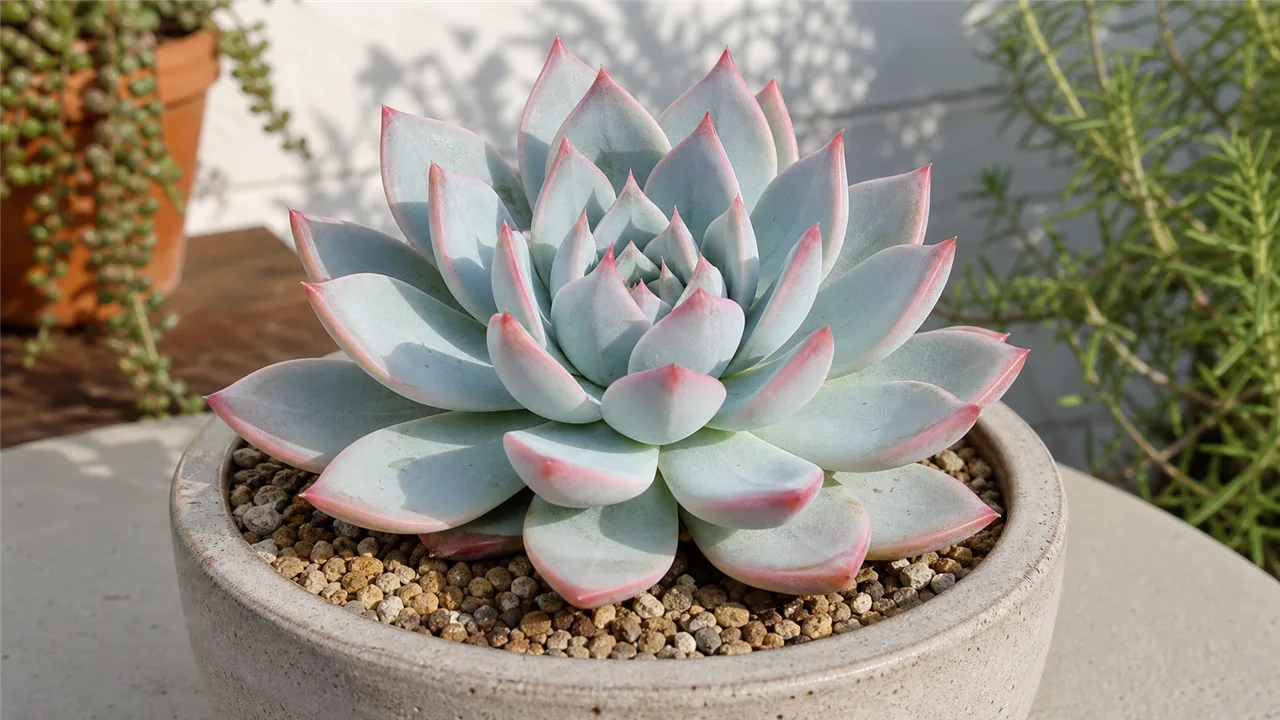
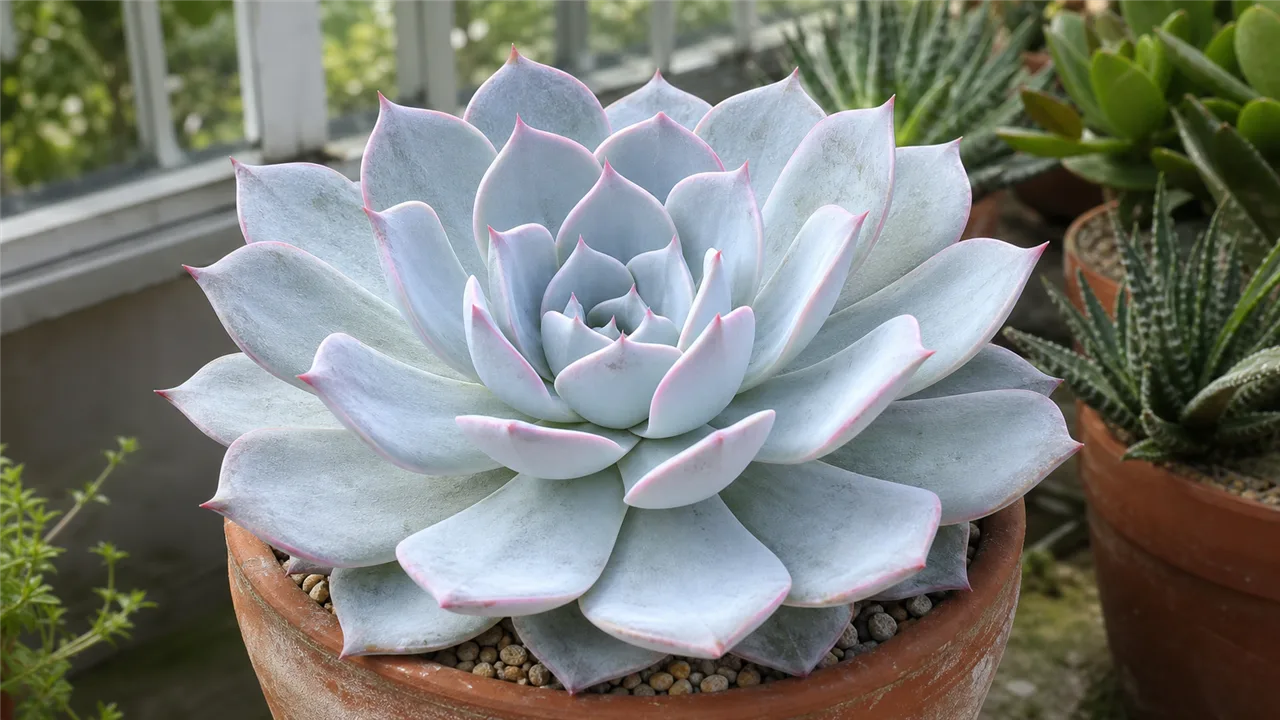
The rosette of Echeveria chihuahuaensis typically reaches 5–12 cm across at maturity, with leaves arranged in a tight, near-symmetrical spiral. Individual leaves are spoon-shaped to obovate, broad at the tip and tapering towards the base where they meet the rosette centre. They are thick and fleshy, storing water in the same way as other succulents.
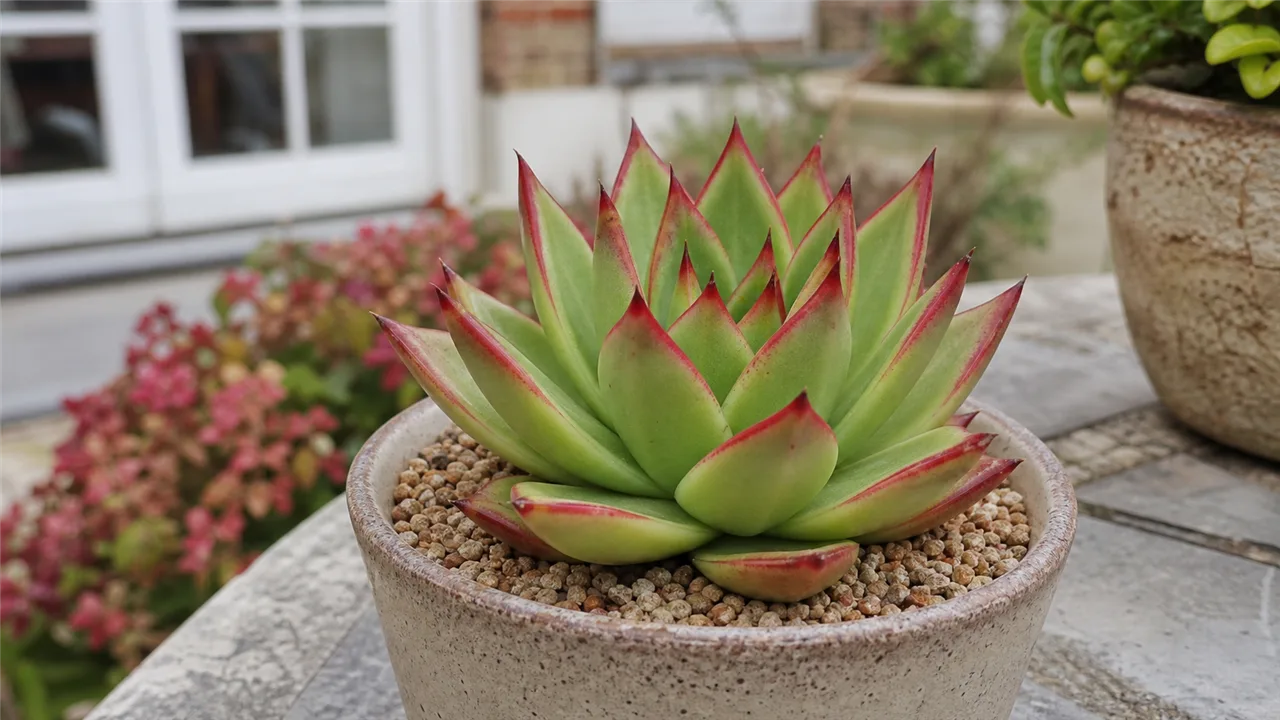
The defining visual feature is the colour of the leaves. They are a soft, pale blue-grey to blue-green, frequently described as glaucous. This appearance comes from a fine, whitish, powdery coating known as farina or epicuticular wax, which sits on the leaf surface and gives the rosette a chalky, slightly matt finish. The farina is easily marked by handling, water droplets or contact with gritty compost, so the plants are best left undisturbed once they are in their final display position. When the rosette is grown in strong light the leaf tips and margins may flush with pink, coral or lavender tones, adding to the plant's decorative value.
The inflorescence appears in late spring to mid-summer. A slender flower stem emerges from the rosette, often arching or becoming pendent as the buds develop. The flowers are bell-shaped and held in loose clusters; they are typically pink, orange-pink or coral, with the inside of the bell usually a little paler than the outside. As with other echeverias, individual flowers are relatively long-lasting for a succulent and may remain attractive for several weeks.
Growing Conditions
Light is the most important environmental factor. Echeveria chihuahuaensis grows naturally in open, sunny sites, and in cultivation it should receive as much direct sun as is practical. In the UK this means a south- or west-facing windowsill, a bright conservatory or a spot in an unheated greenhouse during the warmer months. Insufficient light causes the rosette to stretch and the leaves to space out, a condition known as etiolation, which weakens the plant and spoils its shape. Strong sunlight through glass in midsummer can scorch leaves, particularly after a run of dull weather, so light shade during the hottest part of the afternoon is helpful in southern and central England. An outdoor position should be introduced gradually so that leaves can acclimatise.
Temperature must remain above freezing at all times. The species will tolerate cool winter conditions provided the compost is kept on the dry side, but it performs best at typical room temperature during the active growing season. It is well suited to an unheated but frost-free greenhouse, a conservatory that does not fall below freezing in winter, or a bright windowsill in a heated room. Outside these conditions, the plant is not suitable for year-round outdoor cultivation in any part of the United Kingdom.
Soil must be very free-draining. A proprietary cactus and succulent compost is suitable, and many growers improve it further with added horticultural grit or perlite to be sure that water passes through quickly. A home-mixed blend of roughly equal parts loam-based or peat-free multi-purpose compost and horticultural grit also works well. The aim is a substrate that dries out rapidly after watering and does not remain soggy around the root zone, because wet compost in cool conditions is the principal cause of failure with this species.
Planting and Care
Watering follows the soak-and-dry method. During the growing season from spring through summer, water thoroughly so that the entire root ball is moistened, then allow the compost to dry out almost completely before the next watering. Depending on pot size, temperature and air movement, this may mean watering every seven to fourteen days in summer and less often in cooler weather. In winter the plant is semi-dormant and water should be reduced substantially, often to once a month or even less. The rosette should never sit in wet compost, and the leaves should never be allowed to remain wet in cool conditions, as both encourage rot.
Feeding is light. A half-strength liquid cactus and succulent fertiliser applied roughly once a month through the growing season is sufficient, with no feeding at all in winter. Over-feeding produces soft, lush growth that is more susceptible to rot and pests, and it can dilute the pale colour of the foliage.
Repotting is needed only when the plant has clearly outgrown its pot, generally every two to three years. Repot in spring, into a container only one size larger than the current one, using fresh gritty compost. A terracotta or other porous pot helps the compost dry out between waterings and is generally preferable to a plastic container for this species.
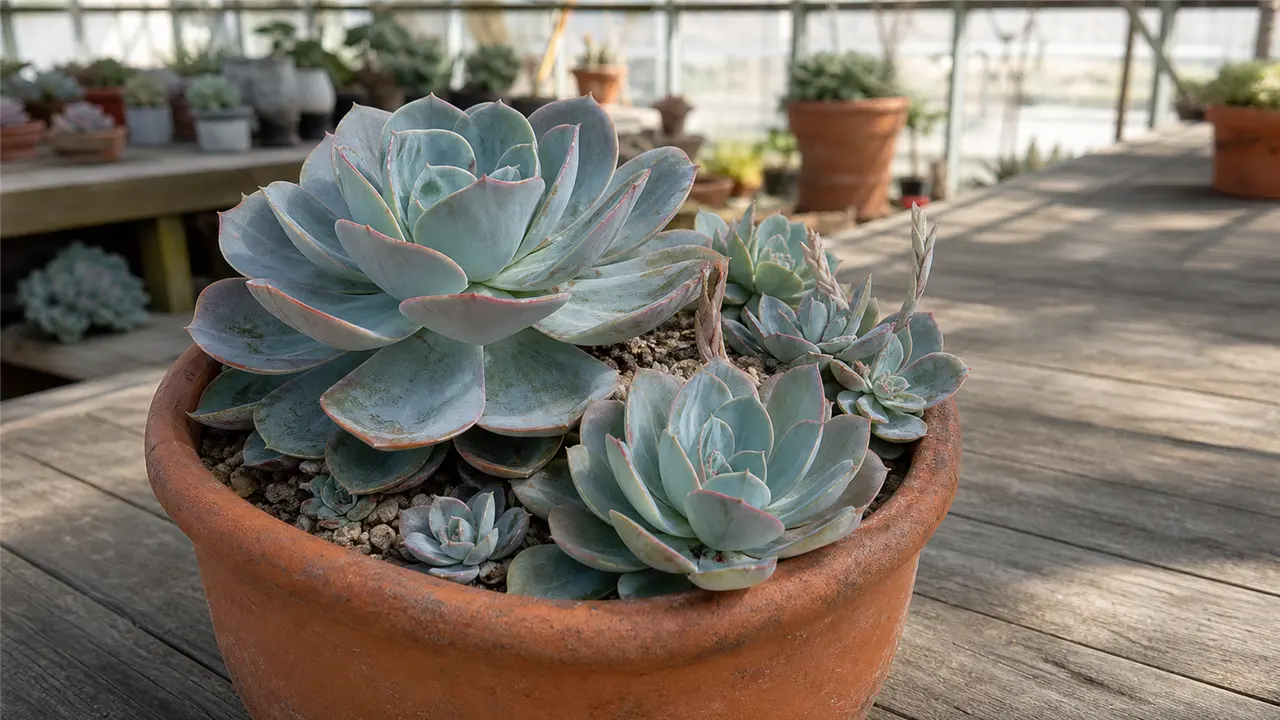
Propagation is straightforward. Healthy individual leaves can be removed with a gentle twist so that the base of the leaf comes away cleanly, left to dry and callous for a few days, and then laid on the surface of a small pot of gritty compost. New roots and a tiny rosette usually form at the base of the leaf within several weeks. Offsets that appear around the parent rosette can be separated with a clean, sharp knife once they have their own roots and potted up individually. Seed propagation is possible but slow, and is seldom used outside specialist collections.
Seasonal care in the UK follows the weather. From late spring to early autumn the plant benefits from being outdoors in a sheltered, sunny spot, which improves colour, strengthens growth and reduces the risk of etiolation. Bring the plant back indoors well before the first frosts, clean the rosette of any debris, and reduce watering. Inspect the plant for mealybugs at this transition, as pests are easily transferred inside from outdoor plants.
Common Problems
Overwatering is the most frequent cause of loss. Leaves become soft, translucent, yellow or black, and the crown of the rosette may collapse. Prevention is straightforward: use a gritty compost, allow it to dry out thoroughly between waterings, and reduce watering in winter. Affected leaves should be removed promptly and, if rot has reached the stem, the healthy top of the rosette can be cut off, allowed to callous and re-rooted in dry compost.
Etiolation occurs when light is insufficient. The rosette becomes elongated, the leaves space out and the plant loses its compact, symmetrical form. Move the plant to a brighter position gradually to avoid sunburn on leaves that have been grown in shade.
Sunburn appears as bleached, brown or papery patches on the most exposed leaves. It is most common when a plant that has been grown indoors is moved into strong outdoor sun without acclimatisation, or after a run of dull weather followed by bright conditions. Move plants outdoors in stages over a week or two and provide light shade at midday during heatwaves.
Mealybugs are the most common pest. They appear as small, white, cottony masses tucked into leaf axils and the underside of the rosette. They can be removed with a cotton bud dipped in rubbing alcohol, or treated with a suitable insecticidal soap applied according to the label. Regular inspection of leaf crevices is the most reliable way to keep numbers low.
Aphids sometimes colonise the flower stem as it emerges, distorting buds and excreting sticky honeydew. A strong jet of water, or an insecticidal soap treatment if the infestation is heavy, is usually sufficient. Vine weevils can be a problem in greenhouse and conservatory composts; the grubs eat roots and the adults notch leaf margins, and a suitable biological or chemical treatment may be used where the pest is known to be present.
Popular Varieties
The species itself is the principal form in cultivation, and well-grown plants of typical wild appearance are widely available from specialist succulent nurseries. The pale glaucous rosette, neat symmetry and pink-tipped leaves in bright light are the characteristics that growers select for.
Selected forms of Echeveria chihuahuaensis occasionally appear in specialist listings under their own names, and a small number of named clones circulate among collectors. These tend to emphasise particular features such as especially compact rosettes, particularly strong pink flushing, or unusually thick farina. As with many less commonly cultivated succulents, named cultivar availability varies between suppliers and from year to year, so plants should be bought from a reputable nursery that provides accurate botanical identification.
The species is also used in hybridisation within the genus, and hybrids of E. chihuahuaensis with other echeverias are encountered in collections. These crosses are valued for combining the glaucous leaf colour and tidy rosette form of the species with the size or colouring of related parents. Hybrids should be labelled and sold under their hybrid or cultivar names rather than as the species itself.
Pests and Diseases
| Problem | Symptoms | Management |
|---|---|---|
| Aphids | Clusters of small green or black insects on new growth and flower buds. | Spray with insecticidal soap or introduce natural predators like ladybirds. |
| Root rot | Leaves become soft, translucent, and mushy starting from the base. | Ensure well-draining compost and allow soil to dry out completely between waterings. |
| Sunburn | Brown or bleached patches on leaves exposed to intense direct sunlight. | Acclimate plants gradually to full sun and provide shade during peak summer heat. |
| Mealybugs | White, cottony fluff appears in leaf axils and on stems. | Isolate the plant and treat with a systemic insecticide or dab spots with alcohol. |
| Vine weevil | Notches on leaf margins during the day and root damage at night. | Apply nematodes to the soil in autumn or use a systemic granular treatment. |
For step-by-step help, read Controlling Aphids Naturally. Or browse the full plant problem solver to diagnose an issue by symptom.
Recommended Products
GardenWizz earns a commission from qualifying purchases made through affiliate links on this page (including links within the article) — as an Amazon Associate, and from Thompson & Morgan via the Awin network. This does not affect the price you pay. See our disclaimer for details.