Derenberg's Painted Lady
Echeveria derenbergii
The Gardening Year
Best months in UK gardens · full planting calendar →
🖨 Printable care card (PDF)At a Glance
| Botanical name | Echeveria derenbergii |
|---|---|
| Common name(s) | Derenberg's Painted Lady |
| Family | Crassulaceae |
| Plant type | succulent (evergreen perennial) |
| Height × Spread | 10 cm × 10–50 cm |
| Position | Full sun |
| Soil | standard cactus compost, well-drained, loam or sand, acid or alkaline or neutral pH |
| Flowering | January, February, December |
| Toxicity | — |
| Native range | eastern Oaxaca in Mexico |
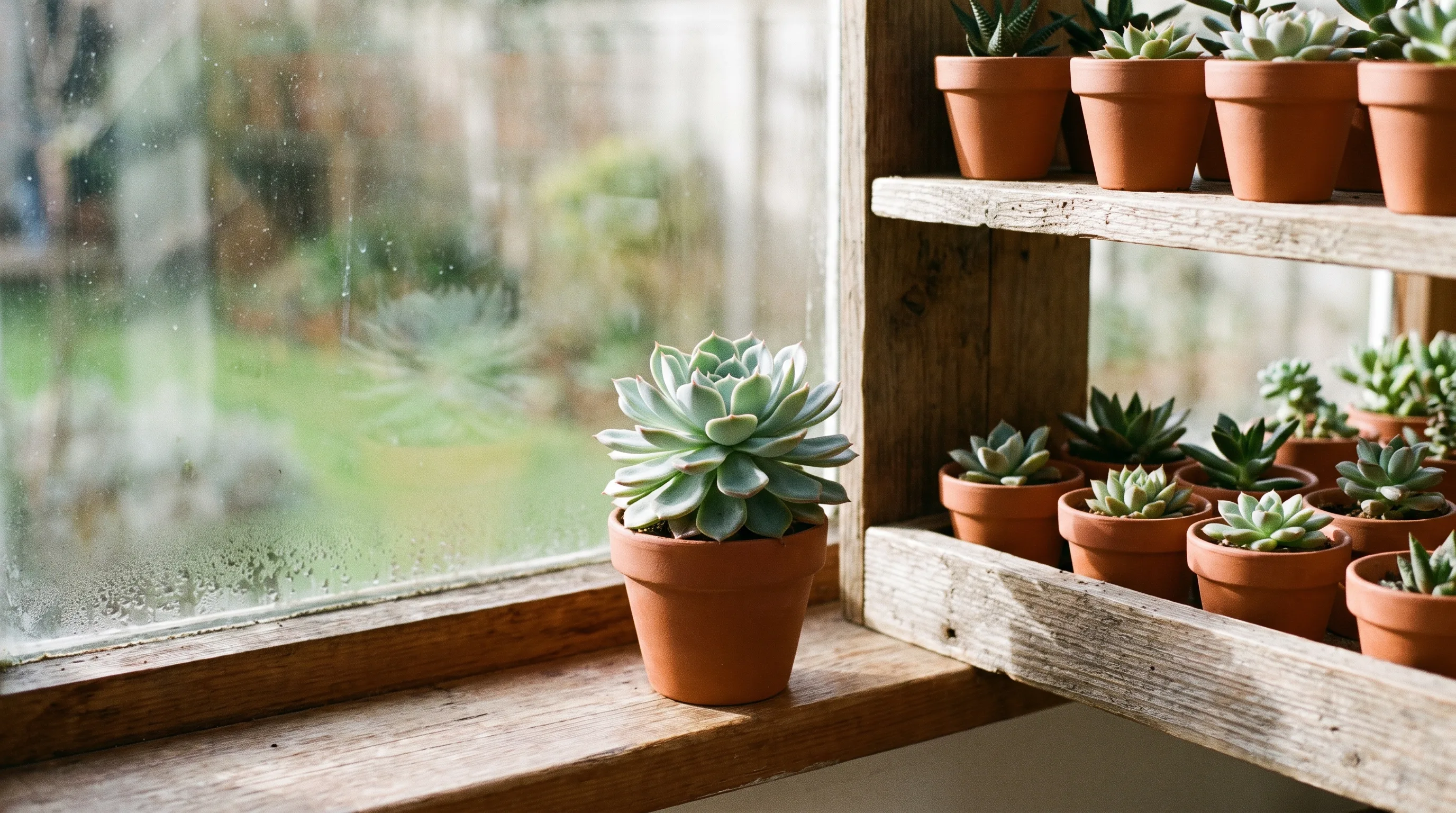
Echeveria derenbergii, usually called painted lady, is a compact Mexican succulent prized for its neat, pale rosettes and warm-toned flowers. In the UK it is best treated as a houseplant or conservatory specimen, although a pot can spend settled summer weather outdoors in a bright, sheltered place.
Overview
Echeveria derenbergii belongs to the stonecrop family, Crassulaceae. The accepted species is native to eastern Oaxaca in Mexico, where it grows in a seasonally dry climate. Its thick leaves store water, but its roots do not tolerate stagnant moisture.
Painted lady is naturally small enough for a sunny windowsill, bright porch or heated conservatory. A single rosette makes a precise architectural specimen, while established plants produce offsets and gradually become a low colony. The portable nature of container culture is particularly useful in the UK: plants can receive more light and ventilation outside during warm summer spells, then return under glass well before frosty weather.
The species is sometimes sold as baby echeveria. These are common names, not separate varieties. Identification should consider its compact pale rosettes, pointed leaves and red-and-yellow flowers rather than leaf colour alone.
Appearance
The foliage is arranged in dense basal rosettes. Each fleshy leaf is obovate to spoon-shaped or broadly triangular, narrowing to a short point. A pale, powdery coating, known as farina, gives the surface a frosted blue-green, grey-green or almost whitish appearance. The coating helps protect the leaf and marks permanently when rubbed, so the rosette is best handled by its pot rather than by its foliage.
Strong light keeps the leaves close together and can bring out reddish margins or tips. Inadequate light produces greener, open, stretched growth called etiolation. It does not shrink back when light improves, although subsequent growth can become compact.
Mature rosettes stay low, generally reaching no more than about 10 cm in height. Offsets arise around the base and can extend the overall spread considerably. Flower stems arch above the leaves and carry one-sided clusters of small, cup- or bell-shaped blooms. Yellow interiors and red to orange-red outer colouring create the ‘painted’ effect behind the common name. Flowering can occur from late winter into summer, with spring and early summer a useful expectation under UK glass.
Growing Conditions
Give painted lady the brightest indoor position available. An east- or south-facing windowsill often suits it, provided that a plant raised in softer light is acclimatised to direct sun over a week or two. Move it abruptly from a shop or dim room into fierce sunlight and pale or brown scorch patches may develop. Rotate the pot occasionally so growth remains balanced, but avoid repeatedly touching the farina.
Use a peat-free cactus or succulent compost that drains rapidly. Adding coarse horticultural grit, pumice or another suitable mineral component can improve aeration where a proprietary mix remains moisture-retentive. The container must have an unobstructed drainage hole. Terracotta dries faster and may suit a careful grower in a cool home; plastic retains moisture for longer, so watering must be adjusted accordingly. Never allow the pot to stand in water inside a decorative cover.
Compost pH is not critical provided drainage is excellent. Good air movement is valuable in darker months, but avoid a persistently cold, wet draught. A humid bathroom or closed terrarium is unsuitable because slow evaporation encourages rot.
In summer, a container may stand outside in a sheltered, sunny position after gradual acclimatisation. Check it after prolonged rain and keep drainage free. Bring it back under cover during early autumn rather than waiting for the first frost. Through winter, prioritise light, ventilation and dryness; warm, dim conditions combined with regular watering produce weak growth.
Planting and Care
Repot in spring when roots fill the container, offsets crowd the rim or old compost drains poorly. Choose a pot only slightly wider than the root ball, as unused compost stays damp. Keep the rosette above the surface and add clean grit around the neck. Wait several days before watering if roots were damaged.
During active growth, water thoroughly until surplus drains from the base, then allow the compost to approach dryness before watering again. Test below the gritty surface rather than following a fixed weekly schedule. Empty saucers and pot covers promptly. Reduce watering sharply as light levels fall in autumn; in winter, give only enough to prevent prolonged shrivelling. Avoid pouring water into the rosette, particularly when evaporation is slow.
Feed sparingly from late spring through summer. A dilute, low-nitrogen cactus fertiliser can be applied to already-moist compost at intervals during growth. Do not compensate for poor light with fertiliser: excess nitrogen encourages soft, distorted growth and can leave roots vulnerable in wet compost. Stop feeding during the winter rest.
No annual pruning is required. Remove completely dry lower leaves with clean tweezers and cut spent flower stems near the base. Do not pull living leaves from the crown. This improves airflow and removes pest hiding places.
Offsets are the quickest and most reliable means of propagation. In spring, ease a rooted offset away from the parent with a clean blade, allow any cut surface to dry, then pot it into a small container of free-draining compost. Leaf cuttings can also be taken in spring or early summer. Detach a healthy mature leaf cleanly, including its base, allow the wound to callus, and lay it on barely moist gritty compost. Keep it bright but out of harsh sun until roots and a new rosette form. Stem cuttings are another option for an elongated or damaged plant. Seed is possible but slow and variable.
Seasonally, repot and propagate in spring, feed and water more actively from late spring through summer, and inspect outdoor pots after rain. Move plants under cover in early autumn, cease feeding and reduce watering as days shorten. The species is indoor-grown in typical UK cultivation, so it does not require an outdoor sowing, planting or pruning calendar.
Common Problems
Root and crown rot are the most serious problems. Warning signs include translucent or yellowing lower leaves, a soft stem base, an unstable rosette and an unpleasant smell from the compost. Waterlogged compost, a blocked drainage hole, cold wet conditions or water trapped in the crown are common causes. Isolate the plant, remove affected material with a sterile blade and try to save sound offsets, leaves or a healthy stem section. Prevention is more reliable than treatment.
Mealybugs appear as white, waxy deposits between leaves, beneath dead foliage or around roots. Isolate an affected plant, inspect neighbouring succulents and remove accessible insects carefully without rubbing the leaf bloom. Persistent infestations, especially root mealybug, may require repotting into clean compost and use of a treatment currently approved for indoor ornamentals; always follow its label. Aphids may gather on tender flower stems, while vine-weevil larvae can damage roots. Regular inspection catches all three before damage becomes extensive.
Etiolated growth indicates insufficient light. Move the plant gradually to a brighter place and consider propagating a compact top if the bare stem is unattractive. Dry, corky scorch patches can follow a sudden increase in direct sun and will remain until the marked leaves are naturally shed. A few shrivelled bottom leaves are part of normal renewal, but rapid leaf loss calls for a check of roots, moisture and light.
Popular Varieties
No widely accepted set of named cultivars or botanical varieties of Echeveria derenbergii is consistently documented in authoritative UK plant references. The straight species is the recognised garden plant and should be labelled simply Echeveria derenbergii.
Painted lady and baby echeveria are two common names for that same species, not cultivar names. Unnamed selections may vary slightly in leaf width, powdery colour or red edging because of growing conditions and ordinary variation, but those differences do not establish a cultivar. Labels should not be created from a colour description alone.
The species has been used in breeding, and named echeveria hybrids with E. derenbergii ancestry occur in collections. Such hybrids are not varieties of painted lady and may differ in size, colour and care response. For a true-to-name plant, buy from a specialist supplier that gives the full botanical name and retain the original label when offsets are propagated.
Pests and Diseases
| Problem | Symptoms | Management |
|---|---|---|
| Vine weevil | Adults chew notches in leaf margins while larvae destroy roots, causing wilting. | Apply nematodes to the compost in autumn and spring or use a systemic insecticide. |
| Mealybugs | White, cottony wax masses appear in leaf axils and on stems, weakening the plant. | Wipe off with alcohol-dipped cotton buds or spray with a suitable insecticide. |
| Root rot | Leaves become soft, translucent, and mushy as the stem base collapses. | Ensure sharp drainage and water only when compost is dry; avoid winter wetness. |
| Aphids | Clusters of small green or black insects suck sap from new growth and flowers. | Spray off with a strong jet of water or treat with insecticidal soap. |
| Leaf burn | Brown, crispy tips or patches on leaves caused by chemical sensitivity. | Water with rainwater instead of tap water to avoid fluoride damage. |
For step-by-step help, read Controlling Aphids Naturally. Or browse the full plant problem solver to diagnose an issue by symptom.
Recommended Products
GardenWizz earns a commission from qualifying purchases made through affiliate links on this page (including links within the article) — as an Amazon Associate, and from Thompson & Morgan via the Awin network. This does not affect the price you pay. See our disclaimer for details.