Mexican Snowball
Echeveria elegans
The Gardening Year
Best months in UK gardens · full planting calendar →
🖨 Printable care card (PDF)At a Glance
| Botanical name | Echeveria elegans |
|---|---|
| Common name(s) | Mexican Snowball |
| Family | Crassulaceae |
| Plant type | succulent |
| Height × Spread | 5–10 cm × 50 cm |
| Position | Full sun |
| Soil | well-drained |
| Flowering | January, February, March, April, May, December |
| Toxicity | — |
| Native range | Mexico |
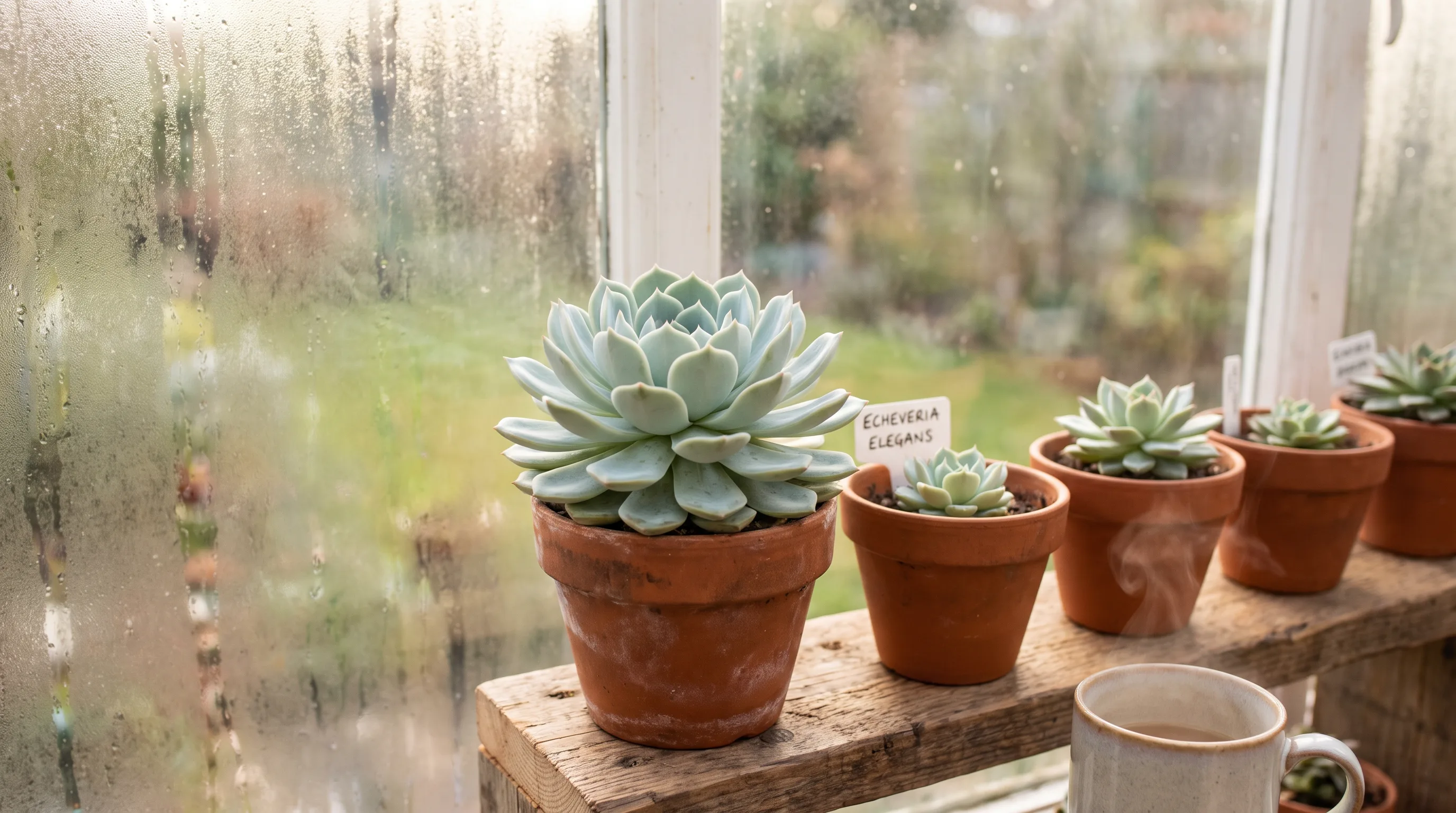
Echeveria elegans, commonly called Mexican snowball, is a compact evergreen succulent prized for its symmetrical, powdery blue-green rosettes. In the UK it is best treated as a bright-window or greenhouse plant, with the option of spending warm, dry summer weather outdoors in a movable container.
Overview
Echeveria elegans belongs to the stonecrop family, Crassulaceae, and is native to rocky Mexican habitats. Its thick leaves store water, and older specimens produce offsets that eventually form low cushions of overlapping rosettes.
British growers usually keep Mexican snowball as a houseplant, in a conservatory or in a heated or frost-free greenhouse. It is not a dependable permanent subject for an outdoor UK rock garden. A container allows it to spend warm, dry summer weather on a sunny patio and return under cover before cold autumn nights.
Its modest dimensions suit windowsills, small terracotta pots and succulent collections. It can share a container with plants requiring the same strong light, lean compost and infrequent watering, provided drainage remains unobstructed.
Appearance
The plant forms a stemless or short-stemmed rosette, typically 10–15 cm in diameter. Thick, smooth, spoon-shaped leaves overlap in a precise spiral, producing the characteristic snowball geometry. Offsets gradually turn a solitary plant into a low clump of distinct rosettes.
Leaf colour ranges from pale blue-green to grey-green. A powdery wax coating, known as farina, creates the silvery cast and reduces water loss from the surface. Farina is easily marked by fingers, water droplets or rubbing and does not quickly return to a damaged area. Plants are therefore best handled by the pot or at the base, rather than by grasping the living leaves.
Established plants may send up slender, arching stems in spring or early summer, bearing small bell-shaped flowers, commonly pink to coral with yellow tips. Ample light encourages flowering, although the persistent rosettes provide the main year-round interest.
In weak light a rosette stretches, leans and develops gaps between its leaves. Better light improves only new growth; existing elongated growth will not become compact again.
Growing Conditions
Very bright light is essential. A sunny south- or west-facing windowsill is often suitable, as is a bright conservatory or greenhouse. Several hours of direct sun help maintain compact growth, but a plant coming from a shop, a shaded winter position or indoor artificial light should be acclimatised gradually. Introduce stronger spring sunshine over several days or weeks to reduce the risk of bleached scorch patches.
Use a sharply drained, low-organic medium. Amend peat-free cactus compost generously with horticultural grit, pumice or perlite; moisture-retentive multipurpose compost alone stays wet too long. The pot must have an unobstructed drainage hole. A relatively small terracotta container dries predictably because clay is porous.
Water according to the compost rather than a fixed schedule. During active growth, soak the root ball, let excess drain, then wait until the compost is fully dry. Water the compost without filling the rosette, and never leave the pot standing in water.
In winter, keep the plant as bright as possible and water much more sparingly, supplying only enough to prevent prolonged severe shrivelling. Cool, wet compost is considerably more hazardous than temporary dryness. Good ventilation is valuable throughout the year and especially in dull weather, because stagnant, humid air slows drying and favours rot. Keep the plant away from persistently steamy rooms and cold, poorly lit corners.
Planting and Care
Repot in spring when roots fill the container or the compost no longer drains freely, moving up only one pot size. Use fresh gritty compost and keep the lowest leaves above the surface. Delay watering briefly if roots were damaged.
Feed lightly in spring and summer with a dilute balanced or low-nitrogen cactus fertiliser. Excess nitrogen encourages soft, distorted growth. Do not feed in winter.
Formal pruning is unnecessary. Remove a spent flower stem near its base with clean secateurs once flowering has finished, and pick away dead lower leaves only when they detach readily. This tidying prevents dry material from trapping moisture or sheltering pests. Do not strip sound leaves simply to expose a longer stem, and avoid wiping the rosette because doing so removes its protective farina. Turn a windowsill pot periodically so that new growth remains even rather than leaning strongly towards the glass.
Offsets are the quickest, most reliable propagation material. In spring or summer, separate a rooted offset with a clean blade if necessary. Let the cut callus, pot into dry gritty compost, and begin light watering only as roots establish.
For leaf propagation, remove a healthy leaf with its entire base intact, let it callus, then lay it on gritty compost. Water cautiously once roots and a new rosette begin. Seed is slower and produces variable seedlings.
For seasonal care, increase watering gradually as brighter spring conditions restart growth. Plants may go outdoors after frost risk has passed, commonly in late May or June depending on locality, but must be hardened to stronger light and protected from long periods of heavy rain. Inspect them for pests and return them to cover before cool autumn weather, often during September. Local conditions take precedence over the calendar. Through winter, prioritise light, airflow and restraint with water.
Common Problems
Root and crown rot are the principal cultural problems. A loose plant, blackened leaf bases, a soft stem or collapse in wet compost are warnings. Causes include blocked drainage, winter overwatering, water in the rosette and stagnant air. Cut away affected tissue, let healthy surfaces callus and repot into fresh, dry, gritty compost. Save unaffected leaves or offsets if the crown is lost.
Mealybugs hide between closely packed leaves, beneath dead basal foliage and around roots. Their white, waxy deposits may accompany distorted new growth or a general loss of vigour. Isolate the plant, inspect every crevice and examine the roots if symptoms persist. Remove accessible insects and use a control approved for the setting and plant, following its label exactly. Repeated checks are necessary because eggs and concealed insects may survive an initial treatment.
Vine-weevil larvae can damage roots in containers, causing a plant to become poorly anchored or collapse unexpectedly; adults may leave notches along leaf margins. Check the compost for cream-coloured larvae and use an appropriate biological or approved control. Maintaining good pot hygiene and inspecting new plants reduces the opportunity for an infestation to spread through a collection.
Not every blemish is caused by a pest. A stretched, open rosette indicates inadequate light and should be moved gradually to a brighter position. Brown or pale bleached areas appearing after a sudden move into intense sun are scorch; damaged tissue will not recover, but acclimatisation prevents further marking. Shrunken leaves in dry compost usually signal thirst, whereas shrivelling in wet compost can indicate roots damaged by rot. Corky marks or oedema may develop when roots absorb water faster than the leaves can use it, particularly in cool, dull conditions. Allow longer drying intervals and improve light and airflow.
Popular Varieties
Named cultivars of Echeveria elegans are rare and are not commonly documented. The species itself is therefore the form most reliably encountered in UK cultivation. The research available for this entry does not substantiate three named cultivars, so none are supplied here: doing so would risk repeating uncertain nursery trade labels as formal cultivar names.
Plants offered under descriptive names may differ slightly in leaf colour, rosette size or the density of their waxy coating, but labels should be checked carefully. Names involving “albicans” have been applied inconsistently in horticulture and botanical treatments, and should not automatically be presented as cultivars of E. elegans. Likewise, other blue rosette-forming Echeveria species and interspecific hybrids are not varieties of Mexican snowball, even when they look similar.
When buying, prioritise a correctly identified, compact plant with firm leaves, an undamaged growing point and dry, free-draining compost. A specimen sold simply as Echeveria elegans displays the defining pale rosettes, clumping habit and spring flowers without requiring a cultivar name.
EXCERPT: Grow Echeveria elegans successfully in the UK with practical advice on bright light, gritty compost, careful watering, propagation and winter care. SEO_TITLE: Echeveria elegans: UK Growing and Care Guide
Pests and Diseases
| Problem | Symptoms | Management |
|---|---|---|
| Root rot | Leaves become soft, mushy, and discoloured while the stem collapses. | Ensure sharp drainage with gritty compost and withhold water during winter dormancy. |
| Vine weevil | Notched edges on leaves above ground and grubs feeding on roots below. | Check new plants for grubs and use biological nematodes or systemic controls. |
| Mealybugs | White, cottony wax-like clusters in leaf axils and along stems. | Isolate the plant and dab insects with alcohol-soaked cotton buds. |
| Aphids | Small green or black insects clustering on new growth and flower stalks. | Spray off with water or apply insecticidal soap to affected areas. |
| Leaf burn from fluoride | Brown, necrotic tips or edges on the fleshy leaves. | Water exclusively with rainwater or filtered water to avoid tap water salts. |
For step-by-step help, read Controlling Aphids Naturally. Or browse the full plant problem solver to diagnose an issue by symptom.
Recommended Products
GardenWizz earns a commission from qualifying purchases made through affiliate links on this page (including links within the article) — as an Amazon Associate, and from Thompson & Morgan via the Awin network. This does not affect the price you pay. See our disclaimer for details.