Lau's Echeveria
Echeveria laui
The Gardening Year
Best months in UK gardens · full planting calendar →
🖨 Printable care card (PDF)At a Glance
| Botanical name | Echeveria laui |
|---|---|
| Common name(s) | Lau's Echeveria |
| Family | Crassulaceae |
| Plant type | succulent (slow-growing perennial) |
| Height × Spread | 10–50 cm × 10–50 cm |
| Position | Full sun |
| Soil | peat-free cactus compost, which is gritty and sharply draining |
| Flowering | June–August |
| Toxicity | — |
| Native range | Oaxaca, Mexico |
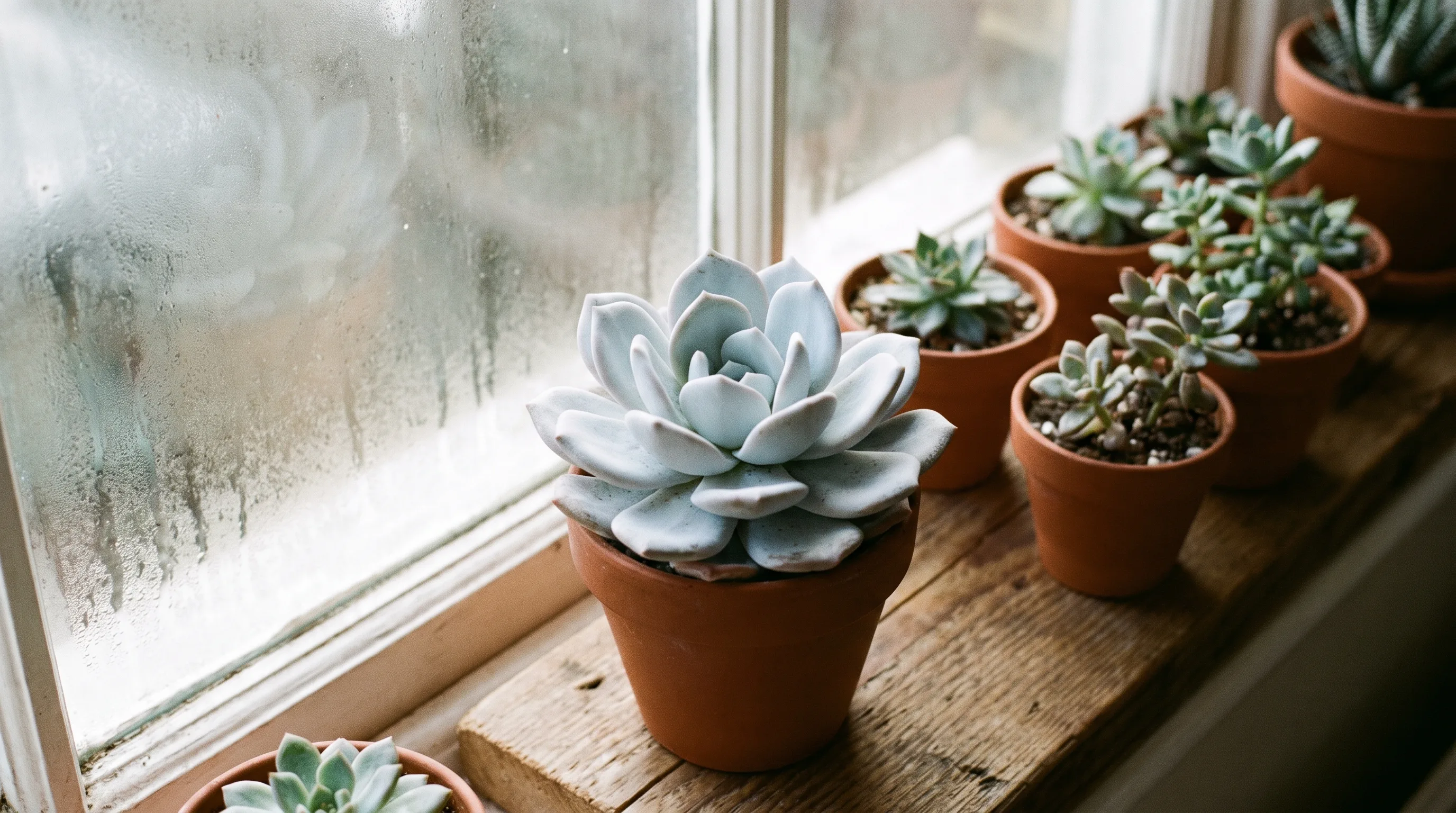
Echeveria laui is a rare Mexican succulent prized for a remarkably neat rosette of rounded, blue-white leaves. A thick, powdery wax coating gives the foliage its characteristic pale finish, but also makes the plant easy to mark. In the UK it is best treated as a specialist, frost-free pot specimen for a bright room, conservatory or greenhouse.
Overview
Echeveria laui belongs to the stonecrop family, Crassulaceae, and is one of more than 150 species in a predominantly Mexican genus of rosette-forming succulents. It was formally described in 1976 and remains much less common in cultivation than familiar hybrid echeverias. Plants offered by reputable UK specialists are generally labelled simply by the botanical name because no widely accepted English common name has become established.
The species is endemic to a small area of central Mexico, where it grows on limestone cliffs at roughly 600–1,200 metres. Its habitat helps explain its particular needs. Plants occupy steep or nearly vertical rock faces, sometimes with shade and atmospheric moisture, yet water drains away immediately. A UK pot must reproduce the drainage and root aeration of that niche rather than merely being kept hot and dry.
This is an evergreen, usually solitary succulent with an extremely short stem. Offsets may eventually form around an old plant, but they develop slowly. It is therefore better regarded as an individual specimen than as ground cover. Its compact scale suits a windowsill or greenhouse bench, although its slow growth, sensitivity to excess water and easily damaged leaf coating make it more demanding than many common houseplants.
Wild plants have a very restricted distribution and can be threatened by collecting. Buy nursery-propagated plants from a reputable succulent specialist and avoid material of uncertain origin. Correct identification also matters: E. laui has sometimes been confused or mislabelled in trade, while superficially similar plants may belong to Pachyphytum, Sedum or another Echeveria species.
Appearance
A mature plant forms a dense, nearly circular rosette. In pots it commonly reaches about 12–17 cm across, although an old specimen may eventually exceed 20 cm. Achieving that size can take many years. The leaves overlap closely, curve slightly inwards and may produce a subtly depressed centre, giving the rosette an unusually orderly, sculptural appearance.
Individual leaves are thick, fleshy and broadly oval to almost round, typically about 5–8 cm long and 4–7 cm wide on a mature plant. Their underlying colour is pale grey-blue, but the defining feature is a heavy covering of farina: a blue-white, powdery epicuticular wax. This bloom helps protect the foliage, yet it rubs off readily. A fingerprint, water droplet or insect can leave a lasting darker mark because farina removed from an existing area of leaf does not regenerate.
Flowers appear on a pinkish, arching or pendulous stem. The small, bell-shaped blooms are generally salmon-pink to coral-orange and are about 1.5 cm long. In a UK glasshouse or conservatory, flowering is most likely from February to April. Flower production can vary according to the plant's age, light and winter care, so a healthy young specimen may not bloom every year.
The root system is relatively fine and modest compared with the fleshy rosette. This makes a large volume of damp compost especially hazardous. Old outer leaves naturally yellow, dry and detach over time; this gradual loss is normal rather than evidence that the whole plant is failing.
Growing Conditions
Give Echeveria laui abundant light without prolonged, fierce midday sun. An east-facing windowsill, bright north-facing position, conservatory bench with light shading, or frost-free greenhouse is suitable. Gentle morning sun helps maintain compact growth, while intense sun through south-facing glass can bleach or scorch the leaves. Acclimatise the plant gradually whenever moving it to a brighter position, especially in spring.
The growing medium must drain rapidly. Use cactus and succulent compost amended with about 30–50 per cent horticultural grit, pumice or perlite. Experienced growers sometimes use an almost entirely mineral mix for valuable mature specimens. Whichever blend is chosen, it should allow a thorough watering to pass through freely and then dry throughout. Avoid rich, peat-heavy compost that remains wet around fine roots.
A porous terracotta pot supports the necessary wet-and-dry cycle and is often preferable to plastic. The container must have an unobstructed drainage hole and should be only slightly wider than the rootball. A broad plant does not require an equally broad mass of compost. Never leave the pot standing in a saucer of water.
In the UK, grow this species under frost-free cover for most or all of the year. A warm summer spell may allow a pot to stand outside in bright shade, sheltered from heavy rain, but bring it indoors well before cold nights return. Choose a position with air movement. High humidity alone is not essential, and humid, stagnant air combined with a wet crown encourages rot and grey mould.
Winter management is critical. Keep the plant bright and the compost essentially dry from November to February, providing only a little water if leaves begin to shrivel noticeably. A warm indoor plant may need slightly more than one kept cool under glass, so use the dryness of the entire pot rather than a fixed timetable as the guide.
Planting and Care
Plant with the base of the lowest leaves just above the compost surface. Burying the rosette or allowing compost to lodge between its leaves creates a damp neck and increases the risk of crown rot. A top-dressing of coarse grit steadies the plant, keeps the neck clean and prevents wet compost splashing onto the farina. Handle the specimen by its pot or rootball rather than gripping the leaves.
From spring to early autumn, water thoroughly only after the compost has dried completely below the surface. Apply water slowly at the pot rim, avoiding the rosette, and let every excess drain away. Do not compensate for cautious watering by giving frequent small splashes: an occasional full soak followed by complete drying is healthier. Reduce watering sharply as light levels fall and growth slows.
Feed sparingly during active growth. A half-strength, low-nitrogen liquid fertiliser applied about once a month is sufficient. Rich feeding produces soft, stretched foliage, spoils the compact rosette and can increase susceptibility to rot. Do not feed a dormant or recently repotted plant.
Repot in spring or early summer, usually every three or four years, when the mix has broken down or roots have filled the container. Move up by only one pot size, inspect the roots and remove any dead material with clean tools. After disturbance, allow damaged roots to dry before resuming normal watering.
There is no routine pruning or cutback. Remove a flower stalk once it has finished and gently take away fully dry outer leaves, using tweezers if necessary so that healthy leaves are not touched. Dead material trapped against the stem can harbour pests or retain moisture, but partially green leaves should remain until they have naturally finished feeding the plant.
Propagation is possible from offsets, leaf cuttings or seed. Offsets are the safest way to preserve a named, correctly identified plant, but E. laui is slow and shy to produce them. Separate a rooted offset in April, May or June, let the wound callus, then pot it into dry gritty mix before watering cautiously. For a leaf cutting, remove a whole healthy leaf cleanly in spring or summer, allow the base to callus, and rest it on barely moist mineral-rich compost. Success can be slow and is not guaranteed. Specialist nurseries also surface-sow the extremely fine seed under cover.
Common Problems
Crown and root rot are the main threats in UK cultivation. Warning signs include translucent, soft leaves, a darkened stem, an unstable rosette or rapid collapse from the centre. Cold, wet compost, a buried neck, oversized pots and water trapped among the leaves are frequent causes. Prevention is far more reliable than treatment. Isolate an affected plant, remove rotten tissue with a sterile blade and attempt to reroot only sound material.
Grey mould, or botrytis, may develop on damaged foliage in a cool, humid and poorly ventilated greenhouse. Remove affected material promptly, keep leaves dry and increase air movement. Avoid crowding plants together during winter, when low light and slow evaporation make disease more likely.
Mealybugs hide deep in the rosette, around leaf axils or among the roots. Look for white, waxy insects, sticky residue and distorted new growth. Isolate the plant and remove visible insects carefully with a cotton bud lightly moistened with methylated spirit, taking care not to spread liquid over the farina. Recheck repeatedly because concealed eggs and juveniles can survive an initial treatment.
Vine-weevil adults may notch leaf edges, while their cream-coloured grubs feed unseen on roots and can cause a plant to loosen suddenly in its pot. Inspect roots when unexplained decline occurs. A suitable biological nematode treatment can be used when compost temperatures permit, following the product instructions.
Sun scorch appears as pale, bleached or brown patches, often after a plant is moved abruptly into direct sun or placed close to south-facing glass. Damaged tissue and rubbed-off farina will not repair themselves, although new leaves can remain unmarked. Move the pot away from harsh afternoon sun and improve conditions gradually rather than removing otherwise healthy leaves.
Stretching, with an open rosette and elongated leaves, indicates insufficient light. Increase brightness carefully, rotate the pot periodically for even growth and avoid high-nitrogen feeding. Some lower-leaf shrinkage during a dry winter is normal; widespread softness in wet compost is not.
Popular Varieties
No reliably documented named cultivars or botanical varieties of Echeveria laui are widely established in UK horticulture. It would be misleading to list popular Echeveria hybrids or similarly coloured species as varieties of this particular plant. Stock may differ slightly in leaf shape, bloom thickness and rosette size because nursery plants are often seed-raised, but such variation does not create a recognised cultivar.
When buying, check that the plant is labelled with the full species name and has the characteristic thick, rounded leaves and dense blue-white farina. Very cheap, rapidly offsetting or strongly pointed plants may be another species or a hybrid. Ask a specialist nursery about provenance and propagation, particularly for a costly mature specimen. Nursery-propagated E. laui is the appropriate choice for both accurate cultivation and protection of its restricted wild populations.
Pests and Diseases
| Problem | Symptoms | Management |
|---|---|---|
| Root rot | Leaves become soft, mushy, and discoloured while the stem may collapse. | Water only when compost is dry and ensure pots have excellent drainage. |
| Powdery mildew | A white, powdery fungal growth appears on leaves and stems. | Improve air circulation and avoid wetting foliage; treat with a suitable fungicide if severe. |
| Mealybugs | White, cottony clusters appear in leaf axils and on stems. | Wipe off with alcohol-dipped cotton bud or apply insecticidal soap. |
| Vine weevil | Notches chewed into leaf margins and larvae feeding on roots in compost. | Use biological nematodes or systemic insecticides to control larvae. |
| Leaf tip burn | Brown, necrotic tips on leaves caused by chemical sensitivity. | Water with rainwater instead of tap water to avoid fluoride damage. |
For step-by-step help, read Treating Powdery Mildew. Or browse the full plant problem solver to diagnose an issue by symptom.
Recommended Products
GardenWizz earns a commission from qualifying purchases made through affiliate links on this page (including links within the article) — as an Amazon Associate, and from Thompson & Morgan via the Awin network. This does not affect the price you pay. See our disclaimer for details.