Sea Milkball
Euphorbia flanaganii
The Gardening Year
Best months in UK gardens · full planting calendar →
🖨 Printable care card (PDF)At a Glance
| Botanical name | Euphorbia flanaganii |
|---|---|
| Common name(s) | Sea Milkball |
| Family | Euphorbiaceae |
| Plant type | succulent |
| Height × Spread | 2–50 cm × 10–50 cm |
| Position | Full sun, Partial shade |
| Soil | well-drained |
| Flowering | August–November |
| Toxicity | IRRITANT to skin/eye harmful if eaten |
| Native range | South Africa |
Overview
Euphorbia flanaganii, commonly known as Medusa's Head, is a small, clump-forming succulent in the family Euphorbiaceae. Native to the arid Eastern Cape of South Africa, where it grows in shallow soils over rock, it is widely grown in British collections as an unusual, architecturally striking specimen for a sunny windowsill, greenhouse or conservatory, and in favoured microclimates can be stood outdoors in containers during the UK summer.
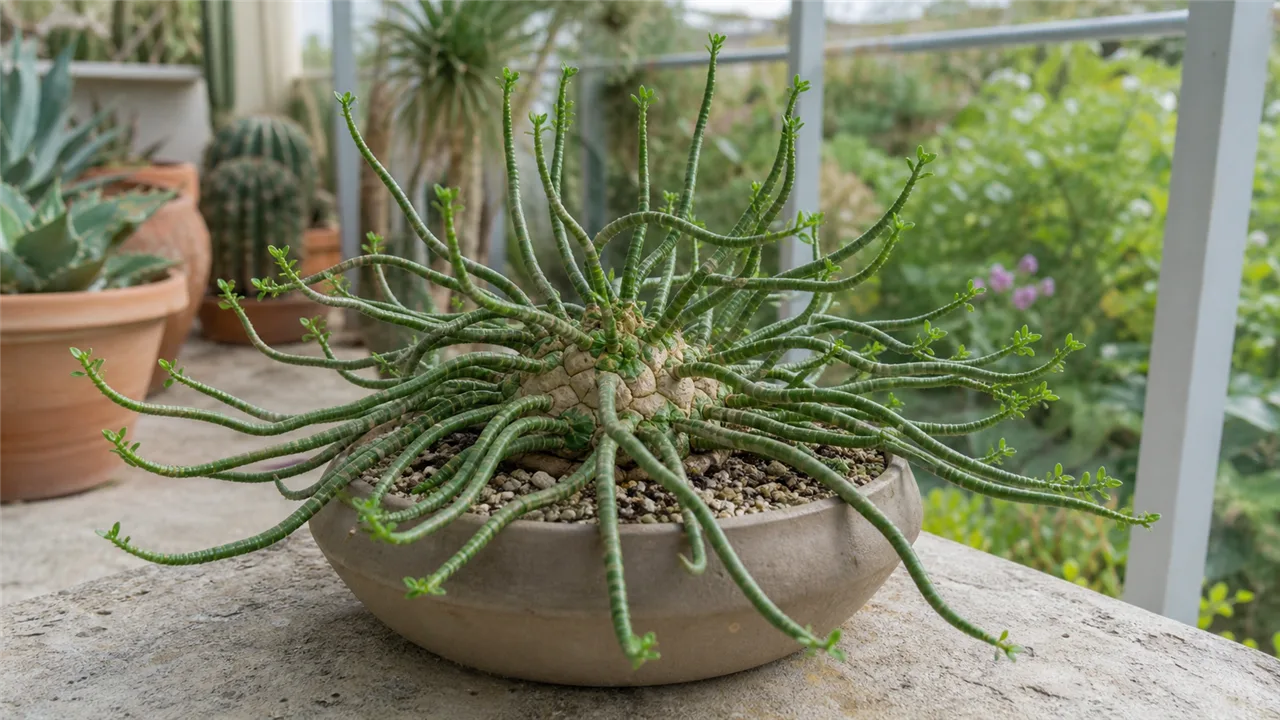
The plant is grown for its habit rather than its flowers: a central, often partly buried caudex produces a flattened rosette of cylindrical, snake-like arms radiating outwards, suggesting a head of snakes — hence the common name. It is a true succulent in cultivation terms but, like every Euphorbia, it is not a cactus; its defences are a milky, caustic latex rather than true spines. Mishandled — overwatered, kept too cold or potted in a peaty mix — it rots quickly; the table below summarises the essentials and each is covered in more detail further down.
In UK cultivation the species is most often grown as a single pot specimen or as the focus of a small succulent pan. It combines well with other small, drought-tolerant South African succulents — Lithops, Haworthia, Gasteria and dwarf Aloe — provided every component is given the same free-draining, dry-winter regime. Outdoors it can stand in a sheltered sunny spot for the warmer months but must come back under cover well before the first autumn frosts.
Appearance
Mature Euphorbia flanaganii forms a low, spreading colony. A short central stem — in older plants often partly buried or forming a small caudex — produces a ring of slender, finger-like arms 1 to 2 cm thick and up to 15–20 cm long, each curving outwards and lying more or less flat on or just above the soil surface. The overall effect is a dense, roughly circular cushion 20–30 cm across, slightly higher in the middle.
The arms are fresh green in good light, taking on paler or grey-green tones in deeper shade or during winter rest. They are shallowly ribbed and bear small, paired spine-like stipules on the ribs where leaves once emerged, giving a faintly prickly texture without the sharpness of true cactus spines.
True leaves are small (around 1–2 cm long), narrowly oblong, and appear briefly at the stem tips in spring and summer when growth is active. They drop readily in dry conditions, low light, or as the season turns; a mature plant in full sun may carry only a small tuft at each growing point for much of the year.
Flowers are not the main feature. In late spring and summer the plant produces cyathia — the cup-like "false flowers" characteristic of Euphorbia — at the tips of the arms. Each is small, yellow-green and not particularly showy; pollination is uncommon in cultivation and the flowers are a curiosity rather than a display.
Every part of the plant exudes a thick, white latex when cut or damaged — a strong skin and eye irritant and toxic if ingested. Any handling that involves cutting, dividing or dislodging an arm must be done with thick gloves; the cut surface should be rinsed or dusted with charcoal to stop the flow. Sap safety is the single most important consideration when growing or propagating this species.
Growing Conditions
Light and temperature: Bright light is essential for compact, well-coloured growth — a south- or west-facing windowsill, a glasshouse bench or a conservatory roof suits it well; in poor light the arms elongate and become weak. The plant is tender in the UK and cannot be relied upon outdoors in winter anywhere. Keep it above about 5 °C in winter, ideally in a dry atmosphere — a heated greenhouse kept just frost-free, or a bright spare room, is ideal.
Water: Drought-tolerant. From late spring to early autumn water thoroughly only when the compost has dried out fully, then let it dry again. From late autumn through early spring keep the plant almost dry; an occasional light drink in midwinter is enough in a heated room. Overwatering, especially in winter, is by far the commonest cause of loss.
Soil and pot: A very sharply drained mix is essential — a cactus-and-succulent compost improved with about 50% coarse grit or perlite, or a loam-based John Innes No. 2 cut generously with grit. Use a terracotta pot where possible; it dries faster than plastic and gives the roots the airy conditions they need.
Feeding: A single diluted feed of a low-nitrogen, high-potash cactus fertiliser in late spring and again in mid-summer is ample. Overfeeding produces soft, elongated arms and a thin caudex.
Planting and Care
Planting: Pot up in spring as new growth starts, choosing a pot only one size larger than the current one — these plants prefer to be slightly root-bound. Place coarse drainage at the base, set the central stem at or just below the compost surface, backfill with the gritty mix and top-dress with gravel to keep the crown dry.
Watering: From April to September water when the compost has dried out fully, then leave it to dry again. Reduce sharply from October and keep the plant on the dry side through winter until growth resumes in spring.
Feeding: A dilute, low-nitrogen cactus feed in late spring and again in mid-summer is ample; overfeeding produces soft, elongated arms.
Pruning: Little is needed. Remove dead or shrivelled arms at the base, or trim a damaged tip, with a clean blade and gloves. Avoid cutting into healthy tissue; the plant seals its own wounds slowly.
Propagation: Easiest by division of an offset in late spring. With thick gloves, sever a well-rooted side arm close to the main stem with a sterile knife, callus the cut for two or three days in a dry shaded spot, then pot into dry gritty compost. Do not water for a further week. Stem cuttings root more slowly; seed is rarely offered in the UK.
Seasonal care in the UK: in spring, repot if needed, resume watering and start light feeding; in summer, water when dry and keep in bright, well-ventilated conditions; in autumn, reduce watering and move indoors before any frost; in winter, keep almost dry, cool but frost-free, in the brightest position available.
Common Problems
Overwatering and basal rot: By a wide margin the commonest cause of failure. Soft, discoloured patches at the base of the arms and a limp, darkened appearance are the symptoms. Prevention — gritty compost, a terracotta pot and dry winters — is far better than cure.
Frost and cold damage: Below about 5 °C the tissue blackens and softens. Move plants indoors before the first autumn frosts and harden off gradually in spring.
Mealybugs: The most likely pest in UK cultivation, especially in dry, warm indoor air. Small white waxy insects settle in the crown and at the growing tips. Remove small infestations with a cotton bud dipped in diluted horticultural soap, or treat with a systemic insecticide suitable for ornamentals.
Scale insects: Small brown discs on the arms. Scrape off manually or treat as for mealybugs. Check during the dormant winter months before populations build up.
Spider mites: Fine webbing and a bronzed look on the arms in very dry indoor conditions. Improve humidity by standing the pot on a gravel tray; treat with an appropriate acaricide if necessary.
Leggy, pale growth: Almost always insufficient light. Move to a brighter position; etiolated arms will not shorten, but new growth will come in compact and well-coloured.
Sap irritation: A repeat of the warning in the Appearance section — the milky latex is a skin and eye irritant and toxic if ingested. Wear thick gloves when handling cut material, keep the plant out of reach of children and pets, and wash hands and tools afterwards. Sap on skin: rinse with water. Sap in an eye: seek medical advice promptly.
Popular Varieties
True cultivar selection within Euphorbia flanaganii is narrow — most plants are sold under the species name — but two forms are reliably available in the UK:
- `Euphorbia flanaganii` f. `cristata` — the crested form, in which the growing point fans into a flattened, ribbon-like crest rather than a single cylindrical arm. It is almost always sold grafted onto the upright stem of a related Euphorbia rootstock (commonly E. canariensis or E. ingens) because its own roots are weak. The result is a fan-shaped, wavy green crest on a stout stem, prized in succulent collections.
- The typical species form, sometimes labelled the "Medusa's Head" clone, is the most widely grown and is what most UK suppliers mean by E. flanaganii without further qualification.
Named selections beyond these appear sporadically, usually sold as "selected forms" rather than under stable cultivar names. UK growers should treat any cultivar name other than `cristata` with caution and buy from a reputable supplier who can confirm the plant's identity.
Pests and Diseases
| Problem | Symptoms | Management |
|---|---|---|
| Mealybugs | White, cottony wax patches appear in leaf axils and on stems, often accompanied by sticky honeydew. | Isolate the plant and treat with a systemic insecticide or dab affected areas with alcohol-soaked cotton buds. |
| Root rot | Stems become soft, shrivelled, and discoloured while the soil remains persistently wet. | Ensure excellent drainage using gritty compost and water only when the substrate is completely dry. |
| Red spider mites | Fine webbing appears on foliage with stippled, yellowing leaves under hot, dry conditions. | Increase humidity around the plant and spray with a horticultural oil or miticide if infestation is severe. |
| Scale insects | Small, immobile, brown or white bumps attach firmly to stems and leaves. | Scrape off visible scales manually and apply a recommended insecticidal soap or systemic treatment. |
| Overwatering | Leaves turn yellow and drop prematurely while the stem base feels mushy. | Reduce watering frequency immediately and repot in fresh, free-draining succulent compost if necessary. |
Or browse the full plant problem solver to diagnose an issue by symptom.
Recommended Products
GardenWizz earns a commission from qualifying purchases made through affiliate links on this page (including links within the article) — as an Amazon Associate, and from Thompson & Morgan via the Awin network. This does not affect the price you pay. See our disclaimer for details.