Horned Spurge
Euphorbia ceratocarpa
The Gardening Year
Best months in UK gardens · full planting calendar →
🖨 Printable care card (PDF)At a Glance
| Botanical name | Euphorbia ceratocarpa |
|---|---|
| Common name(s) | Horned Spurge |
| Family | Euphorbiaceae |
| Plant type | perennial (evergreen perennial or subshrub) |
| Height × Spread | 1.5–2 m × 1–2.5 m |
| Position | Full sun, Partial shade |
| Soil | moist but well-drained, light soil; chalk, loam, sand; acid, alkaline or neutral pH |
| Flowering | January–December |
| Toxicity | all parts toxic if ingested; milky sap causes intense irritation to hands and eyes |
| Native range | Sicily and southern Italy |
Overview
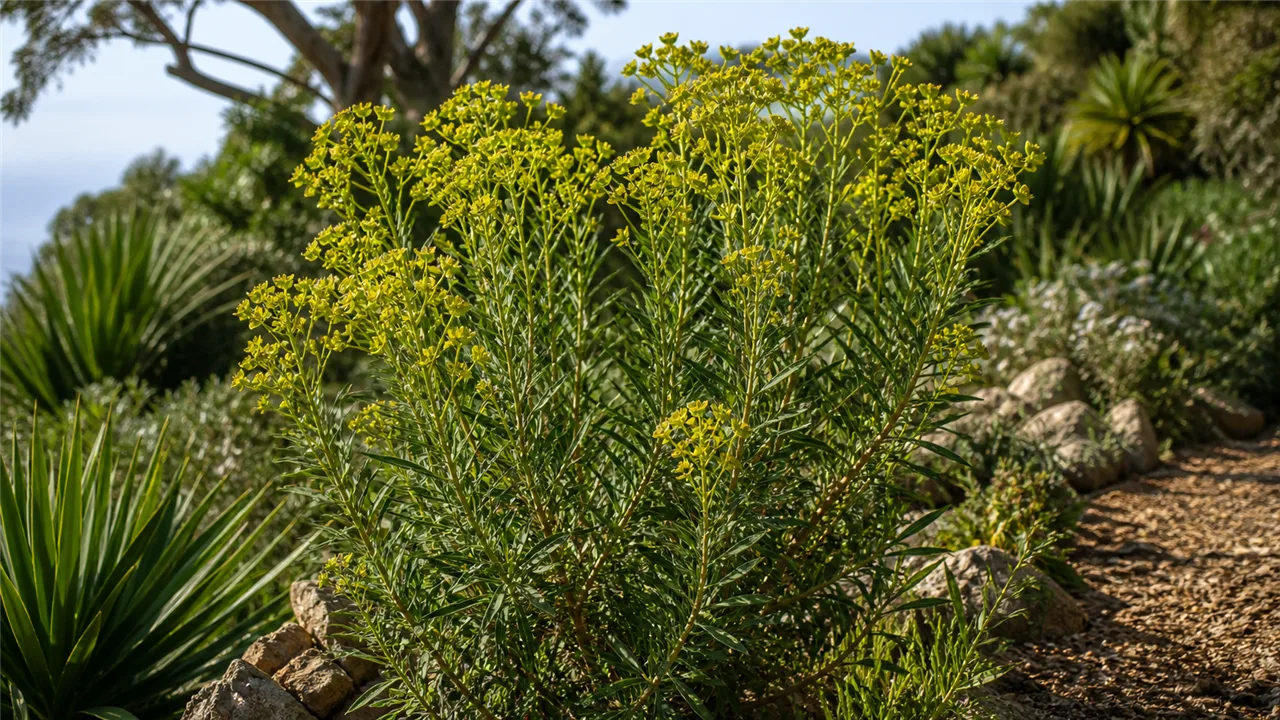
Euphorbia ceratocarpa, the horned spurge, is a vigorous evergreen to semi-evergreen sub-shrub in the spurge family (Euphorbiaceae). Native to Sicily and parts of southern mainland Italy, it forms a dense, rounded clump of erect to arching stems clothed with narrow green leaves and topped, from late spring into summer, with broad cymes of bright yellow-green flowers. In a UK garden it fits comfortably into Mediterranean-style plantings, gravel gardens and coastal borders, where its tolerance of poor, dry soils and its long flowering display earn it a place among the more architectural spurges.
For UK gardeners, E. ceratocarpa is a useful but under-used alternative to the better-known Euphorbia characias and the hybrid Euphorbia × pasteurii. It shares their chartreuse flower colour and evergreen presence, but on a more compact, manageable frame — typically 60–90 cm in height and spread once established. It is hardy across most of lowland Britain given a well-drained site and a sunny position, and asks for little beyond an annual cut-back in early spring to keep the clumps vigorous.
All parts of the plant exude a milky white latex when cut or broken. This sap is a significant skin and eye irritant and the plant is toxic if ingested, so gloves and eye protection are essential when handling, pruning or propagating it. Site it away from areas where children or pets may have unsupervised access.
Appearance
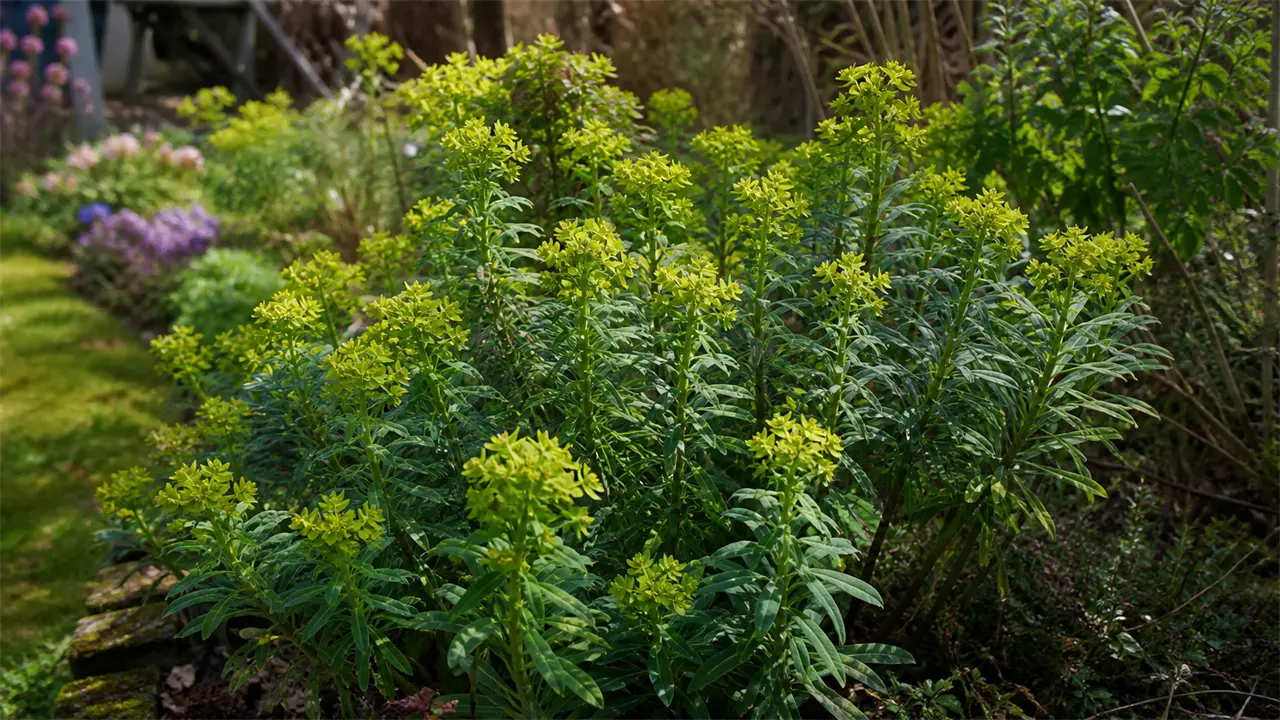
Euphorbia ceratocarpa is a clump-forming sub-shrub with a rounded, bushy habit. The stems are erect to gently arching, branching freely from near the base and carrying the year's flowers on wood produced in the previous season. The overall effect is a soft, mounding dome of fine-textured foliage studded with flat-topped flower clusters.
The leaves are narrow and lance-shaped to linear, typically 5–10 cm long, with smooth, untoothed (entire) margins. They are a fresh, slightly greyish green and arranged spirally up the stems. Foliage is dense through the growing season and remains on the plant in all but the harshest winters; in colder districts or exposed sites the plant may behave as semi-evergreen, shedding some leaves during cold spells before reflushing in spring.
The flowers are borne in terminal cymes — branched, flat-topped clusters at the stem tips. As with all Euphorbia, what appears to be the flower is technically a cyathium: a cup-shaped involucre holding the true, much-reduced flowers. In E. ceratocarpa the involucres are a clear, bright yellow-green, sitting above paired, conspicuous bracts of the same colour, and they are produced in succession from late May or June through into August, often with a lighter second flush in September. The display is luminous rather than showy: the bracts hold their colour for many weeks before fading to a softer buff tone.
The fruit is a smooth, three-lobed schizocarp — a dry capsule that splits at maturity to release the seeds. Seedheads are not a major ornamental feature and are usually left in place until the spring cut-back. As with every Euphorbia, broken stems, leaves and capsules bleed a sticky white latex; this is the plant's defining defence and the reason for the genus's toxic reputation.
Growing Conditions
Euphorbia ceratocarpa is, in horticultural terms, a sun-loving Mediterranean plant that performs best where its natural preferences are met: sharp drainage, plenty of light and a soil that does not stay wet through winter. In the UK this translates to a straightforward plant across most of lowland England and Wales, with more care needed in colder, wetter regions and on heavy clay.
Soil. Average, well-drained garden soil suits it perfectly. It tolerates poor, rocky, sandy or gravelly soils and is a natural choice for gravel gardens and mineral mulches. Heavy clay should be improved with grit and organic matter before planting, or — better — avoided in favour of a raised bed or slope. A neutral to slightly alkaline pH is preferred; very acid soils are tolerated but rarely ideal.
Light. Full sun produces the most vigorous, upright growth and the heaviest flower display. Light dappled shade is tolerated, but flowering is reduced and the stems may lean, becoming leggy.
Position. A south- or west-facing border is ideal, with shelter from cold east winds. Gravel gardens, dry Mediterranean plantings, coastal gardens and the foot of a warm house wall are all excellent placements. Avoid frost pockets and sites that sit wet through winter.
Hardiness. Euphorbia ceratocarpa is generally hardy across the UK in well-drained conditions, but dislikes the combination of wet soil and hard frost. A cold, wet winter is more dangerous than a cold, dry one. In colder regions of the north, upland areas and much of Scotland, growing it against a warm wall, on a raised bed or in sharply drained soil markedly improves survival. The published hardiness rating is held in the structured badge and is not repeated in prose.
Drought tolerance. Once established, the plant is notably drought-tolerant and thrives through typical UK summers without supplementary watering, suiting it to low-irrigation and gravel plantings.
Planting and Care
Planting. Container-grown plants can be set out in spring or early autumn; spring planting is preferable in colder districts, giving the roots a full season to establish before their first winter. Space plants approximately 45–60 cm apart to allow for mature spread. Dig a hole wider than the rootball and plant at the same depth the plant sat in its pot, backfilling with the original soil and firming gently. Water in well and mulch with a thin layer of gravel or grit rather than a moisture-retaining organic mulch, which can hold damp around the crown.
Watering. Water moderately during the first growing season to settle the plant in. Once established, supplementary watering is needed only in prolonged drought, particularly on lighter soils.
Feeding. The plant is not a heavy feeder. A light top-dressing of well-rotted compost or a balanced general fertiliser in spring is plenty. Overfeeding produces soft, leafy growth that flops and flowers poorly.
Pruning. Euphorbia ceratocarpa flowers on the previous season's stems, so the annual prune is best carried out in early spring — typically March, once the worst of the frosts have passed but before strong new growth emerges. Cut all stems back to within a few centimetres of the base, or to low emerging buds on established clumps. This hard annual cut-back is what keeps the plant compact, vigorous and well-flowered; unpruned plants become leggy and bare at the base. Wear gloves, long sleeves and eye protection: the milky latex bleeds freely from cut stems and is a severe irritant to skin and eyes. Wash tools and hands thoroughly afterwards.
Propagation. Established clumps are easily propagated by division in spring (March–April), lifting the plant and teasing apart sections with roots attached, then replanting immediately and watering in. Basal cuttings taken in late spring or early summer, when new shoots are firm at the base, also root readily; allow cut surfaces to callus briefly before inserting into a free-draining cutting compost. Take care with the latex at all stages.
Seasonal care. A light tidy of damaged or frost-blackened stems can be carried out in late winter in mild areas, but the main cut-back belongs to spring. After flowering, a light deadheading of spent main cymes can encourage the secondary autumn flush; this is optional and should not replace the spring prune. Top-dress with compost each spring and refresh the gravel mulch if it has become fouled with leaf litter.
Common Problems
Euphorbia ceratocarpa is generally trouble-free given the well-drained, sunny position it prefers. Most problems stem from poor siting (wet soil, deep shade, cold exposure) or normal garden pest pressure.
Powdery mildew. Can affect foliage in humid summers or where air circulation is poor. Ensure adequate spacing, avoid overhead watering and remove affected shoots. Usually cosmetic.
Aphids. May cluster on young shoots and developing flower buds in late spring. Usually kept in check by natural predators; if populations build, insecticidal soap or a strong jet of water is sufficient.
Botrytis (grey mould). Develops on damaged or overcrowded stems in damp conditions, particularly through mild, wet winters. Cut out affected growth and improve airflow.
Slugs and snails. Young spring growth is attractive and can be disfigured. Use organic controls (nematodes, ferric phosphate pellets) or hand-pick in the evening if damage is heavy.
Crown rot. Rare but a real risk in waterlogged or compacted soils — the plant yellows and collapses. Prevention (sharp drainage, no winter wet) is the only reliable cure.
Latex irritation. The single most important issue with any Euphorbia. The milky sap is a significant skin and eye irritant and is toxic if ingested. Always wear gloves and eye protection when cutting or propagating, and keep the plant away from children and pets.
Euphorbia leaf spot. A fungal leaf-spot (Ascochyta and related species) can mark foliage in damp seasons; rarely serious — remove affected leaves.
Crown gall. The soil-borne bacterium Agrobacterium tumefaciens can produce galls at the crown of stressed plants. Avoid wounding the crown.
Glasshouse red spider mite. Only an issue under glass or in very hot, dry summers in the south; not normally a problem in the open garden.
Popular Varieties
Named cultivars of Euphorbia ceratocarpa are not widely listed in the UK nursery trade, and the species itself is generally sold simply as E. ceratocarpa. Gardeners seeking a named form are most likely to encounter the species raised from a known wild collection, and for most planting schemes this performs perfectly well without cultivar selection.
For gardeners wanting the same architectural presence in a slightly different frame, the following closely related spurge species and hybrids are widely available in the UK and offer a comparable yellow-green spring-and-summer display:
- Euphorbia characias subsp. characias — the classic Mediterranean spurge, larger and more upright than E. ceratocarpa (to 1.2 m and beyond), with broader blue-grey leaves and very large, long-lasting flower heads in spring. Best in well-drained soil at the base of a sunny wall.
- Euphorbia characias subsp. wulfenii — similar to the type but slightly broader in leaf and typically hardier; widely planted in UK gardens and often seen as the default architectural spurge.
- Euphorbia × pasteurii — a hybrid between E. stricta and E. mellifera, semi-evergreen with narrow leaves and honey-scented, brownish-yellow flower heads in late spring. Larger than E. ceratocarpa (to 1.5 m) and tolerant of a wider range of UK conditions.
- Euphorbia mellifera — the honey spurge, an evergreen shrub producing clusters of sweetly scented, bronze-tinted flowers in late spring. Larger-leaved and less xeric than E. ceratocarpa, suited to a sheltered border rather than a gravel garden.
- Euphorbia myrsinites — the donkey-tail spurge, a low, sprawling evergreen with succulent blue-grey leaves spiralling up the stems and bright yellow-green spring flowers. A natural companion in gravel gardens at the front of a border.
Within E. ceratocarpa itself, growers occasionally offer seed-raised plants under regional provenance names (for example, Sicilian or southern Italian collections), but these are not formal cultivars. If a particular form is offered under a cultivar name in a nursery catalogue, treat the label as the authoritative source for that plant.
Pests and Diseases
| Problem | Symptoms | Management |
|---|---|---|
| Root and stem rots | Stems become soft, discoloured and mushy, often leading to plant collapse in wet conditions. | Ensure well-drained soil and avoid overwatering, especially during winter months. |
| Aphids | Clusters of small insects on new growth causing leaf distortion and sticky honeydew. | Spray off with water or use insecticidal soap; encourage natural predators like ladybirds. |
| Powdery mildew | White, powdery fungal growth appears on leaves and flower bracts. | Improve air circulation and apply a suitable fungicide if infection is severe. |
| Slugs and snails | Irregular holes chewed in leaves and silvery slime trails on foliage and soil. | Use physical barriers, copper tape, or approved slug pellets to protect young plants. |
For step-by-step help, read Controlling Aphids Naturally, Dealing with Slugs and Snails and Treating Powdery Mildew. Or browse the full plant problem solver to diagnose an issue by symptom.
Recommended Products
GardenWizz earns a commission from qualifying purchases made through affiliate links on this page (including links within the article) — as an Amazon Associate, and from Thompson & Morgan via the Awin network. This does not affect the price you pay. See our disclaimer for details.