Tree Fuchsia
Fuchsia arborescens
The Gardening Year
Best months in UK gardens · full planting calendar →
🖨 Printable care card (PDF)At a Glance
| Botanical name | Fuchsia arborescens |
|---|---|
| Common name(s) | Tree fuchsia |
| Family | Onagraceae |
| Plant type | tree |
| Height × Spread | 1.5–2.5 m × 1.5–2.5 m |
| Position | Full sun, Partial shade |
| Soil | Loam. Moist but well–drained or Well–drained. pH: Acid or Alkaline or Neutral |
| Flowering | June–October |
| Toxicity | — |
| Native range | Central America |
Tree fuchsia is a tender evergreen shrub or small tree valued for clouds of tiny lilac-pink flowers, glossy foliage and a more architectural habit than familiar bedding fuchsias. In Britain it is best treated as a conservatory or heated-greenhouse specimen, or grown in a large container that can stand outdoors in warm summer weather and return under cover before autumn cold.
Overview
Fuchsia arborescens belongs to the evening primrose family, Onagraceae, and is native from Mexico to Guatemala. It differs markedly from the compact, large-flowered fuchsia hybrids widely sold for baskets and summer containers. Rather than producing conspicuous pendant blooms one or two at a time, tree fuchsia bears many small flowers in broad, branched clusters. The resulting display has the soft, hazy appearance of lilac blossom, which explains the alternative common name lilac fuchsia.
The species forms a woody, upright and freely branching plant. Its evergreen character is most apparent where warmth and good light can be maintained throughout the year. In UK cultivation, growth may slow in winter and some leaf loss can occur if conditions become cool, dry or dim. A mature specimen makes an effective focal plant in a conservatory or glasshouse, while a younger plant can be displayed on a sheltered patio during summer.
Tree fuchsia is not a dependable year-round outdoor shrub for most British gardens. Container culture is usually safest because the plant can be moved under cover. Permanent planting is appropriate only with reliable protection and a warm microclimate; cold winds and saturated winter soil should still be avoided.
Appearance
This fuchsia develops a distinct woody framework, with upright stems that branch into a rounded or broadly spreading crown. Under managed conditions it usually reaches about 1.5–2.5 m in height and spread, although its ultimate size depends strongly on the available root space, warmth and pruning. Container-grown plants can be kept smaller by measured spring pruning, while specimens under glass may gradually become substantial shrubs.
The leaves are glossy, dark green and elliptic, sometimes reaching about 20 cm long. They are arranged oppositely or in whorls along the shoots. Their smooth texture and relatively large size give the plant a lush, subtropical appearance even when it is not flowering. Healthy leaves should be evenly coloured and firm; pale growth can indicate exhausted compost, poor root function or insufficient feeding, while a dull, stippled surface may point to sap-feeding pests.
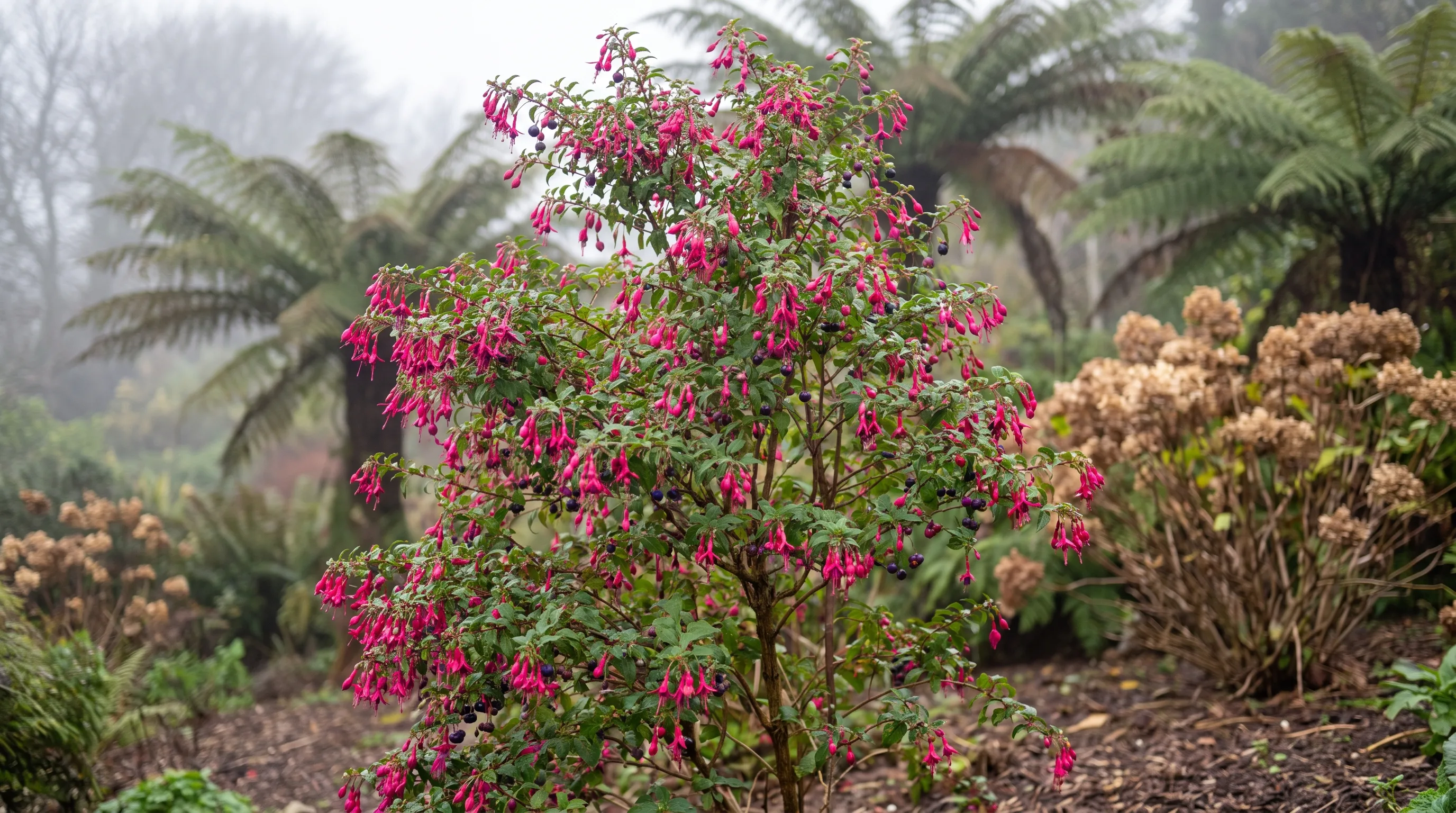
Flower buds are deep pink and open into small, single, pinkish-purple to lilac flowers. These are gathered into dense terminal panicles held above and among the foliage. Individual blooms are slender and delicate, but their abundance makes the whole cluster conspicuous. The flowers may be fragrant and are normally produced in summer, with the exact duration influenced by warmth, light and regular care.
Pollinated flowers can be followed by rounded fruits which change from green and reddish shades to dark purple or blue-black as they ripen. Fruit production is an ornamental bonus rather than the main reason for growing the plant in Britain. Removing only dead or damaged material, rather than routinely cutting off every faded flower cluster, allows fruits to develop where growing conditions permit.
Growing Conditions
Give tree fuchsia a bright position with good air movement. Outdoors during summer it can grow in full sun or partial shade, but a newly moved plant should be acclimatised gradually to stronger light to prevent leaf scorch. A sheltered east-, west- or south-facing position is suitable if the container is protected from drying winds. Under glass, bright filtered light is ideal; some shading and ventilation may be needed when intense midday sun causes overheating.
The root system performs best in a fertile, humus-rich medium that holds useful moisture while draining freely. A peat-free multi-purpose potting compost suits young plants. For a larger, long-term specimen, a loam-based peat-free mix provides greater stability and retains nutrients well; coarse material can be incorporated if drainage is slow. The plant tolerates a range of soil reactions, so structure, drainage and consistent care matter more than achieving a narrowly defined pH.
Keep moisture reasonably even during active growth. Repeated drying can cause leaf drop and aborted buds, while saturated compost excludes air from the roots. Do not leave a pot standing in water; ensure drainage holes are clear and empty decorative outer pots after watering.
UK suitability depends on protected winter accommodation. A heated greenhouse or conservatory is most reliable. Move plants outdoors in June, once cold nights have passed, then return them under cover during September or early October, before frost threatens. Keep them away from cold draughts and hot radiators, with ventilation to discourage mites, whitefly and grey mould.
Planting and Care
Pot or repot in March or April as growth begins. Choose a container modestly wider than the root ball, set the plant at its previous depth, firm in and water thoroughly. Use a stable pot and stake a top-heavy specimen until its roots anchor it. Increase pot size in stages rather than surrounding a small root ball with excessive wet compost.
Water freely from April through September. Soak until water drains from the base, then let the surface begin to dry. Large leafy plants use moisture quickly outdoors and under sunny glass. Reduce watering from October through winter as growth slows, without allowing the root ball to dry completely.
Feed container plants monthly from April to September with a balanced liquid fertiliser, following the product rate. Regular feeding supports both foliage and flower production, but excessive fertiliser can create soft, pest-prone shoots. Stop or greatly reduce feeding from October while winter growth is slow. Where a mature plant cannot be repotted safely, remove and replace several centimetres of surface compost in March or April without damaging major roots.
Prune in March or April before vigorous new growth is under way. First remove dead, damaged, weak and crossing stems with clean secateurs. Shorten selected shoots to preserve a balanced framework and control height, cutting just above a healthy pair or whorl of leaves. Avoid severe, repeated cutting merely to force a naturally large species into an unsuitable space. Pinching the soft tips of young shoots encourages branching, although frequent pinching delays the first flowers.
Softwood cuttings taken from fresh non-flowering shoots between April and June are the most practical means of propagation. Trim a cutting just below a node, remove the lowest leaves and insert it into a moist, free-draining propagation mix. Keep it warm, humid and in bright indirect light, ventilating regularly to limit rotting. Semi-ripe cuttings from firmer current-season growth can also be taken in July or August. Seed propagation is possible, but seedlings are slower to produce a useful specimen and may vary.
Seasonal care centres on the move between protected and outdoor conditions. In May, begin hardening plants off gradually, moving them outside in June once nights are reliably mild. From June through August, turn the pot periodically for even growth, secure it against wind and monitor watering closely. In September, inspect the leaves and stems, remove debris and treat pest outbreaks before bringing the plant into a conservatory or greenhouse no later than early October. From November through February, provide bright light, restrained watering and enough space for air to circulate around the foliage.
Common Problems
Glasshouse whitefly and aphids gather on young shoots and leaf undersides, where they remove sap and leave sticky honeydew. Inspect plants weekly, especially before moving them indoors. Small infestations can often be reduced by removing badly affected tips and washing pests from the foliage. Biological controls or an approved treatment may be appropriate under glass; follow the current label and avoid spraying open flowers visited by insects.
Glasshouse red spider mite thrives in warm, dry conditions and causes pale stippling, dull leaves and fine webbing. Improving ventilation, avoiding severe drought stress and checking leaf undersides help with early detection. Mealybugs and scale insects may hide at leaf joints and on woody stems. Isolate an affected plant promptly so pests do not spread through a collection.
Vine weevil is particularly important in containers. Adults notch leaf margins, but the pale larvae in the compost cause more serious damage by feeding on roots. An inexplicably wilting plant with loose roots should be examined. Fuchsia gall mite can produce tightly distorted, reddened shoot tips and malformed flowers. Remove affected material carefully and obtain current local guidance, because control can be difficult.
Fuchsia rust produces yellowing and orange-brown pustules, often beginning on lower leaves. Remove fallen and affected foliage, avoid wetting leaves unnecessarily and improve spacing. Grey mould develops readily on dying flowers and soft tissue in humid, stagnant air, so clear debris and ventilate protected structures. Rarely, honey fungus may attack woody plants; unexplained dieback accompanied by characteristic fungal growth around the roots requires careful diagnosis.
Physiological problems are commoner than disease. Sudden leaf fall may follow cold draughts, an abrupt move into strong sunlight, drought or waterlogging. Few flowers can result from deep shade, weak feeding or repeated tip-pruning. Review the plant's position and root conditions before applying treatments, and quarantine newly acquired fuchsias before adding them to an established collection.
Popular Varieties
Named cultivars of Fuchsia arborescens are not widely documented in mainstream UK horticultural references, and plants are generally sold simply as the species. It would therefore be misleading to attach names from unrelated hardy or bedding fuchsias to this plant. Check the botanical name on a nursery label: cultivars such as ‘Genii’, ‘Hawkshead’ and ‘Mrs Popple’ belong elsewhere in the genus and do not share the tree fuchsia's distinctive broad panicles.
No reliably documented infraspecific varieties or named garden cultivars of Fuchsia arborescens are commonly available through ordinary UK nurseries. The name Fuchsia arborescens f. tenuis should not be used for this species: current botanical treatment places it under Fuchsia paniculata subsp. paniculata. For most gardeners the useful choice is between seed-raised species plants and cutting-raised stock selected by a specialist nursery. When comparing plants, favour a compact, well-branched specimen with clean foliage, an undamaged growing point and a clear Fuchsia arborescens label.
EXCERPT: Grow tree fuchsia as a striking conservatory specimen or movable patio plant, with month-by-month UK advice on watering, feeding, pruning and winter protection.
Pests and Diseases
| Problem | Symptoms | Management |
|---|---|---|
| Fuchsia gall mite | Shoot tips become distorted with masses of yellowish-green or reddish-pink tissue instead of normal leaves or flowers. | Cut out and burn all affected growth immediately to prevent spread, as the mites are microscopic and hard to eradicate chemically. |
| Aphids | Clusters of small soft-bodied insects on new growth causing leaf curling and sticky honeydew. | Squash by hand or use a strong jet of water; apply insecticidal soap if infestations are severe. |
| Vine weevil | Notches on leaf margins and wilting plants due to larvae feeding on roots in the compost. | Use biological nematodes or insecticidal drenches in early autumn when adults are active. |
| Glasshouse red spider mite | Fine webbing and stippled, yellowing leaves, particularly in dry, warm greenhouse conditions. | Increase humidity and spray with a horticultural oil or miticide suitable for greenhouses. |
| Root rot | Young plants wilt and collapse due to overwatering or poor drainage in heavy composts. | Ensure pots have good drainage and avoid watering young roots until they are established. |
For step-by-step help, read Controlling Aphids Naturally. Or browse the full plant problem solver to diagnose an issue by symptom.
Recommended Products
GardenWizz earns a commission from qualifying purchases made through affiliate links on this page (including links within the article) — as an Amazon Associate, and from Thompson & Morgan via the Awin network. This does not affect the price you pay. See our disclaimer for details.