Bulb-Bearing Leopard Lily
Lachenalia bulbifera
The Gardening Year
Best months in UK gardens · full planting calendar →
🖨 Printable care card (PDF)At a Glance
| Botanical name | Lachenalia bulbifera |
|---|---|
| Common name(s) | Bulb-bearing leopard lily |
| Family | Asparagaceae |
| Plant type | — |
| Height × Spread | 15–30 cm × — |
| Position | Full sun |
| Soil | free-draining, sandy |
| Flowering | February–April |
| Toxicity | — |
| Native range | — |
A pot of Lachenalia bulbifera can bring vivid red-orange flowers to a frost-free greenhouse while the outdoor garden is at its quietest. This compact South African bulb follows a winter-growing cycle, so successful UK cultivation depends on bright protected conditions, careful watering through active growth and a dry summer rest.
Overview
Lachenalia bulbifera is a compact bulbous geophyte in the asparagus family, Asparagaceae. Kew records its native range in the western and southern Cape Province of South Africa, where it grows in a subtropical biome. It is deciduous, but unlike most familiar British garden bulbs it makes its leaves and flowers during the cooler, wetter part of the year before becoming dormant in summer.
That reversed seasonal rhythm shapes its use in Britain. The species is most dependable as a pot bulb in a cool greenhouse, alpine house, frost-free conservatory or another bright protected place. It is not a sensible choice for an exposed border where winter wet and frost combine; a container allows both moisture and protection to be controlled. A bright indoor display can work for flowering, provided the room is not excessively warm and the plant is returned to suitable growing conditions afterwards.
Its accepted botanical name is Lachenalia bulbifera (Cirillo) Engl. The epithet refers to the plant's ability to produce small bulbils, an additional means of vegetative propagation. Bulb-bearing leopard lily and Cape cowslip are both used as common names, although labels should retain the botanical name because common names are applied inconsistently within the genus.
The plant is ornamental rather than a crop. Its strongest garden value lies in combining boldly marked foliage, intense tubular flowers and a flowering period that can extend from November into February under protected UK cultivation. Grouped pots can enliven a winter greenhouse bench, while a single well-grown specimen is small enough for close viewing.
Appearance
The bulb usually produces one or two broad, fleshy leaves. These are strap-shaped to lanceolate and may be conspicuously patterned with maroon, reddish or purple spots. The markings make the foliage attractive before the flowers open and help distinguish the plant from plainer-leaved winter bulbs. Leaves rise from the base and form a low framework around the upright flower stem.
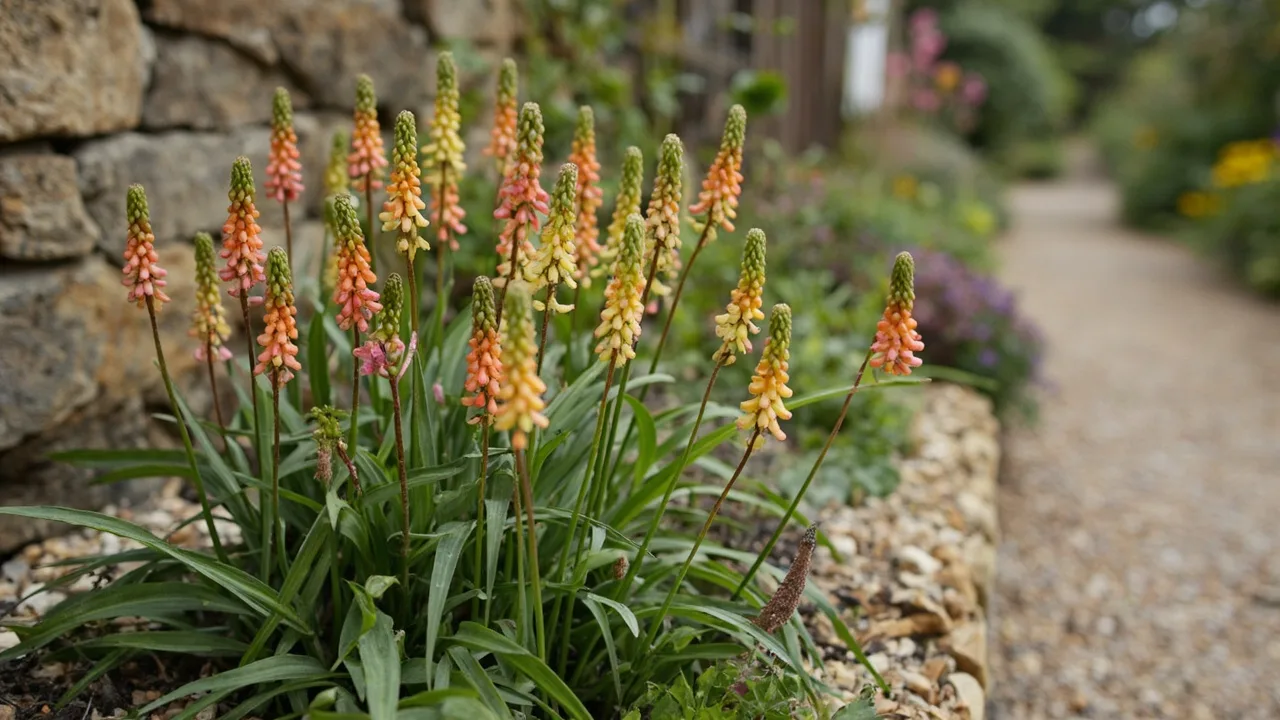
An erect stem carries a loose raceme of pendent, tubular flowers. Their principal colour is commonly carmine-red, orange-red or red, with contrasting green and purple at the tips. The colour change along each tube gives the inflorescence a layered appearance rather than a single flat block of colour. Individual flowers hang outwards or downwards from short stalks, while the raceme remains upright.
The RHS describes the species as reaching about 25 cm, while well-grown plants may approach 30 cm. This compact habit suits pots and places the flowers at a convenient height for viewing on a greenhouse bench. Growth is generally neat rather than spreading, although offsets and bulbils can gradually increase the number of bulbs in a container.
The seasonal sequence begins when growth resumes in late summer or autumn. Leaves develop through autumn, flower stems rise during the cooler months, and the foliage remains important after flowering because it replenishes the bulb. As spring advances, the leaves yellow and die back naturally. Nothing may remain above the compost during summer dormancy, but a healthy bulb persists below the surface ready for the next cycle.
Growing Conditions
Full light is essential for compact leaves and sturdy flower stems. In Britain, a bright greenhouse, alpine house or frost-free conservatory is more suitable than a permanently warm sitting room. Clean greenhouse glass in autumn so that low winter sunlight is not unnecessarily reduced, and avoid placing the pot behind larger plants. Good ventilation helps prevent stagnant conditions without exposing the bulb to frost.
Use a peat-free, loam-based potting compost made sharply free-draining with horticultural grit or another coarse drainage material. A practical mixture is two parts loam-based compost to one part horticultural grit, adjusted if the compost remains wet for too long. The pot must have unobstructed drainage holes. A layer of crocks is not a substitute for an open compost and a free outlet for excess water.
The species occurs naturally in colonies on deep acidic or coastal sands in the Western Cape. Cultivation under glass cannot reproduce that habitat exactly, but it reinforces the need for an airy root environment and rapid drainage. Heavy garden soil, water-retentive multipurpose compost used alone, or a container left standing in a saucer of water can all keep the bulb too wet.
Temperature management should follow the plant's winter-growing habit. Protect it from frost, but do not force it with constant domestic heat. Cool, bright conditions encourage firm growth and can preserve the flower display. Keep the pot away from radiators and heated draughts, which may dry foliage unevenly while leaving the centre of the compost wet.
Water according to visible growth rather than at fixed intervals. Once shoots appear, moisten the compost and then allow its surface to begin drying before watering again. During active growth it should be lightly moist, never saturated. As foliage yellows in late spring, reduce watering progressively. During summer dormancy, keep the bulb substantially dry in its pot and sheltered from heavy rain.
Planting and Care
Pot dormant bulbs in August or September so they can establish as their natural growing season begins. Choose a clean container only slightly larger than the bulb group; an oversized pot holds more wet compost than the roots can use. Set each bulb upright with its top approximately 2-3 cm below the compost surface, firm gently, label the pot and water cautiously. Several bulbs may share a wider container if they are not crowded against one another.
After planting, keep the pot bright, airy and protected. Do not repeatedly soak apparently bare compost while waiting for shoots. When active leaves are present, water moderately from the top and let surplus drain completely. Empty any saucer or cachepot promptly. Irregular neglect followed by flooding is less suitable than modest, consistent watering.
Feed only while the plant is actively growing. A balanced liquid fertiliser at half strength every three to four weeks is sufficient where bulbs remain in the same compost. Stop feeding as the foliage begins to yellow. Excess nitrogen can produce soft leaves and weak stems, so generous feeding is not a shortcut to flowering.
Pruning is unnecessary and should not be entered as a routine calendar event for this bulb. Spent flowers may be removed if seed is not required, but retain the flower stem and every green leaf until they yellow naturally. Premature cutting reduces the leaf area available to recharge the bulb. Once growth is completely dry, remove loose dead material to keep the pot clean.
Seasonal care is straightforward when the change between growth and dormancy is respected. From August or September, repot when necessary and watch for new shoots. From November to February, provide full light, frost-free shelter, ventilation and moderate water. Continue caring for green foliage after flowering. In late spring, taper watering as dieback starts; through summer, store the dry pot in an airy, sheltered place where pests cannot easily enter.
Propagation is most reliable from offsets or bulbils. During summer dormancy, unpot a congested clump, inspect the bulbs and gently separate well-developed offsets with their roots intact. Pot them individually or in small groups in the same free-draining mix. The species can also be raised from seed, although seedlings take several years to reach flowering size and need careful labelling and patient cultivation.
Repot only when drainage has deteriorated, the compost has broken down or bulbs have become crowded. Dormancy is the least disruptive time. Discard soft or decayed material, wash reusable pots and use fresh compost rather than returning healthy bulbs to a contaminated mixture. Container-grown bulbs need not be lifted annually merely to satisfy a calendar routine; remaining dry in their pots is usually simpler and causes less damage.
Common Problems
Bulb mealybug is a particularly serious threat. White, waxy insects or cottony deposits may be hidden around the bulb, leaf bases, roots and pot rim, while an advanced infestation can weaken and ultimately disintegrate the bulb. Quarantine new plants, inspect them before adding them to a collection and isolate suspect pots immediately. Clean tools and staging after handling infested material, and do not propagate from a badly affected bulb.
Bulb rot is usually a cultivation problem rather than an unavoidable disease. Warning signs include failure to emerge, a soft bulb, an unpleasant smell or a collapsing shoot. The common causes are waterlogged compost, blocked drainage and routine watering during summer dormancy. Remove the bulb from its pot, discard rotten tissue or an extensively affected bulb, clean the container and correct the moisture regime before replanting sound material.
Aphids can cluster on tender leaves and flower stems under glass. They distort new growth and leave sticky honeydew. Inspect plants weekly, especially as spikes develop, and remove small colonies by hand or with a gentle jet of water. Better spacing and ventilation make inspection easier and discourage excessively soft growth.
Glasshouse red spider mite may become troublesome in warm, dry, poorly ventilated conditions. Fine mottling, bronzed foliage and delicate webbing are typical clues. Check leaf undersides with a hand lens, separate affected plants and improve growing conditions. Because available controls and label approvals change, consult current RHS advice before choosing a treatment.
Weak, elongated growth and a lack of flowers commonly indicate insufficient light, excessive warmth, too much nitrogen or leaves removed before they finished replenishing the bulb. Move the pot to brighter, cooler protected conditions and review feeding rather than simply adding more fertiliser. Small offsets and seed-raised bulbs may also be too immature to flower.
Persistent abnormal streaking, distortion or decline may indicate a virus, although the species naturally has marked leaves and normal patterning should not be mistaken for disease. Isolate a suspicious plant and avoid taking bulbils or offsets from it. If symptoms recur throughout new growth, disposing of the plant is safer than risking spread through a collection.
Popular Varieties
There are no well-documented named cultivars of Lachenalia bulbifera that can be recommended confidently as distinct, UK-available selections. Stock is generally offered as the species, and natural variation in flower shade or leaf markings should not be turned into an invented cultivar name. Availability from specialist bulb growers may be intermittent, so confirm the botanical name when buying.
Other Lachenalia species are sometimes grown alongside it, but they are alternatives rather than varieties of L. bulbifera. Lachenalia aloides, Lachenalia rubida and Lachenalia viridiflora are separate species and should not be listed as cultivars of this plant. The same distinction matters on nursery labels because different species can vary in appearance and flowering time.
Where several seed-grown forms of L. bulbifera are offered, choose sound, correctly identified bulbs rather than relying on informal colour descriptions. A plant with particularly good flowers may be propagated vegetatively from its bulbils or offsets to preserve that individual form, but it remains unnamed unless it has been formally selected and published under a cultivar name.
Sources & Further Reading
- Royal Horticultural Society: Lachenalia bulbifera, accessed 2026-07-22.
- Royal Botanic Gardens, Kew, Plants of the World Online: Lachenalia bulbifera, accessed 2026-07-22.
- South African National Biodiversity Institute, PlantZAfrica: Lachenalia bulbifera, accessed 2026-07-22.
Pests and Diseases
| Problem | Symptoms | Management |
|---|---|---|
| Bulb rot | The bulb becomes soft, mushy, and may emit a foul odour while foliage yellows and collapses. | Ensure excellent drainage in compost and allow bulbs to dry completely during their dormant period. |
| Powdery mildew | A white, dusty fungal growth appears on leaves and flower stems, often in humid conditions. | Improve air circulation around plants and treat with a suitable fungicide if infection is severe. |
| Vine weevil | Notched edges on leaves indicate adult feeding, while larvae damage roots causing plant decline. | Apply nematodes to the soil in autumn or use a systemic insecticide drench for prevention. |
| Slugs and snails | Irregular holes are chewed into young leaves and emerging flower spikes, often leaving slime trails. | Use slug pellets, beer traps, or hand-pick pests at night to protect tender growth. |
| Overwatering | Leaves turn yellow and translucent while the bulb softens due to waterlogged soil conditions. | Water sparingly during dormancy and ensure pots have adequate drainage holes. |
For step-by-step help, read Dealing with Slugs and Snails and Treating Powdery Mildew. Or browse the full plant problem solver to diagnose an issue by symptom.
Recommended Products
GardenWizz earns a commission from qualifying purchases made through affiliate links on this page (including links within the article) — as an Amazon Associate, and from Thompson & Morgan via the Awin network. This does not affect the price you pay. See our disclaimer for details.