Baum's Pincushion Cactus
Mammillaria baumii
The Gardening Year
Best months in UK gardens · full planting calendar →
🖨 Printable care card (PDF)At a Glance
| Botanical name | Mammillaria baumii |
|---|---|
| Common name(s) | Baum's Pincushion Cactus |
| Family | Cactaceae |
| Plant type | succulent |
| Height × Spread | 0–10 cm × — |
| Position | Full sun, Partial shade |
| Soil | Free-draining cactus compost; loam or sand with good drainage |
| Flowering | May–August |
| Toxicity | — |
| Native range | Mexico |
Overview
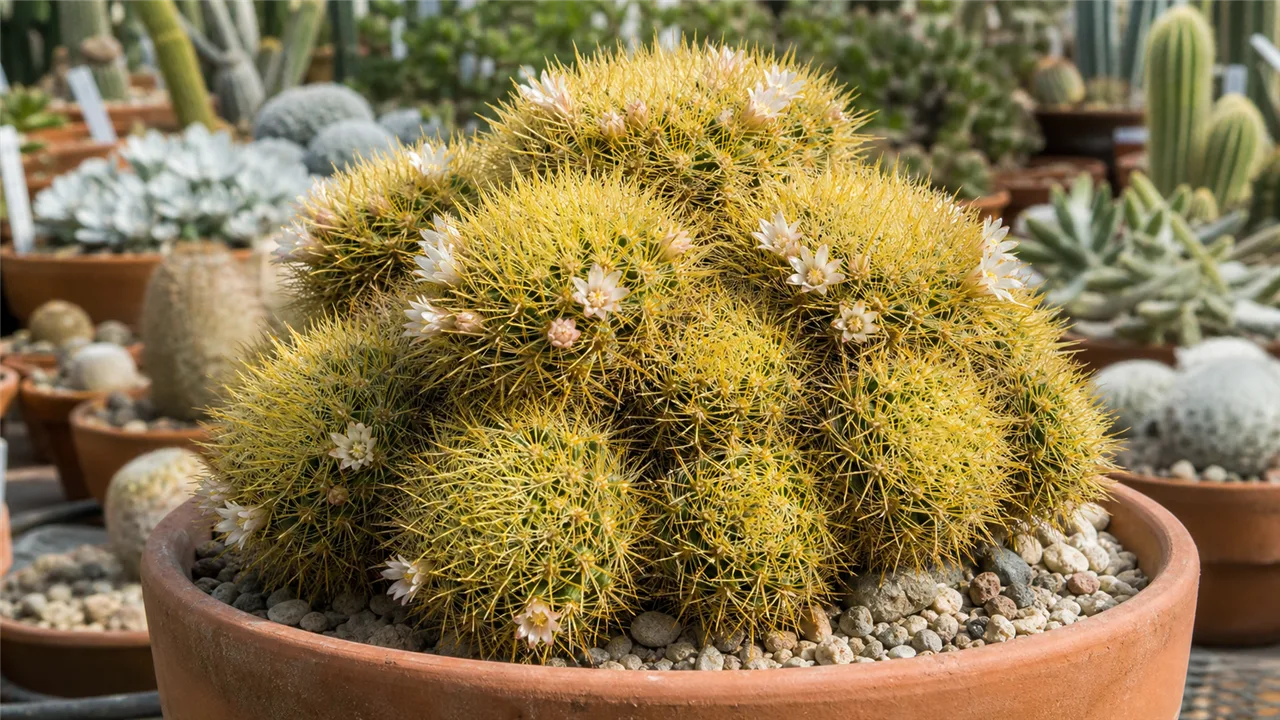
Mammillaria baumii is a small, freely-flowering cactus from the semi-arid hills of northeastern Mexico, where it grows on rocky slopes in the states of Coahuila, Nuevo León and Tamaulipas. It belongs to the genus Mammillaria, the largest group within the family Cactaceae, whose members are recognised by their conical tubercles and rings of small flowers that emerge from the previous year's growth rather than from the tip. Among these, M. baumii is prized by collectors for its neat globular form, its soft pale spines and its unusually generous display of bright yellow flowers relative to its size.
In UK cultivation it is treated as a tender indoor or conservatory plant. It tolerates the dry atmosphere of centrally heated rooms far better than most houseplants, asks for very little attention through the year, and rewards correct watering in spring and summer with a ring of flowers that can almost cover the crown of the plant. It is well suited to a sunny windowsill, a frost-free greenhouse, or a sheltered courtyard during the warmer months.
Appearance
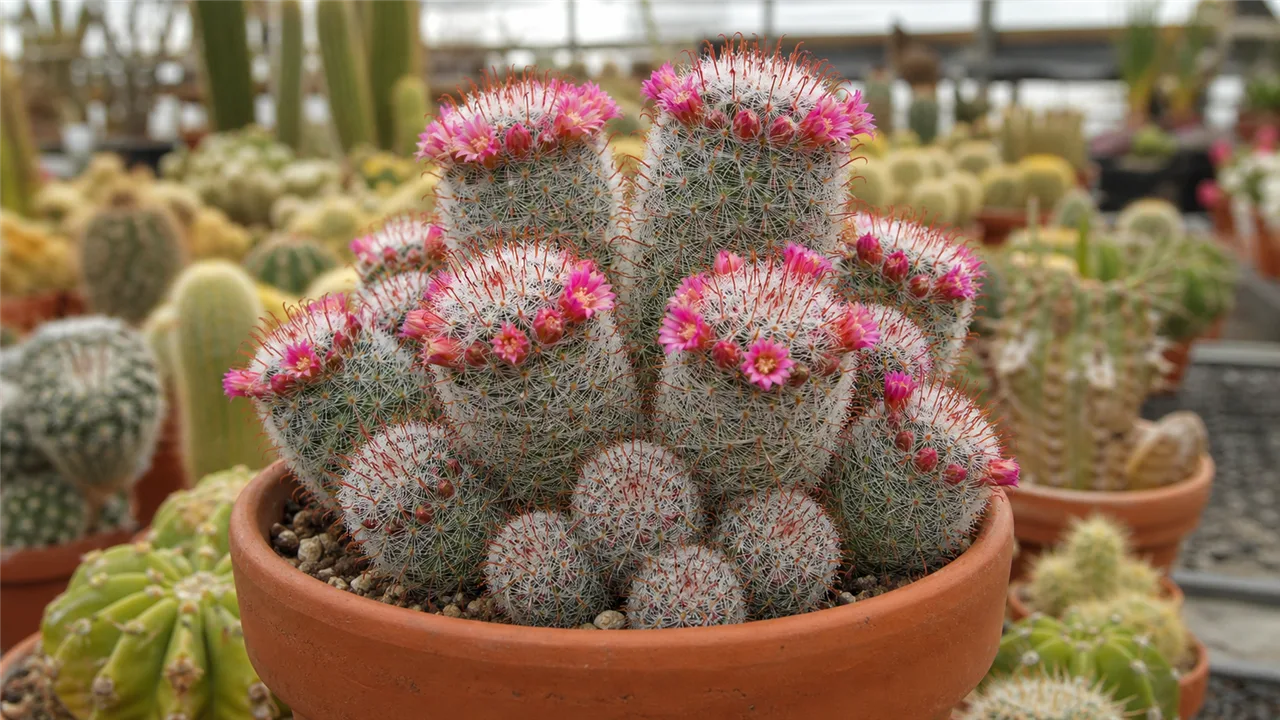
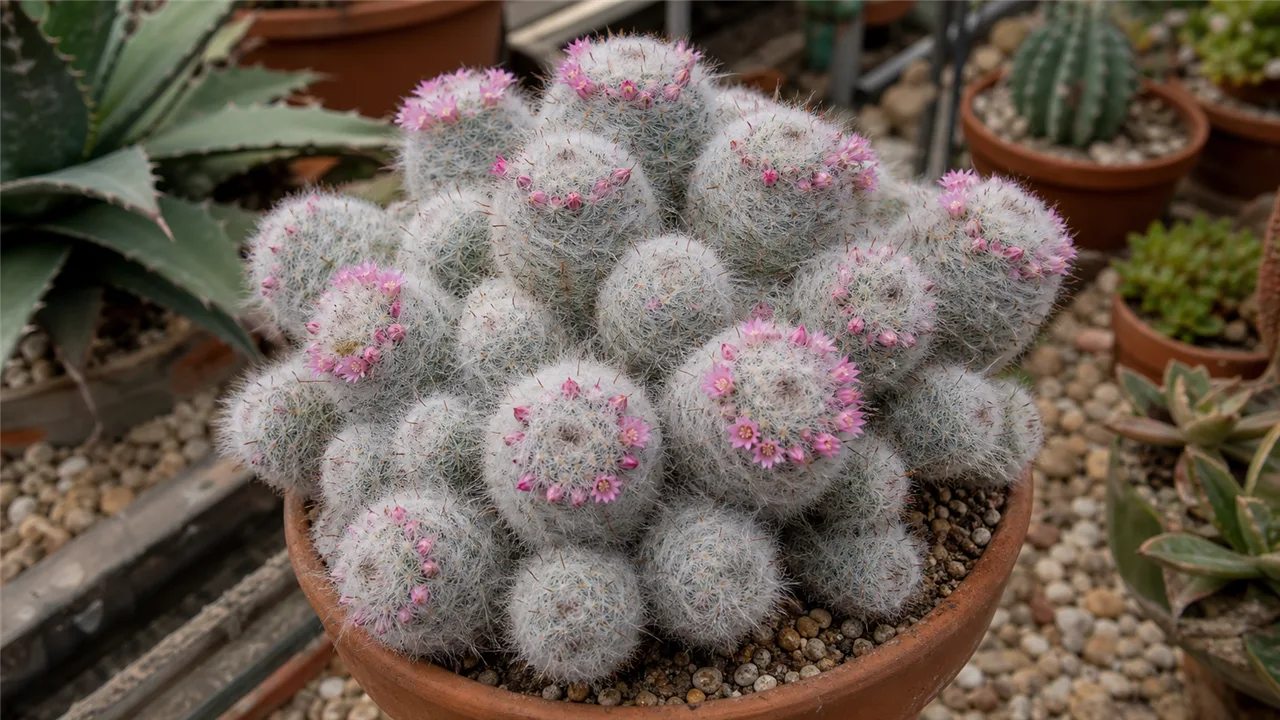
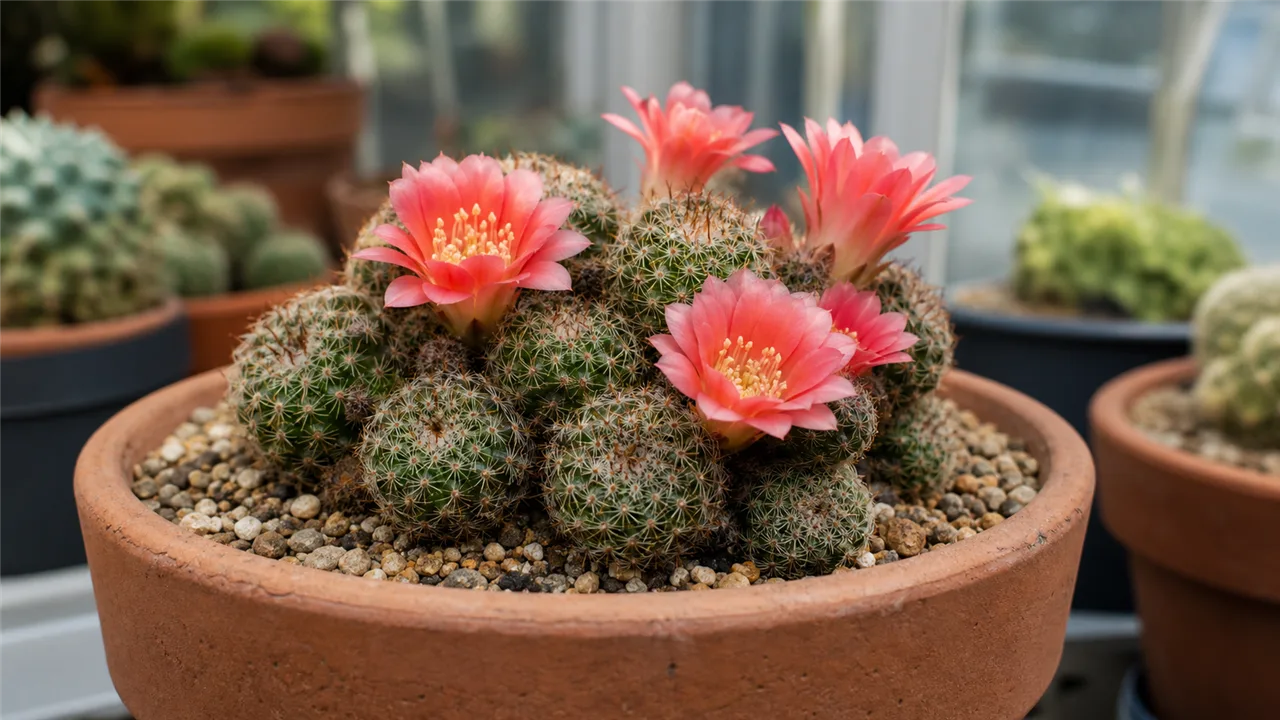
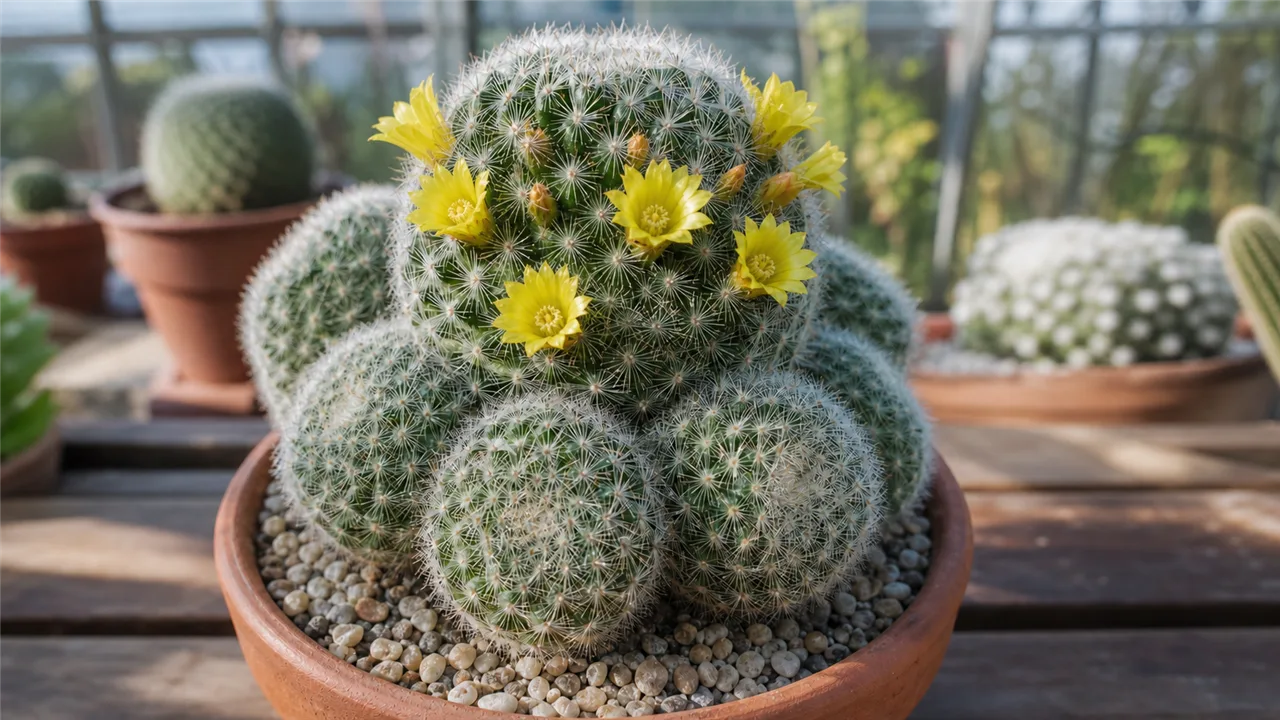
Mammillaria baumii forms a solitary or slowly clustering stem that is globular when young and becomes slightly elongated with age. Mature stems typically reach 4–7 cm in diameter and around 5–10 cm in height. The surface is dark green and densely covered with short, conical tubercles arranged in spirals, each tipped with a small areole. The axils between the tubercles carry a fine white wool, which is most visible near the growing tip.
Each areole produces two distinct sets of spines. The central spines number one or two and are short, straight and sturdy, often dark-tipped. The radial spines are more numerous — usually between eight and fifteen per areole — slender, spreading and soft to the touch, and coloured creamy white to pale yellow. The overall effect is of a softly haloed globe rather than the aggressively armed silhouette of many cacti.
Flowers appear in late spring and summer, opening in a ring around the crown of the stem just below the growing point. Each flower is funnel-shaped, approximately 1.5–2 cm across, with a short tube covered in wool and bristles, and ranges in colour from pale lemon-yellow to a clear bright yellow. Healthy, well-grown plants can produce successive flushes over several weeks, and the flowers are followed by small, smooth, club-shaped fruits that ripen to a pinkish or dull red and contain dark seeds.
Growing Conditions
Light is the single most important factor. Mammillaria baumii wants as much sun as it can be given without scorching — a south- or west-facing windowsill is ideal, and an unheated greenhouse or conservatory in full sun is even better. Insufficient light leads to weak, elongated growth and a failure to flower. Where light is limited indoors, plants can be moved outside onto a bright patio from late May through early September, hardening them off gradually to avoid sunburn on tissue that has been grown under glass.
Temperature through the growing season should sit between roughly 18 °C and 30 °C. In winter the plant benefits from a genuine rest: a bright, cool position where temperatures stay around 8–12 °C suits it well. Warm, dark corners in heated rooms during winter cause weak, drawn growth and predispose plants to rot. The plant will not tolerate frost and must be brought under cover well before the first cold nights of autumn.
Watering follows the seasons strictly. From spring through early autumn, water thoroughly only when the compost has dried out completely, then allow it to dry again before the next drink. In winter, watering is reduced to a bare minimum — a light drink once every six to eight weeks is usually enough to stop the stem from shrivelling. Humidity should be kept low and the air around the plant well ventilated; stagnant, damp air is a route to fungal problems.
The compost should be sharply draining. A 50:50 mix of a loam-based cactus and succulent compost (such as a John Innes-based formulation) with horticultural grit, coarse sand or perlite works well. Standard multi-purpose peat composts hold too much moisture and should be avoided, even when labelled for cacti.
Planting and Care
Pot choice matters. Unglazed terracotta is preferable to plastic because it allows the compost to dry more evenly and lets the root zone breathe. The container must have one or more generous drainage holes, and the plant should sit at the same depth it occupied previously — burying the stem below the soil line invites rot. A top dressing of coarse grit over the compost surface keeps the neck of the plant dry and gives a tidy finish.
Repotting is needed only when the stem has filled the pot or roots are appearing from the drainage holes. This is typically every two to four years, ideally carried out in spring just as new growth begins. Fresh spined plants are awkward to handle; folded newspaper, a strip of stiff card, or purpose-made cactus tongs all make the job safer. After repotting, withhold water for a week or so to let any damaged roots heal.
Feeding should be light. A low-nitrogen liquid cactus fertiliser, applied at half the manufacturer's recommended strength once a month from spring through to early autumn, is ample. Feeding in late autumn or winter encourages soft, weak growth that will not survive cooler conditions.
Pruning is not required. Old flower stems wither away on their own, and the spines and tubercles should be left undisturbed. Any dead or damaged tissue can be teased away with tweezers once it has dried.
Propagation is straightforward from offsets, which older plants produce around the base. In spring or early summer, a cluster can be detached cleanly with a sharp sterile knife, the cut surface left to callous in a dry, shaded spot for several days, and the offset then potted up into dry gritty compost. Water sparingly until roots have formed — usually within four to six weeks. Seed propagation is also possible but slow; surface-sow fresh seed on a damp gritty mix, cover with a thin layer of grit, and keep at around 21 °C under bright light.
Seasonal care in the UK follows a simple rhythm. From late spring into early autumn, water normally, feed monthly and give as much sun as possible. Move plants outside once night temperatures are reliably above 10 °C, and bring them back in well before the first frost. Over winter, keep the plant cool, dry and bright; resume normal watering only when new growth is seen in spring.
Common Problems
Overwatering is by far the most common cause of loss and the cause of most of the other problems below. Symptoms include a soft, discoloured or translucent patch at the base of the stem, a sudden lean, or a stem that feels spongy when gently squeezed. When in doubt, do not water: the plant will tolerate drought far better than it will tolerate wet feet.
Rot, once it takes hold at the root collar or base, can move quickly through the tissue. If caught early, the plant can sometimes be saved by lifting it, cutting away all soft or discoloured tissue back to clean firm flesh with a sterile blade, dusting the cut surface with a little sulphur or charcoal, and leaving the cutting to callous in a dry shaded spot for one to two weeks before repotting in dry compost. Water should then be withheld until new roots have formed.
Mealybugs are the most frequent pest. They appear as small, cottony white flecks tucked into the axils between tubercles and around the base of the stem, sometimes also colonising the roots underground. Light surface infestations can be removed with a cotton bud dipped in diluted isopropyl alcohol; heavier infestations respond to a systemic insecticide labelled for ornamental cacti. Scale insects are seen occasionally and respond to the same treatment.
Etiolation, or stretching, happens when light is insufficient. The stem elongates unnaturally, loses its compact globular shape, and the new growth is pale and weak. Move the plant to a brighter position gradually over a week or two to avoid sunburn, and accept that etiolated growth will not shrink back — new, compact growth will eventually replace it if conditions improve.
Shrivelling during the growing season is less common but can indicate root loss, an underwatered rootball, or a pest problem at the roots. Lift the plant and inspect; healthy roots are white to pale tan and firm, while dead roots are brown and papery.
Popular Varieties
True cultivars of Mammillaria baumii are scarce in general cultivation, and most plants offered for sale in the UK are raised from seed without a clonal name. Where variant names do appear, they refer to forms selected for heavier spine coverage, more pronounced wool at the crown, or particularly free-flowering habit. The following are the forms most often encountered; growers should expect some variation between seed-raised batches.
Mammillaria baumii 'Aylostera' form — an old trade name still seen on some European nursery lists, referring to plants with particularly dense white wool at the growing tip and an unusually compact, flattened-globe shape.
Mammillaria baumii 'Yellow-spined' form — informal name used by collectors for seed strains in which the radial spines develop a noticeably warm, butter-yellow tint rather than the more typical creamy white.
Mammillaria baumii 'Longispina' — a designation sometimes applied to plants with longer-than-average central spines; less compact in outline but prized for the contrast between dark central spines and pale radials.
Mammillaria baumii 'Cristata' — a rare crest form in which the growing point fans out into a wavy, ribbon-like shape. These plants are slow-growing, typically grafted onto a sturdy rootstock, and treated as specialist collector specimens rather than houseplants.
It is worth noting that many plants sold as M. baumii in the UK trade are seed-raised and therefore variable, and a small number may be hybrids with closely related species such as Mammillaria candida or Mammillaria elongata. Where a specific cultivar name is offered, buy from a reputable specialist nursery that can vouch for the parentage.
Pests and Diseases
| Problem | Symptoms | Management |
|---|---|---|
| Root rot | The plant becomes soft, mushy, and discoloured at the base. | Ensure well-draining compost and allow the soil to dry out completely between waterings. |
| Mealybugs | White, cottony fluff appears in stem joints and around the base of spines. | Isolate the plant and treat with a systemic insecticide or wipe off with alcohol-dampened cotton buds. |
| Scale insects | Small, immobile, brown or white bumps adhere to the stems. | Remove manually with a soft brush or apply a suitable horticultural oil spray. |
| Sunburn | Patches of bleached, yellow, or brown tissue on the upper surface exposed to light. | Gradually acclimatise the plant to brighter conditions and avoid direct midday sun in summer. |
| Vine weevil | Notches appear on leaf margins (if present) and roots are chewed, causing wilting. | Use nematode treatments in the soil during warm months or apply a systemic insecticide. |
Or browse the full plant problem solver to diagnose an issue by symptom.
Recommended Products
GardenWizz earns a commission from qualifying purchases made through affiliate links on this page (including links within the article) — as an Amazon Associate, and from Thompson & Morgan via the Awin network. This does not affect the price you pay. See our disclaimer for details.