Silken Pincushion Cactus
Mammillaria bombycina
The Gardening Year
Best months in UK gardens · full planting calendar →
🖨 Printable care card (PDF)At a Glance
| Botanical name | Mammillaria bombycina |
|---|---|
| Common name(s) | Silken Pincushion Cactus |
| Family | Cactaceae |
| Plant type | succulent |
| Height × Spread | 10–80 cm × 10–50 cm |
| Position | Full sun |
| Soil | standard cactus compost |
| Flowering | March–August |
| Toxicity | — |
| Native range | Jalisco and Aguascalientes states, in western central Mexico |
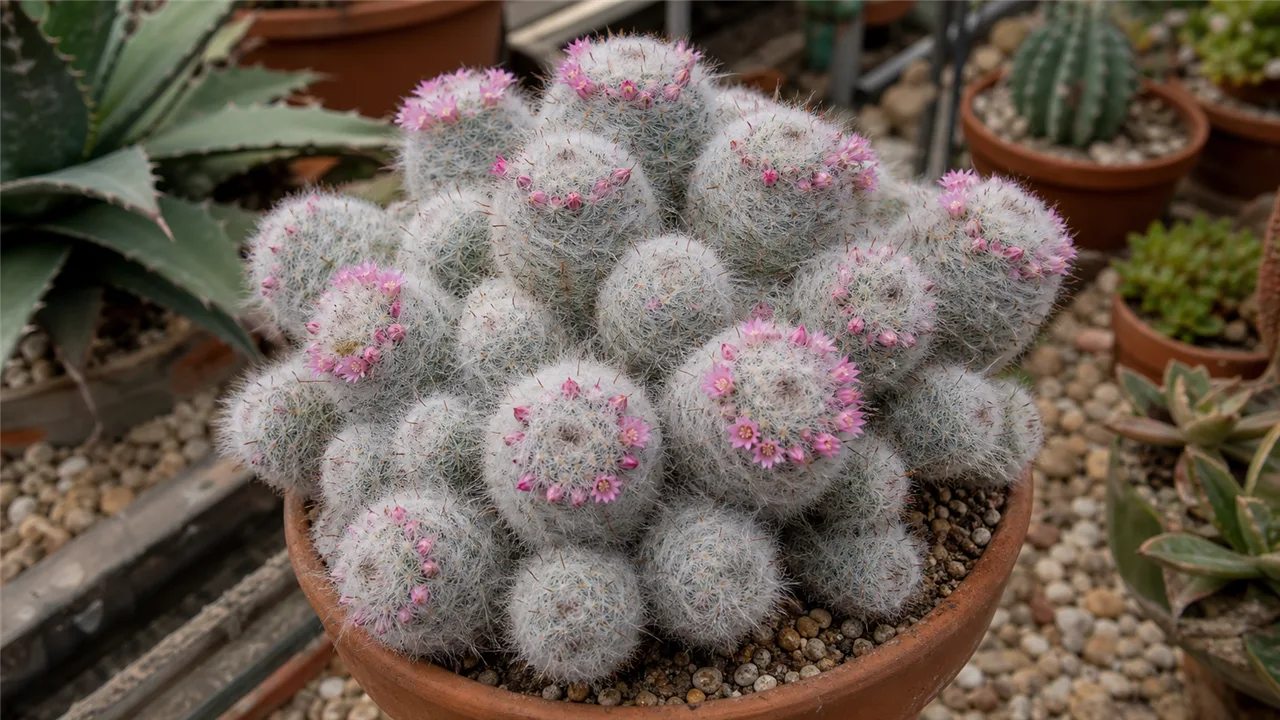
A compact, silk-spined globular cactus from central Mexico, Mammillaria bombycina is one of the most recognisable members of its genus. Its dense covering of fine, white, hair-like radial spines gives the stem a soft, cobwebby appearance that contrasts with the warmer reddish-brown central spines beneath, and a neat crown of pink to magenta flowers in late spring completes the display. It is well within the scope of a UK indoor or under-glass collection, where it can be relied upon to flower reliably given a sunny position and a strict winter rest.
Overview
Mammillaria bombycina belongs to the family Cactaceae and is one of around 200 accepted species in Mammillaria. It is native to the semi-arid uplands of central Mexico, where it grows on rocky, free-draining slopes. In the wild it tends to be solitary or slowly clustering, and it has a deserved reputation as one of the more ornamental small cacti, prized for both its spination and its willingness to flower in cultivation.
In the UK the plant is treated firmly as a glasshouse or indoor subject. It must be kept under glass through a British winter, and most growers keep it on a sunny windowsill, in a frost-free conservatory, or on a greenhouse bench. Given bright light, lean watering, and a cool, dry winter rest, it is straightforward to grow and flowers annually once it reaches flowering size, typically within three to five years from seed.
The species sits comfortably alongside other small globular cacti in a mixed collection, tolerates the occasional cold night provided the compost is bone-dry, and responds to the standard cactus cultivation cycle used across British hobby collections. It is widely available from UK mail-order succulent specialists and from specialist cactus nurseries, both as seed-grown plants and as larger flowering-size specimens.
Appearance
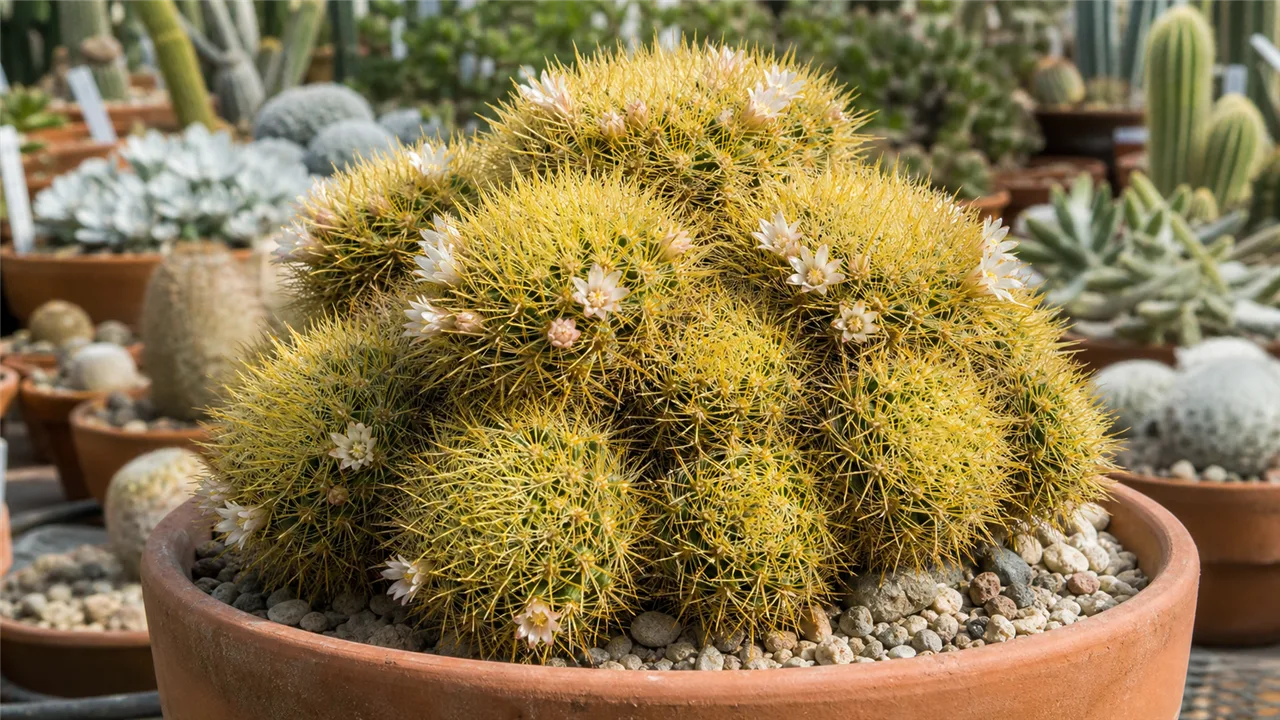
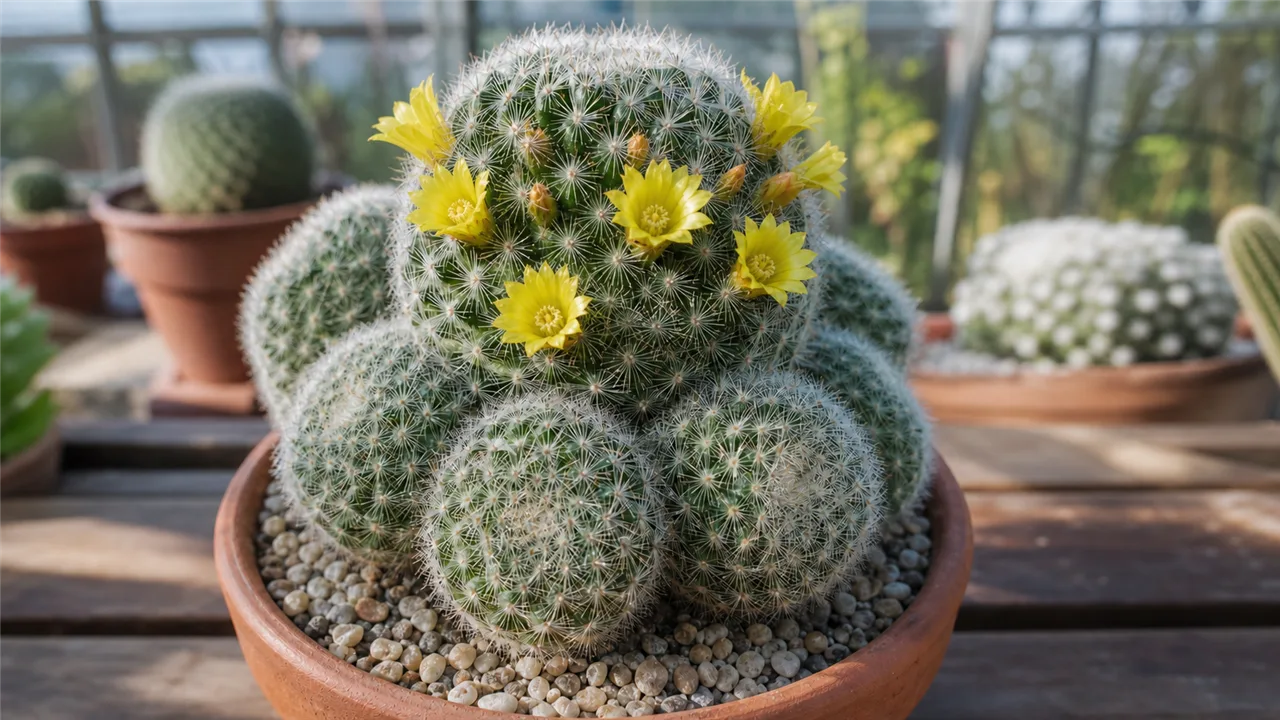
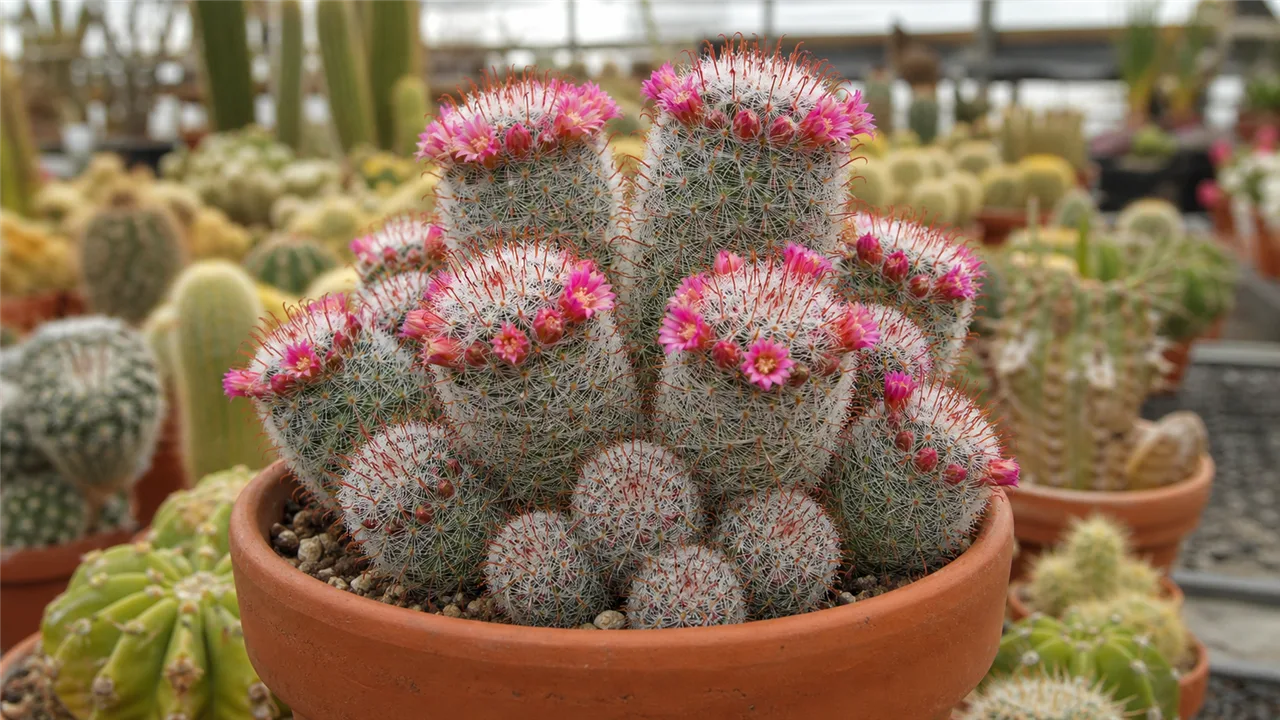
Mammillaria bombycina develops a squat, globular to short-columnar stem reaching roughly 6–15 cm across and up to 20 cm tall at maturity. The stem is bright green when well grown, and its surface is covered in spirally arranged tubercles — the nipple-like projections that give Mammillaria its name. Each tubercle is tipped by an areole from which the spines emerge.
The spination is the main ornamental feature. Each areole produces a dense cluster of 20–30 or more fine radial spines that are white and hair-like, lying against the surface of the stem and partly obscuring it. This soft white veil is the source of the common names "silk pincushion" and "silk spinemammillaria". Beneath the radials, the areole also bears a small number of central spines — usually four — that are stiffer, reddish-brown to yellowish, and may be straight or hooked. The contrast between the white radial halo and the warmer central spines is one of the diagnostic features of the species.
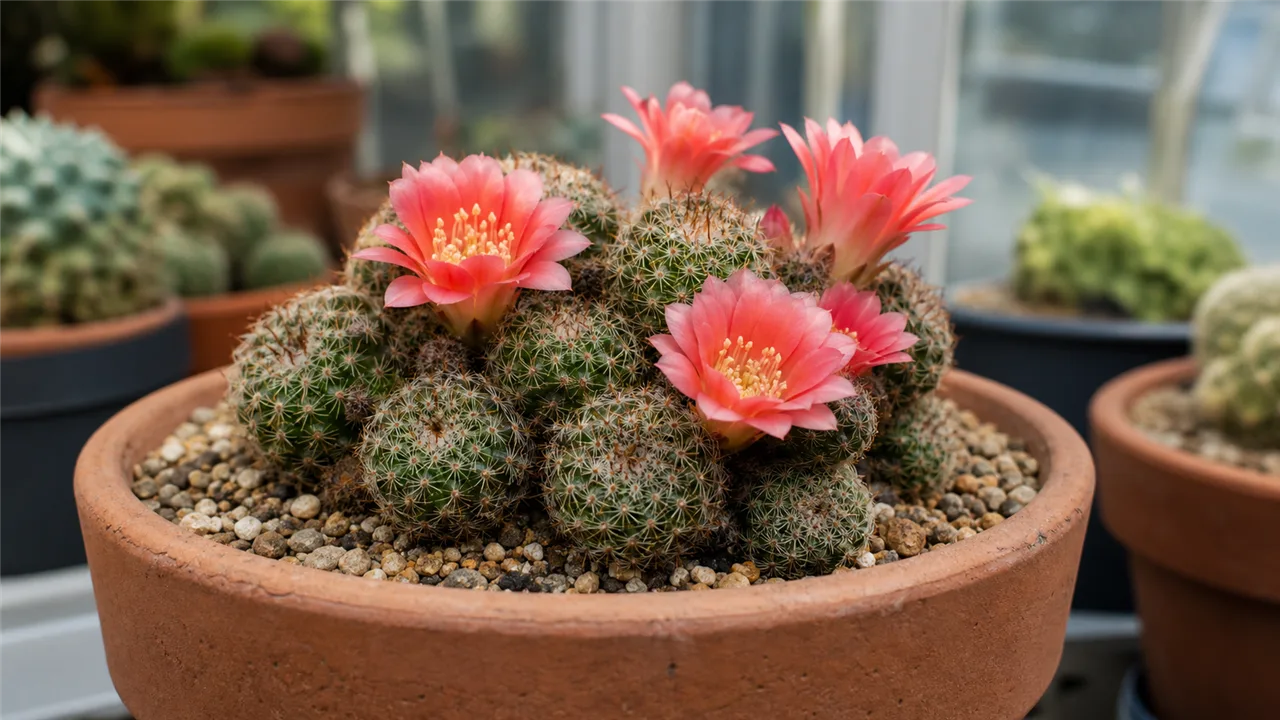
Flowers appear in spring and early summer, after a full, cool, dry winter rest. They are funnel-shaped, around 15–20 mm across, and range from pale pink to deep magenta, often with a darker mid-stripe on each petal. They emerge in a ring around the crown of the stem. After pollination, small club-shaped reddish fruits develop along the crown.
The root system is typically a single stout taproot with limited lateral spread, which has practical implications for pot choice — see Planting and Care below.
Growing Conditions
Light. Mammillaria bombycina wants the brightest position available. A south- or east-facing windowsill, a sunny conservatory, or a ventilated greenhouse bench is ideal in the UK. Plants grown in poor light stretch, lose their compact form, and flower poorly or not at all.
Temperature. During the growing season, normal indoor temperatures of 18–27 °C are fine; the plant benefits from being moved outdoors once nights stay above about 10 °C. In winter it must be kept dry and cool, ideally around 5–10 °C, and never exposed to frost.
Soil and drainage. Use a very free-draining cactus compost — roughly two parts loam-based compost to one part sharp sand and one part perlite or pumice. Drainage is the single most important factor in keeping the plant alive through a British winter.
Water. Apply the soak-and-dry method. Water thoroughly, then let the compost dry almost completely before watering again. During active growth in spring and summer, water roughly every ten to fourteen days depending on pot size and temperature. In autumn reduce sharply; in winter withhold water almost entirely — a light monthly splash is the most a rested plant should receive.
Feeding. A low-nitrogen, potassium-rich cactus fertiliser at half strength once a month during the growing season is sufficient. Do not feed during the winter rest.
Planting and Care
Pot choice. Use a shallow terracotta pot that fits the taproot. Terracotta is preferable to plastic because it allows the compost to dry more evenly and helps prevent the damp conditions that lead to rot. Ensure the pot has generous drainage holes.
Repotting. Repot every two to three years in spring, just as new growth begins. Tease away old compost, inspect for mealybugs or rot, and replant into fresh gritty mix. Hold off watering for about a week so damaged roots can callus over.
Summer placement. From late May to early September the plant can go outdoors to a sheltered south- or west-facing spot. A cold frame with the lid open, or a sunny patio corner, works well. Bring it back under glass before nights turn cold in autumn.
Winter rest. The cool, dry winter rest is not optional — it triggers reliable flowering the following spring. Keep the plant in a bright, cool, frost-free place and withhold water almost entirely. A heated greenhouse set to a minimum of about 5 °C, or a bright unheated porch in milder parts of the UK, is appropriate.
Propagation. Most reliably raised from seed, which produces typical, even-sized plants. Offsets form only slowly; where a cluster develops, individual heads can be detached, callused for a few days, and rooted in a dry gritty mix. Do not water cuttings until roots have formed.
Routine checks. At every repotting, inspect the stem crevices and the root collar for mealybugs, which favour the spaces between tubercles. Brush loose debris from the crown so water does not sit against the stem.
Common Problems
Overwatering and rot. The single most common cause of loss. Symptoms include a soft, discoloured patch at the base or side of the stem, and a plant that suddenly collapses. Prevention is far easier than cure: keep the compost gritty, water only when dry, and keep the plant dry in winter.
Mealybugs. Small, white, cottony insects that hide between tubercles and at the roots. Dab individual insects with a cotton bud dipped in methylated spirit, or apply a systemic insecticide suitable for cacti. At repotting, wash the roots to dislodge root mealybugs.
Scale insects. Occasionally colonise stems as small brown or grey raised discs. Remove manually with a soft brush or a methylated-spirit-dipped bud, and improve airflow around the plant.
Fungal rot. Usually appears as blackened tissue where the stem meets the compost, in damp, still air. Improve ventilation, cut back to healthy green tissue with a sterile blade, dust the cut with sulphur, and let the wound dry before resuming watering.
Sun scorch. Pale or tan patches on the side facing the sun, typically after a sudden move from shade to full sun. Harden plants off gradually when moving outdoors in late spring.
Etiolation. Stems elongate, lose their compact form, and become pale green when light is insufficient. The damage cannot be reversed, but the plant can be grown on in brighter light and the etiolated head eventually removed and re-rooted if desired.
Popular Varieties
Mammillaria bombycina is encountered in cultivation primarily as the type species, and the supply of formally named, vegetatively distinct cultivars is limited. Rather than rely on cultivar names that may not be consistently applied in trade, most British growers select plants on spine colour, spine density, and body form.
Plants sold simply as Mammillaria bombycina typically show the classic dense white radial halo with reddish-brown central spines, and these are the most widely available. Specimens marketed with descriptive phrases such as "long-spined form" or "dense white form" refer to intraspecific variation in spine length and density rather than to registered cultivar names, and are worth seeking out if a particular look is preferred.
Older reference works may list the plant under broader circumscriptions that include closely related but now-distinct taxa. When sourcing, buy from a reputable specialist who can confirm provenance, and expect the species as currently accepted to be a tight, globular, white-spined plant with a magenta spring flower.
For collectors wishing to broaden a display, companion plants within the genus — such as Mammillaria bocasana, Mammillaria hahniana, and Mammillaria plumosa — share a similar cultivation regime and offer a useful comparison of spine form and flower colour.
Pests and Diseases
| Problem | Symptoms | Management |
|---|---|---|
| Mealybugs | White, cottony masses appear in crevices and around the base of the plant. | Isolate the plant and treat with a systemic insecticide or dab spots with alcohol-soaked cotton. |
| Root rot | The stem becomes soft, discoloured, and mushy, often starting at the base. | Ensure well-draining compost and allow the soil to dry out completely between waterings. |
| Vine weevil | Notches on leaf margins (if present) or sudden collapse due to root damage by grubs. | Check roots when potting and use a systemic insecticide if infestation is suspected. |
| Scale insects | Small, immobile, brown or white bumps attached to the stem surface. | Scrape off visible scales and apply an appropriate horticultural oil or insecticide. |
| Sunburn | Bleached, yellow, or brown patches on the side of the plant facing direct light. | Acclimatise gradually to bright light and avoid sudden exposure to intense midday sun. |
Or browse the full plant problem solver to diagnose an issue by symptom.
Recommended Products
GardenWizz earns a commission from qualifying purchases made through affiliate links on this page (including links within the article) — as an Amazon Associate, and from Thompson & Morgan via the Awin network. This does not affect the price you pay. See our disclaimer for details.