Powderpuff Cactus
Mammillaria bocasana
The Gardening Year
Best months in UK gardens · full planting calendar →
🖨 Printable care card (PDF)At a Glance
| Botanical name | Mammillaria bocasana |
|---|---|
| Common name(s) | Powderpuff Cactus |
| Family | Cactaceae |
| Plant type | succulent |
| Height × Spread | 10 cm × 0–10 cm |
| Position | Full sun |
| Soil | standard cactus compost |
| Flowering | March–August |
| Toxicity | — |
| Native range | Northern central Mexico |
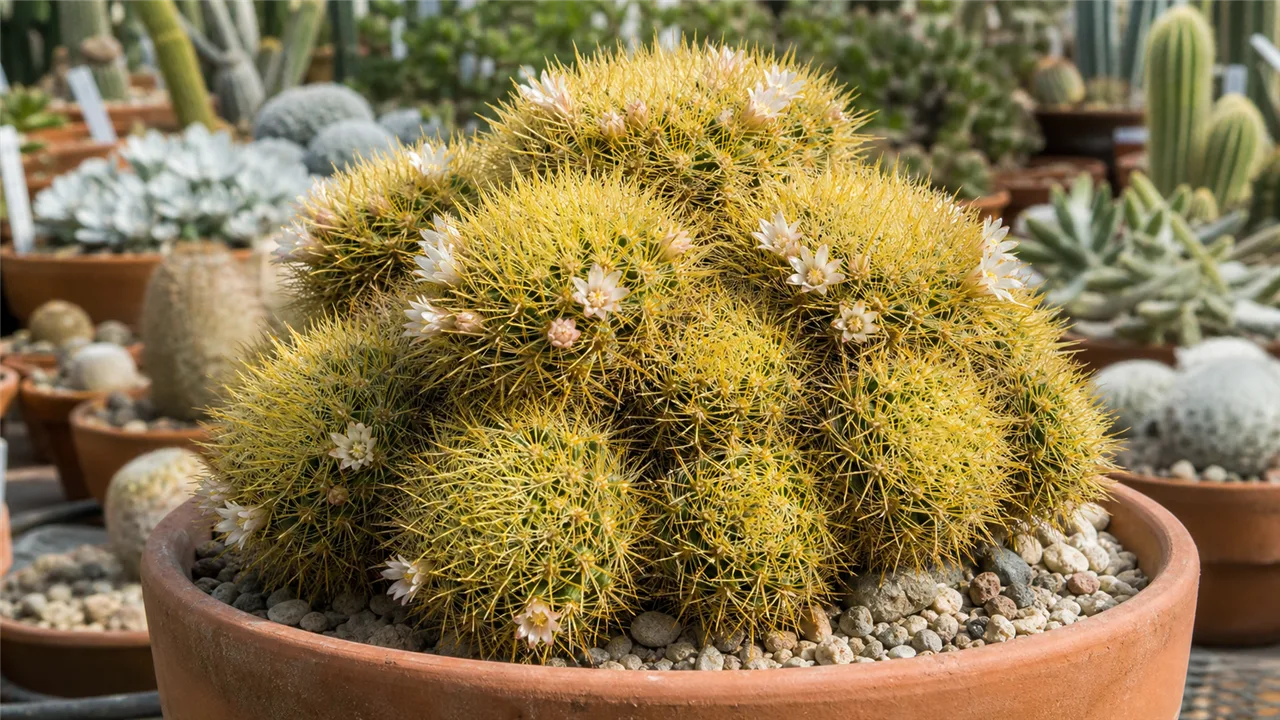
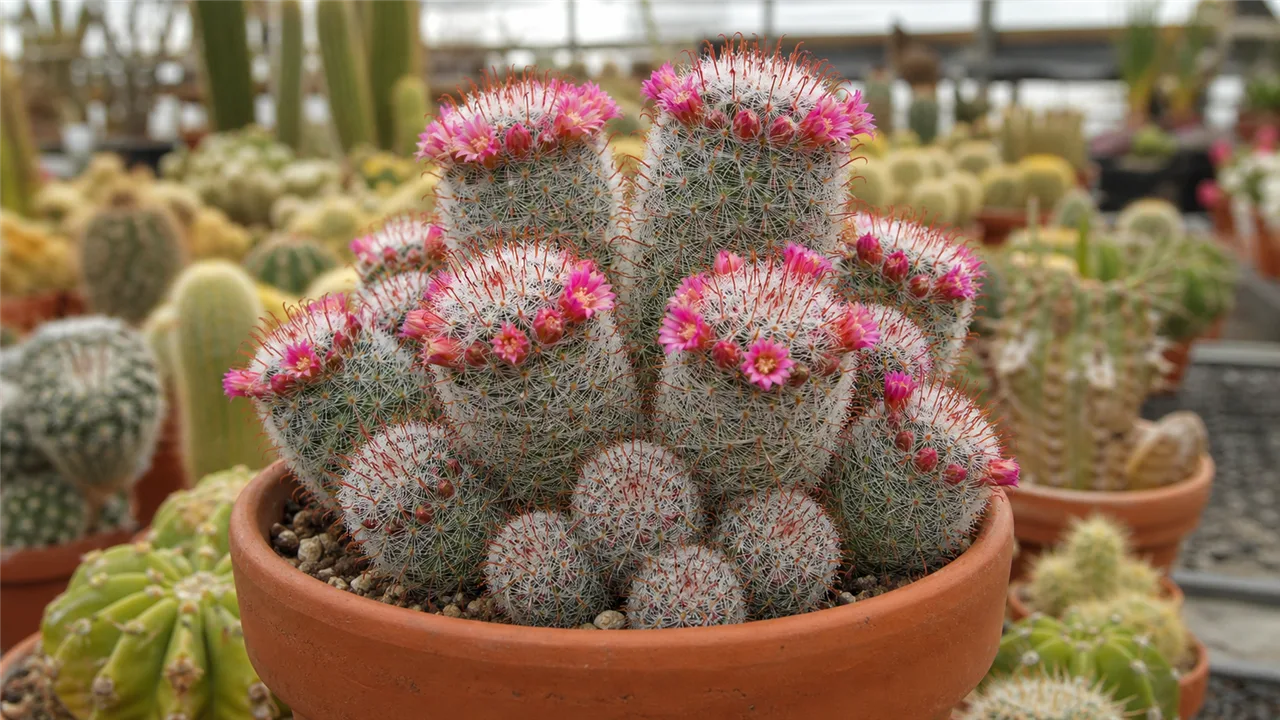
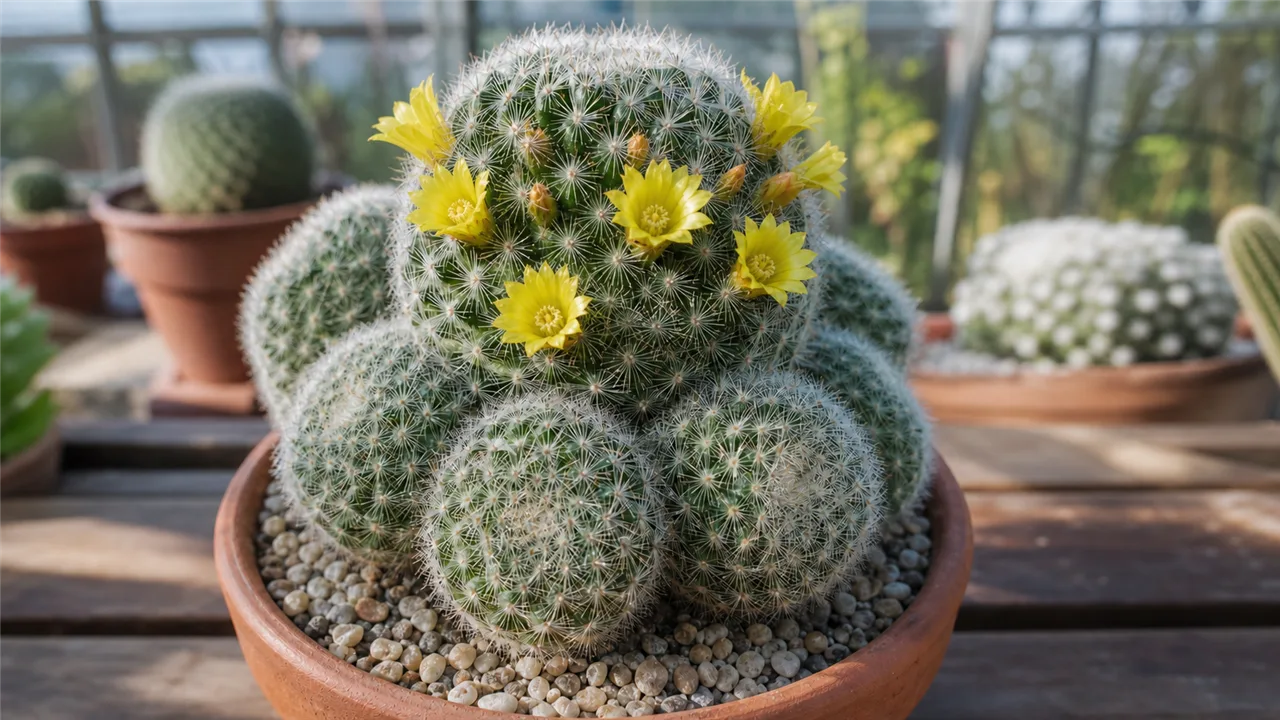
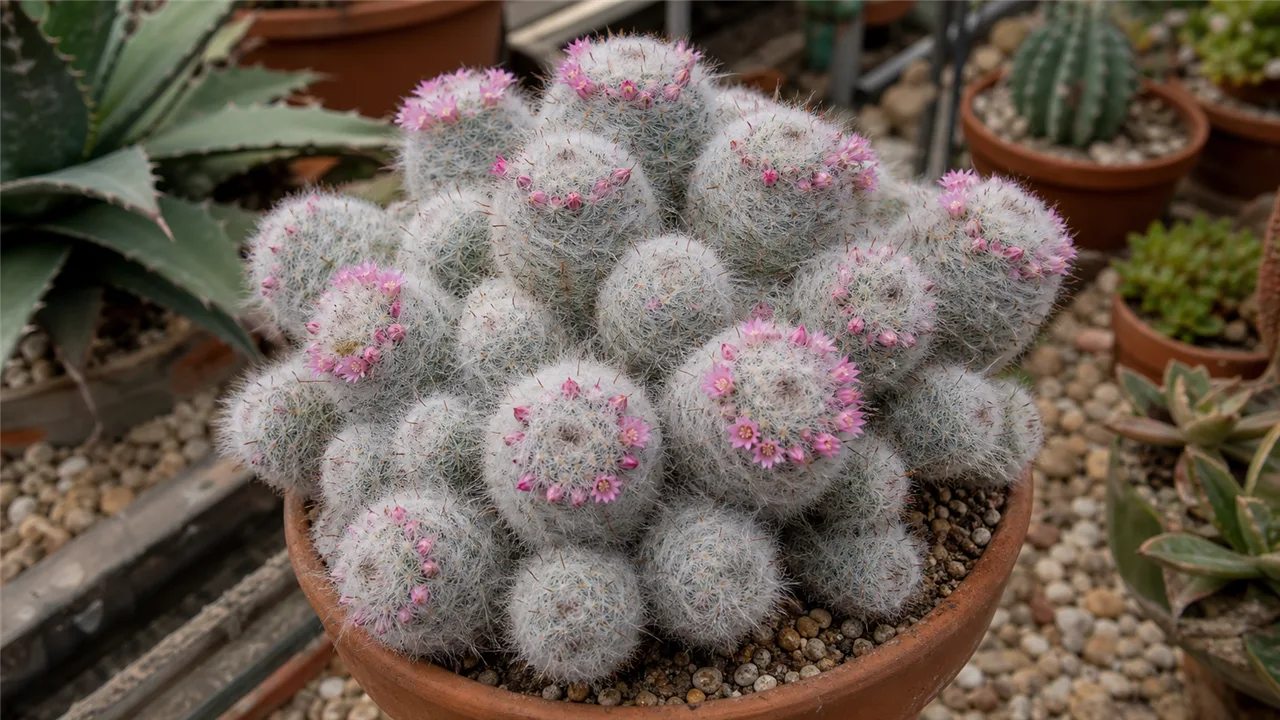
Powder-puff cactus (Mammillaria bocasana) is one of the most recognisable small globular cacti, instantly identifiable by the dense white bristly spines that envelop each stem and the soft hooked centrals that give it the colloquial name "fish-hook cactus". Native to a small area of central Mexico, it has been in cultivation since the mid-nineteenth century and remains a staple of cactus collections because of its forgiving nature, willingness to offset freely and its reliable ring of small flowers produced in good conditions. In the United Kingdom it is grown almost exclusively as a tender indoor plant, though it can spend summer outdoors in a sunny sheltered spot.
Overview
Mammillaria bocasana belongs to the large genus Mammillaria, one of the most species-rich groups in the cactus family, characterised by nipple-shaped tubercles rather than the ribs seen on many other cacti. The species was described in 1853 by the German botanist Heinrich Poselger from material collected near Real de Catorce in the Mexican state of San Luis Potosí. Its natural range is restricted to a few semi-arid mountain localities in central Mexico, where it grows on rocky limestone slopes at elevations of roughly 1,500–2,500 m, often tucked into crevices or under low scrub.
In habitat the plant forms low spreading mounds of small globes, each stem densely clothed in white radial spines that reflect intense sunlight and reduce water loss. Its thick tap root stores moisture through the long dry season, and the woolly spine covering gives the stems a notably soft appearance — hence the "powder-puff" and "snowball" common names — though closer inspection reveals the hooked central spines that catch in skin or clothing. The species was introduced to European collections in the mid-1800s and has remained continuously popular, appearing in almost every cactus reference book since the late nineteenth century.
In British cultivation it behaves as a tender perennial. It tolerates the dry indoor air of centrally heated homes better than many cacti, and it can be brought into flower reliably given a cool dry winter rest. A specimen grown for five to ten years will form an attractive multi-headed clump and can produce offsets freely enough to share with friends or to pot up as spares.
Appearance
Mammillaria bocasana develops as a single rounded stem at first, typically reaching 6–8 cm across and 5–8 cm tall after two or three years. Mature flowering plants then begin to produce offsets from the base and sides, gradually forming a low clump that can spread to 15–30 cm across after many seasons. Each head is built from spirally arranged conical tubercles rather than vertical ribs — a defining feature of the genus — and each tubercle carries a tuft of fine, hair-like white radial spines, usually 25–50 per areole, that completely obscure the green stem beneath.
Interspersed among the radials are one to three longer central spines, pale yellow to reddish brown, with the lowermost central distinctly hooked at the tip. It is this hook that gives the plant its third common name, "fish-hook cactus". The hook is sharp enough to catch in fabric and can be uncomfortable to handle, so specimens are best moved with a folded newspaper sleeve, a pair of kitchen tongs or thick leather gloves.
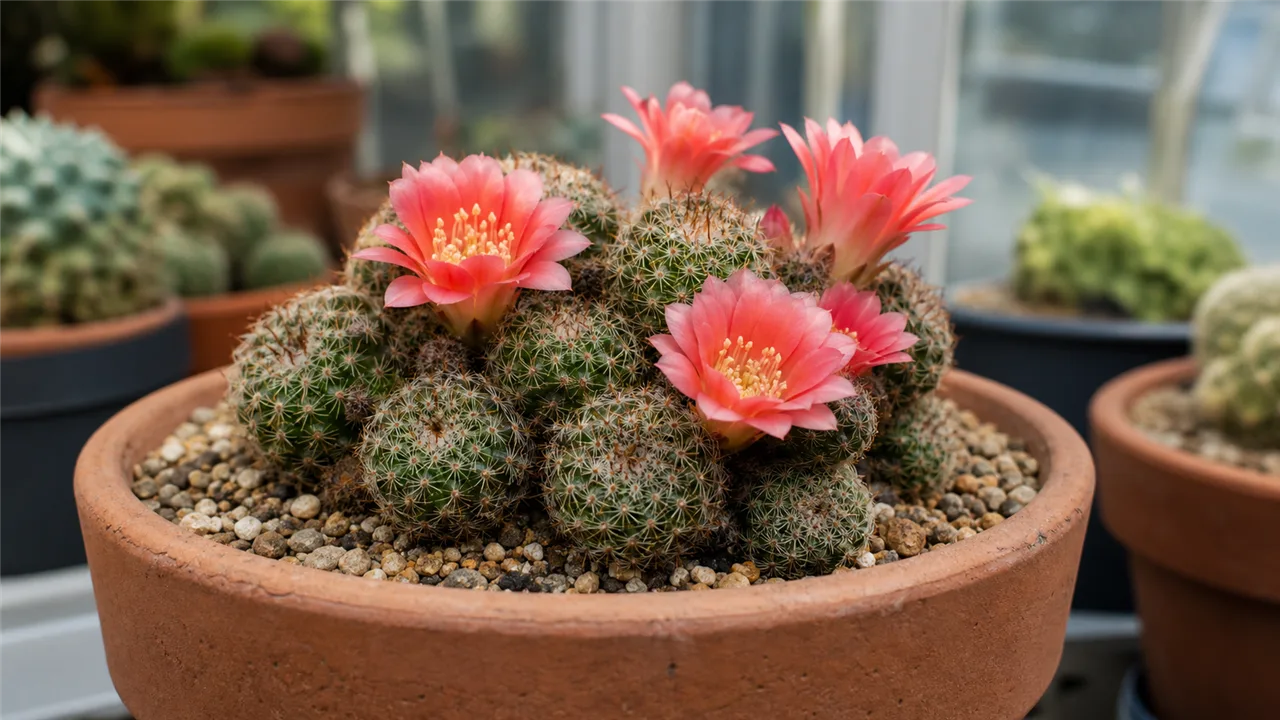
Flowers appear in a characteristic ring around the crown of each head, opening in succession over several weeks from late spring into early summer. Each bloom is small — roughly 1.5–2 cm across — creamy white to very pale pink with a faint darker midstripe on the outer petals. They are followed, when pollination occurs, by slender pinkish-red cylindrical berries that protrude from the woolly crown and may persist on the plant for several months.
Growing Conditions
Light is the single most important factor for healthy growth and flowering. A position on a south- or west-facing windowsill, or in a conservatory with unshaded glass, produces compact spiny growth and abundant buds. Insufficient light produces elongated, paler stems (etiolation) and very few flowers; this is the most common cause of a "never blooms" complaint from new growers. From late May to early September, plants benefit from being moved outdoors into a bright sheltered corner — a patio table, the top of a low wall or a gravel garden plunge — where light intensity is higher than any windowsill can provide. Bring them back inside before the first frosts in autumn.
The growing medium must be sharply drained. A standard cactus and succulent compost works for most growers, but heavier multipurpose composts should be improved with at least a third by volume of horticultural grit, pumice or perlite. A slightly alkaline mineral mix suits the species; pure peat-based substrates stay too damp for the thick tap root. Pots must have generous drainage holes, and clay terracotta is preferable to plastic because it allows the sides of the rootball to dry between waterings.
Temperature requirements reflect its Mexican mountain origins. Plants grow actively between roughly 18 °C and 28 °C and tolerate brief drops to around 5 °C without damage when kept dry. A cool winter rest — ideally between 5 °C and 10 °C — encourages bud initiation for the following spring. Rooms that remain warm all winter will keep the plant alive but often suppress flowering entirely.
Planting and Care
Watering follows a simple wet-dry cycle. From late March to September, water thoroughly when the top 2–3 cm of compost feel dry, typically once a week in summer for a pot on a sunny sill. Allow excess to drain freely and never let the pot stand in a saucer of water for more than a few minutes. From October to early March the plant should be kept almost dry — a light splash once a month is sufficient in most homes, just enough to prevent the stems from shrivelling. The single most common cause of failure is winter watering combined with cool temperatures, which rots the tap root and base of the stems.
Feeding needs are modest. Apply a half-strength cactus fertiliser — one low in nitrogen and higher in potassium — once a month from April to August. Avoid standard houseplant feeds, which produce soft, sappy growth prone to scorch and rot. A single dose of a slow-release granular feed at the start of the season is an alternative for those who prefer a low-maintenance approach.
Repotting is needed only every two to four years because the plant is slow-growing and prefers a slightly snug pot. Move up one pot size at a time, refresh the gritty compost and check the tap root for any signs of rot or desiccation. The best time to repot is late winter or very early spring, just as new growth is about to begin.
Pruning is largely unnecessary — the plant has a fixed architectural form and removing parts will only scar the stem. The main intervention is the careful removal of dead or damaged heads from a clump, using a sharp sterile knife and a folded paper sleeve to protect hands from the hooked spines. Always dust cut surfaces with powdered charcoal or sulphur to reduce the risk of fungal infection.
Propagation is straightforward and is usually done by offsets. Large clumps naturally produce well-rooted pups around the edge of the pot; these can be detached in spring with a clean twist, allowed to callus over for a day or two and then potted individually into dry gritty compost. Do not water for the first two to three weeks, then resume very light watering until roots are established. Propagation from seed is also possible: surface-sow fresh seed on a moist gritty mix, cover with a thin layer of grit, seal in a clear propagator and keep at around 21–24 °C. Germination is usually rapid — within one to three weeks — but seedlings grow slowly and may take three or four years to reach flowering size.
Seasonal care is dominated by the winter rest. From late September, gradually reduce watering and move the plant to the brightest, coolest room available — an unheated spare bedroom, a frost-free porch or a cool conservatory are all ideal. Avoid placing it near a radiator or above a heat source. Resume normal watering only when new growth is clearly visible at the crown, usually from late March or April.
Common Problems
Mealybug is the most frequent pest, appearing as small white woolly tufts in the spine axils or around the base. Treat small infestations by dabbing individual insects with a cotton bud dipped in 70 % isopropyl alcohol; larger outbreaks respond to a systemic insecticide labelled for ornamental cacti. Quarantine affected plants for several weeks to prevent spread.
Root and stem rot occur almost exclusively from overwatering in cool conditions. Symptoms include a soft discoloured patch at the base, sudden collapse of an otherwise healthy-looking head or a sour smell from the compost. The remedy is unappealing but effective: unpot the plant, cut away all soft tissue back to clean white firm flesh, dust the cut surfaces with sulphur, allow to callus for a week and re-root in dry gritty compost. Prevention is far easier — keep the plant dry and cool in winter.
Sun scorch appears as bleached yellow or brown patches on the side of the stem most exposed to strong midday sun through glass. It is rarely fatal but mars the appearance. Move the plant slightly back from the window or provide a thin net curtain during the brightest hours of mid-summer.
Failure to flower usually points to one of three causes: insufficient winter rest, too little direct sunlight during the growing season, or a pot that has become too large. Restoring a cool dry winter and a brighter summer position will normally bring buds back the following year.
Popular Varieties
Mammillaria bocasana has relatively few formally named cultivars, but several recognised selections are widely grown.
Mammillaria bocasana 'Fred' is the best-known monstrose or cristate form, characterised by lumpy irregular growth rather than the usual rounded stems. It rarely flowers but its curious sculptural shape has made it a collector's plant. It is propagated only by grafting or offsets, as it does not come true from seed.
Mammillaria bocasana f. multilanata (sometimes sold as 'Multilanata') carries an unusually dense covering of long white hair-like radial spines, giving each head a distinctly woolly appearance. It is otherwise identical to the species and flowers freely in the same conditions.
Mammillaria bocasana 'Rosea' is a pink-flowered selection occasionally offered by specialist nurseries. Its flowers are a noticeably deeper pink than the species, and the stems and spines are typical of the wild form. Availability is inconsistent, so it is worth contacting specialist cactus nurseries in advance.
Plants sold as Mammillaria bocasana var. splendens or under the older synonym Mammillaria longicoma appear in some catalogues and reference books, but most modern authorities treat them as either synonyms of the species or as a closely related Mexican taxon with only minor differences in spine length and density. For ordinary garden purposes they can be grown exactly as the species.
Pests and Diseases
| Problem | Symptoms | Management |
|---|---|---|
| Root rot | Stems become soft, shrivelled and discoloured, often turning black or brown. | Ensure excellent drainage with gritty compost and water sparingly, allowing the soil to dry completely between waterings. |
| Mealybugs | White, cottony wax-like masses appear in stem joints and around the base of spines. | Isolate the plant and treat with a systemic insecticide or dab spots with alcohol-soaked cotton wool. |
| Vine weevil | Semi-circular notches on leaf margins (if present) or sudden collapse due to root damage. | Use nematode treatments in the soil during warm months or apply a systemic insecticide as a preventative measure. |
| Scale insects | Small, immobile, brown or white bumps attached firmly to the stem surface. | Scrape off visible scales and spray with horticultural oil or a recommended insecticide. |
| Sunburn | White or bleached patches on the upper surfaces of stems exposed to intense light. | Gradually acclimatise plants to brighter conditions and provide shade during peak summer sunlight. |
Or browse the full plant problem solver to diagnose an issue by symptom.
Recommended Products
GardenWizz earns a commission from qualifying purchases made through affiliate links on this page (including links within the article) — as an Amazon Associate, and from Thompson & Morgan via the Awin network. This does not affect the price you pay. See our disclaimer for details.