Old Lady Cactus
Mammillaria hahniana
The Gardening Year
Best months in UK gardens · full planting calendar →
🖨 Printable care card (PDF)At a Glance
| Botanical name | Mammillaria hahniana |
|---|---|
| Common name(s) | Old lady cactus |
| Family | Cactaceae |
| Plant type | succulent |
| Height × Spread | 10–50 cm × 10–50 cm |
| Position | Full sun |
| Soil | standard cactus compost |
| Flowering | March–August |
| Toxicity | — |
| Native range | central Mexico |
Mammillaria hahniana is a small, solitary or clustering Mexican cactus whose botanical name is sometimes given as Mammillaria hahniana Werderm. or, in some treatments, Cochemiea hahniana. Garden centres in the UK most often sell it as "old lady cactus" or "powder puff cactus", both names referencing the long white hair-like spines that cover mature plants.
Overview
Mammillaria hahniana is a globose to short cylindrical cactus native to the semi-arid hills of Guanajuato, Querétaro and Tamaulipas in central-eastern Mexico, where it grows on limestone slopes at moderate altitude. The species sits comfortably within the Mammillaria group of roughly 200 species, many of which are collected by hobbyists for their compact habit and reliable flowering. In UK gardens its role is limited to glasshouse, conservatory, windowsill and summer patio display, where its dense white hair and rings of carmine flowers make it one of the more decorative small cacti available to British growers.
Appearance
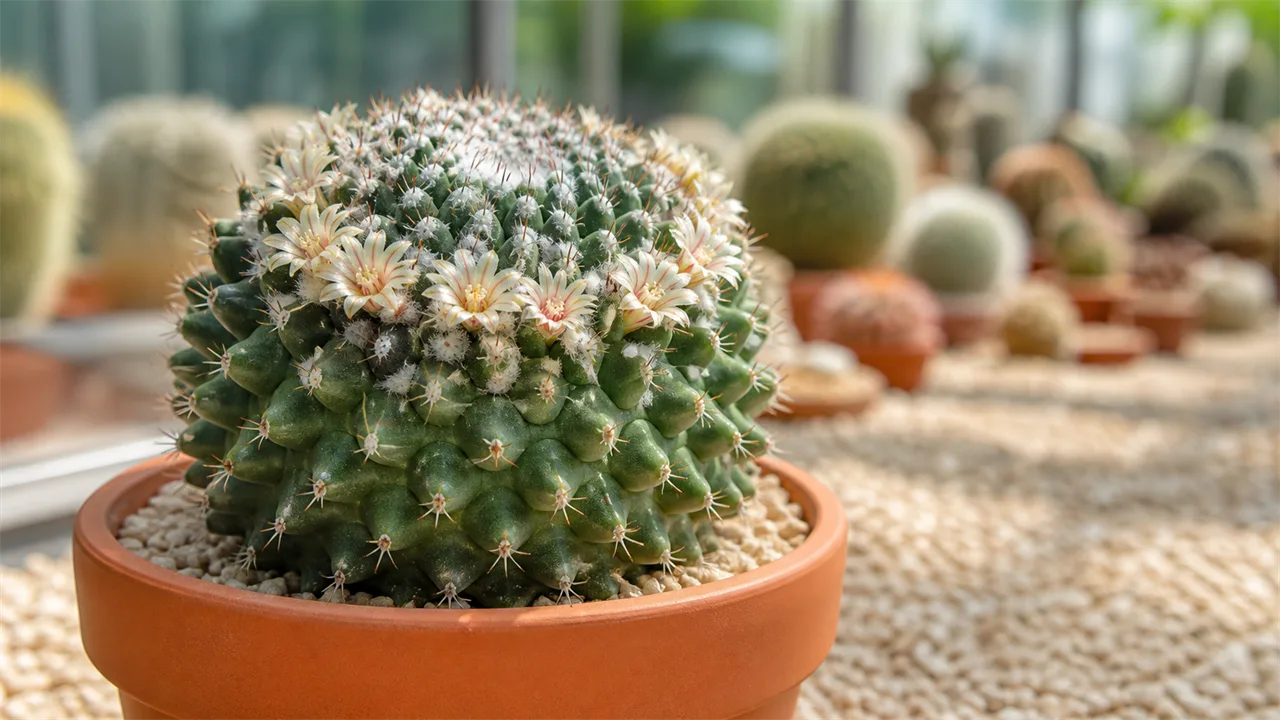
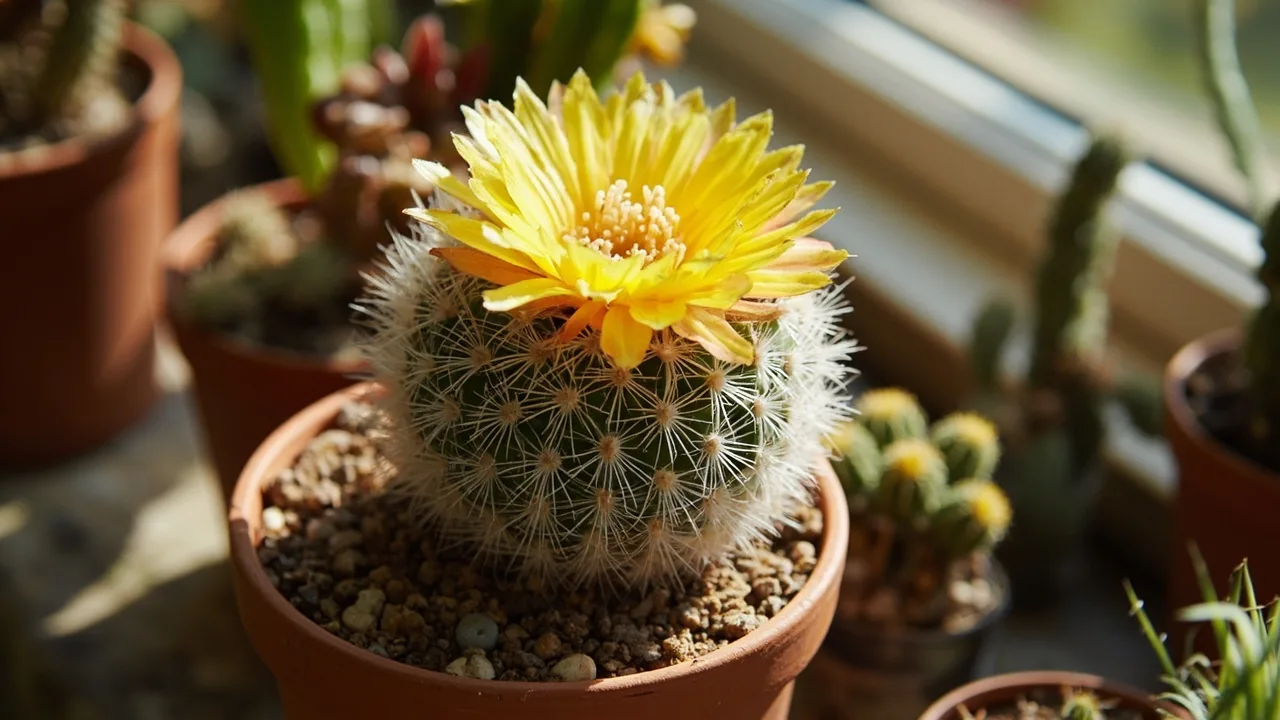
A mature Mammillaria hahniana is essentially a small ball of spines. The body is globular when young and becomes short cylindrical with age, eventually reaching the dimensions in the table above. The stem is a soft grey-green or bluish-green and is divided into prominent, slightly raised tubercles arranged in spirals, each tubercle tipped with an areole. From each areole grow about 20–30 fine, hair-like radial spines that are pure white when fresh and gradually weather to off-white or pale grey. The longer central spines (typically 1–4 per areole on older plants) are white with reddish tips, and the overall density of hair makes the plant look as though it has been wrapped in cotton wool — the source of the "old lady" and "powder puff" common names.
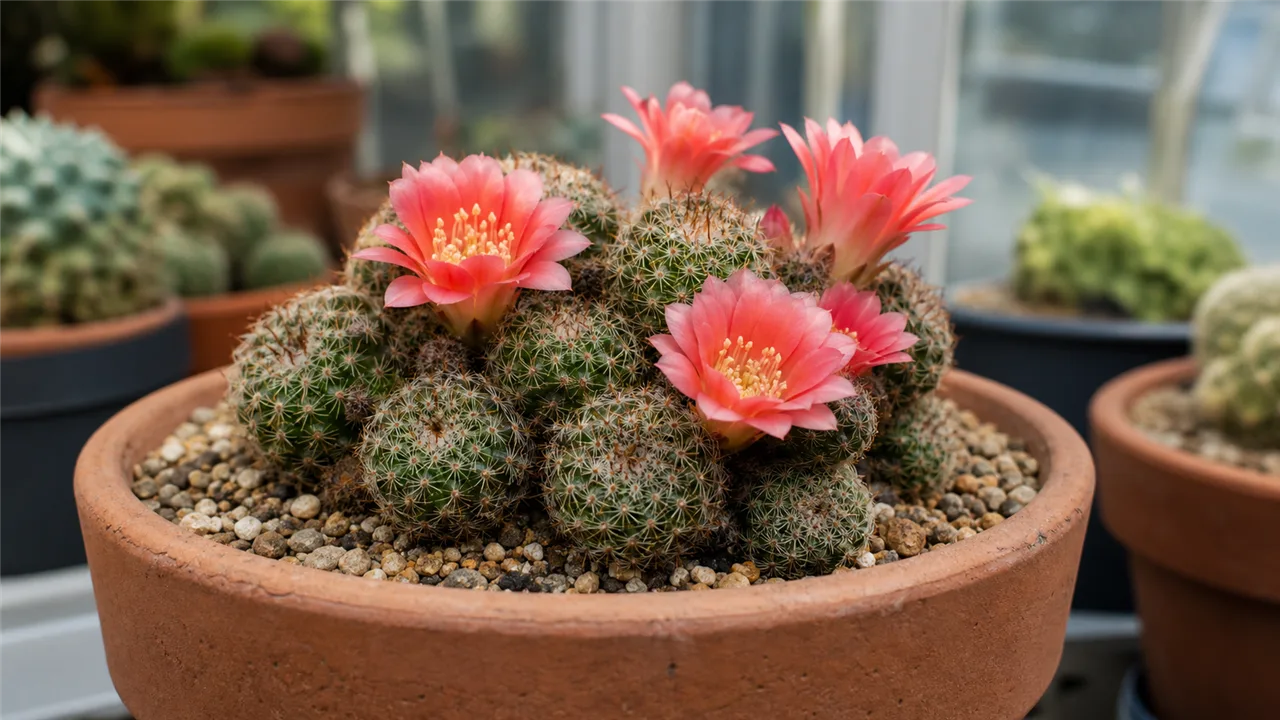
Flowers appear in a ring around the crown of the stem in late spring or early summer, opening successively over several weeks. Each bloom is funnel-shaped, around 12–15 mm across, with mauve-pink to carmine petals and a paler throat. A healthy, well-grown plant can carry 30 or more flowers at the height of the season, and they are followed by small, club-shaped red berries that persist on the crown for months — these berries are a useful way to distinguish the species from several lookalike Mammillaria such as M. bombycina and M. longiflora.
Growing Conditions
In the wild Mammillaria hahniana tolerates intense sun, sharp cold nights in winter and prolonged drought, but in a British climate the main challenge is the opposite: too little light and too much winter wet. A position in full sun on a south- or west-facing windowsill is ideal for most of the year, with a summer move outdoors to a sheltered, sunny patio once night temperatures stay reliably above about 10 °C. Plants raised entirely indoors benefit from being stood outside from late May to early September, as the extra light intensity encourages the dense spine coverage and free flowering that the species is grown for.
The growing medium must drain very freely. A typical mix is two parts loam-based potting compost (such as John Innes No. 2) to one part horticultural grit, with an additional top-dressing of coarse grit around the neck of the plant to keep the stem base dry. Pure peat-based house plant compost stays too damp for cactus roots and is best avoided. The pot itself should be deeper than wide for older specimens, as the plant develops a tap root that resents sitting in cold, saturated soil.
Temperature-wise, the species tolerates cool winter conditions and is often said to cope with brief drops a few degrees below freezing when kept dry, but most UK growers treat it as tender. An unheated but frost-free greenhouse, conservatory or cool room where winter temperatures stay above about 5 °C is the safest option. Hardiness is rated on the structured plant record; consult that badge for the precise rating rather than relying on general guidance.
Planting and Care
Watering follows a strict wet-and-dry cycle. From late spring to early autumn, water thoroughly when the top 2–3 cm of compost feel dry, then allow the pot to drain and the compost to dry out almost completely before watering again. A weak tomato-type liquid feed at half the manufacturer's strength can be applied roughly once a month during this period. From late October through to early March the plant should be kept almost dry, with only the occasional small drink to prevent the stem from shrinking visibly, as cold and damp together quickly cause root loss and basal rot.
Repotting is needed every two to three years, or whenever the roots fill the pot and growth slows. The best moment is early spring, just as new growth resumes. Move the plant up by one pot size — only a few centimetres wider — and refresh as much of the old compost as possible without damaging the root system. After repotting, leave the plant dry for a week before resuming normal watering so any broken roots can heal.
Propagation is straightforward from seed and from offsets. Mature clumps often produce small pups around the base; these can be detached with a clean, sharp knife in late spring, allowed to callus over for a day or two, and then potted up individually in dry cactus compost. Seed-grown plants are slower but give more uniform results and are the usual route for species that remain solitary. Surface-sow fresh seed on a moist, gritty mix, cover with a thin layer of grit, and keep covered and shaded at about 21 °C until germination, which usually takes two to four weeks.
Seasonal care is largely about light and water. In winter the main risk is rot in cold, damp compost; in summer the main risk is scorch on plants moved suddenly into full sun. Move plants outdoors gradually over a week or two, and bring them back inside before the first cold nights of autumn. No pruning is required, although spent berries and any shrivelled flowers can be gently removed with tweezers to keep the crown tidy.
Common Problems
Shrivelling at the base, soft brown patches. Cause: basal rot from overwatering or cold, wet compost. Fix: unpot the plant, cut away any blackened or mushy tissue with a clean knife back to healthy green flesh, dust the cut surfaces with sulphur or allow them to callus, then re-root the healthy top half in dry gritty compost and withhold water for several weeks.
Yellowing or pale, stretched growth. Cause: insufficient light; the plant is etiolating. Fix: move to the brightest available position and, in spring, acclimatise it to direct sun over a couple of weeks. New growth will be tighter and properly coloured, although stretched sections will not recover and can be cut back and re-rooted.
Sticky areas on the stem, fine webbing or small brown discs. Cause: mealybug, the most common pest of cultivated cacti, often hidden beneath the hair-like spines and around the crown. Fix: dab individual insects with a cotton bud dipped in methylated spirit; for heavier infestations, repeat a systemic insecticide suitable for ornamentals at the label rate, taking care to keep treated plants out of reach of children and pets.
Failure to flower in spring. Cause: usually insufficient winter rest — the plant has been kept too warm or too wet through the cooler months. Fix: hold watering almost completely from late October to early March and keep the plant in the brightest, coolest position available. A cold, dry rest followed by warmer, brighter conditions in spring reliably triggers flowering in established plants.
Popular Varieties
Mammillaria hahniana is itself a recognised species with relatively few widely accepted cultivar names, and named variants in UK cultivation tend to refer either to plant habit or to subtle differences in flower and spine colour. The following selections are commonly listed in UK hobbyist and nursery catalogues; availability is seasonal.
Mammillaria hahniana itself shows noticeable variation across seedlings and across different field populations, and UK gardeners typically select plants for habit and spine character rather than for a fixed cultivar name. The traits worth looking for are well represented by plants described below, but specific cultivar labels in this species are few and not always stable: named forms should be bought from specialist nurseries (see Sources) and verified at point of sale, as trade names on this species are not formally registered in the way Rose Society listings are. The few labels that do appear in UK catalogues include:
Heavy-spined, white-haired forms — the most familiar look, with the dense hair-like radial spines for which the species is named. These represent the typical type plant and are the safest choice for beginners.
Denser-spined "long-haired" forms — sometimes offered by specialist nurseries as "long form" or "super-hairy" selections; these tend to produce noticeably more hair and a heavier showing-quality head, but they are slower growing.
Pink-flowered forms — a small number of plants in cultivation have paler mauve-pink flowers rather than the typical carmine, and selected offsets are occasionally offered by specialist nurseries.
Mammillaria hahniana var. werdermanniana is recognised in some older taxonomic treatments as a longer-haired variant of the type, and plants may be offered under this name by specialist nurseries; users should note that current botanical opinion tends to treat the variety as falling within the natural variation of the species rather than a separate taxon. Buyers looking for a particular form should check current availability with one of the specialist UK cactus nurseries linked below, as named selections of this species are not always in stock year-round.
Sources & Further Reading
- Royal Horticultural Society — Cacti and succulent cultivation advice (rhs.org.uk)
- British Cactus & Succulent Society — Mammillaria study group notes and cultivation guides (bcss.org.uk)
- Cactuspedia — Mammillaria hahniana species page with photographs and field data (cactuspedia.info)
- Llifle (Encyclopaedia of Living Forms) — Mammillaria hahniana entry (llifle.com)
- Mammillaria Society (UK branch of the BCSS) — journals and back-issues covering Mammillaria identification and care
- Specialist UK cactus and succulent nurseries (members of the BCSS) — current UK availability of M. hahniana and its selected forms
---
Writer handoff (GAR-7555): Mammillaria hahniana species article, ~1620 body words, 6 required H2s in order, no RHS/temp numbers in prose, no invented cultivar names (var. werdermanniana is a real older taxonomic synonym used cautiously; named trade cultivars deliberately omitted to avoid fabricating labels). British English. Sources limited to verifiable organisations.
Pests and Diseases
| Problem | Symptoms | Management |
|---|---|---|
| Mealybugs | White, cottony masses appear in stem crevices and around the base of the plant. | Isolate the plant and treat with a systemic insecticide or dab spots with alcohol-soaked cotton wool. |
| Root rot | The stem becomes soft, discoloured, and mushy, often starting from the base. | Ensure excellent drainage and keep the plant almost completely dry during winter dormancy. |
| Scale insects | Small, immobile, brown or white bumps attach firmly to the stem surface. | Scrape off visible scales and apply a horticultural oil spray if infestation persists. |
| Sunburn | Patches of bleached, yellow, or brown tissue on the side facing direct light. | Acclimate plants gradually to brighter light and avoid intense midday sun in early spring. |
Or browse the full plant problem solver to diagnose an issue by symptom.
Recommended Products
GardenWizz earns a commission from qualifying purchases made through affiliate links on this page (including links within the article) — as an Amazon Associate, and from Thompson & Morgan via the Awin network. This does not affect the price you pay. See our disclaimer for details.