Pincushion Cactus
Mammillaria lauii
The Gardening Year
Best months in UK gardens · full planting calendar →
🖨 Printable care card (PDF)At a Glance
| Botanical name | Mammillaria lauii |
|---|---|
| Common name(s) | Pincushion cactus |
| Family | Cactaceae |
| Plant type | succulent |
| Height × Spread | 0–6 cm × 0 cm |
| Position | Full sun |
| Soil | cactus compost |
| Flowering | February–March |
| Toxicity | — |
| Native range | Tamaulipas state in Mexico |
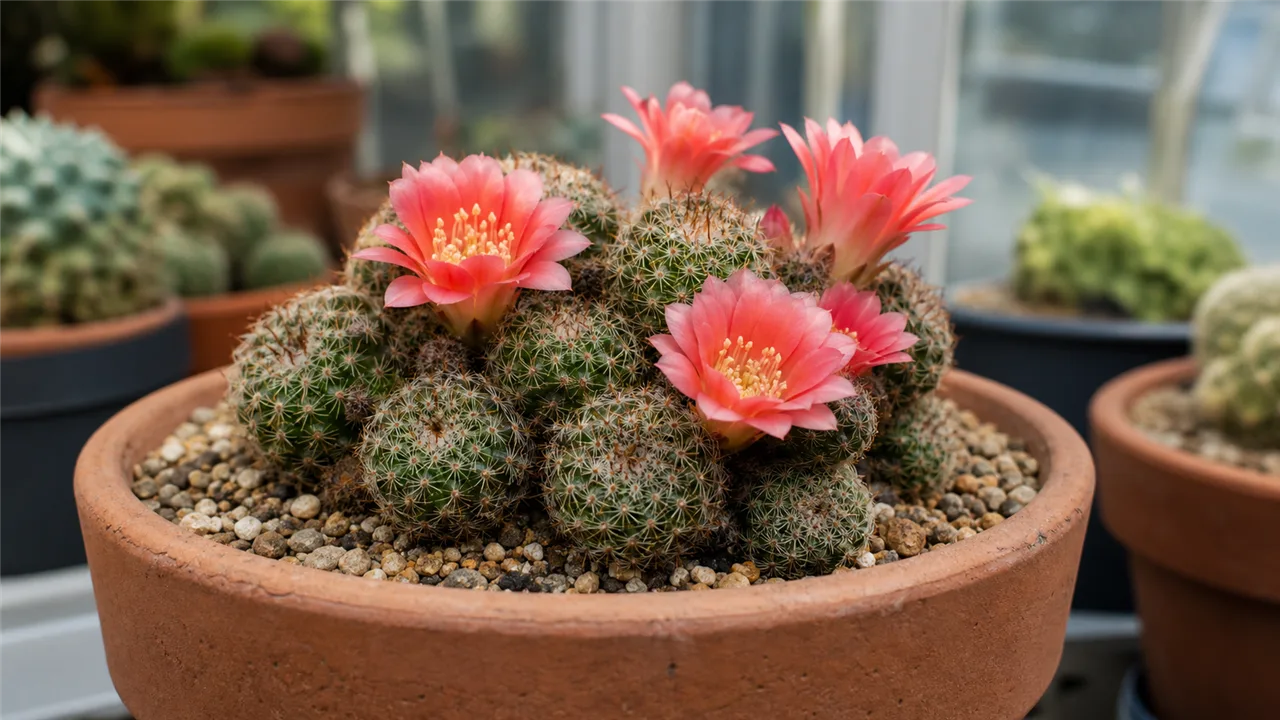
A miniature, feather-spined pincushion cactus from the limestone cliffs of Tamaulipas in eastern Mexico, Mammillaria lauii has become one of the most distinctive dwarf cacti in UK cultivation. It is small enough to live on a windowsill, slow enough to demand almost no maintenance, and unusual enough that collectors prize it for its soft white spines rather than its flowers. In British conditions it is grown entirely as a tender indoor or under-glass plant, where a cool, dry winter rest reliably brings out a ring of pale pink blooms in late winter.
Quick-Care Table
Overview
Mammillaria lauii D.R. Hunt belongs to the family Cactaceae and is placed within the large genus Mammillaria, a group of roughly 200 species characterised by nipple-shaped tubercles rather than continuous ribs. The species was described by the British botanist D.R. Hunt in 1980 and named in honour of the German-born Mexican cactus collector Alfred Bernhard Lau. Some recent molecular work has proposed reclassifying it into the genus Escobariopsis as Escobariopsis laui, but the name Mammillaria lauii remains the accepted form in UK horticulture and on the RHS Plants database.
In the UK it is treated as a tender indoor cactus. It is not frost-hardy and is grown on a bright windowsill, in a heated greenhouse, or in a cool conservatory. The Royal Horticultural Society lists Mammillaria lauii on its Plants database and gives general cacti-and-succulents houseplant guidance, but does not assign a specific H-rating for this species; growers should assume tender conditions and protect it from frost. The species is classed as Critically Endangered in its native habitat in Tamaulipas, and almost all plants offered for sale in the UK trade are seed-raised rather than collected from the wild.
Appearance
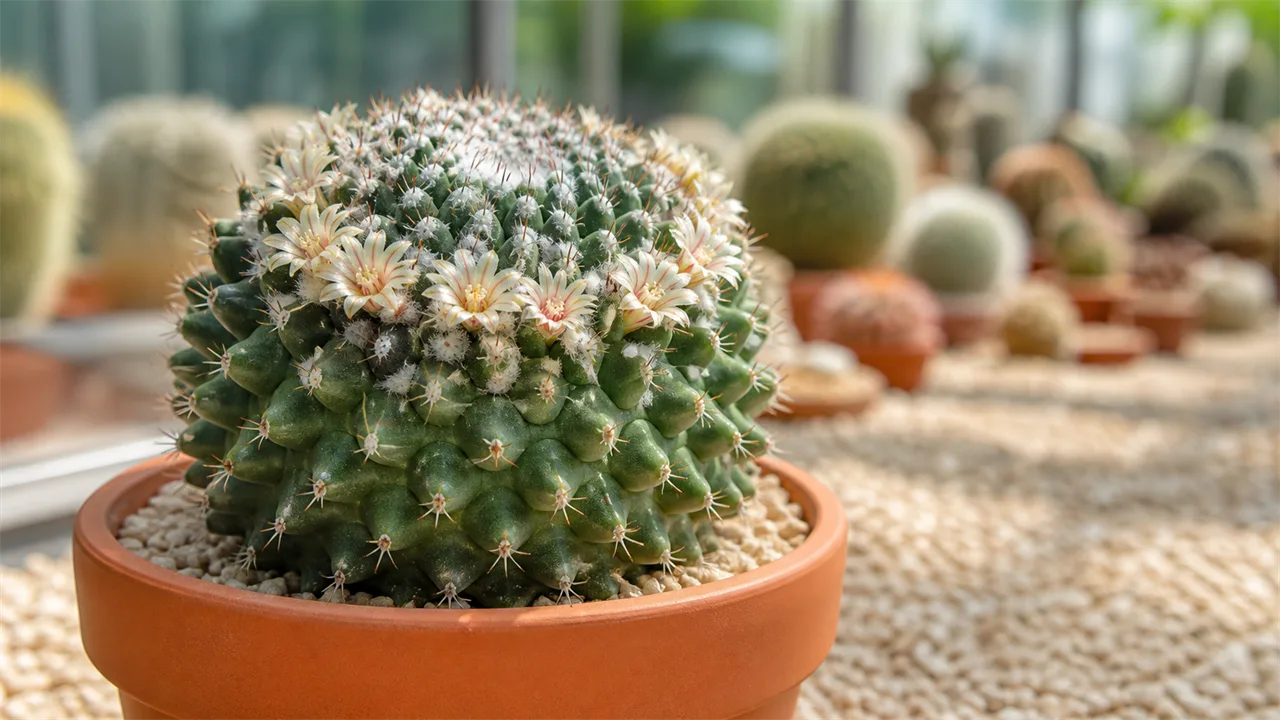
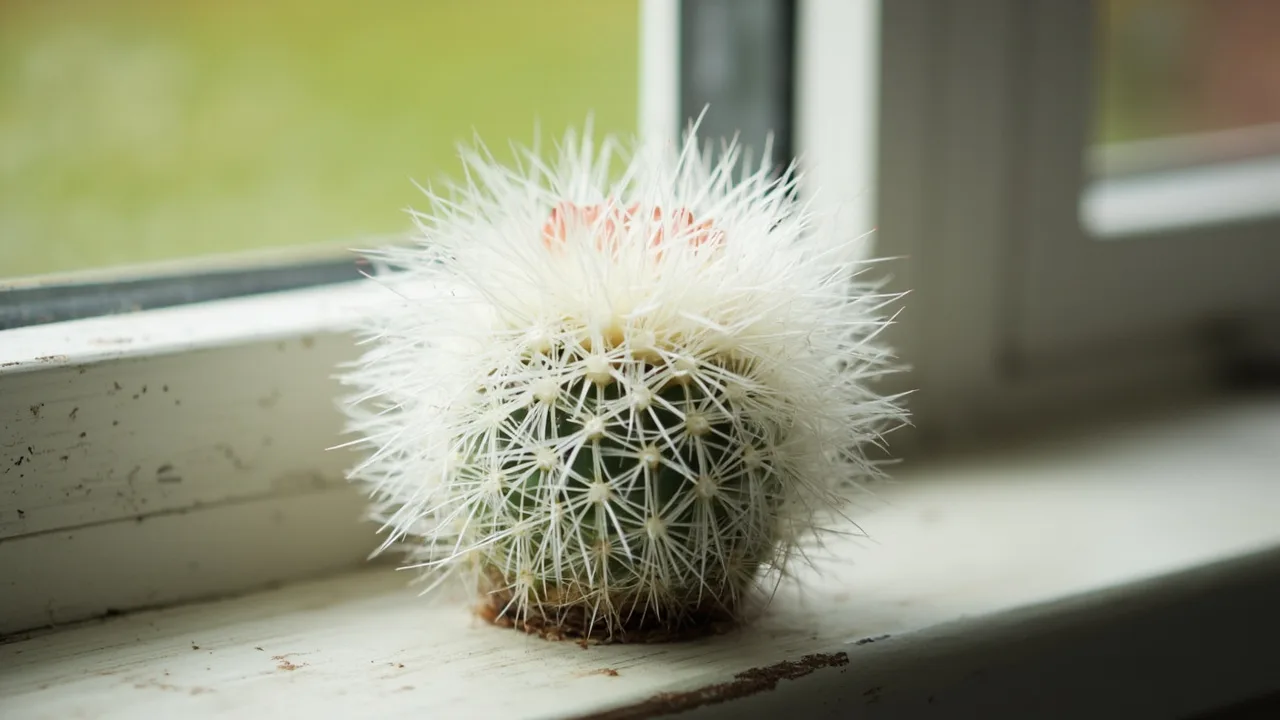
A mature M. lauii forms a depressed-globose to short-cylindrical stem typically 4–6 cm tall and 4–7 cm across at the widest point. The epidermis is dull grey-green to blue-green, and the apex is slightly sunken where new growth emerges. Plants are usually solitary when young, clustering slowly with age to form a small mound of heads.
The defining feature of the species is its spines. Each areole carries around 20–30 fine, feathery, pure-white radial spines that lie flat against the stem, giving the plant the appearance of a soft white pincushion or a small bird's nest — a habit that has earned it the informal UK trade name "bird's-nest cactus". Central spines are normally absent, or occasionally one short central is produced. The feathery spines are softer to the touch than they look, but they are easily damaged by handling.
Flowers appear in late winter to early spring, carried in a ring (a "crown") around the top of the stem. Each flower is funnel-shaped, roughly 1.5 cm across, and ranges from pale pink to carmine-pink. After pollination the spent flowers develop into small, club-shaped, pale pink to reddish berries containing black seeds. The roots are fibrous and shallow, which makes the plant quick to respond to watering but also quick to rot if the compost stays damp.
Growing Conditions
Mammillaria lauii comes from sun-baked limestone cliffs, and in UK cultivation it needs strong light, a lean mineral compost, dry feet in winter, and free air movement. A south- or west-facing windowsill, a sunny greenhouse bench, or a conservatory with light shade from the strongest midday summer sun through glass are all suitable positions. Light shade through midsummer is helpful rather than essential.
During the active growing season (roughly April to September in the UK) the plant is comfortable at typical indoor temperatures and tolerates higher summer heat provided the air is not stagnant. In winter it should be kept cool but frost-free; the RHS cacti-and-succulents houseplant guidance covers tender cacti generally, and growers aiming for flowers tend to give the plant a cooler rest through January and February to encourage bud initiation.
The compost must be sharply free-draining. A standard approach is John Innes No. 2 or a loam-based potting compost amended with at least 30–50 % horticultural grit, pumice or perlite; a slightly alkaline, lean mix suits the plant's limestone origins. Water thoroughly during the growing season only when the compost has dried out completely, then withhold water again. From late autumn through winter the plant should be kept almost dry — just enough moisture to prevent the stem from shrivelling. A balanced cactus fertiliser diluted to quarter or half strength, applied once a month in the growing season, is sufficient; no feeding is required in winter.
Good ventilation is essential year-round. Stagnant, humid air combined with cool temperatures is the principal cause of fungal losses in UK collections.
Planting and Care
A small terracotta pot suits a mature single head — typically 7–9 cm across — and helps the compost dry evenly between waterings. Repot only when the roots have filled the container, usually every two to three years, in late spring just as new growth begins. Use fresh dry cactus compost and withhold water for about a week after potting to allow any damaged roots to callus. A top-dressing of coarse grit around the stem base keeps the neck of the plant dry and discourages basal rot.
Watering follows the "soak and dry" pattern from April to September: give the compost a thorough wetting, then let it dry fully before the next watering. Through October, water is gradually reduced, and from November to early March the plant is kept almost dry. A dilute high-potash cactus feed is applied once a month during active growth; none is given in winter. Pruning is not required — old flower stems can be teased away once dry, and dead spines can be removed with a soft brush.
Propagation is most often from seed, which germinates readily when sown on a warm, gritty surface in spring. Offsets form only on older, mature plants; any that develop can be detached, allowed to callus for a few days, and then rooted in dry gritty compost. Because wild populations are Critically Endangered, growers should source only seed-raised plants from reputable UK or EU nurseries and avoid any plants offered as "field-collected" or "Lau collection".
In the UK many growers move plants outdoors from late May to early September once night temperatures are reliably warm, placing them in a sunny, sheltered, rain-shaded spot such as a south-facing wall or open greenhouse bench. Acclimatise gradually to brighter light to avoid scorch. Bring plants back indoors before the first frosts in October.
Common Problems
Basal or stem rot. The principal cause of loss in UK collections. Caused by cold, damp compost, overwatering in winter, or pots standing in saucers of water. The base of the stem turns soft, brown or black and the plant rapidly collapses. Prevention is straightforward: a free-draining mineral compost, a dry winter rest, clean drainage holes, and no standing water in the saucer.
Mealybugs. The most frequent pest on indoor cacti. Above-ground infestations appear as small white cottony tufts tucked between the spines or at the stem apex; root mealybugs show as white fluff when the plant is unpotted and cause general decline even when the compost is appropriately moist. Treat above-ground infestations with a cotton bud dipped in 70 % isopropyl alcohol or a suitable systemic insecticide; root mealies require unpotting, washing the roots thoroughly, and repotting into fresh compost.
Red spider mite. Two-spotted spider mite can colonise indoor cacti in warm, dry conditions. Symptoms include fine webbing between spines and a bronzed, dusty look to the stem. Briefly raising humidity and treating with an appropriate miticide brings the infestation under control.
Sun scorch. Hard brown patches on the side of the stem facing the glass appear when light intensity changes suddenly, particularly in spring when plants are moved outdoors. Acclimatise gradually over a week or two.
Etiolation. Thin, pale, stretched growth indicates insufficient winter light. Move the plant to a brighter position before the new growth becomes permanent.
Popular Varieties
In cultivation two named forms are commonly encountered; both are seed-raised and available in the UK trade from specialist cactus nurseries.
Mammillaria lauii f. dasyacantha. A higher-elevation form (1,400–1,700 m in habitat) with denser, more bristly spines, sometimes treated as a separate variety. In UK collections it tends to be slightly slower-growing and whiter than the type form.
Mammillaria lauii var. subducta. A whiter, denser-spined variant widely offered in the UK trade under names such as "Mammillaria lauii subducta". It is favoured for its compact habit and the contrast between the dense white spines and the pink flower ring.
There are no widely-recognised UK cultivar names beyond these forms. Specialist nurseries occasionally list seedling-raised selections under their own numbers, but no cultivar has received an Award of Garden Merit from the Royal Horticultural Society.
Pests and Diseases
| Problem | Symptoms | Management |
|---|---|---|
| Mealybugs | White, cottony masses appear in stem crevices and around the base of the cactus. | Isolate the plant and treat with a systemic insecticide or dab spots with alcohol-soaked cotton wool. |
| Scale insects | Small, immobile brown or white bumps adhere firmly to the stems. | Remove small infestations manually or apply a recommended horticultural oil or insecticide. |
| Root rot | The stem becomes soft, discoloured, and mushy, often starting at the base. | Ensure well-draining compost and allow the soil to dry out completely between waterings. |
| Vine weevil | Notches appear on leaf margins (if present) or the plant wilts due to root damage. | Use nematode treatments in the soil during warm months or apply a granular insecticide. |
| Overwatering | Stems look swollen, translucent, or shrivelled without signs of pest activity. | Reduce watering frequency and ensure the pot has adequate drainage holes. |
Or browse the full plant problem solver to diagnose an issue by symptom.
Recommended Products
GardenWizz earns a commission from qualifying purchases made through affiliate links on this page (including links within the article) — as an Amazon Associate, and from Thompson & Morgan via the Awin network. This does not affect the price you pay. See our disclaimer for details.