Northern Phlox
Phlox adsurgens
The Gardening Year
Best months in UK gardens · full planting calendar →
🖨 Printable care card (PDF)At a Glance
| Botanical name | Phlox adsurgens |
|---|---|
| Common name(s) | Northern phlox |
| Family | Polemoniaceae |
| Plant type | perennial |
| Height × Spread | 30 cm × — |
| Position | Partial shade |
| Soil | Humus-rich, moist but well-drained soil in partial or dappled shade; will also grow in poorer soils and tolerate some direct sun. |
| Flowering | May–June |
| Toxicity | — |
| Native range | United States, in Oregon and a section of the northern Coast Ranges of California |
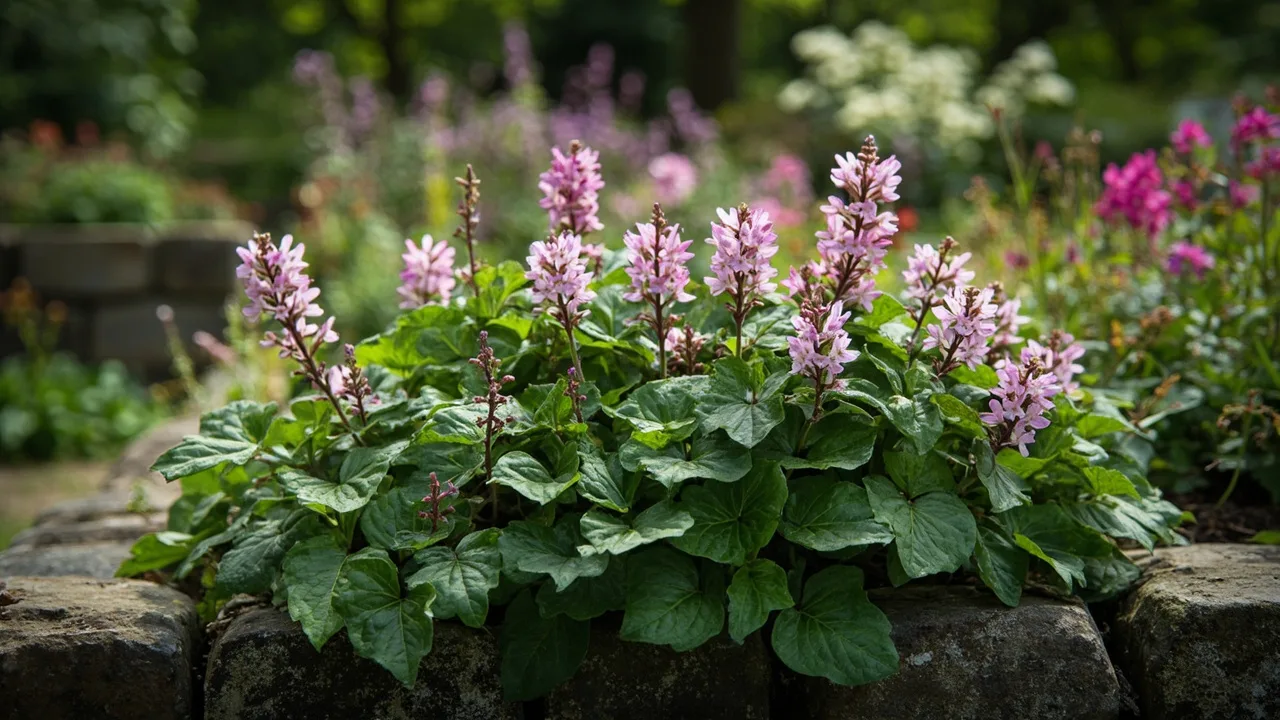
A low, spreading mat of Phlox adsurgens can soften the edge of a rock garden while carrying loose clusters of pink flowers above glossy foliage. In UK gardens, this western North American perennial succeeds best where its roots receive sharp drainage and its leaves are not crowded by vigorous neighbours.
Overview
Phlox adsurgens belongs to the Polemoniaceae and is native to wooded mountain country in Oregon and northern California. It grows as a prostrate, stem-rooting perennial rather than forming the tall upright clumps associated with border phlox. The Royal Horticultural Society describes it as semi-evergreen and mat-forming, while botanical records confirm Phlox adsurgens as an accepted species.
Its combination of low foliage and raised flower stems suits a raised bed, rock garden, trough or the front of a lightly shaded border. It is not a plant for filling large areas quickly: the stems spread steadily where conditions suit them, but the mat remains relatively restrained. Place it where its small scale can be seen at close quarters, perhaps beside a path or spilling slightly over a stone edge.
UK cultivation requires attention to winter wet. Established plants can cope with ordinary seasonal cold, but stagnant moisture around the crown and roots is more damaging than low temperatures. A sloping position, raised bed or deep container therefore gives more reliable results than a flat pocket of heavy clay.
Appearance
The plant forms a broad, low mat of trailing stems that may root where they touch suitable soil. Its leaves are simple, glossy green and broadly oval to rounded, giving the plant a softer appearance than the narrow, needle-like foliage of many alpine phlox. The foliage may remain partly present through winter in a sheltered, freely drained position, although exposure and wet weather can make the mat look sparse by spring.
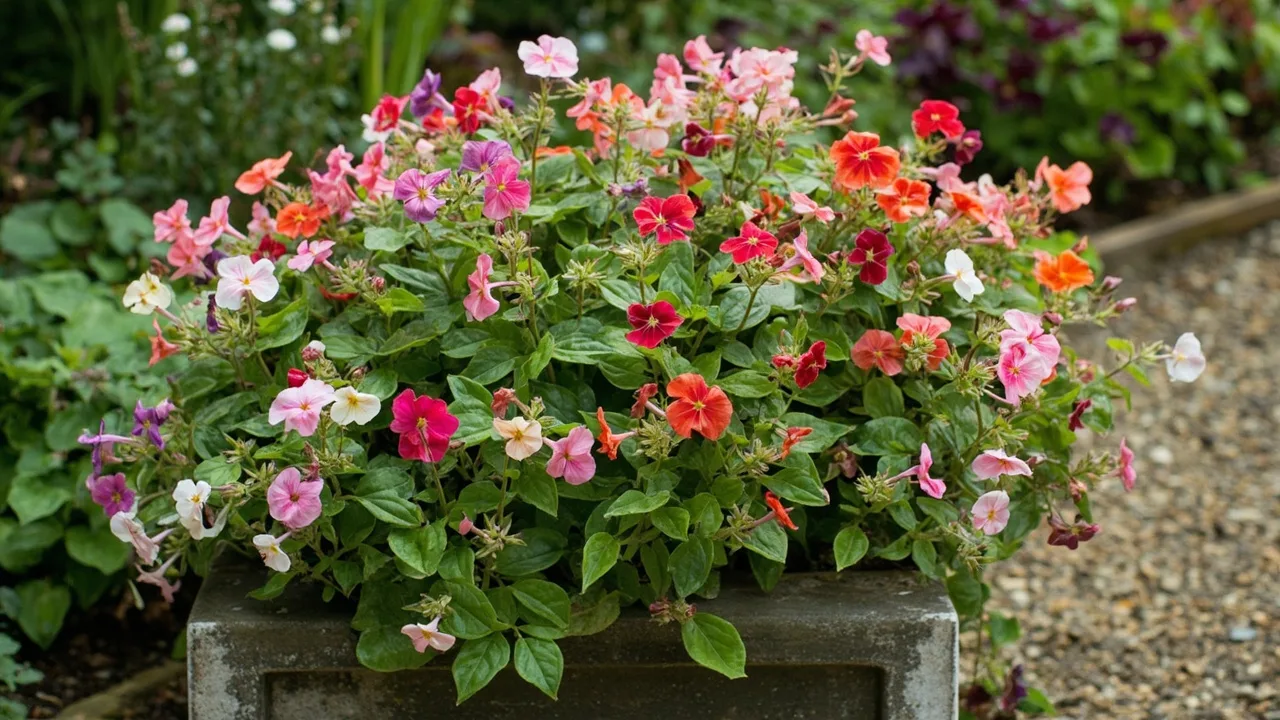
Flowering shoots rise above the foliage, usually reaching approximately 15-25cm. Each carries an open cluster of salver-shaped flowers: the petals spread from a narrow tube into five broad lobes. The typical colour range is pink to purplish pink, often with a paler eye, although named selections vary in tone and pattern. Flowering is generally concentrated in late spring and early summer in Britain, with local timing influenced by aspect and the speed at which the soil warms.
The loose flower clusters give P. adsurgens a woodland character, even when it is grown in a sunny rock garden. Its habit contrasts well with compact mounds, small ferns and spring bulbs, but nearby plants should not be allowed to close over the mat. Good air movement helps the foliage dry after rain and reduces the humid conditions that favour fungal problems.
Growing Conditions
Drainage is the central requirement. The RHS groups P. adsurgens among specialist phlox suited to gritty, sharply drained soil, and its natural occurrence on open wooded slopes also indicates that the roots should receive both moisture and air. In a raised bed, combine ordinary loam with coarse horticultural grit and leaf mould. The resulting medium should retain some moisture in spring without becoming saturated during winter rain.
Full sun is suitable where the soil does not bake completely dry, particularly in northern and western parts of the UK. Light or dappled shade can be preferable in warm, dry gardens, provided overhead branches do not create a rain shadow and fallen leaves do not smother the mat. Avoid deep shade, where growth becomes thin and flowering declines, and avoid enclosed sites where damp air lingers around the leaves.
A neutral to mildly acid soil is a dependable starting point, although established cultivars are recorded across a broader pH range. The physical structure of the soil matters more than rich fertility. Heavy clay should not merely be amended in a small planting hole, because that can form a sump; use a raised bed or container instead. On very sandy soil, leaf mould or fine compost helps prevent rapid drying in spring.
For container growing, choose a broad pot or alpine trough with generous drainage holes. A loam-based peat-free compost mixed with coarse grit gives sufficient weight and porosity. Raise the container on feet through autumn and winter, and prevent rainwater from collecting beneath it. Repot or top-dress in March when roots have filled the available compost.
Choose companion plants with similar restrained growth. Small saxifrages, compact hardy geraniums and diminutive spring bulbs can work, but vigorous ground cover will overwhelm the phlox. Maintain an open strip around the crown so that the stems receive light and can be inspected for slugs or dieback.
Planting and Care
Plant in spring, ideally from March to May once the ground is workable. Spring planting allows roots to establish before the wettest winter weather. In mild districts, early autumn planting is possible in exceptionally free-draining soil, but it offers little advantage where rainfall is high. Space plants about 25-30cm apart, or allow more room when the eventual mat is intended to spread over a stone edge.
Prepare the whole planting pocket rather than adding grit only beneath the rootball. Set the crown level with the surrounding surface and fan trailing stems over the soil without burying their leaves. Water thoroughly after planting to settle the roots, then check that excess water drains away promptly. A thin gravel mulch keeps foliage away from wet compost and discourages mud from splashing onto the leaves.
Water newly planted specimens whenever the upper soil begins to dry during their first spring and summer. Established plants need supplementary water during prolonged dry periods, especially in containers, but should never stand continuously wet. Direct water at the soil in the morning rather than soaking the foliage late in the day. In winter, remove saucers from pots and keep drainage channels clear.
Feeding should be modest. Apply a light dressing of balanced slow-release fertiliser in March, or top-dress with a small quantity of well-rotted leaf mould. Excess nitrogen produces soft, congested growth that is less floriferous and more susceptible to mildew. Container plants may receive a dilute balanced liquid feed every four to six weeks from April until flowering ends, but stop if growth becomes lush.
As a herbaceous perennial, P. adsurgens needs cutting back and division rather than woody pruning. After flowering, remove faded clusters with clean scissors if a tidier mat is wanted, taking care not to cut into healthy trailing stems. In early spring, comb away dead leaves and cut back only damaged growth. Avoid shearing the whole plant hard into old, leafless material.
Propagate by division in March or April. Lift a mature mat carefully, separate rooted outer sections with several healthy shoots, and replant them immediately into prepared soil. Stem cuttings are another practical method: take short non-flowering shoots in late spring, remove the lowest leaves and insert them around the edge of a pot filled with gritty propagation compost. Keep the compost lightly moist in bright shade until roots form. Seed can be used for the species, but seedlings will not reliably reproduce named cultivar characteristics.
Seasonal care is largely preventative. In autumn, clear fallen leaves before they compact over the foliage. During winter, inspect pots after storms and ensure their drainage holes remain unobstructed. In March, remove damaged material, refresh the gravel mulch and divide overcrowded plants. Through May and June, water during dry spells and remove fading blooms if appearance matters. Divide established mats every few years when the centre becomes woody or flowering weakens.
Common Problems
Powdery mildew may cover leaves with a pale, dusty coating, particularly when roots are dry but air circulation is poor. Improve spacing, water the soil during drought and remove badly affected material. Do not compensate for dry roots by repeatedly wetting the foliage. Resistant replacement cultivars are not well documented for this species, so good siting remains the main control.
Crown and root rots are more serious in heavy or waterlogged ground. Warning signs include shoots collapsing from the base, blackened tissue and a mat that fails to recover in spring. Lift affected plants, discard rotted portions and replant only firm, healthy divisions in a raised, sharply drained site. Where the entire crown is soft, disposal is safer than attempting to save it.
Slugs and snails can damage tender spring growth and newly rooted divisions. Look for irregular holes and silvery trails, especially beneath stones and containers. Reduce daytime hiding places, water in the morning and use wildlife-conscious controls where damage is persistent. Young plants may need temporary protection until the mat thickens.
Phlox eelworm can cause distorted, stunted shoots and narrow or damaged leaves. There is no simple restorative treatment for a badly infested plant. Remove and dispose of affected material rather than composting it, clean tools, and avoid moving divisions from suspect clumps. Similar distortion can arise from poor growing conditions, so examine the crown and roots before reaching a diagnosis.
Spider mites may trouble container plants kept too dry in hot, sheltered positions. Fine mottling, bronzing and delicate webbing beneath leaves are characteristic. Improve humidity around, but not saturation within, the root zone; move the pot away from a heat-reflecting wall and remove severely damaged foliage. Regular inspection is more effective than waiting until the whole mat has faded.
Poor flowering most often reflects excessive shade, overfeeding or overcrowding rather than disease. Move the plant in spring to brighter conditions, reduce nitrogen-rich feeding and divide congested mats. A plant recently divided may flower lightly while establishing, but should improve once roots occupy the new soil.
Popular Varieties
Named forms are uncommon in mainstream UK retail catalogues, and availability is often limited to specialist alpine nurseries. The following cultivars are documented by the RHS or specialist horticultural references; checking current stock before planning a scheme is advisable.
- Phlox adsurgens 'Mary Ellen' - an RHS-listed cultivar of the species. It retains the low, spreading character and is selected for its ornamental flowers.
- Phlox adsurgens 'Oregon Blush' - another RHS-listed selection, valued for its softly coloured flowers and mat-forming habit.
- Phlox adsurgens 'Wagon Wheel' - a distinctive selection with salmon-pink flowers and a pale eye. The RHS records it for well-drained chalk, sand or loam, and specialist references describe it as suitable for troughs and retaining-wall edges.
Where named plants cannot be obtained, seed-raised P. adsurgens offers the natural variation of the species, but it should be labelled as the species rather than assigned a cultivar name. Buy from a nursery that uses the full botanical name: several unrelated low-growing phlox are sold loosely as "creeping phlox" and may require different conditions.
Sources & Further Reading
- Royal Horticultural Society: Phlox adsurgens, accessed 2026-07-22.
- Royal Horticultural Society: how to grow specialist phlox, accessed 2026-07-22.
- Royal Horticultural Society: Phlox adsurgens 'Wagon Wheel', accessed 2026-07-22.
- Royal Horticultural Society: Phlox adsurgens 'Mary Ellen', accessed 2026-07-22.
- Royal Botanic Gardens, Kew: Plants of the World Online search for Phlox adsurgens, accessed 2026-07-22.
- Lady Bird Johnson Wildflower Center: Phlox adsurgens, accessed 2026-07-22.
Pests and Diseases
| Problem | Symptoms | Management |
|---|---|---|
| Powdery mildew | White, dusty fungal growth appears on leaves and stems, often causing distortion. | Ensure good air circulation and water at the base; apply a fungicide if severe. |
| Slugs and snails | Irregular holes in leaves and silvery slime trails on foliage and soil. | Use physical barriers, copper tape, or iron phosphate-based pellets to control populations. |
| Aphids | Clusters of small soft-bodied insects on new growth, often accompanied by sticky honeydew. | Spray off with a strong jet of water or treat with insecticidal soap or natural predators. |
| Root rot | Yellowing, wilting leaves and stunted growth despite adequate moisture in the soil. | Improve drainage and avoid overwatering; remove affected plants to prevent spread. |
For step-by-step help, read Controlling Aphids Naturally, Dealing with Slugs and Snails and Treating Powdery Mildew. Or browse the full plant problem solver to diagnose an issue by symptom.
Recommended Products
GardenWizz earns a commission from qualifying purchases made through affiliate links on this page (including links within the article) — as an Amazon Associate, and from Thompson & Morgan via the Awin network. This does not affect the price you pay. See our disclaimer for details.