Plums, Cherries, And Allies
Prunus
At a Glance
| Botanical name | Prunus |
|---|---|
| Common name(s) | — |
| Family | — |
| Plant type | — |
| Height × Spread | — × — |
| Position | — |
| Soil | — |
| Flowering | — |
| Toxicity | — |
| Native range | — |
Prunus is a diverse genus of trees and shrubs that includes ornamental cherries, plums and flowering almonds as well as familiar stone fruits. Its members are valued for spring blossom, decorative bark, autumn colour or edible crops, but their size and care vary greatly, so the identity of the species, cultivar and rootstock matters.
Overview
The genus Prunus belongs to the rose family, Rosaceae. It contains cherries, plums, damsons, gages, sloes, peaches, nectarines, apricots and almonds, together with numerous plants grown mainly for their flowers, foliage or bark. The fruit is a drupe: a fleshy, or occasionally dry, outer part surrounding a hard stone that contains the seed.
There is no single mature size, pollination rule or pruning system for the genus. Rootstock has a major influence on the vigour of grafted fruit trees, and cultivars differ in fertility, flowering time and disease susceptibility. The label supplied with a plant should therefore be retained and used when planning its position and care.
For safety, eat fruit or nuts only from correctly identified edible species and cultivars; fruit on ornamental plants must not be presented or treated as edible. Leaves and many damaged or bitter kernels contain cyanogenic compounds and can be toxic; do not eat them. Correctly identified edible sweet almonds (Prunus dulcis) are a named exception, but bitter almonds and raw apricot kernels may be hazardous.
Appearance
Members of Prunus range from low, spreading shrubs to substantial trees. Most garden forms are deciduous, although cherry laurel and Portuguese laurel are evergreen. Leaves are simple and alternate, commonly oval to lance-shaped, and often have finely toothed margins. Deciduous species may colour yellow, orange or red before leaf fall.
Many cherries show conspicuous horizontal lenticels, and selected cultivars develop polished copper, mahogany or dark brown trunks. The habit may be upright, columnar, rounded, spreading or weeping, so the stated height and spread are important when choosing a site.
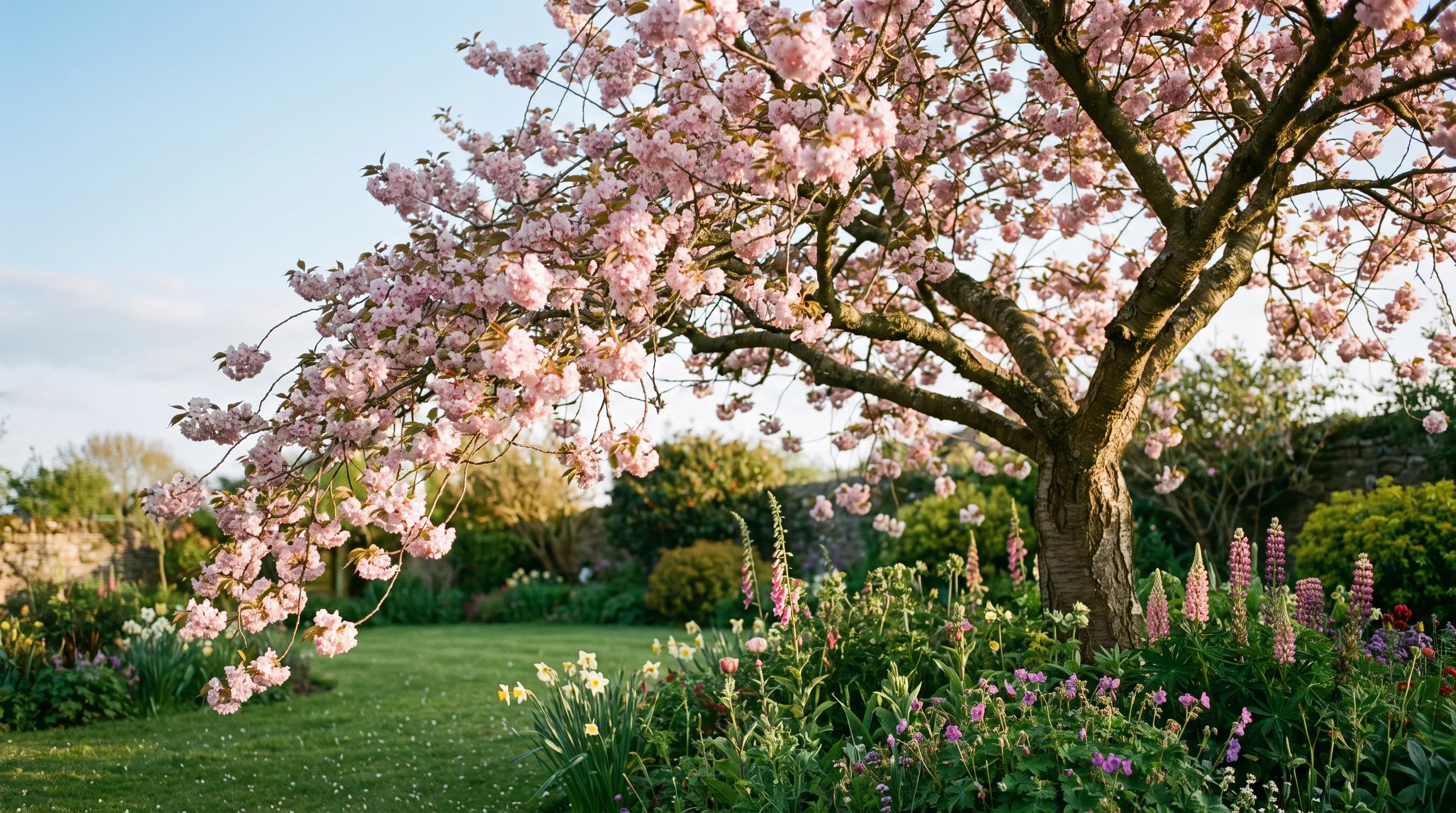
Flowers generally have five petals and are carried singly or in clusters. White and pink are the most frequent colours, although depth of colour varies between cultivars. Many species flower in spring before or as the leaves emerge, creating a strong display on otherwise bare branches. Some ornamental cherries flower intermittently during mild periods from autumn into winter. Cultivars may have single, semi-double or double flowers; single blooms are usually more accessible to visiting insects.
After successful pollination, edible kinds develop their characteristic stone fruits. Ornamental forms may carry small drupes or may have been selected for little fruit. Fruit size, colour and ripening time differ widely across the genus, from small dark sloes to sweet cherries and large plums, peaches or nectarines.
Growing Conditions
Most flowering and fruiting Prunus grow and perform best in full sun. Good light supports flower-bud formation, fruit colour and ripening. Many ornamental cherries accept light partial shade, but dense shade tends to reduce flowering and can produce a thinner canopy. Peaches, nectarines, apricots and almonds benefit from the warmest, most sheltered position available in much of the UK; a south- or west-facing wall can improve ripening.
Choose fertile soil that holds useful moisture but drains freely. Persistent waterlogging restricts roots and encourages decline, while very dry soil can cause poor establishment or premature fruit drop. Tolerance of clay, chalk and acidity varies between species and rootstocks, so check the requirements of the named plant.
Avoid frost pockets where cold air collects. Early blossom may be damaged by late frost even when established branches survive winter, reducing that year's crop or display. Wall-grown fruit is easier to protect temporarily when frost is forecast.
Allow for the expected spread and keep vigorous trees away from buildings, drains and restricted rooting spaces. For fruit trees, select a rootstock compatible with the available area and the intended bush, pyramid, fan or other training system. Exposure also matters: a sheltered site protects blossom and helps insects work the flowers during unsettled spring weather.
Planting and Care
Plant bare-root trees and shrubs during dormancy, generally from November to March, whenever the soil is neither frozen nor waterlogged. Container-grown plants can be planted at other times, but autumn or spring gives easier establishment than hot, dry summer weather. Dig a hole no deeper than the root system and wide enough to spread the roots. On grafted plants, leave the graft union clearly above soil level so the scion does not root and override the rootstock's influence.
Firm gently, water thoroughly and stake a young tree if unstable. Apply an organic mulch over moist soil, keeping it clear of the trunk. Water deeply during prolonged dry spells for at least the first two growing seasons. Fruiting and wall-trained plants need particular attention while fruits swell.
In spring, mulch with well-rotted organic matter and apply a balanced general fertiliser where growth is weak or soil fertility is low. Avoid excessive nitrogen, which encourages soft growth at the expense of flowers.
Pollination requirements must be checked cultivar by cultivar. Some fruit cultivars are self-fertile, while others require a compatible cultivar of the same fruit type whose blossom opens at a similar time. Even self-fertile trees may crop more heavily when compatible blossom and pollinating insects are nearby. Thin an excessive fruit set where recommended for that fruit, and support branches carrying unusually heavy crops.
Prune stone fruits only when necessary, in dry weather during active growth, usually from late spring through summer or just after harvest. Avoid routine autumn and winter pruning because fresh cuts are then more vulnerable to silver leaf and bacterial canker. Remove dead, damaged, diseased or crossing wood with clean, sharp tools. Follow a plant-specific method: a free-standing plum, an ornamental cherry and a fan-trained peach need different treatment. Old ornamental cherries can respond poorly to severe cutting and should not be hard-pruned without a sound reason.
Seed does not preserve a named cultivar, so named fruit and ornamental cultivars are normally propagated by budding or grafting onto an appropriate rootstock. Some shrubby species can be propagated from cuttings. Remove fallen and mummified fruit in autumn, check stakes in winter, protect vulnerable blossom in spring, and water during dry summer periods.
Common Problems
Silver leaf can cause foliage to develop a silvery appearance, with brown staining in cut wood and eventual branch dieback. Reduce risk by making necessary pruning cuts in dry summer conditions and removing affected wood promptly. Bacterial canker produces sunken or gummy lesions, shoot dieback and sometimes small holes in leaves. Avoid unnecessary wounds and remove diseased material with clean tools.
Blossom wilt and brown rot may kill flower clusters and rot developing or stored fruit; shrivelled, mummified fruits can remain attached and carry infection. Remove affected shoots and fruit, clear debris and keep the canopy open without over-pruning. Peach leaf curl causes thickened, distorted and reddened leaves on peaches and nectarines. For wall-trained plants, a rain cover used from before bud burst until later spring can reduce infection, provided ventilation and access for pollinators are maintained.
Aphids distort young shoots and leave sticky honeydew, while scale insects and caterpillars can weaken foliage. Plum moth larvae spoil developing plums. Birds readily take cherries and other ripening fruits, and wasps feed where sweet fruit is damaged. If netting is used, secure it tautly, choose a suitable mesh and inspect it frequently so wildlife cannot become trapped.
Root decline is more likely in waterlogged ground, and some plants may be affected by honey fungus. Appropriate siting, steady watering, garden hygiene and correctly timed pruning provide the best general prevention.
Popular Varieties
- Prunus 'Kanzan' is a vigorous ornamental cherry with abundant deep pink double spring flowers and a broad, vase-shaped crown. It needs space to develop.
- Prunus 'Amanogawa' is an upright, narrowly columnar ornamental cherry with pale pink, semi-double flowers, useful where garden width is limited.
- Prunus 'Tai-haku', the great white cherry, bears notably large single white flowers and develops a spreading habit.
- Prunus × subhirtella 'Autumnalis Rosea' produces pale pink flowers intermittently during mild weather from autumn into spring.
- Prunus domestica 'Victoria' is a familiar dual-purpose plum with red-flushed yellow fruit; its final size depends strongly on rootstock and training.
- Prunus avium 'Stella' is a self-fertile sweet cherry cultivar, though another compatible cherry nearby may still improve cropping.
Choose by purpose and available space, then compare mature dimensions, rootstock, pollination compatibility and flowering or harvest period. A cultivar suitable on one rootstock may be too vigorous on another.
Pests and Diseases
| Problem | Symptoms | Management |
|---|---|---|
| Powdery mildew | White powdery fungal growth on leaves and shoots, causing distortion and eventual browning. | Improve air circulation and apply a suitable fungicide if infection is severe. |
| Bacterial leaf spot and canker | Dark spots on leaves that drop out to form holes, potentially leading to bark lesions. | Prune out infected branches in dry weather and avoid wetting foliage when watering. |
| Honey fungus | General decline, wilting, and dieback of branches due to root decay. | Remove infected plants and roots completely; resistant varieties are recommended for replanting. |
| Slugs and snails | Irregular holes chewed in young leaves and shoots, often with slime trails. | Use physical barriers like copper tape or apply iron phosphate-based pellets. |
| Pocket plum | Fruits become elongated, hollow, and inedible without a stone inside. | Remove affected fruits promptly to reduce spore spread and improve site drainage. |
For step-by-step help, read Dealing with Slugs and Snails and Treating Powdery Mildew. Or browse the full plant problem solver to diagnose an issue by symptom.
Recommended Products
GardenWizz earns a commission from qualifying purchases made through affiliate links on this page (including links within the article) — as an Amazon Associate, and from Thompson & Morgan via the Awin network. This does not affect the price you pay. See our disclaimer for details.