Crown Cactus
Rebutia
The Gardening Year
Best months in UK gardens · full planting calendar →
🖨 Printable care card (PDF)At a Glance
| Botanical name | Rebutia |
|---|---|
| Common name(s) | Crown cactus |
| Family | Cactaceae |
| Plant type | succulent |
| Height × Spread | 5–15 cm × — |
| Position | — |
| Soil | free-draining, cactus compost |
| Flowering | April–June |
| Toxicity | — |
| Native range | Bolivia and Argentina |
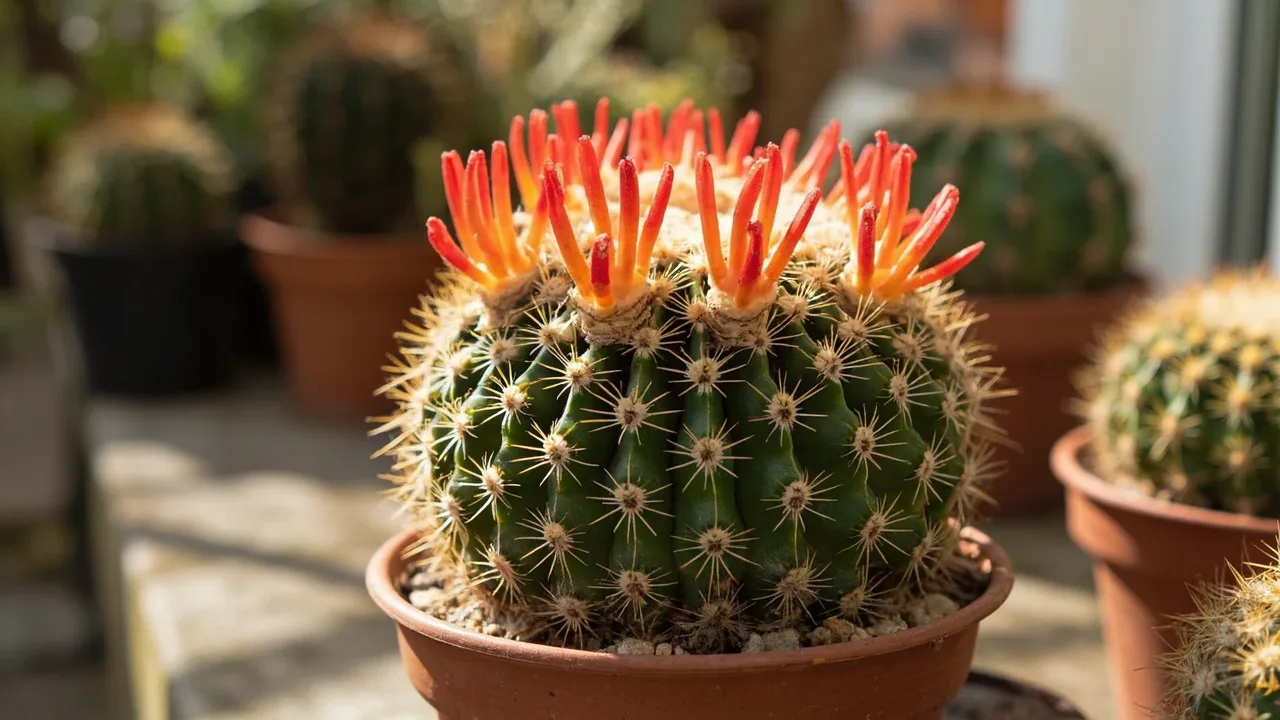
A bright windowsill can turn a modest Rebutia into a ring of scarlet, orange or pink flowers in spring. These compact South American cacti suit UK homes, conservatories and frost-free greenhouses, provided they receive strong light, sharply drained compost and a cool, dry winter rest.
Overview
Rebutia is a genus in the cactus family, Cactaceae, native principally to the Andean regions of Bolivia and Argentina. Its species grow naturally on rocky slopes and in upland valleys, where intense light, free drainage and marked seasonal changes shape their compact habit. In Britain they are best treated as indoor or under-glass plants rather than planted permanently outside.
The genus is valued for an unusually generous display from relatively small plants. Funnel-shaped flowers often appear around the lower sides of each stem, making a colourful ring around the body rather than forming only at its crown. A mature clump can carry many buds at once and occupies little windowsill or greenhouse space.
Rebutias are often suitable for a first cactus collection because their basic requirements are straightforward, and many offset readily. They are nevertheless vulnerable to the most common error in cactus cultivation: wet compost in cool, dim conditions. Their annual rhythm matters as much as any individual watering rule. Growth and watering increase from spring, while autumn introduces a much drier rest that helps initiate the following season's flowers.
Modern botanical treatments have altered the boundaries between Rebutia and related genera, so plants may appear under different names in collections and catalogues. For practical cultivation, the name on a correctly labelled plant should be retained, while current RHS or Kew records can be consulted when precise nomenclature is important.
Appearance
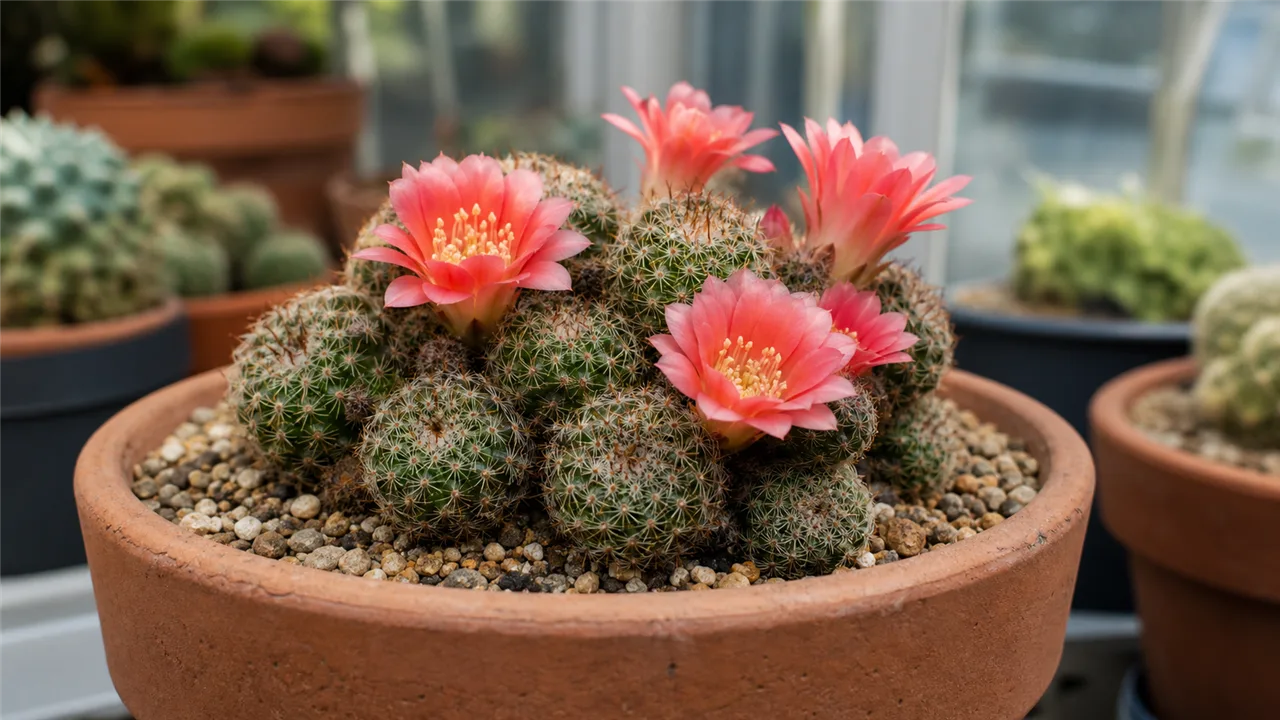
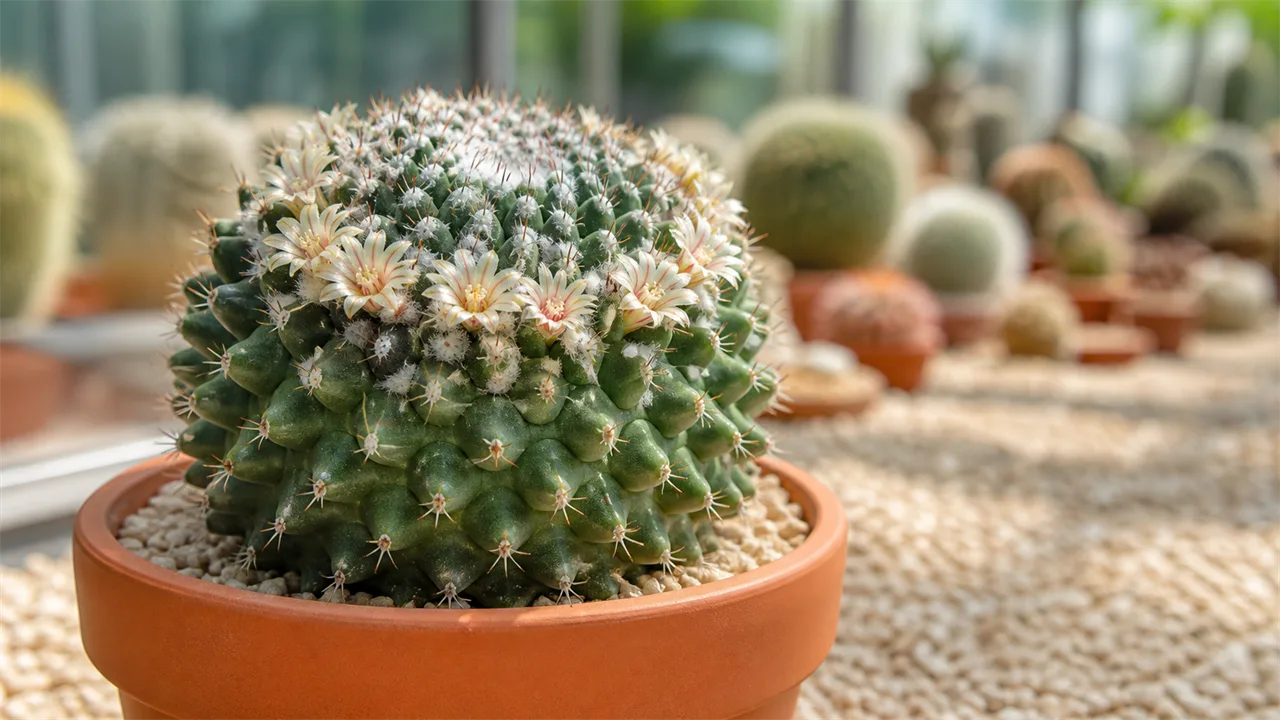
Rebutias have rounded to shortly cylindrical stems, usually divided into low ribs or spiralling rows of small tubercles. Each tubercle carries an areole from which the spines arise. The body may be fresh green, dark green or almost concealed by spines, depending on the species. Individual stems remain small compared with many columnar cacti, but offsets can gradually create a broad, hummock-like cluster.
Spination is highly variable and is useful when distinguishing plants. Some species have short bristles lying close to the stem; others carry fine radial spines arranged like the teeth of a comb. Rebutia heliosa is particularly distinctive for dense, silvery spines held close against the body, creating a delicate webbed appearance. By contrast, forms of R. minuscula may show more of the green stem between their fine spines.
The flowers are disproportionately large beside the stems. They open in daylight and emerge from older areoles on the sides or near the base. Red and orange are common, but yellow, pink, magenta and pale-flowered species also occur. The flowers are generally funnel-shaped, with numerous pointed petals surrounding conspicuous stamens. The exact colour, size and timing depend on species and growing conditions, but the main UK display normally falls in spring and early summer.
After successful pollination, small berry-like fruits may develop among the spines. These can be inconspicuous, particularly in tightly clustered plants. The seeds are useful for raising genetically varied plants, although offsets are the quicker way to reproduce an exact clone.
Growth is slow enough for a Rebutia to remain manageable for years. Its clumping character should not automatically be treated as overcrowding: a well-balanced group of heads is the natural mature form. Repotting becomes necessary when drainage deteriorates, roots fill the container or the clump becomes unstable, rather than simply because offsets touch one another.
Growing Conditions
Strong light is essential for compact growth and reliable flowering. An east- or south-facing UK windowsill, bright conservatory or well-ventilated greenhouse is generally suitable. Glass can intensify summer sunshine, however, and a plant moved suddenly from subdued winter conditions may scorch. Increase exposure over a week or two in spring, using light shading during exceptionally fierce midday sun if the epidermis begins to bleach.
Rebutia requires frost-free cultivation. During active growth it responds well to ordinary warm daytime conditions and cooler nights, provided air can circulate around the plant. In winter, a bright, cool room, porch or greenhouse kept safely frost-free is preferable to a centrally heated, poorly lit living room. The combination of cool conditions and little or no water establishes dormancy and encourages flower-bud formation.
Use a porous growing medium. A proprietary cactus compost can be improved with horticultural grit, pumice or another clean, coarse mineral component. Alternatively, a loam-based compost such as John Innes No. 2 can form the organic portion of a mix containing roughly one-third to one-half mineral drainage material. Fine garden soil, builders' sand and moisture-retentive multipurpose compost used alone are unsuitable because they can compact around the roots.
A drainage hole is indispensable. Terracotta pots dry more rapidly and can be helpful in a cool greenhouse, while plastic pots retain moisture longer and need more cautious watering. The container should only be slightly wider than the root system or clump. An oversized pot leaves a large volume of damp compost beyond the roots and increases the chance of rot.
Dry indoor air is generally tolerated. Rebutias should not be kept in closed terrariums or permanently humid display cases. Greenhouse ventilation is particularly important on warm spring and summer days, both to reduce stagnant humidity and to limit red spider mite-friendly heat. Plants moved outdoors for summer need a sheltered position protected from prolonged rain and should return under cover well before cold autumn nights.
Planting and Care
Repot in late winter or early spring, just before sustained growth begins. Wear folded newspaper, kitchen tongs padded with foam, or stout gloves to steady the plant without crushing spines. Remove old compacted compost carefully, inspect the roots and choose a clean pot only one size larger. Set the cactus at its previous depth, keeping the green stem above the compost, and leave the newly disturbed roots dry for several days before watering.
From spring into early autumn, water thoroughly enough for surplus water to leave the drainage hole, then empty the saucer or outer pot. Do not give repeated sips that wet only the surface. Wait until the compost is almost dry before watering again; the interval will vary with pot material, root volume, temperature and weather. A plant in terracotta under warm greenhouse glass may dry quickly, while the same species in plastic on a cool windowsill may remain moist much longer.
Reduce watering progressively as light and temperatures decline in September and October. Keep an established plant almost dry during its cool winter rest, giving only minimal moisture if severe shrivelling threatens. Resume cautiously on a bright day in spring when growth becomes evident. If cold, overcast weather returns, delay the next watering rather than following a fixed weekly schedule.
Feed only during active growth. A low-nitrogen cactus fertiliser or dilute, high-potash feed can be applied at half the stated strength about every four to six weeks after watering. Excess nitrogen encourages soft, distorted growth and does not compensate for poor light. Stop feeding as autumn approaches and do not feed dormant plants.
Routine pruning is unnecessary. Remove only dead flowers or completely dead, diseased or rotted tissue with a sterile blade. Healthy offsets contribute to the plant's characteristic clump; thin them only for propagation or to rebalance an unstable specimen.
Offsets provide the simplest propagation method. Detach a well-developed pup by gently twisting it away or cutting at the narrow junction with a sterile knife. Allow the wound to dry and callus for a day or two, then place the offset in dry, gritty cactus compost. Keep it bright but out of scorching sun and wait about a week before providing a little water. Once roots develop, adopt normal growing-season care.
Seed propagation takes longer but can produce numerous plants. Sow fresh seed on a fine, sterile, free-draining medium in spring, keep it evenly moist rather than saturated, and provide warmth and bright filtered light. Ventilate seedlings gradually after germination to reduce fungal losses. Seedlings should not receive the severe dry winter treatment given to established specimens until they are sufficiently developed.
Common Problems
Root and basal rot is the principal cultural threat. The base becomes dark, translucent or soft, and the plant may lean or collapse. Cold, wet compost, blocked drainage and an oversized pot are common causes. Unpot the cactus immediately, remove affected roots and cut back to clean, firm tissue with a sterile blade. Allow a healthy top or offset to callus before attempting to re-root it in fresh, dry mineral-rich compost. Advanced rot may be irreversible.
Mealybugs appear as white, cottony deposits between tubercles, around offsets or at the stem base. Root mealybugs can remain hidden within the rootball and may first reveal themselves through stalled growth or white deposits inside the pot. Isolate an affected plant, remove visible insects carefully, inspect the roots and replace contaminated compost. Use only a pesticide currently approved for the pest and situation, following the label exactly; repeated inspection is necessary because eggs and concealed insects may survive an initial treatment.
Red spider mites, including two-spotted spider mite, can cause fine pale stippling, dull patches and webbing. Their damage may become permanent scarring. Examine neighbouring plants, isolate the affected specimen and improve ventilation. Biological controls can be useful under glass where conditions suit the predator, while any plant-protection product must be authorised for current UK use and applied according to its label.
Sciarid flies are small dark flies seen around persistently damp compost. Their larvae feed in organic matter and can damage vulnerable roots and seedlings. Allowing the surface to dry, improving drainage and removing decaying material reduce the breeding conditions. Yellow sticky traps monitor adults, while a suitable biological control may be used according to its supplier's directions.
Sun scorch produces pale, yellowish or corky patches on the side facing the glass. It often follows an abrupt move into strong spring sunlight or outdoors. Acclimatise plants gradually and provide temporary midday shading. Scorched tissue does not regain its original appearance, but undamaged new growth should remain healthy once exposure is corrected.
A Rebutia that grows but does not flower is often receiving insufficient light or has spent winter too warm and wet. Move it to brighter conditions gradually and provide a cool, dry rest the following winter. A plant that becomes elongated or leans strongly towards a window also indicates inadequate or one-sided light; rotate the pot periodically during active growth without repeatedly changing its overall conditions.
Popular Varieties
The following named species and cultivar have established RHS records, although retail availability can vary between UK nurseries and specialist cactus growers from season to season.
- Rebutia minuscula — the type species, forming small clusters and commonly producing vivid red flowers. Its modest scale and free-offsetting habit make it a useful introduction to the genus.
- Rebutia fiebrigii 'Muscula' — listed by the RHS as little mouse crown cactus. It forms clusters of spherical stems with bristly spines and bright reddish-orange flowers in early to midsummer.
- Rebutia heliosa — recognised by densely packed silvery spines that lie close to the small stems, contrasting with orange-toned flowers. It benefits from especially careful watering because its compact clumps can conceal lingering moisture.
- Rebutia nivosa — an RHS-listed species with the rounded or shortly cylindrical stems and showy funnel-shaped flowers characteristic of the genus. Its pale, fine spination gives it a softer appearance than many green-stemmed forms.
- Rebutia 'Flame' — a named cultivar recorded by the RHS. Verify the plant label when buying, since unlabelled flowering Rebutias and seed-raised hybrids are sometimes sold simply by colour.
Buy from a reputable UK cactus nursery or society sale where the name and provenance are recorded. Flower colour alone is not a dependable identification feature, and online taxonomy may differ between sellers. Regardless of selection, the key to a healthy display remains consistent: bright growing-season light, thorough but well-spaced watering, excellent drainage and a cool, dry winter rest.
Sources & Further Reading
- RHS: How to grow houseplant cacti and succulents, accessed 2026-07-22.
- RHS: Rebutia fiebrigii 'Muscula', accessed 2026-07-22.
- RHS: Rebutia 'Flame', accessed 2026-07-22.
- RHS: Rebutia nivosa, accessed 2026-07-22.
- British Cactus and Succulent Society: The Growing Year, accessed 2026-07-22.
- BBC Gardeners' World: Rebutia fiebrigii, accessed 2026-07-22.
Pests and Diseases
| Problem | Symptoms | Management |
|---|---|---|
| Root rot | The stem becomes soft, mushy, and discoloured, often starting at the base where it meets the soil. | Ensure excellent drainage with gritty compost and allow the soil to dry completely between waterings. |
| Mealybugs | Small white cottony masses appear in crevices, on spines, or at the base of the plant. | Remove pests manually with a cotton bud dipped in methylated spirits or apply insecticidal soap. |
| Spider mites | Fine webbing and tiny moving specks are visible, often accompanied by stippled or yellowing tissue. | Increase humidity around the plant and treat with a suitable miticide or insecticidal soap. |
| Vine weevil | Semi-circular notches are chewed into the edges of leaves, while larvae damage roots underground. | Use nematodes in the soil during warmer months or apply a systemic insecticide to prevent root loss. |
| Sunburn | Patches of bleached, white, or brown necrotic tissue appear on the side facing direct light. | Acclimate plants gradually to brighter light and provide shade during intense midday summer sun. |
Or browse the full plant problem solver to diagnose an issue by symptom.
Recommended Products
GardenWizz earns a commission from qualifying purchases made through affiliate links on this page (including links within the article) — as an Amazon Associate, and from Thompson & Morgan via the Awin network. This does not affect the price you pay. See our disclaimer for details.