Red Clover
Trifolium pratense
The Gardening Year
Best months in UK gardens · full planting calendar →
🖨 Printable care card (PDF)At a Glance
| Botanical name | Trifolium pratense |
|---|---|
| Common name(s) | Red Clover |
| Family | Fabaceae |
| Plant type | perennial (short-lived perennial) |
| Height × Spread | 20–80 cm × — |
| Position | Full sun |
| Soil | moist but well-drained, slightly acid soil with low levels of nitrogen; succeeds on clay, heavy, moist, well drained, light, sandy, and poor soil |
| Flowering | April–August |
| Toxicity | no toxic effects reported |
| Native range | Europe, Western Asia, and northwest Africa |
Quick Care
Overview
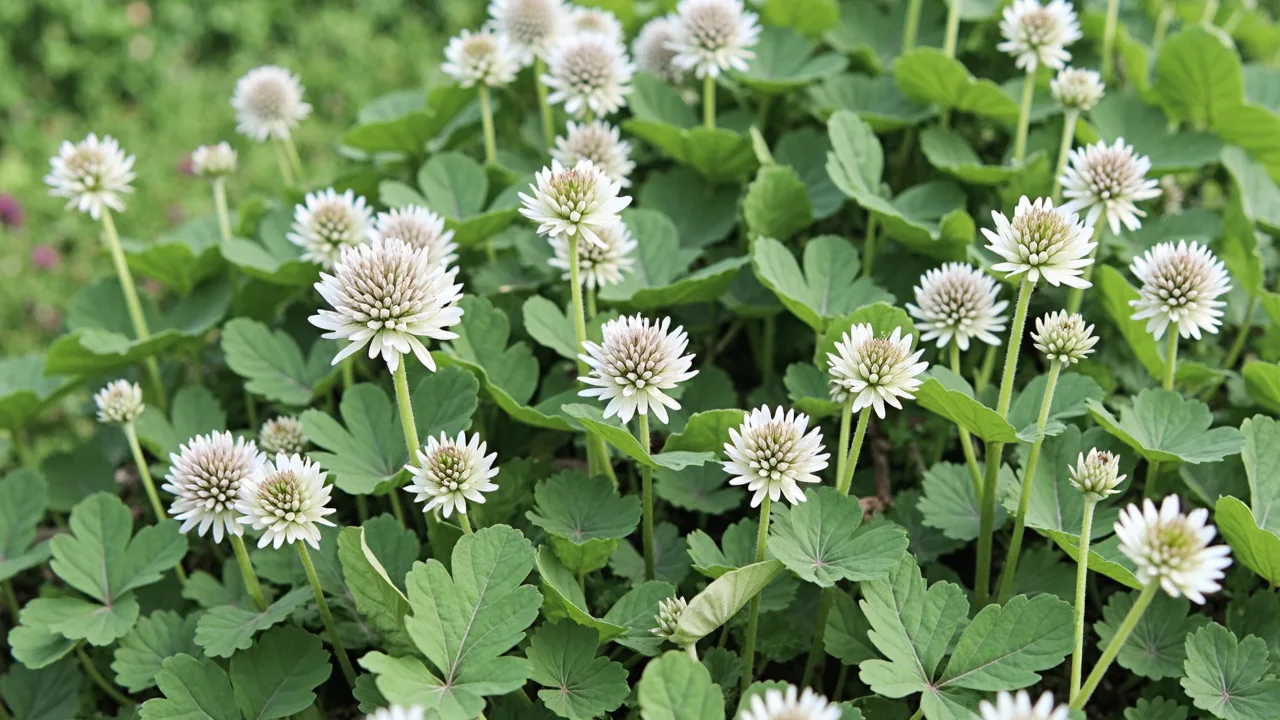
Red Clover (Trifolium pratense) is a short-lived herbaceous perennial in the pea family (Leguminosae, also called Fabaceae), native to the UK and the rest of Europe and thoroughly naturalised in British grasslands, road verges, and old pastures. Gardeners value it for three quite different reasons: as an ornamental wildflower in meadow and cottage-garden plantings, as a nitrogen-fixing workhorse that improves tired soil, and as a reliable nectar source for bees and bumblebees. It is a defining plant of the British summer meadow, alongside buttercups, oxeye daisies, and common knapweed, and it sits at the centre of many seed mixtures sold for wildlife gardens and "no-mow" lawns.
The species has been cultivated in Britain for centuries as a fodder crop, particularly in traditional hay meadows and short-term leys. It is well adapted to temperate UK conditions, fully frost-hardy, and tolerant of a wide range of soil types provided drainage is reasonable. Its deep taproot and symbiotic relationship with Rhizobium bacteria make it doubly useful: it both breaks up compacted ground and feeds the soil from the air.
A note on taxonomy: the white-flowered agricultural form sometimes listed as Trifolium pratense var. sativum is treated by many botanists as part of the same species, with variation in flower colour being continuous rather than a clean varietal split. Gardeners can treat the rose-pink to purple-red forms as a single, somewhat variable species.
Appearance
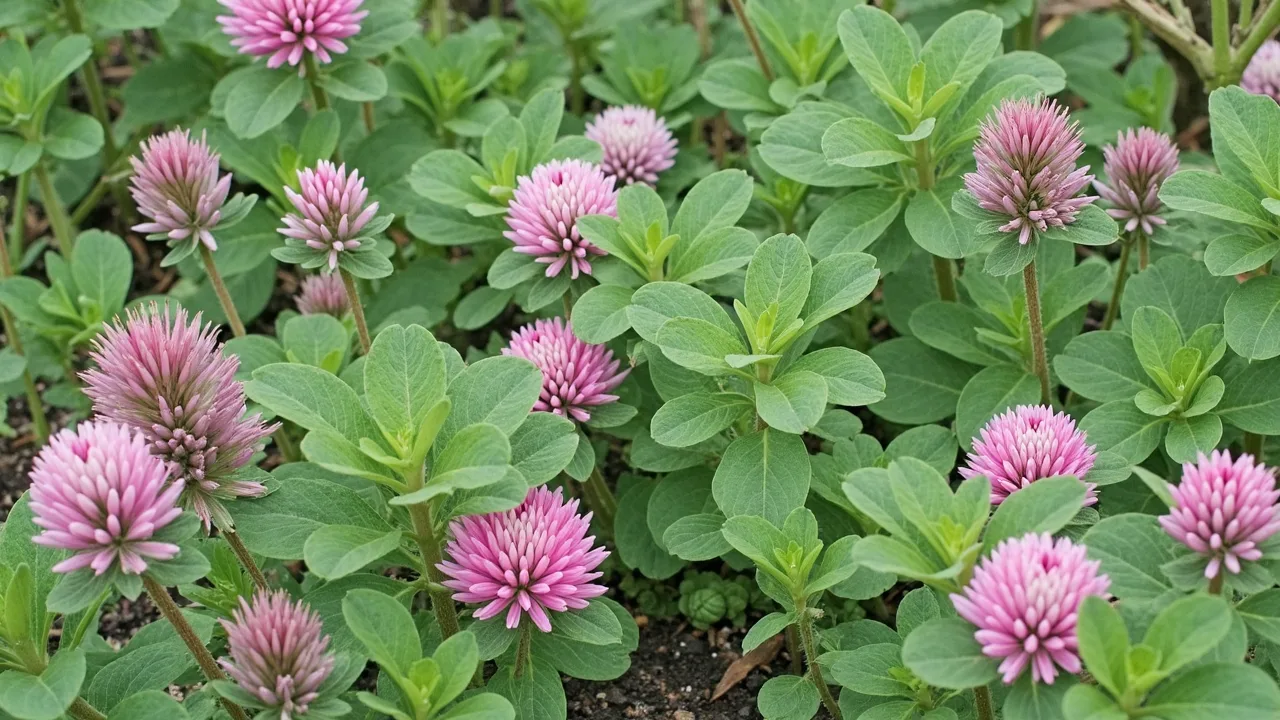
Red Clover typically grows 20–80 cm tall, with most garden and meadow plants falling in the 30–60 cm range. The stems are ascending to erect, slightly hairy, and branch from a stout crown. The leaves are trifoliate, each leaflet oval to obovate and 1.5–3 cm long, with a characteristic pale, V-shaped or chevron marking on the upper surface. The marking is most pronounced in spring and early summer growth and tends to fade on older leaves.
Flowers are carried in dense, globular heads (technically capitula) 2–3 cm across, made up of many small pea-shaped florets packed tightly together. Colour ranges from deep rose-pink through to purple-red, often paler at the base of the head. The flowers are rich in nectar and a magnet for long-tongued bumblebees, particularly Bombus hortorum and Bombus ruderatus, as well as honeybees and a range of smaller solitary bees.
Flowering begins in late May in southern England and continues in flushes through to September, with a heavy main flush in June and July. Plants that are cut back after the first flush usually produce a second, lighter flush in late summer. Seed pods form from late July onwards; each pod typically contains a single yellow-brown seed.
Growing Conditions
Red Clover is undemanding provided a few basic conditions are met. It grows best in full sun, but tolerates light or partial shade, particularly in the southern half of the UK where summer shade is seldom prolonged.
Soil: medium to light, well-drained, moderately fertile loams are ideal. The pH should sit between about 5.5 and 7.0. The plant tolerates poorer soils exceptionally well thanks to its nitrogen-fixing root nodules, but it dislikes waterlogged ground, where it quickly succumbs to root rots. Sandy loams and chalky soils both work well; heavy clay should be improved with grit and organic matter before sowing.
Climate: the species is fully hardy across the UK, including upland areas of northern England and Scotland. It performs best where annual rainfall is between roughly 600 and 1,000 mm, which covers most of lowland Britain. In drier eastern counties, occasional summer watering of newly established plants is helpful.
The species has no widely published RHS hardiness rating as a wild plant; it sits comfortably in the standard UK perennial range, broadly comparable to H7 (hardy in the severest European continental climates, > −20 °C) for general horticultural purposes, though gardeners should treat that as a rough indication only. A confirmed RHS rating has not been published in the public RHS plant finder for the species.
Planting and Care
Sowing: the easiest way to establish red clover is from seed, sown directly into prepared ground in spring (March to May) or in early autumn (August to September). Broadcast at 2–3 g per square metre onto a fine, weed-free seedbed, rake lightly, and firm. Germination takes 7–14 days in warm soil. Autumn sowings should be made early enough for seedlings to develop a crown before winter — late August is the safe end of the window for most of the UK.
Inoculation: where red clover (or any other legume) has not been grown in the previous three to four years, treating the seed with a Rhizobium leguminosarum inoculant markedly improves nodulation and early nitrogen fixation. Inoculants are available as peat-based powders or granules and are simple to mix with the seed at sowing.
Spacing: when sown in rows for cut flower or green-manure use, space rows 15–30 cm apart. In a meadow or mixed border setting, broadcast sowing into a prepared seedbed is preferable to row planting; plants will fill in via basal shoots over the first season.
Watering: keep the seedbed moist during the three to four weeks of establishment. Once plants have a developed crown and taproot, red clover tolerates dry spells well and additional watering is seldom needed outside severe drought.
Feeding: in most garden situations no fertiliser is required — the plant fixes its own nitrogen. On very poor ground, a light spring application of phosphate and potash can boost flowering, but avoid high-nitrogen feeds, which favour leafy growth at the expense of flowers.
Pruning and cutting: in a meadow context, cut or mow after the first main flush of flowering, usually in late July or August, to a height of around 8–10 cm. This tidies the sward and usually triggers a second, smaller flush in late summer. A final cut in October or November, after seed has set, keeps the sward open and reduces thatch. For hay-making, cut at roughly 50% flowering for the best balance of yield and nutritional value.
Propagation: red clover is straightforward from seed. Vegetative propagation by division of established crowns is possible in early spring but is rarely worthwhile, given how cheaply the plant can be raised from seed and how short-lived individual plants are. Most plants perform strongly in years two and three, after which they begin to decline, so a four- to five-year cycle of re-sowing is normal in productive use.
Seasonal care: in the kitchen garden, red clover is often used as a winter green manure, either broadcast onto empty beds in late summer and dug in the following spring, or undersown beneath sweetcorn and brassicas to fix nitrogen and suppress weeds. If using it as a green manure, dig in at full bloom, before the stems turn woody and slow to break down.
Common Problems
Red Clover is generally healthy in UK gardens, but a few recurring problems are worth knowing about.
Powdery mildew (Erysiphe polygoni) appears as a white, powdery coating on the upper leaf surface, typically in warm, dry, still weather. Improve airflow by thinning dense stands and remove badly affected material. The plant usually outgrows the infection once cooler, wetter weather returns.
Clover rot (Sclerotinia trifoliorum) is more serious in damp autumns. It causes a brown basal rot and rapid collapse of plants. The standard control is rotation: keep at least a three- to four-year gap between red clover crops on the same ground, and avoid close rotation with other legumes such as beans and peas.
Rust (Uromyces trifolii) produces small orange-brown pustules on stems and undersides of leaves in humid summers. Cut and destroy affected material; do not compost it.
Pea and bean weevil (Sitona lineatus) is the most common insect pest. Adults chew distinctive U-shaped notches in leaf margins in spring, while larvae feed on root nodules. Damage is usually cosmetic in garden settings but can check spring-sown establishment.
Slugs and snails will graze young seedlings, particularly in damp conditions. Standard controls — beer traps, hand-picking in the evening, or copper collars around particularly valuable plants — work as for any other seedling crop.
Clover cyst nematode (Heterodera species) causes stunted, yellowed growth in ground that has hosted clover continuously. The remedy is rotation; chemical controls are not practical for garden use.
In a kitchen-garden setting, avoid grazing livestock (especially sheep and cattle) on red clover swards during flushes of very lush growth, as it can cause bloat in ruminants. This is a farming-scale concern and does not apply to ornamental or green-manure use in a domestic garden.
Popular Varieties
Cultivar selection in red clover is largely a matter of agricultural seed trade rather than ornamental horticulture, and reliable, named garden cultivars are limited. The most commonly available selections fall into two groups.
The broad "wild-type" seed sold for meadow mixtures and pollinator plantings is variable in flower colour, plant height, and growth habit, reflecting natural population diversity. This is the right choice for most gardeners wanting a naturalistic look.
Agricultural cultivars bred for fodder and short-term leys (commonly grouped as "double-cut" or "single-cut" types based on their regrowth habit) are widely available from farm seed merchants. These are typically vigorous, high-yielding, and biennial-leaning in their production cycle, and are useful where red clover is being grown primarily as a green manure or livestock feed rather than as an ornamental.
A white- to pale-pink-flowered variant of the species, sometimes listed as Trifolium pratense var. sativum or sold as "white-flowered red clover," is occasionally offered by specialist wildflower seed suppliers. Gardeners wanting a clear white form should confirm the source — true white-flowered seed is much less common than the standard rose-pink form, and some suppliers use the term loosely.
Because cultivar naming in this species is inconsistent across UK and European seed lists, the safest approach for most gardeners is to buy a named meadow mixture from a reputable supplier and treat any variety names on the packet as a guide to provenance rather than a guarantee of distinct ornamental traits.
🌿 Wild species. Grown as the true native plant, not as named garden cultivars — so there is no cultivar list here by design, not for want of data.
Pests and Diseases
| Problem | Symptoms | Management |
|---|---|---|
| Clover root aphid | Plants appear stunted with yellowing foliage and poor growth due to sap-sucking on roots. | Improve soil drainage and avoid excessive nitrogen fertiliser to reduce susceptibility. |
| Slugs and snails | Irregular holes chewed in leaves and seedlings damaged, particularly in damp conditions. | Use physical barriers like copper tape or apply iron phosphate pellets around young plants. |
| Powdery mildew | White, powdery fungal growth appears on leaves and stems, often in humid weather. | Ensure good air circulation and avoid overhead watering to keep foliage dry. |
| Anthracnose leaf spot | Small, dark brown spots with yellow halos develop on leaves, leading to premature defoliation. | Remove infected debris and improve air flow; fungicides are rarely needed for ornamental use. |
| Nutrient deficiency | General yellowing of older leaves or pale new growth indicating lack of nitrogen or phosphorus. | Test soil pH and apply a balanced, slow-release fertiliser if growth is poor. |
For step-by-step help, read Controlling Aphids Naturally, Dealing with Slugs and Snails and Treating Powdery Mildew. Or browse the full plant problem solver to diagnose an issue by symptom.
Recommended Products
GardenWizz earns a commission from qualifying purchases made through affiliate links on this page (including links within the article) — as an Amazon Associate, and from Thompson & Morgan via the Awin network. This does not affect the price you pay. See our disclaimer for details.