Lady Tulip
Tulipa clusiana
The Gardening Year
Best months in UK gardens · full planting calendar →
🖨 Printable care card (PDF)At a Glance
| Botanical name | Tulipa clusiana |
|---|---|
| Common name(s) | Lady tulip |
| Family | Liliaceae |
| Plant type | bulb |
| Height × Spread | 15–30 cm × — |
| Position | Full sun |
| Soil | Well-drained loam or sandy soil; alkaline to neutral pH |
| Flowering | March–May |
| Toxicity | Tulipanin A and B are toxic to horses, cats and dogs. Tulipalin A induces dermatitis. |
| Native range | Afghanistan, Iran, Iraq, Pakistan and the western Himalayas of India |
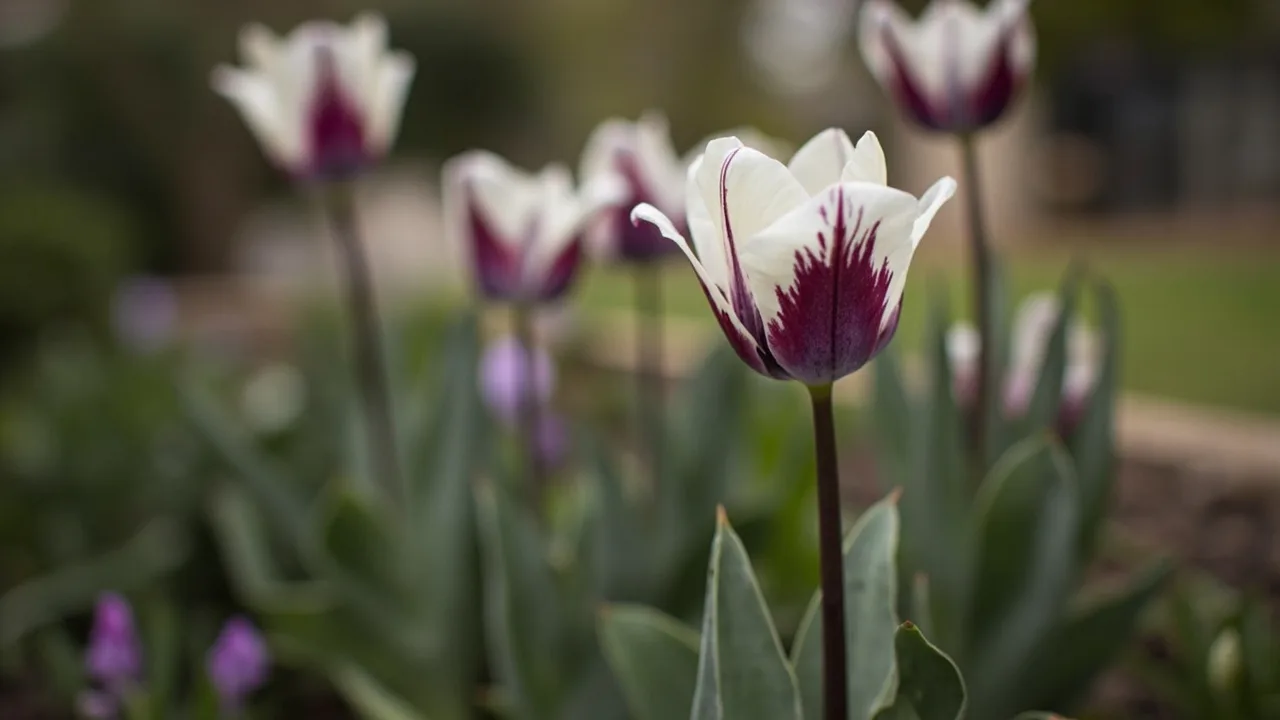
Quick answer: Tulipa clusiana, the lady tulip, is a compact species tulip from the hills of Iran, Afghanistan and the western Himalaya that has been grown in British gardens since the early seventeenth century. It produces narrow grey-green leaves and slender 20-30 cm stems topped with pointed, bicoloured flowers that open in mid-spring, the outer tepals flushed rose-red over a starry white interior. It is best planted 10-15 cm deep in autumn in sharply drained soil in full sun, and it rewards a sunny rock garden, raised bed or container more reliably than it does a heavy border.
Overview
Tulipa clusiana is one of the most reliable species tulips for British gardens and an easy plant to grow well where soil and drainage are right. Carolus Clusius, the Flemish botanist who did more than anyone to bring the tulip to northern European horticulture, first described the species from material sent back from Persia, and it entered Low Countries cultivation around 1607. It is recorded across a wide range of central and southern Asia, from northern Iraq through Iran and Afghanistan into Pakistan and the western Himalayas, growing on rocky hillsides and in seasonally dry grassland.
In UK conditions the species behaves as a small bulbous perennial that comes into growth in late winter, flowers in mid-spring and goes dormant by early summer. Its modest height and refined flower colouring make it a plant of detail rather than of bedding scale, and most experienced growers treat it as an alpine or rock-garden subject. In suitable well-drained soil it naturalises slowly by offsets and seed; in heavy or persistently damp ground the bulbs tend to rot or dwindle within two or three seasons.
Appearance
The plant forms a small clump from a pointed, papery-skinned bulb of 2-3 cm diameter. Two to four narrow, channelled leaves rise from each bulb, strap-shaped, grey-green and 10-15 cm long, with a distinct central rib. They are held erect at first, then arch gently outward as the flower stem emerges. The slender wiry stem, typically 20-30 cm tall, carries a single star-shaped flower with six pointed tepals (three petals and three sepals of much the same shape). When closed in cool weather the bud is sharply pointed and entirely rose-red outside, with a white margin. In sunshine the flower opens almost flat into a six-pointed star, revealing a creamy-white interior with a small dark basal blotch. Plants occasionally produce two flowers per stem on well-grown clumps.
In the variety most often seen in cultivation, T. clusiana var. clusiana (the true lady tulip), the colour is white inside with a distinct cherry-red reverse on the outer tepals. T. clusiana var. chrysantha carries smaller flowers of buttery yellow inside with a brick-red reverse, and is sometimes sold as 'Chrysantha' or in mixed packs as "yellow lady tulip". The two forms differ only in pigment distribution and are sometimes confused in trade.
Growing Conditions
Tulipa clusiana grows best in sharply drained soil in full sun, replicating the dry, rocky hillsides of its native range. It succeeds in gritty loam, chalky soils and very well-made raised beds, and is one of the easier species tulips to use in containers as long as the compost is free-draining. It tolerates a neutral to mildly alkaline pH and resents acidity below about pH 5.5, performing poorly on peaty substrates. The Royal Horticultural Society plant profile specifies well-drained soil and full sun for this species.
Drainage is the single most important factor for success. The bulbs need moisture through autumn and spring to root, grow and flower, but they must dry out completely during the summer dormancy from June to August. In heavy clay or in a border that stays damp into summer the bulbs typically rot; the same plant that thrives in a gravel garden will fail within two seasons in a poorly drained rose bed. South- or west-facing slopes at the base of a wall, raised beds built over a 5-10 cm layer of coarse grit, and large clay pots with a generous grit content in the compost are all reliable placements.
In UK gardens the species is hardy across most of the country. The current RHS hardiness rating for Tulipa clusiana is held on the structured plant record and rendered by the hardiness badge; this article does not republish it. Gardeners in colder inland or upland districts should expect some winter bulb loss on exposed sites, but in most lowland and suburban gardens the bulbs overwinter reliably without any lift or storage.
Planting and Care
Plant fresh, firm bulbs between late September and mid-November, as soon as they become available. Set the bulbs 10-15 cm deep, point uppermost, at 8-10 cm spacing for drifts and 12-15 cm for display clumps. In open ground, fork the area and work a 2-3 cm top-dressing of coarse grit into the top 10-15 cm to improve drainage, particularly on heavier loams. In containers use roughly two parts loam-based compost to one part sharp horticultural grit, and plant at the same depth.
Water once thoroughly to settle the soil around the bulbs, then leave the bed alone over winter. No routine watering is needed between November and March, because UK winter rainfall is sufficient. In spring, water newly planted bulbs during prolonged dry spells so that roots and shoots do not desiccate before flowering; this is most important in the south and east on free-draining soils.
No routine feeding is needed for naturalised plants or for container plantings refreshed each autumn. For established clumps where flowering has declined, a single low-nitrogen, high-potash feed in late winter supports the following year's bulb. High-nitrogen lawn or rose feeds should be avoided because they encourage soft leafy growth vulnerable to grey mould and slugs.
Allow the foliage to yellow and die back naturally after flowering, usually six to eight weeks. Cutting the leaves off while still green — a common mistake — prevents the bulb from replenishing and is the single most frequent cause of a second-year failure. Lift and divide overcrowded clumps only when flowering visibly declines, usually after four to six years, and replant the largest bulbs immediately at the same depth in fresh, gritty soil. Propagation from offsets is straightforward; named cultivars do not come true from seed.
Common Problems
Slugs attack the emerging shoots in late winter and early spring, often before the leaves are properly unfurled. A light scattering of ferric phosphate pellets around the shoots at night is the most effective control; copper rings or coarse grit top-dressings also help in containers. Tulip fire (Botrytis tulipana) is a sporadic but destructive fungal disease causing brown spotting and distortion on leaves and petals that may rot the bulb entirely. Affected plants should be lifted and destroyed (not composted), and tulips should not be replanted in the same ground for at least three years.
Stem and bulb eelworm (Ditylenchus dipsaci) is a serious nematode pest of tulips and narcissi that causes distorted, stunted growth and dark patches inside the bulb scales. Most reputable UK suppliers now propagate from clean stock, but bulbs from informal channels can introduce it; affected plants and the surrounding ground must be cleared of bulbs for several years. Bulb rot, typically caused by Fusarium or Pythium species, is almost always a symptom of poor drainage; the cure is site selection rather than fungicide.
Squirrels, mice and voles all dig up and eat tulip bulbs during autumn and winter. The most reliable deterrents are physical: lay a piece of chicken wire flat just below soil level, or top-dress with a thick layer of coarse gravel. Cracked or split skins on bulbs at planting time are normal and the bulbs still grow on; only soft, mouldy or sour-smelling bulbs should be discarded.
Popular Varieties
Tulipa clusiana var. clusiana is the type form, with white interior tepals and a strong cherry-red reverse; it is the plant most often sold simply as "lady tulip" in UK bulb catalogues and remains the most widely planted form in British gardens. It is also the form most likely to naturalise reliably on a well-prepared sunny bank.
Tulipa clusiana var. chrysantha is the yellow form, smaller in stature with clear buttery-yellow flowers inside and a brick-red reverse; it is widely sold under the cultivar name 'Chrysantha' and is a useful companion for the type in mixed spring plantings. Tulipa clusiana 'Cynthia' is a deeper-coloured selection often listed as a synonym or close variant of var. chrysantha; bulbs are occasionally available from specialist UK suppliers, although stock can be limited in any given year.
Tulipa clusiana 'Lady Jane' is a compact, vigorous form widely offered by UK bulb merchants in autumn, with the characteristic white-and-rose bicolour and slightly broader leaves than the type. Tulipa clusiana 'Peppermint Stick' is a stronger red-and-white form often promoted for forcing in bowls and patio containers, although it performs just as well in open ground. Tulipa clusiana 'Tinka' is a yellow-centred, red-edged selection frequently sold alongside the others in mixed "species tulip" collections from larger UK suppliers. No cultivar in current UK trade carries a published RHS Award of Garden Merit for this species at the time of writing.
Sources & Further Reading
- Source: https://www.rhs.org.uk/plants/18503/tulipa-clusiana/details, accessed 2026-07-22
- Source: https://powo.science.kew.org/taxon/urn:lsid:ipni.org:names:542880-1, accessed 2026-07-22
- Source: https://www.rhs.org.uk/plants/tulip/specialist, accessed 2026-07-22
- Source: https://www.rhs.org.uk/plants/tulip/growing-guide, accessed 2026-07-22
- Source: https://en.wikipedia.org/wiki/Tulipa_clusiana, accessed 2026-07-22
- Source: https://plants.ces.ncsu.edu/plants/tulipa-clusiana/, accessed 2026-07-22
Pests and Diseases
| Problem | Symptoms | Management |
|---|---|---|
| Slugs and snails | Irregular holes chewed in leaves and flowers, often accompanied by silky trails. | Use copper tape barriers or iron phosphate-based pellets around the planting area. |
| Vine weevil | Semi-circular notches on leaf margins and wilting due to root damage underground. | Apply nematode treatments in autumn or use systemic insecticides in the soil. |
| Tulip fire (Botrytis) | Greyish-brown blotches on leaves and flowers, often with fuzzy grey mould. | Remove affected plant parts immediately and ensure good air circulation around bulbs. |
| Bulb rot | Bulbs become soft, mushy, and emit a foul odour, often causing the plant to fail to emerge. | Plant in well-drained soil and avoid waterlogging during storage and growth. |
| Viral mottling | Irregular streaks, rings, or mottling of colours on the flower petals. | Remove and destroy infected plants to prevent spread by aphids; control aphid populations. |
For step-by-step help, read Dealing with Slugs and Snails. Or browse the full plant problem solver to diagnose an issue by symptom.
Recommended Products
GardenWizz earns a commission from qualifying purchases made through affiliate links on this page (including links within the article) — as an Amazon Associate, and from Thompson & Morgan via the Awin network. This does not affect the price you pay. See our disclaimer for details.