Cootamundra Wattle
Acacia baileyana
The Gardening Year
Best months in UK gardens · full planting calendar →
🖨 Printable care card (PDF)At a Glance
| Botanical name | Acacia baileyana |
|---|---|
| Common name(s) | Cootamundra wattle |
| Family | Fabaceae |
| Plant type | shrub |
| Height × Spread | 3–10 m × 2.5–4 m |
| Position | Full sun |
| Soil | Moist but well–drained loam or sand; Acid or Neutral pH |
| Flowering | January–March |
| Toxicity | — |
| Native range | New South Wales, Australia |
Acacia baileyana, commonly known as Cootamundra Wattle or Bailey's Acacia, is a medium-sized evergreen tree from south-eastern Australia whose spectacular winter and early-spring display of bright yellow flowers has earned it a devoted following in milder British gardens. Introduced to European horticulture in 1888 and prized for its feathery, grey-green bipinnate foliage, it offers something genuinely rare in UK plantings: mass floral colour at a time when little else is in bloom. In coastal and southern English counties it performs reliably enough to feature as a specimen tree, while in colder inland districts it is grown as a wall-trained shrub with winter protection.
Overview
Acacia baileyana belongs to the family Fabaceae (the legume or pea family) and is one of around 1,000 species of Acacia native chiefly to Australia. The species was described in 1888 from material collected near Cootamundra, a town in the South Western Slopes region of New South Wales, and was named in honour of the Australian botanist Frederick Manson Bailey. Although its natural range is relatively restricted — a small area of temperate south-eastern Australia — it has been planted widely across the warmer temperate world, including South Africa, New Zealand, California and Mediterranean Europe, where it is valued for its drought tolerance and out-of-season flowering.
In the United Kingdom the species occupies a niche between the hardier, more familiar Acacia dealbata (Golden Wattle or Blue Wattle, widely seen as a florists' flower) and the borderline-tender subtropicals. A. baileyana is generally regarded as slightly more compact and hardier than A. dealbata in cool maritime climates, with a more refined, silvery-grey foliage tone that holds better in dry summer conditions. Its UK performance is strongly regional: it thrives in the south-west, the Channel Islands, the Scilly Isles and other microclimates moderated by the sea, but is unreliable inland or north of a line roughly from the Wash to the Severn unless given a sheltered, south- or west-facing wall.
The plant received considerable horticultural recognition in Australia, where it is widely used as a street and parkland tree and where its golden blooms have strong cultural associations. In the United Kingdom it has been grown in specialist collections for well over a century, though it remains a connoisseur's choice rather than a mainstream garden centre purchase.
Appearance
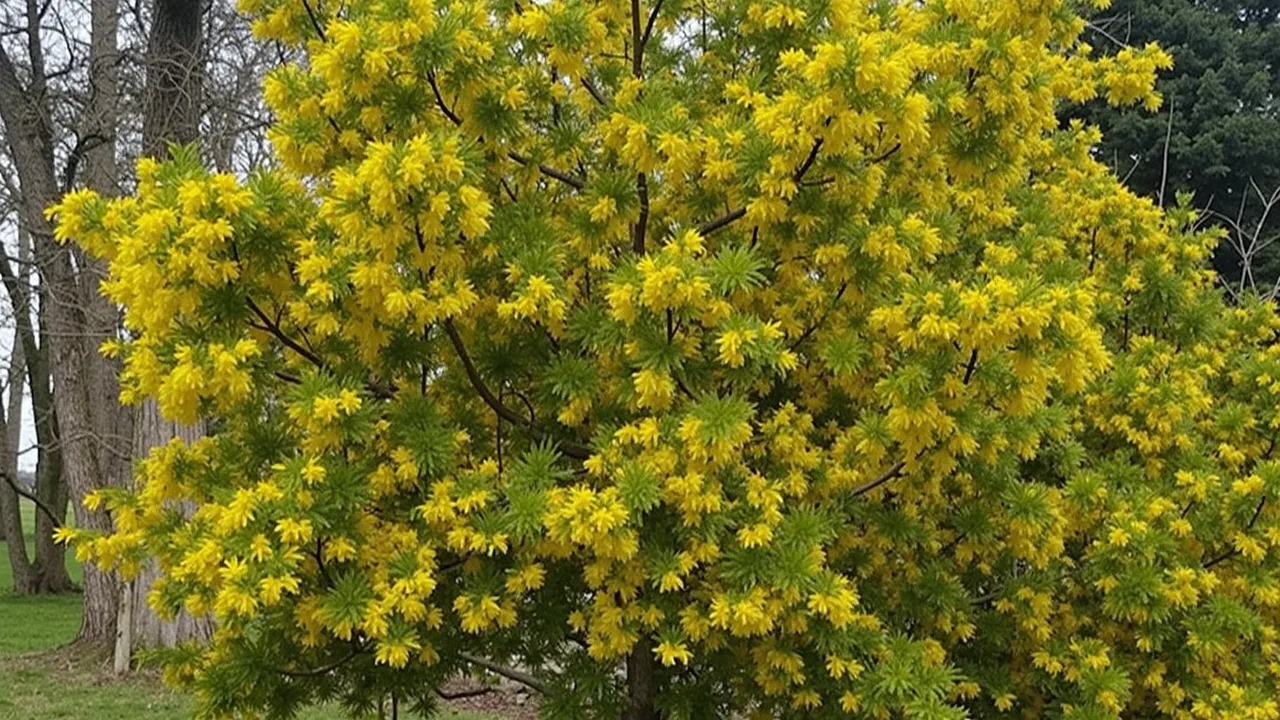
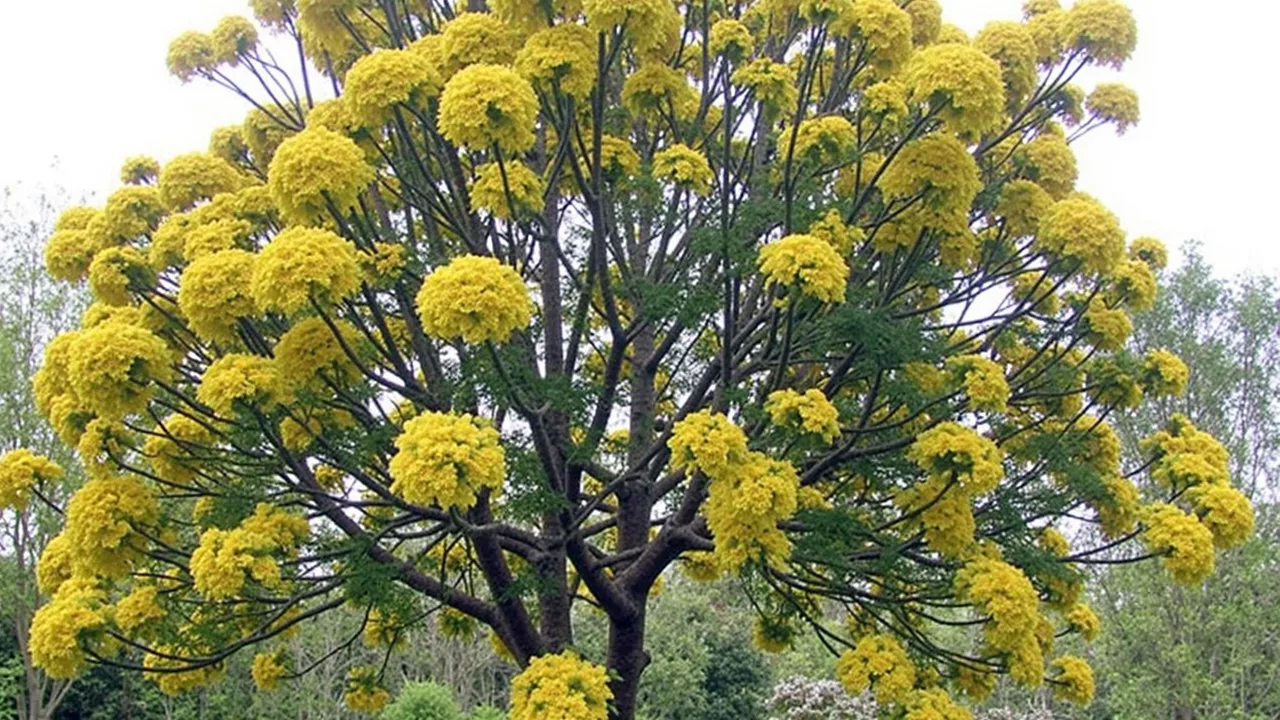
A mature Cootamundra Wattle in the open develops a broadly domed, slightly weeping canopy rather than a strict central leader, eventually making a graceful, asymmetrical tree 5–10 metres tall with an equal or greater spread. Growth is rapid in the first five to seven years and then slows; very old specimens in mild Cornish or Channel Island gardens can exceed 10 metres, though most UK plants remain in the 6–8 m range. The bark is smooth and grey-brown on young wood, darkening and becoming finely fissured on the lower trunk of older trees.
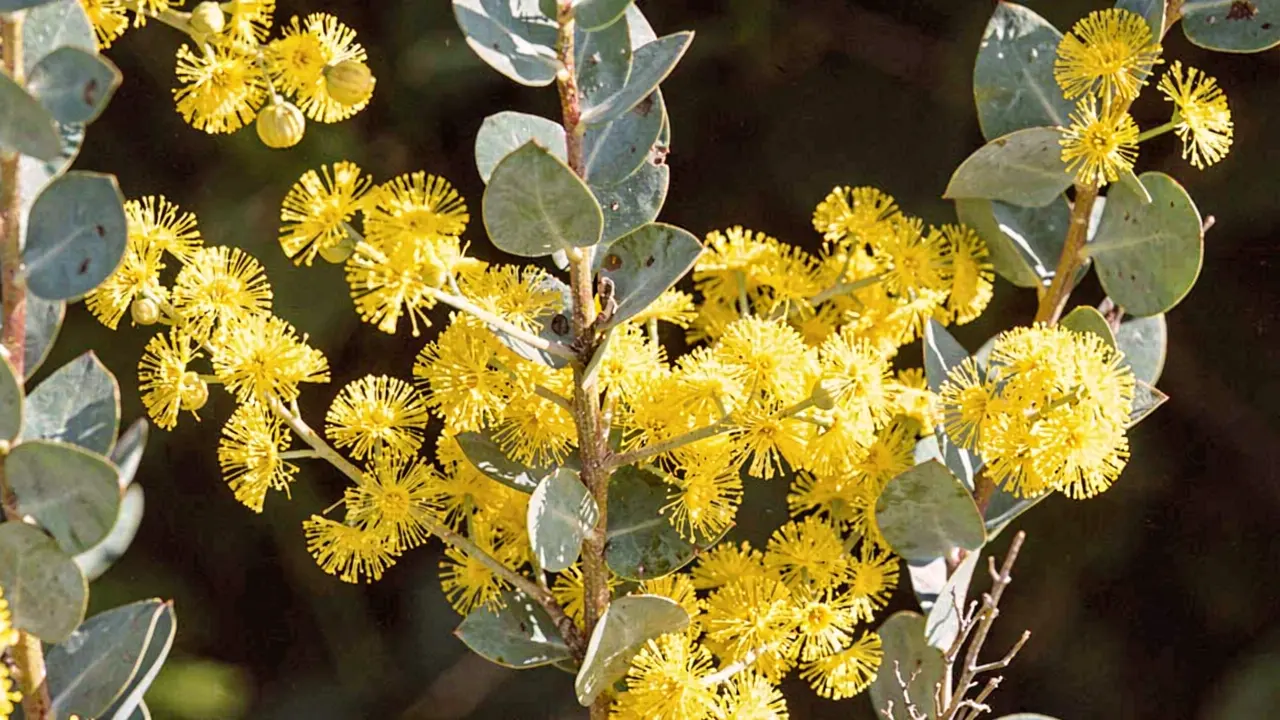
The foliage is the species' most distinctive feature. Unlike many wattles, which carry phyllodes (flattened leaf-stalks functioning as leaves), A. baileyana retains true bipinnate (twice-divided) leaves. Each leaf is 2–5 cm long, fern-like and feathery, with tiny paired pinnae along a central rachis. Mature leaves are a soft blue-grey to grey-green; the new growth, which emerges in flushes through the growing season, is often flushed bronze, purple or mauve — a character exploited in the popular cultivar 'Purpurea'. The foliage is finely textured and gives the canopy a feathery, almost cloud-like outline that contrasts well with bold-leaved evergreens such as Phormium, Cordyline or Fatsia.
Flowers are carried in dense globular heads, each head composed of 20–40 tiny individual flowers with prominent stamens giving the characteristic powder-puff appearance. Heads are roughly 5–8 mm across, bright golden-yellow, and borne in long, branched, drooping racemes (compound clusters) that can be 7–15 cm long. Each raceme carries many heads, so a well-flowered tree produces a sheet of yellow visible from a considerable distance. In UK conditions the display peaks between late January and late March, occasionally straggling into April in cold springs, and is often at its best before the foliage has fully expanded.
The fruits are typical legume pods: flattened, narrowly oblong, 5–10 cm long and 8–12 mm wide, ripening from green to grey-brown. They split along both seams to release hard, black, elongated seeds. In mild gardens seedlings can appear beneath established plants and, in the right conditions, the species will self-sow modestly.
Growing Conditions
The Royal Horticultural Society rates Acacia baileyana as H3 — "half-hardy" in their system, meaning it tolerates short periods down to roughly −5 °C and is best suited to coastal and mild locations in the south and west of the UK. Mature, well-established plants in sheltered sites have been recorded surviving brief exposure to about −8 °C, but damage to young growth and thin stems is common once temperatures fall below −5 °C for any length of time. The plant is therefore recommended for RHS hardiness Zones 8 and 9 (roughly the milder coastal and southern counties), with caveats for inland Zone 8 sites. Cold, exposed midlands, northern England, most of Scotland and inland Ireland are generally unsuitable without substantial winter protection.
Aspect is critical. Full sun is essential for prolific flowering; in shade or partial shade the plant becomes leggy, sparsely flowered and prone to wind-rock. The ideal site is a south- or west-facing position with overhead shelter from the coldest winter winds, ideally against a masonry wall that radiates stored warmth. Cold easterly winds in late winter and early spring are more damaging than the absolute minimum temperature because they scorch the soft new growth and brown the flowers.
Soil must be free-draining. A. baileyana tolerates a wide pH range from moderately acidic to near-neutral but suffers quickly in heavy clay or anywhere that water lies around the roots in winter, where it is vulnerable to Phytophthora root rot. A medium loam or sandy loam suits it best; on chalky ground the species tends to develop chlorosis (yellowing of the foliage from iron deficiency) and grows poorly unless grafted onto a tolerant rootstock or grown in a container with ericaceous compost. Once established the plant is notably drought-tolerant and will survive the dry summers typical of the south-east without supplementary watering.
Planting and Care
Container-grown plants establish best and can be planted at any time of year when soil is workable and the ground is not frozen, though the preferred planting window is spring (March to May) once the worst frosts have passed, or early autumn (September to early October) in mild areas where there is time for roots to settle before winter. Dig a hole one-and-a-half to two times the width of the root ball and no deeper; the crown of the plant should sit at or just above the surrounding soil level, as acacias are prone to collar rot if sunk too deeply. Backfill with the native soil, water in thoroughly, and apply a 5–8 cm mulch of bark or compost, keeping it clear of the stem.
Watering is most important in the first two growing seasons: water deeply once a week during dry spells, then taper off. Once the plant is established (typically by year three), supplementary watering is rarely needed except in prolonged drought or for container specimens. Over-watering is a more common cause of failure than under-watering.
Feeding is generally unnecessary in open ground. On very poor or sandy soils a light application of a balanced general-purpose fertiliser in mid-spring will improve vigour, but high-nitrogen feeds should be avoided as they promote soft, frost-vulnerable growth at the expense of flower. Container specimens benefit from a monthly dilute liquid feed through the growing season.
Pruning is light and best done immediately after flowering has finished, typically in late March or April. Remove any damaged, crossing or frost-blackened shoots, shorten over-long branches to maintain a balanced shape, and, on wall-trained plants, tie in new framework growth. A. baileyana responds well to harder renovation pruning if it becomes leggy or outgrows its space, regenerating freely from older wood when cut back to within 30–60 cm of the main framework in mid-spring. Avoid heavy pruning in autumn or winter, which can stimulate vulnerable late-season growth.
Propagation is most reliably carried out by seed. Acacia seeds have a hard coat and benefit from scarification — a brief immersion in just-boiled water left to cool for 12–24 hours, or a light nick with sandpaper — before sowing in a free-draining seed compost at around 18–21 °C in spring. Named cultivars such as 'Purpurea' must be propagated vegetatively; semi-ripe cuttings taken in mid- to late summer and rooted with bottom heat in a gritty compost will strike reasonably well, though success rates vary.
Container culture is appropriate in colder districts where the plant must be moved to a frost-free greenhouse or conservatory for winter. Use a loam-based (John Innes-type) compost with added grit for drainage, water freely in summer and sparingly in winter, and feed monthly through the growing season. Repot annually until the plant reaches the desired size, then top-dress each spring.
Seasonal care is minimal: in late winter, protect young or wall-trained specimens with horticultural fleece during hard frosts; in spring, prune and tidy once flowering is over; in summer, watch for the first signs of water stress in container-grown plants; in autumn, clear fallen pods if self-sowing is not wanted, and reduce watering for pot-grown specimens as temperatures fall.
Common Problems
Frost damage is the single most frequent issue. Young foliage, soft new shoots and thin branches are blackened by anything more than a few degrees of frost, and prolonged hard freezes can kill stems back to the main framework. The remedy is siting, mulching and, where feasible, fleece protection in late winter.
Cold, drying winds cause leaf scorch — the leaflets turn brown at the margins and the plant looks generally distressed. This is best prevented by choosing a sheltered site; once damage has occurred the plant usually recovers in the following season.
Phytophthora root rot appears in heavy, wet or poorly drained soils, causing sudden wilting, die-back and often the death of the whole plant. There is no effective chemical cure; prevention through good drainage is the only reliable approach. Affected plants and surrounding soil should be removed and the site avoided for replanting with acacias for several years.
Chlorosis (yellowing leaves with green veins) indicates iron or manganese deficiency, almost always on alkaline or chalky soils. Treat by applying a chelated iron feed, by mulching with acidic organic matter such as pine bark, or, in containers, by switching to ericaceous compost. Long-term, planting in suitably acidic soil is the only permanent solution.
Scale insects can colonise stems and the undersides of leaves, appearing as small brown or grey bumps, often with sooty mould developing on the honeydew they excrete. Treat with a winter wash of horticultural oil or, in the growing season, with a suitable systemic insecticide following label instructions.
Powdery mildew is occasionally seen in dry, still summers, producing a white dusty coating on the foliage. Improve air circulation by thinning surrounding vegetation; persistent outbreaks can be managed with sulphur-based or potassium bicarbonate sprays.
Self-sown seedlings, while rarely a serious nuisance, can appear in mild gardens from fallen seed. Hand-pull them while young if unwanted.
Popular Varieties
'Purpurea' is the best-known and most widely planted cultivar of A. baileyana. Its new growth is distinctly bronze to purple, flushing through summer and gradually maturing to the same grey-green as the species, which gives the canopy an attractive two-tone effect. The flowering and habit are otherwise identical to the type. It is also sold under the name Acacia baileyana 'Rubra'.
Acacia baileyana var. aurea (sometimes sold as 'Aurea') refers to plants with particularly intense golden new growth, though availability in the UK is limited and the distinction from typical seedlings of 'Purpurea' is debated in some references.
Acacia baileyana 'Compacta' is a lower-growing, denser selection reaching only around 2–3 m, useful where space is limited or where a wall shrub is required. Plants in the UK trade are sometimes offered under this name but supply can be inconsistent.
Beyond these, a number of naturally occurring and selected forms exist in Australian horticulture, but their availability in British nurseries is sporadic. Gardeners seeking unusual forms are generally best served by specialist Australian-plant nurseries, by seed exchanges, or by grafting onto seedling rootstock, which is the technique used to maintain some of the better foliage clones.
Cultivars and Varieties
| Cultivar | Height | Flower | Notes | AGM |
|---|---|---|---|---|
| 'Purpurea' | — | — | RHS AGM (H3) | ✓ |
Pests and Diseases
| Problem | Symptoms | Management |
|---|---|---|
| Glasshouse red spider mite | Fine webbing and stippled, yellowing leaves caused by tiny mites feeding on foliage. | Increase humidity around the plant and spray with a horticultural oil or insecticidal soap. |
| Mealybugs | White, cottony wax-like masses found in leaf axils and on stems, often accompanied by sticky honeydew. | Wipe off infestations with a cloth dampened in methylated spirit or apply systemic insecticide. |
| Fluted scale | Small, immobile, fluted brown scales attached to stems and leaves, weakening the plant. | Prune out heavily infested branches and treat remaining pests with horticultural oil in winter. |
| Honey fungus | Wilting foliage, dieback of branches, and white fungal growth under the bark at the base. | Improve drainage and remove infected roots; severe cases may require removing the plant. |
| Vine weevil | Notched leaf margins on young plants and root damage caused by grubs in the compost. | Check pots for grubs before planting and use nematodes or systemic insecticides as a preventative. |
Or browse the full plant problem solver to diagnose an issue by symptom.
Recommended Products
GardenWizz earns a commission from qualifying purchases made through affiliate links on this page (including links within the article) — as an Amazon Associate, and from Thompson & Morgan via the Awin network. This does not affect the price you pay. See our disclaimer for details.