Chenille Plant
Acalypha hispida
The Gardening Year
Best months in UK gardens · full planting calendar →
🖨 Printable care card (PDF)At a Glance
| Botanical name | Acalypha hispida |
|---|---|
| Common name(s) | Chenille Plant |
| Family | Euphorbiaceae |
| Plant type | shrub (Evergreen; dioecious) |
| Height × Spread | 1–2.5 m × 91–183 cm |
| Position | Full sun, Partial shade |
| Soil | Moist but well-drained; fertile, humus-rich; loose potting soil rich in organic matter and sand; peat-free potting compost |
| Flowering | January–December |
| Toxicity | Clear latex is poisonous and can irritate skin and mucous membranes |
| Native range | Tropical Asia (Malesia, Papuasia), New Guinea, Malaya |
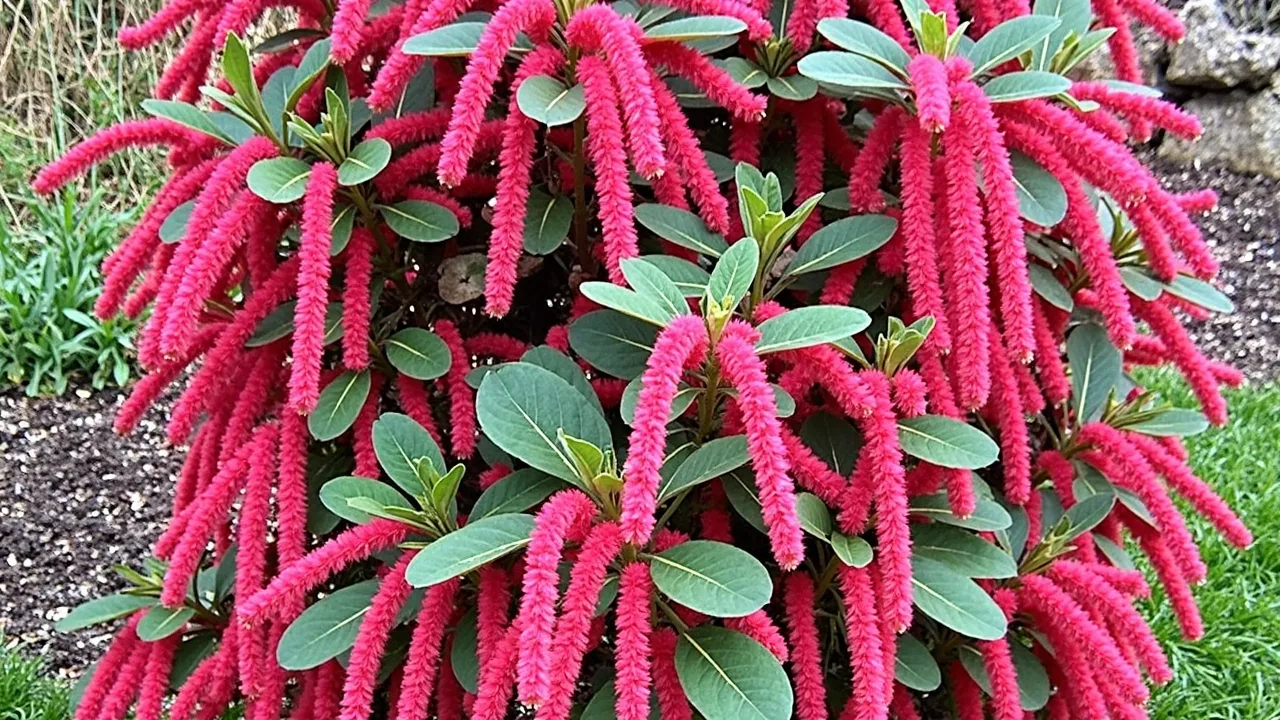
The chenille plant (Acalypha hispida) is a tender evergreen shrub from the spurge family (Euphorbiaceae), grown for its extraordinary long, drooping, crimson-red flower catkins. In the UK it is treated almost exclusively as a container or conservatory specimen because it is not frost-hardy, but in the right warm, bright position it produces an almost unmatched floral display from late spring through autumn. The same plant is sold under the common names red hot cattail and foxtail plant, both describing the long, furry, tassel-like inflorescences that give the species its ornamental value.
Overview
Acalypha hispida is native to New Guinea, the Malay Archipelago and parts of the Pacific, where it grows as an understorey shrub in warm, humid woodland. It was introduced to European glasshouse collections in the late nineteenth century and quickly became a popular feature plant for tropical and warm-temperate glasshouses because of its unusual and long-lasting flowers. In its native range it can reach 2.5–3 m, but in cultivation, and especially in pots in the UK, it is usually kept between 60 cm and 1.8 m tall.
The species is dioecious, meaning male and female flowers are borne on separate plants. Only female plants are normally cultivated, as they produce the long, showy crimson catkins; male plants bear shorter, less conspicuous inflorescences and are rarely seen in horticulture. In the UK it has received the Royal Horticultural Society's Award of Garden Merit, recognising its performance as a glasshouse and warm-conservatory subject.
For UK gardeners it is best understood as a summer patio and year-round indoor plant rather than a permanent outdoor border shrub. It tolerates neither frost nor prolonged cold, and a single sharp frost will kill top growth. Given frost-free overwintering, bright light in summer and steady moisture, however, it flowers freely and reliably.
Appearance
The chenille plant forms a soft-wooded, evergreen shrub with a rounded, slightly open habit. Stems are green to reddish-brown and bear alternate, broadly ovate to heart-shaped leaves up to 20 cm long. The leaves are mid-to-dark green, slightly glossy above, with a paler underside and a coarsely toothed margin. Young stems and leaf stalks carry fine bristles, which give the species its name hispida — Latin for "bristly".
The flowers are the plant's defining feature. Female plants produce pendulous, cylindrical catkins from the leaf axils, typically 20–50 cm long and 1–2 cm across. Each catkin is densely packed with tiny, petalless flowers set among bright red bristles, giving the whole spike a soft, velvety, almost fur-like texture. Mature catkins range from a vivid scarlet through crimson to deep pinkish-red depending on clone and growing conditions. A well-grown plant in active growth can carry dozens of catkins at once, and individual spikes last for several weeks before fading.
Plants are normally sold in flower during late spring and summer, when the catkins are most conspicuous. The flowers are followed by small, three-lobed seed capsules on female plants, although seed set is uncommon in UK cultivation where pollinating insects are rarely present under glass.
Growing Conditions
Acalypha hispida is tender and requires warm, frost-free conditions for most of the year. The Royal Horticultural Society rates it H1B, meaning it needs a minimum winter temperature of 10–15 °C and is suitable only for heated glass or a warm conservatory. In the very mildest coastal UK microclimates, such as Tresco on the Isles of Scilly, established plants may survive a light frost with protection, but this should not be relied upon elsewhere in Britain.
It performs best where summer temperatures sit between 18 °C and 27 °C, with bright light and humidity above about 60 per cent. Cold draughts from single-glazed windows or open doorways in winter will quickly cause leaf drop, and dry air from central heating encourages glasshouse red spider mite.
Indoor and conservatory placement: site in a south- or west-facing position with at least four hours of direct sun daily. A bright kitchen or bathroom with good natural light also suits it. Outdoors in summer, a sheltered, sunny patio is ideal; an open east-facing site should be avoided because of cold morning winds in spring.
Soil and compost: use a moisture-retentive but freely draining mix. A peat-free multipurpose compost with roughly one part perlite or coarse grit to four parts compost works well. Aim for a slightly acidic to neutral pH (around 6.0–7.0). For permanent container specimens, refresh the top 5 cm of compost each spring and repot into a slightly larger pot every two to three years.
Planting and Care
Pot size and repotting: Start with a container at least 30–40 cm in diameter for a mature specimen, with several drainage holes. Raise the pot on pot feet so excess water can escape freely. Repot in spring only when the rootball is congested.
Watering: Keep the compost evenly moist from April through September. In hot summer weather the plant may need watering once or even twice daily in a small pot. Reduce watering from October onwards, allowing the top 2–3 cm of compost to dry between waterings, but never let the rootball dry out completely — the chenille plant wilts dramatically and recovers poorly if drought-stressed.
Feeding: Apply a high-potassium liquid fertiliser (the type sold for tomatoes) every 10–14 days from late spring through early autumn to support continuous flower production. Withhold feed in winter when growth slows.
Pruning: Cut back leggy, frost-damaged or exhausted growth in March, just as new growth begins. The plant responds well to hard pruning and will reshoot from older wood. Always wear gloves and consider eye protection: the stems bleed a milky sap typical of the Euphorbiaceae that can irritate skin and eyes.
Propagation: Take 8–10 cm softwood tip cuttings in late spring or early summer. Remove the lower leaves, dip the cut end in rooting hormone and insert into a 50:50 mix of peat-free compost and perlite. Provide bottom heat of around 21 °C and high humidity; roots usually form within three to four weeks. Pot on once rooted and grow on in warmth.
Seasonal care: Harden plants off gradually over 7–10 days in late May before moving them outside for the summer. Watch night forecasts and bring the plant back indoors before nights drop below about 12 °C. By early October the plant should be in its winter quarters — a bright, frost-free room, conservatory or heated greenhouse at a steady 10–15 °C minimum.
Overwintering: Reduce watering, stop feeding and inspect weekly for glasshouse pests. Avoid placing the pot directly above a hot radiator, where dry air and temperature swings cause leaf yellowing and drop. A pebble tray filled with water beneath the pot raises local humidity without waterlogging the roots.
Common Problems
Leaf drop: The most frequent complaint. Causes include cold draughts, a sudden drop in temperature, underwatering, low humidity or being moved outdoors too early in spring. Identify and correct the trigger; most plants recover once conditions stabilise and put out fresh growth in spring.
Glasshouse red spider mite (Tetranychus urticae): Thrives in dry, warm indoor air. Symptoms include fine pale mottling on leaves, fine webbing under the leaf and a general loss of vigour. Increase humidity, consider biological control with Phytoseiulus persimilis, or treat with a suitable acaricide following the label.
Whitefly: Common under glass. Small white insects fly up when the plant is disturbed. Use yellow sticky traps for monitoring and the parasitic wasp Encarsia formosa for biological control in a closed environment.
Aphids: Cluster on young shoot tips and on the developing flower catkins. Knock off with a strong jet of water or treat with an insecticidal soap. Check regularly during the main growing season.
Mealybugs: Found in leaf axils and on the undersides of leaves as small, white, cottony tufts. Dab individual insects with a cotton bud dipped in methylated spirits, or use a systemic insecticide for heavier infestations.
Powdery mildew: A white, dusty coating on leaves in poorly ventilated, stagnant air. Improve air circulation, remove affected leaves and avoid overhead watering late in the day.
Failure to flower: Usually caused by insufficient light or under-feeding. Move to a brighter position and apply a high-potassium liquid feed every fortnight through summer. Young plants may also take a season to settle before flowering heavily.
Root rot: Caused by overwatering, compacted compost or pots without free drainage. Always use containers with drainage holes, add grit or perlite to the compost and let the surface dry slightly between waterings in winter.
Toxicity and sap: All parts are mildly toxic if ingested and may cause gastric irritation; the milky sap irritates skin and eyes. Wear gloves when pruning and keep the plant out of reach of pets and small children.
Popular Varieties
True cultivars of Acalypha hispida are limited, and the species is most often sold simply as the type. Where named forms appear they tend to differ in flower colour, catkin length or plant size rather than in leaf or habit. The following are the forms most commonly encountered in UK horticulture; treat any local nursery listing as a guide rather than a guarantee of identity.
- Acalypha hispida (species form): The standard chenille plant, with crimson-red catkins 20–50 cm long on a 1–1.8 m shrub. The form most often awarded and most widely grown under glass.
- 'Alba' (white chenille plant): A pale-flowered form producing creamy-white to greenish catkins rather than red. Less commonly stocked but occasionally offered by specialist conservatory-plant nurseries. Slightly less vigorous than the red form.
- 'Compacta': A more compact selection, typically reaching 60–90 cm, with shorter catkins but a denser, bushier habit. Useful where space is limited in a conservatory or on a smaller patio.
- 'Pendula': A trailing or markedly pendulous form often grown in hanging baskets or tall pots so that the long catkins can hang freely. Identical flower colour to the species but with a softer, weeping silhouette.
When buying, look for healthy green foliage without yellowing or mottling, and where possible choose plants already showing bud or early catkin development so the colour and length can be assessed before purchase.
Pests and Diseases
| Problem | Symptoms | Management |
|---|---|---|
| Glasshouse whitefly | Tiny white flies swarm when disturbed; leaves become sticky with honeydew and may yellow. | Use yellow sticky traps to monitor adults and treat infestations with insecticidal soap or biological controls. |
| Glasshouse red spider mite | Fine webbing on leaves accompanied by stippled, bronzed foliage and eventual leaf drop. | Increase humidity around the plant and spray with a horticultural oil or miticide if infestation is severe. |
| Mealybugs | White, cottony wax-like masses appear in leaf axils and on stems, often accompanied by sticky residue. | Wipe off visible bugs with a cotton bud dipped in methylated spirits and apply systemic insecticide if needed. |
| Scale insects | Small, immobile, shield-like bumps on stems and leaves that secrete honeydew leading to sooty mould. | Scrape off scales manually or treat with a systemic insecticide applied as a soil drench. |
| Root rot | Leaves turn yellow and wilt despite moist soil, often due to overwatering in winter. | Ensure pots have good drainage and water sparingly during the dormant winter period. |
Or browse the full plant problem solver to diagnose an issue by symptom.
Recommended Products
GardenWizz earns a commission from qualifying purchases made through affiliate links on this page (including links within the article) — as an Amazon Associate, and from Thompson & Morgan via the Awin network. This does not affect the price you pay. See our disclaimer for details.