
Common Bent
Agrostis capillaris
The Gardening Year
Best months in UK gardens · full planting calendar →
🖨 Printable care card (PDF)At a Glance
| Botanical name | Agrostis capillaris |
|---|---|
| Common name(s) | Common Bent |
| Family | Poaceae |
| Plant type | grass |
| Height × Spread | 10–70 cm × — |
| Position | Full sun, Partial shade |
| Soil | Moist but well–drained, Well–drained; Acid, Neutral; Chalk Clay Loam Sand |
| Flowering | May–June |
| Toxicity | — |
| Native range | Eurasia |
Overview
Common Bent (Agrostis capillaris, syn. A. tenuis) is a fine-leaved perennial grass of the family Poaceae, native to the UK and much of temperate Europe, and one of the characteristic species of British lowland grassland. Also known as Colonial Bent or Browntop Bent, it forms a dense, low-growing sward in meadows, pastures, heaths, dunes and rough ground, and has been cultivated for centuries as a constituent of fine lawn and sports-turf seed mixtures. The species is fully hardy across the UK, tolerates a wide range of soil types, and recovers well from close mowing, which together account for its long association with traditional British lawns and golf-course turf. The table below summarises its main requirements for UK growers; the rest of the article covers each in more detail.
Agrostis capillaris is a slender, tufted perennial with a shallow rhizome system that allows it to colonise thin, low-fertility ground where taller, more vigorous grasses struggle. It is wind-pollinated and produces a delicate, open panicle in early summer that turns a soft straw colour as the seed ripens. Ecologically, it is a key component of the UK's traditional neutral and acidic grassland communities, supporting a range of moth larvae and other invertebrates, and is widely sown in wildflower-meadow seed mixtures where a fine grass matrix is required. The species is not considered toxic to humans, livestock or domestic animals.
Appearance
Common Bent forms a low, dense tuft or sward, typically 20 to 60 cm tall depending on soil fertility and whether the plant is grown as a lawn or allowed to flower in a meadow setting. The leaves are slender, 1 to 4 mm wide, flat to slightly inrolled, with a rough upper surface and a smooth, shiny underside; the ligule is short and membranous. Each tiller produces a few short, basal leaves and one to three slender, wiry culms (flowering stems) which are often bent or kneed near the base — the trait that gives the grass its common name.
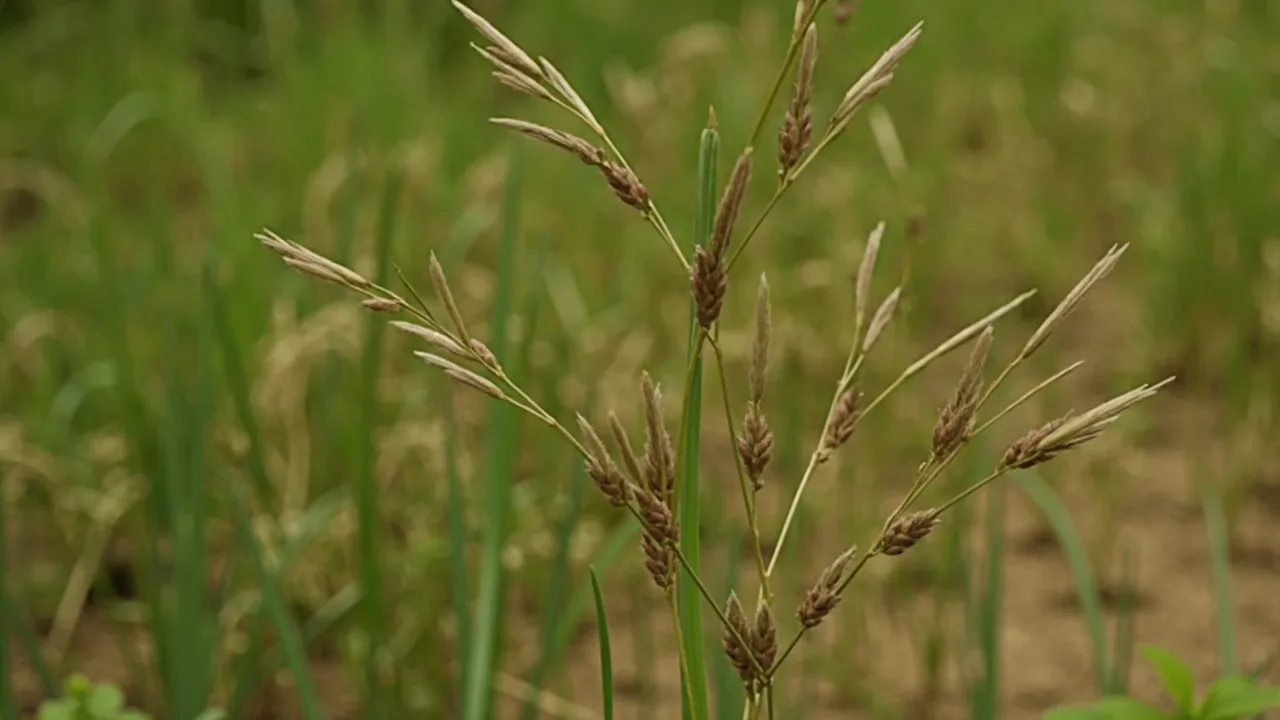
The flowering head is a delicate, open panicle, usually 5 to 15 cm long and as much across, with very fine branchlets that spread at anthesis and contract again in fruit. Spikelets are small, single-flowered, pale green to purplish, and ripen to a buff or pale straw colour from late June onwards. The seed is small and light, and shed readily once ripe. Below ground, the plant develops a network of short rhizomes that knit the sward together; spread is slow but persistent, and a well-established bent turf can be remarkably durable.
In a meadow, the species is most conspicuous from late May through July, when the airy panicles catch the light above the surrounding vegetation. In a lawn, the inflorescences are removed by regular mowing, and the visual character is that of a tight, fine-leaved, slightly bluish-green turf that holds its colour well into winter.
Growing Conditions
Common Bent is one of the most adaptable British native grasses and will establish on a wide range of soils, provided drainage is reasonable. It performs best on well-drained, light to moderately fertile substrates — sandy loams, free-draining clay loams, gravelly ground, and the thin, acidic soils of upland pastures all suit it. It tolerates mildly acidic conditions better than many grasses and is a common component of heathland and moor-edge swards in the west and north of the UK. The species is, however, easily outcompeted on rich, moisture-retentive or heavily fertilised soils, where coarser grasses such as perennial ryegrass and Yorkshire fog will dominate.
It tolerates full sun and light dappled shade equally well, though in dense shade it thins and is invaded by moss. It is fully hardy across the UK, with the RHS rating of H7 indicating tolerance of winter temperatures below -20 °C, and is therefore reliable from the Scottish lowlands to the south coast. Once established, the plant is moderately drought-tolerant: it will brown off in a prolonged dry summer but recovers quickly when rain returns. It is also tolerant of exposed, windy sites, which is why it remains a dominant species on coastal dunes and clifftop grasslands.
Soil pH is not critical, but a slightly acidic to neutral reading of about pH 5.5 to 7.0 suits the species best; values well outside this range are usually a sign that other site factors will dominate the sward. Waterlogged ground is the main condition to avoid: bent will not survive prolonged winter wet at the crown.
Planting and Care
Establish Common Bent either from seed or from small container-raised plants. For lawns or large areas, seed is the standard method: sow in early autumn or, in the south, in early spring, at 10 to 15 g per square metre onto a fine, weed-free seedbed. Rake lightly to cover, firm with a roller or the back of a rake, and keep the surface moist until germination, which takes 10 to 21 days. For wildflower meadows, Agrostis capillaris is typically included as a minor component of a mixed seed sward at 5 to 10 percent by weight, the rest being wildflowers and other fine native grasses.
Container-grown plants can be set out from autumn to early spring, spaced 15 to 20 cm apart for a lawn effect, and watered in thoroughly. Use a gritty, free-draining potting mixture if growing in pots, and divide congested clumps every two to three years in spring.
Watering is important only in the establishment phase; mature bent requires little or no supplementary irrigation except in a prolonged drought on very free-draining soil. Feeding should be light — overfeeding favours coarser grasses and encourages thatch. A single low-nitrogen spring feed, or none at all in a meadow setting, is sufficient.
Mowing is the main maintenance task in a lawn. The species tolerates close mowing down to about 1 to 2 cm, which is why it has been used on golf and bowling greens for over a century. In a meadow, cut once in late July or early August after the main flowering, and again in early spring if desired, removing the cuttings to keep fertility low.
Propagation is straightforward by seed, or by division of established clumps in spring or autumn. The species self-sows freely in a meadow setting, and bare patches in a lawn can be repaired by oversowing in autumn at 5 g per square metre and keeping the surface damp for two to three weeks.
Common Problems
The most common disease of bent turf in the UK is red thread (Laetisaria fuciformis), which produces pinkish-red fungal threads on leaf tips in humid summer weather. It is rarely fatal and usually responds to a light nitrogen feed and improved air movement; resistant cultivars are available for high-value turf. Fusarium patch (Microdochium nivale) causes circular, bleached patches in cool, damp autumn and winter conditions and is best prevented by avoiding overwatering, improving surface drainage and not top-dressing with rich organic matter in late autumn.
The principal insect pest is leatherjackets — the larvae of crane flies (Tipula spp.) — which chew through roots and stem bases and cause yellowing, thinning and bare patches in late spring. Biological control with Steinernema feltiae nematodes, applied in late summer or early autumn when soil is moist and warm, is the standard organic treatment. Chafer grubs can produce similar damage on lighter soils.
Moss invasion is a symptom rather than a cause: it usually indicates compaction, shade, poor drainage or very low fertility. Address the underlying cause by aerating, scarifying, raising the cutting height slightly and, if necessary, applying a low-nitrogen feed. Encroachment by coarser grasses such as ryegrass on fertile ground is managed by reducing fertility and overseeding with bent in early autumn.
Common Bent is not affected by any notifiable pests or diseases in the UK and is generally regarded as a low-maintenance, robust species for both ornamental and ecological plantings.
Popular Varieties
Agrostis capillaris has been selectively bred for turf use for over a century, and several named cultivars are widely available in the UK trade. 'Highland' is a traditional, dark green, fine-leaved form with good winter colour and close-mowing tolerance, long established in lawn and golf-turf mixtures. 'Barking' is a more modern selection bred for improved density and disease resistance, including better tolerance of red thread, and is a common component of professional fine-turf seed mixes. 'AberRoyal' and 'AberGold' are Welsh-bred lines from the IBERSAberystwyth programme, valued in trials for their fine leaf texture and consistent performance under close mowing. 'Tiger' is another cultivar encountered in amenity seed mixtures, selected for rapid establishment and wear tolerance.
For ecological and meadow sowings, seed of the species (rather than a named cultivar) is usually preferred, as it maintains greater genetic diversity and is closer to the native form. Wild-collected or British-origin provenance seed is available from several specialist suppliers and is the appropriate choice for habitat restoration projects.
Pests and Diseases
| Problem | Symptoms | Management |
|---|---|---|
| Dollar spot | Small, silver-dollar-sized patches of bleached or tan grass appear on the lawn surface. | Improve air circulation by mowing regularly and avoid excessive nitrogen fertiliser in warm weather. |
| Fusarium patch | Water-soaked, circular patches of grass that turn straw-coloured, often visible with morning dew. | Ensure good drainage, reduce thatch buildup, and avoid overwatering to prevent fungal growth. |
| Leatherjackets | Grass becomes loose and easily pulled up due to larvae feeding on roots underground. | Apply biological control products containing nematodes in autumn when soil temperatures are above 5°C. |
| Chafer grubs | Irregular patches of dying grass caused by white C-shaped larvae feeding on roots. | Monitor for adult beetles and consider biological nematode treatments if infestation is severe. |
| Algae growth | A slimy, dark green or black layer forms on the soil surface, often in damp, shaded areas. | Improve drainage and aeration by scarifying the lawn and reducing shade where possible. |
Or browse the full plant problem solver to diagnose an issue by symptom.
As an Amazon Associate, GardenWizz earns from qualifying purchases made through links on this page (including links within the article). This does not affect the price you pay. See our disclaimer for details.