
Wood Sorrel
Oxalis acetosella
The Gardening Year
Best months in UK gardens · full planting calendar →
🖨 Printable care card (PDF)At a Glance
| Botanical name | Oxalis acetosella |
|---|---|
| Common name(s) | Wood Sorrel |
| Family | Oxalidaceae |
| Plant type | perennial (herbaceous rhizomatous flowering plant) |
| Height × Spread | 10 cm × — |
| Position | Partial shade |
| Soil | moist but well-drained, fertile soil |
| Flowering | April–May |
| Toxicity | poisonous to pets; contains oxalic acid which can be toxic if eaten in large quantities |
| Native range | most of Europe and northern and central Asia |
Wood sorrel is a low-growing, rhizomatous perennial of the family Oxalidaceae, native to much of temperate Europe including the British Isles. In the United Kingdom it is a familiar sight in ancient woodland, on mossy banks and along shaded hedge bottoms, where it forms loose carpets of trefoil leaves above a scattering of delicate white, lilac-veined flowers from early spring. Long gathered as a wild edible and valued for its cooling, lemony flavour, it is equally at home in a naturalistic garden as a shade-tolerant ground cover beneath deciduous trees and shrubs.
Overview
Oxalis acetosella is the only Oxalis species native to Britain. It is a spring ephemeral in the strict botanical sense — it makes most of its growth between March and early June, then retreats into its creeping rhizome as the woodland canopy closes over and light levels fall. Gardeners value it for what it does in difficult places: it will colonise reliably under beech, yew, rhododendron and other dry-shade casters where many other plants struggle, provided the soil is humus-rich and not parched in summer. It is also a useful indicator plant — where wood sorrel thrives, the soil is typically acidic, moisture-retentive and well supplied with leaf litter.
The species has a long association with British folklore. It was once called "cuckoo's meat" or "cuckoo sorrel" because its flowering coincided with the first cuckoos of spring. The leaves were eaten fresh or used to make a sharp, pleasant conserve; Culpeper and other seventeenth-century herbalists recommended it for "cooling" fevers and mouth ulcers. Modern foragers still use it sparingly in salads and as a garnish, though it contains oxalic acid and should be eaten in moderation, particularly by those prone to kidney stones.
Appearance
Wood sorrel is a small, stemless perennial growing from a slender, branching rhizome that creeps through the top few centimetres of soil or leaf mould. Each leaf arises directly from the rhizome on a long, fleshy, often pinkish stalk and is divided into three heart-shaped, obcordate leaflets — the classic "shamrock" shape from which the genus takes its common name. Leaflets are bright to mid-green, sometimes flushed purple in cold weather, and fold neatly downwards at night and during heavy rain, a phenomenon called nyctinasty.
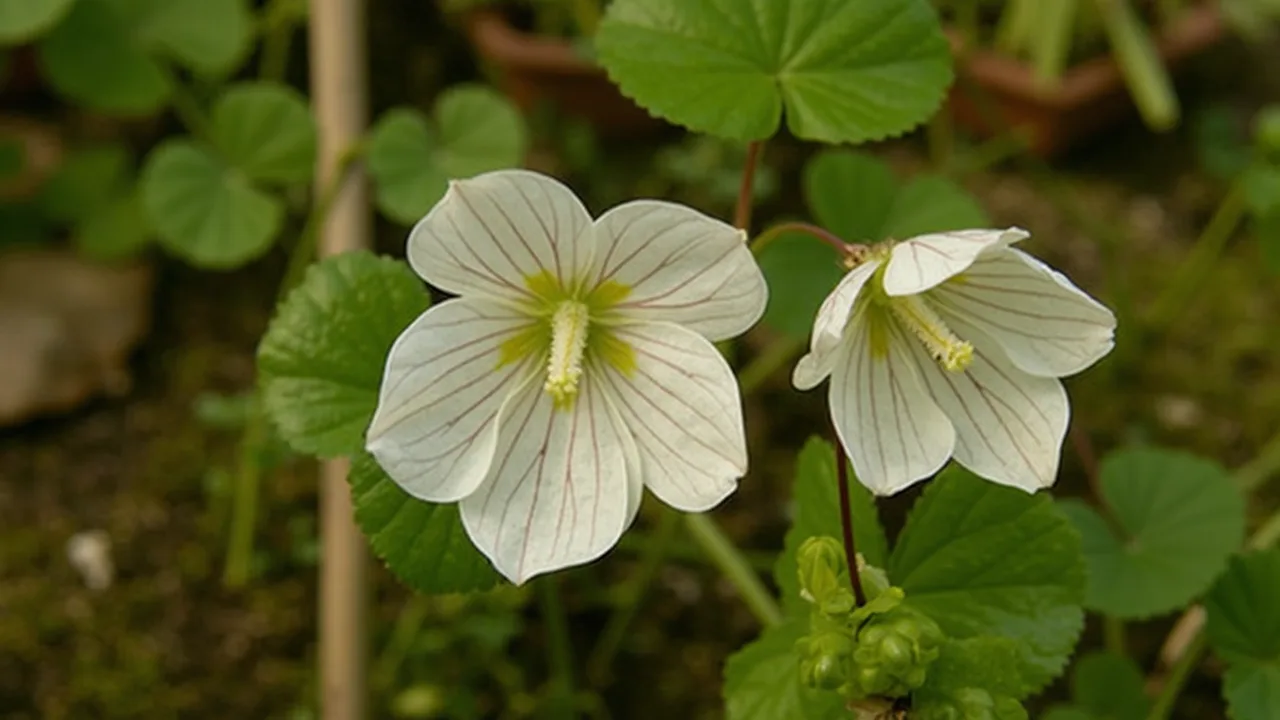
Flowers appear on slender stalks held just above the foliage. Each bloom is around 15–20 mm across, with five white petals delicately veined and shaded lilac or pale pink, and a small yellow throat at the centre. They nod on the stalk and open fully only in sunshine; on overcast days they close and droop. The flowers are self-fertile and produce a small five-sided seed capsule, but in dense woodland seed-set is often poor and the plant spreads chiefly by rhizome.
At maturity a single plant forms a clump perhaps 10–15 cm tall and 20–30 cm across. Established colonies in ideal conditions can carpet several square metres over many years. The plant is fully deciduous in winter and the rhizome persists below ground; in very cold weather the surface may appear completely bare until late February or March.
Growing Conditions
Wood sorrel performs best in the conditions found in its native woodland: dappled shade, cool roots and a moist but free-draining soil rich in decomposed leaf litter. In the garden this translates to a position under deciduous trees or on the north or east side of a fence or building, where the plant receives good light in spring before the leaves come out and is shaded through the hottest part of summer.
The ideal soil is acidic to neutral, with a pH somewhere between about 4.5 and 7.0, though the plant will tolerate mildly alkaline conditions if there is plenty of humus. Heavy clay is tolerated so long as it does not waterlog in winter; light, sandy soils are less suitable unless heavily mulched. Incorporate leaf mould, well-rotted bark or garden compost before planting to mimic the spongy woodland floor the species prefers. Mulch annually in autumn with a further 2–3 cm of leaf mould to keep the rhizome cool and to feed the soil.
Wood sorrel is hardy across all of the United Kingdom. It tolerates winter temperatures well below freezing and is unharmed by late spring frosts. It does not enjoy dry heat, and in the south and east of England a cool, shaded site is essential; in Scotland, northern England, Wales and the wetter west it will grow in surprisingly open ground. The species holds the Royal Horticultural Society's Award of Garden Merit, reflecting its reliability in suitable conditions.
Planting and Care
Plant wood sorrel in autumn or in early spring while the rhizome is active. Set rhizomes or pot-grown plants about 10–15 cm apart if a quick cover is wanted, wider if patience is in supply. Water in well and keep the soil just moist until the plants establish, which is usually within a single growing season.
Once settled the plant needs surprisingly little attention. Watering is only necessary during prolonged summer drought — and even then, occasional deep soakings are far better than frequent light sprinkles. Feeding is rarely needed in a humus-rich soil; an annual mulch of leaf mould or a light top-dressing of worm compost in autumn is sufficient.
Pruning in the conventional sense is not required. As autumn progresses the foliage will yellow and collapse of its own accord and can simply be left in place to mulch the rhizome. If the plant spreads further than intended, it is easily controlled by hand-pulling the shallow rhizomes in winter when the ground is visible; unlike some of its more vigorous South American relatives, Oxalis acetosella is not considered invasive in UK gardens.
Propagation is straightforward by either of two methods. Division of the rhizome is the quickest: lift a clump in autumn or early spring and tease the rhizomes apart into short sections, each with at least one growing point, and replant immediately. Seed can be sown fresh in autumn in a tray of seed compost under a cold frame; germination usually follows in the following spring, though seed-raised plants are slow to reach flowering size.
Seasonal care in the UK is light. From February to April the new leaves push through and flowering peaks; by midsummer in denser shade the plant is going dormant; from October to January the rhizome rests below ground. A single tidy in late autumn, clearing fallen leaves only where they smother the colony, is all that is required.
Common Problems
Wood sorrel is largely free of serious pest and disease problems in UK gardens. The leaves are sometimes nibbled by slugs and snails in damp springs, but damage is rarely severe enough to need treatment, and the plant usually grows through it. Rabbits and deer generally leave it alone.
The most common cause of failure in cultivation is the wrong site. Planted in full sun or in soil that dries out in summer, the rhizome desiccates and the colony thins to nothing within a couple of seasons. Conversely, waterlogged ground in winter will rot the rhizome, so avoid planting in the base of a ditch or a low spot that holds standing water.
Botrytis (grey mould) can affect the foliage in unusually wet, still summers, particularly where air movement is poor. Improving ventilation by thinning overhanging branches, and clearing wet leaf litter away from the crowns in autumn, is usually enough to keep it in check. There are no rust or virus problems of significance in the UK at present.
Some gardeners confuse wood sorrel with clover (Trifolium) or with the various weedy South American Oxalis species, several of which are listed as invasive and should never be planted out. Oxalis acetosella is distinguished by its heart-shaped leaflets (clover leaflets are rounded) and by its preference for shade (the invasive Oxalis corniculata and O. debilis prefer sun and warmer soils).
Popular Varieties
The species itself is the form most commonly grown, and within the wild population there is relatively little named selection. A handful of cultivars are, however, available from specialist nurseries in the UK and are worth seeking out for slightly different garden effects.
Oxalis acetosella var. subpurpurascens is a recognised variant collected from parts of continental Europe, with leaves flushed purple-bronze beneath and pale pink rather than white flowers. It is fully hardy and grows well alongside the typical form but is slower to increase. Oxalis acetosella 'Rosea' is a pink-flowered selection occasionally offered by alpine plant specialists; the colour is delicate and best appreciated at close range. Oxalis acetosella 'Iron Cross' should be treated with caution, as the name is more commonly associated with a wholly different species, Oxalis tetraphylla, and plants sold under this label should be checked carefully at the point of purchase.
For most gardeners, the wild-type Oxalis acetosella is the most reliable and the most attractive choice, particularly when allowed to naturalise in a shaded border or woodland edge. The named forms are curiosities rather than improvements, and in a naturalistic planting the simple species is hard to beat.
Pests and Diseases
| Problem | Symptoms | Management |
|---|---|---|
| Root rot | Wilting, yellowing leaves despite moist soil conditions. | Ensure well-draining soil and avoid overwatering to prevent waterlogging. |
| Vine weevil | Notch marks on leaf edges above ground and root damage below. | Check pots for grubs before planting and use nematodes or chemical controls. |
| Slugs and snails | Irregular holes in leaves and slimy trails on foliage. | Use physical barriers, iron phosphate pellets, or hand-pick at night. |
| Powdery mildew | White powdery fungal growth on leaves and stems. | Improve air circulation and apply a suitable fungicide if severe. |
For step-by-step help, read Dealing with Slugs and Snails and Treating Powdery Mildew. Or browse the full plant problem solver to diagnose an issue by symptom.
As an Amazon Associate, GardenWizz earns from qualifying purchases made through links on this page (including links within the article). This does not affect the price you pay. See our disclaimer for details.