
White Dead-nettle
Lamium album
The Gardening Year
Best months in UK gardens · full planting calendar →
🖨 Printable care card (PDF)At a Glance
| Botanical name | Lamium album |
|---|---|
| Common name(s) | White Dead-nettle |
| Family | Lamiaceae |
| Plant type | perennial (rhizomatous herbaceous perennial) |
| Height × Spread | 70 cm × — |
| Position | — |
| Soil | moist, fertile soils |
| Flowering | — |
| Toxicity | No specific toxicity is listed by the RHS. This is not a guarantee of safety — check with a vet or the ASPCA before pets or children eat any plant. |
| Native range | Europe and Asia |
White dead-nettle (Lamium album) is a herbaceous perennial of the mint family (Lamiaceae), native to the United Kingdom and much of Europe and temperate Asia. Often dismissed as a wayside weed, it is in fact a long-flowering, shade-tolerant native with considerable value to pollinators and a long folk-medicine history. It earns its common name from the strong resemblance of its softly hairy leaves to those of the stinging nettle (Urtica dioica), though it lacks the stinging trichomes that give its lookalike its painful bite. Alternative country names — archangel and white archangel — reflect the whorled arrangement of its flowers and the old association of such plants with protective spirits.
Overview
White dead-nettle is a rhizomatous perennial that forms loose colonies in shaded ground, hedge bottoms and woodland edges. It is fully hardy across the UK, tolerates a wide range of soils, and flowers with unusual persistence from mid-spring through to the first hard frosts of late autumn or early winter. For gardeners it serves principally as a wildlife plant, providing nectar at a time when few other wild flowers are in bloom, and it is often welcome as an honorary resident rather than planted deliberately.
Ecologically it is a notable species: a study published in 2017 by the Centre for Ecology and Hydrology identified white dead-nettle as one of the most important urban plants for nectar production in the UK. It is also of historical interest as a medicinal herb, though it is not a culinary plant and should not be confused with the stinging nettle of soup-and-tea fame.
Appearance
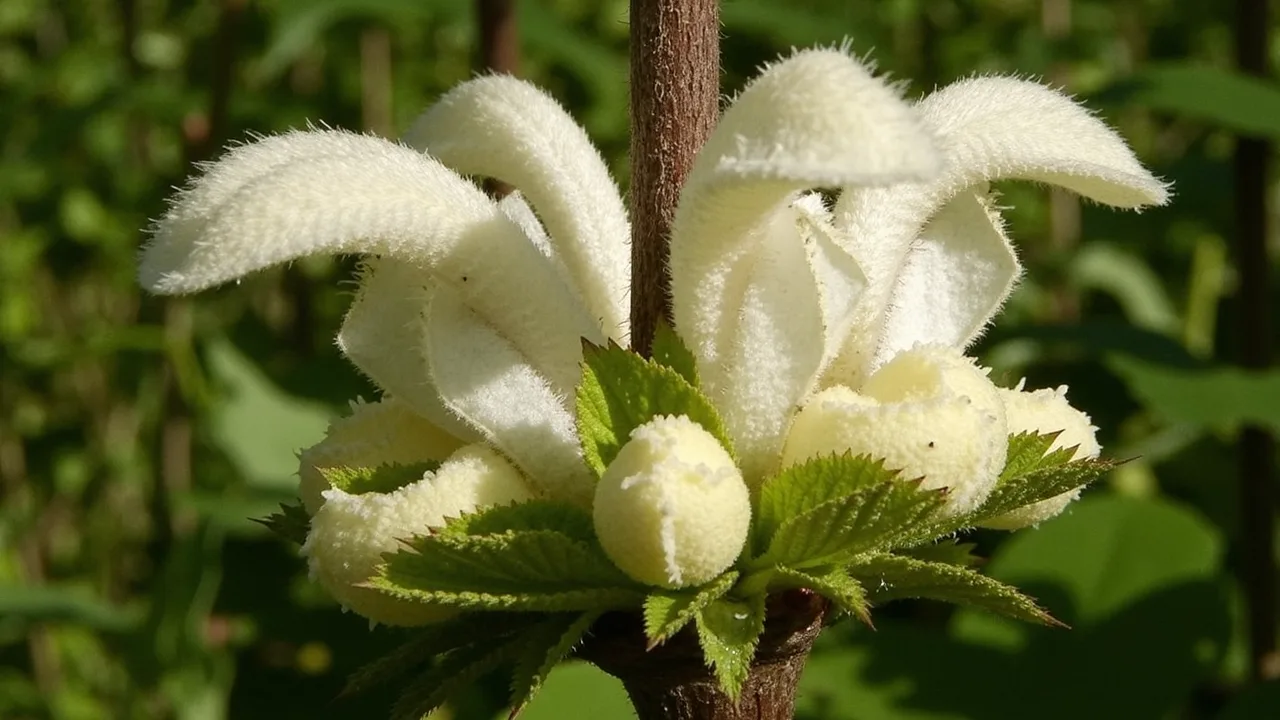
White dead-nettle grows to between 30 and 60 cm tall. Its stems are characteristically square in cross-section, a feature shared across the mint family, and they may be unbranched or sparsely branched. The whole plant is softly hairy, giving young growth a slightly silvery sheen.
Leaves are borne in opposite pairs along the stem. Each leaf is heart-shaped to triangular, with a pointed tip, a serrated margin and a softly wrinkled surface. They reach roughly 3–7 cm long and are carried on short stalks. Despite the superficial resemblance to nettle leaves, they do not sting.
Flowers are the plant's most distinctive feature. They are pure white, two-lipped and tubular, roughly 20–25 mm long, and are arranged in false whorls (verticils) sitting in the axils of the upper leaves. The upper lip is hooded and lightly hairy; the lower lip spreads into two pointed lobes. Flowering begins in April and continues in successive flushes, often through to November or December in mild seasons. The fruit consists of four small brown nutlets clustered at the base of each calyx, and a single plant can produce several thousand seeds in a year.
Growing Conditions
White dead-nettle is one of the most accommodating native perennials and tolerates conditions that defeat fussier ornamentals. It performs best in partial to full shade, particularly on the shaded side of hedgerows, beneath deciduous shrubs, or at the edge of woodland where the light is dappled. Full sun is tolerated where the soil remains moist, but dry, sunny borders tend to produce straggly plants with scorched leaves.
Soil requirements are modest. The species grows in everything from damp clay to dry chalk and sandy loam, provided drainage is reasonable and the ground is not waterlogged for prolonged periods. It is indifferent to pH and grows well on both mildly acid and alkaline substrates. Established colonies are notable for their tolerance of root competition from trees, which makes them useful for planting beneath established hedges and at the base of mature shrubs.
In UK climate terms the plant is reliably hardy throughout the country. Brief sources and standard horticultural references treat it as fully hardy (H7 on the RHS hardiness scale, meaning hardy to below −20 °C), though in practice the aerial growth dies back to ground level in any severe winter and re-emerges from the rhizome in spring. It is unaffected by late frosts once growth has restarted.
Planting and Care
Although white dead-nettle frequently colonises gardens without being invited, deliberate establishment is straightforward. The species can be raised from seed, propagated by division, or transplanted as small pot-grown plants obtained from specialist native-plant nurseries.
Sowing. Seeds require a period of cold and damp to break dormancy. The most reliable method is to direct sow in autumn, allowing winter weather to provide natural stratification; spring sowings should first be mixed with a little damp sand and refrigerated for four to six weeks before being sown on the surface of a tray of peat-free seed compost. Seedlings are pricked out once they have produced their first true leaves and grown on until large enough to handle.
Planting out. Pot-grown plants are best set out in autumn or early spring at roughly 30–45 cm spacing. Water in well and mulch lightly with leaf mould or well-rotted compost; thereafter the plant needs little attention beyond the first dry summer after planting.
Watering. Once established the species is largely drought-tolerant. Additional watering is required only during prolonged summer drought, particularly on light soils and in full shade where rainfall may be intercepted by overhead canopy.
Feeding. White dead-nettle thrives in average garden soil and needs no supplementary fertiliser. Over-rich ground produces lush leaves at the expense of flowers.
Pruning. After the main spring flush has finished, shear the whole plant back to encourage a second, later wave of bloom and to keep clumps tidy. A harder cut in late autumn, after flowering has finished, helps prevent self-seeding and keeps the colony from sprawling into cultivated neighbours.
Propagation. Established clumps can be lifted and divided in either spring or autumn, the rhizomes separating readily. Pieces of rhizome with at least one growing point will re-establish quickly when replanted and watered in. Division is also the simplest way to control an over-enthusiastic colony without resorting to herbicides.
Seasonal care. Apart from the autumn cut-back, the plant needs almost no seasonal attention. In exposed gardens a light mulch after the autumn cut helps protect the rhizomes during hard winters.
Common Problems
White dead-nettle has no significant pest or disease burden in UK gardens. It is not regularly troubled by slug damage, mildew or the viral conditions that affect some of its ornamental relatives in the Lamium genus, and rabbits and deer tend to leave it alone.
The principal issue is the one shared by many successful natives: it can be too vigorous in ideal conditions. The rhizomes creep outwards at a steady pace and the seed, once shed, germinates freely in bare soil. In a managed border this is normally checked by the autumn cut-back and by prompt removal of seedlings in spring. In neglected ground, or beside a wild corner where containment is not required, the plant's spread is rarely a problem — indeed, it is one of the more useful natives for binding soil on shaded banks.
The plant should not be confused with the unrelated stinging nettle, with which it shares a leaf shape; it is also worth distinguishing it from purple dead-nettle (Lamium purpureum), an annual weed of cultivated ground with smaller, pinkish-purple flowers. Gardeners sometimes mistake seedling Lamium galeobdolon (yellow archangel) for white dead-nettle, but the former has yellow flowers and is generally a much more assertive garden plant in its variegated cultivars.
Popular Varieties
White dead-nettle is most often grown as the straight species, and named cultivars of Lamium album are scarce in general horticulture. Where a tidier or more ornamental plant is required for a similar role, gardeners in the UK tend to reach for cultivars of related species. The following are well-established in British cultivation and fill the same niche of shaded ground cover with a long flowering season:
- Lamium maculatum 'White Nancy' — a popular silver-leaved cultivar of the spotted dead-nettle, forming low mats of near-white foliage studded with pure white flowers from late spring into summer. Less vigorous than white dead-nettle and easier to contain in a small border. Generally regarded as the most widely available white-flowered Lamium in UK garden centres.
- Lamium maculatum 'Beacon Silver' — closely related to 'White Nancy' but with pale pink flowers held above silver foliage. Useful where a softer colour is preferred.
- Lamium orvala — the balkan dead-nettle, a clump-forming species rather than a spreader, with larger pinkish-purple flowers in late spring. More suited to a herbaceous border than to naturalistic planting.
Strictly within L. album itself, named selections are uncommon and should be sourced from specialist native-plant nurseries; where a cultivar name is offered by a general retailer it is worth checking that the plant supplied is correctly labelled, as mis-selling of related species under the album name is not unknown in the trade.
Pests and Diseases
| Problem | Symptoms | Management |
|---|---|---|
| Powdery mildew | White powdery fungal growth appears on leaves and stems, often causing distortion or yellowing. | Improve air circulation around plants and apply a sulphur-based fungicide if infection is severe. |
| Slugs and snails | Irregular holes chewed in leaves and silvery slime trails visible on foliage and soil. | Use iron phosphate pellets, beer traps, or hand-pick at night to reduce populations. |
| Root rot | Leaves turn yellow and wilt despite moist soil, with stems becoming soft and brown near the base. | Ensure soil is well-drained and avoid overwatering; remove affected plants to prevent spread. |
| Aphids | Clusters of small green or black insects on new growth, accompanied by sticky honeydew residue. | Spray off with a strong jet of water or introduce natural predators like ladybirds. |
| Leaf spot | Small brown or black spots appear on leaves, sometimes surrounded by yellow halos. | Remove affected leaves and avoid wetting foliage when watering to reduce humidity. |
For step-by-step help, read Controlling Aphids Naturally, Dealing with Slugs and Snails, Treating Powdery Mildew and Tackling Black Spot on Roses. Or browse the full plant problem solver to diagnose an issue by symptom.
As an Amazon Associate, GardenWizz earns from qualifying purchases made through links on this page (including links within the article). This does not affect the price you pay. See our disclaimer for details.