Imperial Begonia
Begonia imperialis
The Gardening Year
Best months in UK gardens · full planting calendar →
🖨 Printable care card (PDF)At a Glance
| Botanical name | Begonia imperialis |
|---|---|
| Common name(s) | Imperial begonia |
| Family | Begoniaceae |
| Plant type | — |
| Height × Spread | 30–60 cm × — |
| Position | Partial shade |
| Soil | well-drained growing medium that is neither constantly wet nor allowed to dry out completely |
| Flowering | June–August |
| Toxicity | potentially toxic in large quantities due to the prevalence of oxalic acid |
| Native range | southern Mexico and Guatemala |
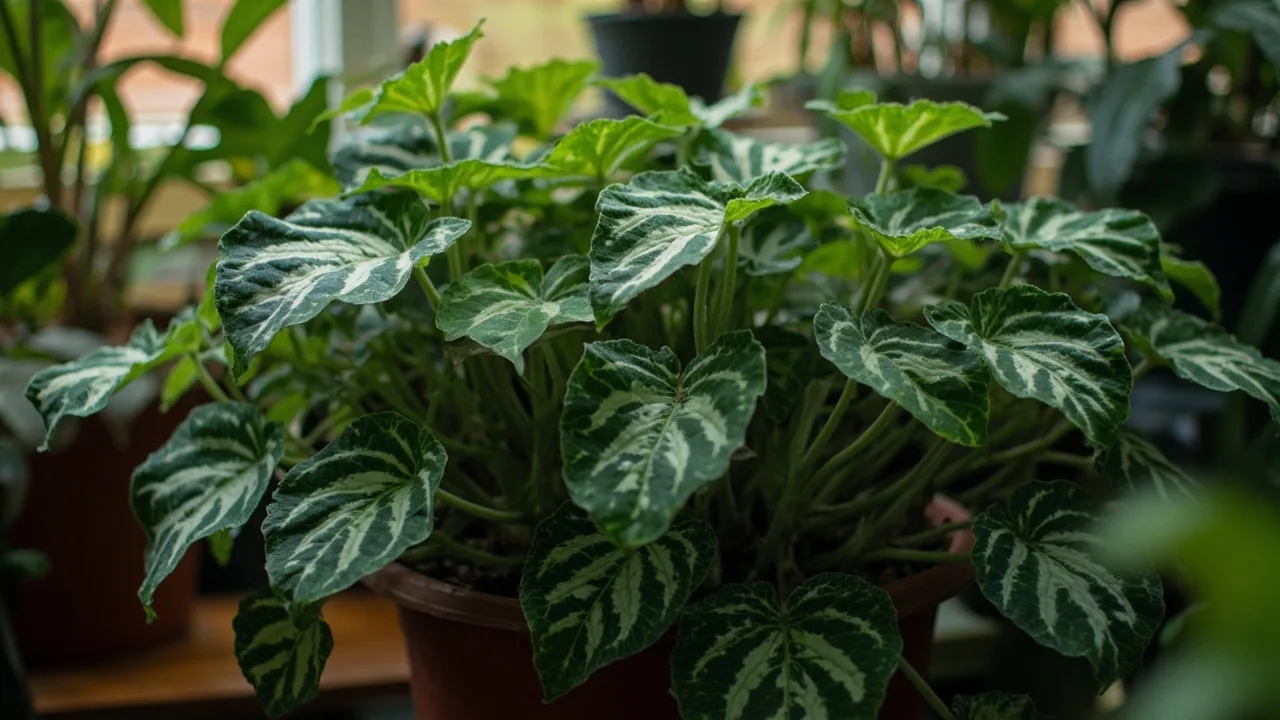
Begonia imperialis is a tender, rhizomatous houseplant from southern Mexico and Guatemala, grown almost entirely for its dramatically textured foliage. The leaves are roughly oval, 8-10 cm long, deep green overlaid with a silvery sheen along the veins, and the upper surface is puckered and covered in very fine red-tinted hairs. In a warm, humid room the plant makes a low, creeping mat; in a terrarium it can be a showpiece.
It is one of the few begonias in UK cultivation that is grown for foliage alone — sprays of small white flowers may appear in midwinter, but they are sparse and easily missed. Most UK growers keep one because the leaves earn the space.
Overview
This is a plant for a warm, shady, humid spot indoors — a north- or east-facing windowsill, a bright bathroom, or a closed terrarium. It dislikes direct sun, which scorches the fine hairs on the leaf surface; it dislikes cold rooms; and it dislikes compost that stays wet. Many gardeners in the UK have started with this species because it is forgiving as long as the three conditions above are met.
I have found it easiest to grow as a year-round houseplant rather than moving it between indoors and out for the summer, because the leaves mark very easily when handled or moved into a different light level. A dedicated spot, with stable light, temperature and humidity, gives the cleanest display. The RHS notes that it may be grown outside in summer once night temperatures are reliably above 10 °C, but a shady, sheltered patio corner is the best you can do in most UK gardens.
Light, Temperature and Humidity
Bright, indirect light is the sweet spot. An east-facing windowsill behind a net curtain is ideal; a north-facing window also works in summer, but may be too dim in midwinter. Aim for a leaf-level reading of roughly 800-1,500 lux at midday if you have a phone light meter. Anything above about 2,000 lux is direct enough to bleach the silver veining.
Temperature should sit between 18 and 26 °C while the plant is in active growth, with a winter minimum of 10 °C. The RHS places this species in its H1b group, which in practice means it must come indoors well before the first frost and stay there — anything close to freezing will kill it. Keep the plant away from cold draughts on winter nights and away from hot radiators in summer; either extreme causes leaf-edge scorch.
Humidity is the limiting factor for most UK growers. The plant grows in cloud-forest understorey in the wild, and below about 50% relative humidity the leaf edges brown and curl. A bathroom or kitchen with regular use provides enough humidity for most homes. In a drier room, group the plant with other shade-tolerant houseplants, stand the pot on a tray of damp gravel with the water level just below the pebbles, or run a small humidifier nearby. Misting the leaves directly is not recommended: the fine hairs trap moisture and the leaves mark.
Watering and Feeding
Water when the top 2-3 cm of compost feels dry — usually every 5-9 days in active growth, less in winter. Water at the soil line with tepid water, never ice-cold, and tip out any water that collects in the saucer within 20 minutes. Cold water spotting is the most common cause of marks on the leaves.
Many gardeners I know under-water this species, because the rhizome is thick and looks drought-tolerant. It is not — the leaves go limp dramatically if the compost dries out completely, and although the plant usually recovers after a soak, every cycle costs new leaf quality. Aim to keep the mix lightly and evenly moist, with the surface just drying between waterings.
Feed sparingly from May to September, every 3-4 weeks with a balanced liquid houseplant feed diluted to half strength. Pause feeding from October to March. Over-feeding causes salt build-up in the compost, which burns the fine roots and shows as dry brown leaf margins. Skip a feed on any plant that has just been repotted, is wilting, or is otherwise stressed.
Compost, Potting and Repotting
Use a peat-free houseplant mix with around 25% added perlite and a handful of fine bark for openness. Begonia imperialis has a shallow, creeping rhizome that wants to sit at or just below the surface, so choose a wide, shallow pot rather than a deep one. A working drainage hole is non-negotiable; if you want the look of a decorative pot without one, use it as a cachepot around a nursery pot you can lift out to water.
Repot every 2-3 years in spring, only when the rhizome has clearly run out of space. Go up one pot size (about 2 cm wider), refresh the compost, and water in lightly. Do not feed for at least 6 weeks after repotting — the fresh compost contains enough nutrient, and fertiliser salts damage the new roots.
Propagation
The RHS lists three methods: seed, leaf cuttings, and sections of rhizome. Leaf cuttings are by far the easiest for a single plant at home. Take a healthy, mature leaf with about 3 cm of stalk, press the stalk into a small pot of moist, peat-free seed compost mixed with perlite, enclose the pot in a clear plastic bag, and keep it in bright indirect light at 20-22 °C. New plantlets should form at the stalk base in 6-10 weeks. Once they have two leaves each, pot them up individually.
Rhizome division is faster and is worth doing at the same time as a spring repot. Cut the rhizome into sections with at least one healthy growth point each, dust the cuts with cinnamon or sulphur, and pot each section into its own shallow tray. Keep humidity high and withhold water for a day or two to let the cuts callus.
Common Problems
Powdery mildew
A white, dusty coating on the leaves, usually appearing in still, humid air combined with dry compost. Improve airflow around the plant, water at the base rather than over the leaves, and treat with a sulphur-based fungicide if it spreads. Many UK growers find that raising humidity but reducing leaf wetness solves the problem without chemicals.
Stem and rhizome rot
Caused by cold, wet compost — usually after a cold snap in winter or a heavy-handed watering. The rhizome turns soft and brown, leaves collapse, and the plant usually cannot be saved. Prevention is far better than cure: water less in winter, keep the plant above 10 °C, and always tip out the saucer after watering.
Mealybugs and vine weevil
Mealybugs appear as small white cottony tufts in the leaf axils; vine weevil grubs attack the roots of pot-grown plants, causing sudden wilting. Mealybugs can be dabbed off with a cotton bud dipped in rubbing alcohol; vine weevil is best controlled with a nematode-based biological drench (Steinernema kraussei) applied in late summer.
Leaf-edge scorch
Dry brown margins usually mean low humidity, cold draughts, or fertiliser burn rather than disease. Move the plant away from radiators, raise local humidity with a tray of damp gravel, and leach the compost by watering through heavily once and letting it drain.
Varieties to Try
- Begonia imperialis var. brunnea — the slightly darker-leaved form most often sold in UK garden centres. Easier to find than the type.
- Begonia imperialis var. smaragdina — a green-leaved form with the silver veining suppressed; useful if you find the type too variegated. Less commonly available.
- Begonia × pustulata 'Silver Jewel' — a hybrid between B. imperialis and B. pustulata, with strongly metallic silver leaves and dark radiating markings. Holds its colour better than the type in slightly drier air.
- Begonia foliosa — a related foliage species with small, fern-like leaves; a good companion plant in a terrarium with B. imperialis.
FAQ
Q? Why are the leaf edges going brown even though I water regularly?
A. Almost always low humidity, not underwatering. Aim for 60% relative humidity or higher. A tray of damp gravel under the pot, grouping with other plants, or a small humidifier will fix most cases.
Q? Can I put it outside in summer?
A. Yes, once night temperatures stay above 10 °C, in a shady, sheltered spot out of direct sun. Bring back indoors well before the first frost in autumn, and check for vine weevil grubs at the same time.
Q? My plant flowered in winter. Should I remove the flowers?
A. The flowers are small and white, and many growers remove them so the plant puts its energy into leaves. If you enjoy them, leave them on; flowering does not noticeably weaken the plant.
Q? Is Begonia imperialis safe for cats and dogs?
A. No — like all Begonia species, it contains oxalates and is considered mildly toxic. The RHS advises keeping the plant away from pets, and wearing gloves when handling or repotting.
Sources & Further Reading
- Royal Horticultural Society — Begonia imperialis plant profile: https://www.rhs.org.uk/plants/88463/begonia-imperialis/details, accessed 2026-07-23
- Royal Horticultural Society — Begonias as houseplants: https://www.rhs.org.uk/plants/begonias/houseplants, accessed 2026-07-23
- Royal Horticultural Society — Begonias: outdoors: https://www.rhs.org.uk/advice/profile?pid=+815, accessed 2026-07-23
- Royal Botanic Gardens Kew — Plants of the World Online, Begonia imperialis Lem.: https://powo.science.kew.org/taxon/urn:lsid:ipni.org:names:104896-1, accessed 2026-07-23
- BBC Gardeners' World — How to grow and care for begonias: https://www.gardenersworld.com/how-to/grow-plants/how-to-grow-begonias/, accessed 2026-07-23
Pests and Diseases
| Problem | Symptoms | Management |
|---|---|---|
| Vine Weevil | Notched leaf margins on seedlings and root damage causing sudden collapse. | Apply nematodes to soil in autumn or use systemic insecticides. |
| Powdery Mildew | White, dusty fungal growth on leaves and stems. | Improve air circulation and treat with a sulphur-based fungicide. |
| Slugs and Snails | Irregular holes in leaves and silvery slime trails. | Use iron phosphate pellets or beer traps to reduce populations. |
| Root Rot | Yellowing, wilting foliage despite moist soil conditions. | Ensure well-draining compost and avoid overwatering. |
For step-by-step help, read Dealing with Slugs and Snails and Treating Powdery Mildew. Or browse the full plant problem solver to diagnose an issue by symptom.
Recommended Products
GardenWizz earns a commission from qualifying purchases made through affiliate links on this page (including links within the article) — as an Amazon Associate, and from Thompson & Morgan via the Awin network. This does not affect the price you pay. See our disclaimer for details.