Dippel's Hawthorn
Crataegus × dippeliana
The Gardening Year
Best months in UK gardens · full planting calendar →
🖨 Printable care card (PDF)At a Glance
| Botanical name | Crataegus × dippeliana |
|---|---|
| Common name(s) | Dippel's Hawthorn |
| Family | Rosaceae |
| Plant type | shrub |
| Height × Spread | 5–15 m × 6–8 m |
| Position | — |
| Soil | moisture-retentive, well-drained |
| Flowering | May |
| Toxicity | — |
| Native range | temperate regions of the Northern Hemisphere in Europe, Asia, North Africa and North America |
Dippel's hawthorn is a scarce ornamental hybrid for UK gardens, combining generous white blossom, broad glossy foliage and unusually large autumn haws on a compact, rounded tree. Give it an open, well-drained position and enough room for a mature crown rather than treating it as a hedging hawthorn.
Overview
Crataegus x dippeliana is a garden-origin hybrid between the Eurasian tansy-leaved thorn, C. tanacetifolia, and the North American dotted hawthorn, C. punctata. Raised in continental Europe during the late nineteenth century and named for the German dendrologist Leopold Dippel, it brings together traits from two geographically distant parents. It is also encountered in older catalogues as Crataegus arnoldiana, but the hybrid name C. x dippeliana is the one used by the RHS.
Unlike common hawthorn (C. monogyna), this is chiefly a specimen tree rather than a practical hedge plant. Its rounded crown, abundant blossom and cherry-sized haws provide three distinct seasons of interest without demanding the space of a large woodland tree. That makes it useful in a medium-sized lawn, a wildlife garden, an informal avenue or the outer part of a mixed border where its thorny branches will not obstruct paths.
The hybrid remains uncommon in mainstream garden centres, although specialist UK tree nurseries offer it from time to time. Its rarity is not evidence of difficult cultivation: it has the resilience expected of a hawthorn and suits most British districts. Availability and nomenclature can be more challenging than the growing itself, so buyers should check both accepted and older botanical names when searching nursery lists.
Flowers provide nectar and pollen for insects in late spring, while the autumn haws are taken by birds including blackbirds, thrushes and visiting fieldfares. The dense, thorny crown can also offer useful shelter. It is therefore a credible wildlife tree, though native hawthorn remains the better choice where specifically native planting or traditional countryside hedging is required.
Appearance
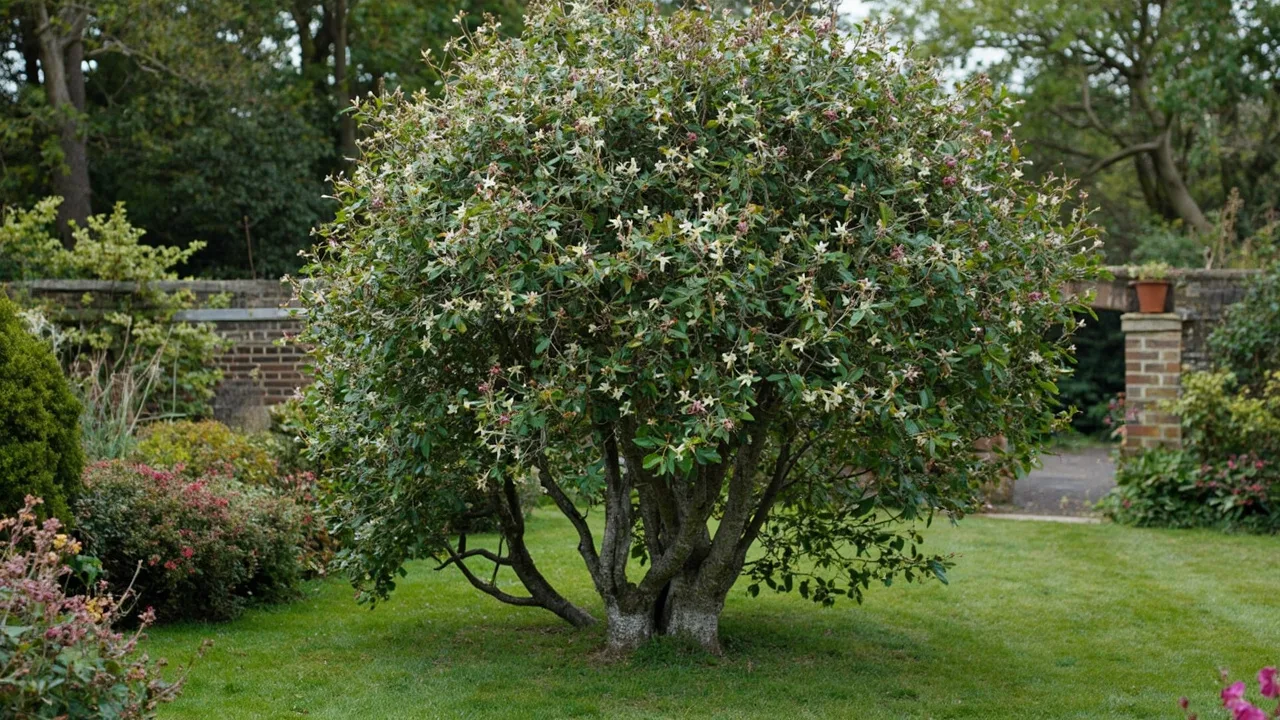
The tree develops a dense, broadly rounded head, usually on a short trunk, with twisted branches and conspicuous thorns. Young specimens are comparatively upright, but the crown broadens with age. Nursery-grown trees may reach around 4 m after ten years; established specimens can eventually approach 8 m in height, with a spread of roughly 4-6 m. Growth rate varies with soil, moisture and rootstock.
Leaves are broad, glossy dark green and shallowly lobed, reaching about 7.5 cm long. Their substantial texture and restrained lobing distinguish them from the more deeply divided foliage of common hawthorn. The undersides are paler, and the foliage forms a full canopy that casts moderate summer shade. Autumn colour is generally secondary to the fruit display rather than being the principal ornamental feature.
White flowers, approximately 2-2.5 cm across, open freely in flat-topped clusters. In southern and sheltered gardens the display may begin in late May; colder districts can expect it during June. The flowers have the recognisable hawthorn form, and their abundance can cover much of the crown. They are borne on short flowering shoots, an important detail when deciding whether any pruning is necessary.
The fruits are notably larger than the haws of familiar hedgerow species, commonly about 12-16 mm across. They colour from orange-red to dull red in early autumn and may remain into November if birds do not take them first. Against the glossy leaves they resemble small red cherries, giving the tree a conspicuous late-season display. Dark grey, ridged bark and the contorted framework become more visible after leaf fall, maintaining some winter character.
The thorns deserve practical consideration. Site the tree away from narrow paths, children's play areas and places where routine mowing would bring people directly under low branches. When pruning or clearing fallen twigs, stout gloves and eye protection are sensible.
Growing Conditions
Full sun produces the strongest blossom and fruit set, although light partial shade is tolerated. In heavy shade the crown becomes less dense and flowering is reduced. An open lawn, sunny boundary or spacious mixed planting generally provides the right balance of light and air movement. The tree tolerates exposure reasonably well once established, but a newly planted standard benefits from staking on windy sites.
Dippel's hawthorn accepts mildly acid, neutral and mildly alkaline ground. A moderately fertile loam is ideal, but texture matters less than drainage: sandy and clay soils can both work if they do not remain waterlogged. On compacted clay, plant slightly proud of the surrounding level and improve drainage across a broad area rather than filling one small hole with rich compost. A compost-filled planting pocket can hold water like a sump and discourage roots from entering the native soil.
Established trees withstand ordinary summer dry spells, but this tolerance develops only after a sound root system has formed. During the first two growing seasons, water deeply in dry weather rather than applying frequent light sprinkles. A clear, mulched circle at least 1 m across reduces competition from grass, which can significantly slow a young tree's establishment.
Choose the position for the mature crown, not the size of the sapling. Allow approximately 4-6 m between the trunk and neighbouring trees, buildings or major structures. Avoid permanently waterlogged hollows and very confined urban pits. Its thorny, twiggy crown also makes it a poor choice immediately beside a terrace or frequently used doorway.
The species hybrid's structured hardiness rating applies across the UK, but exposed container roots are more vulnerable than roots in open ground. Long-term pot culture is therefore unsuitable for a tree of this eventual size. In colder or upland gardens, a sheltered planting position can reduce wind damage to the young crown even though winter cold itself is not normally limiting.
Planting and Care
Plant bare-root trees while dormant, generally from November to March, whenever the soil is neither frozen nor waterlogged. Container-grown trees can be planted throughout the year, but autumn or early spring reduces watering pressure. Dig a hole no deeper than the root system and considerably wider, loosen circling roots, and position the root flare at soil level. Backfill mainly with excavated soil, firm gently and water thoroughly.
Use one low stake on a sheltered site or a robust double-stake arrangement where wind rock is likely. Fasten with a flexible tree tie and inspect it each spring and autumn so that it neither rubs nor constricts the trunk. Remove staking once the roots hold the tree securely, usually after one or two growing seasons. Keep mulch 5-8 cm deep over the root zone but leave a clear gap around the trunk to prevent persistent damp against the bark.
Water newly planted trees thoroughly during prolonged dry periods from spring into early autumn. A slow, generous soak once a week is more effective than wetting the surface daily; local soil and rainfall should determine the interval. By the third season, additional watering is usually needed only during exceptional drought. Reduce watering as leaves fall so growth can mature naturally.
On reasonable garden soil, an annual spring mulch of garden compost or well-rotted manure is sufficient feeding. Excess high-nitrogen fertiliser encourages soft shoots at the expense of flowers and can worsen aphid or mildew problems. Where growth is genuinely weak and soil testing indicates low fertility, apply a balanced general fertiliser at the labelled rate in early spring.
Pruning should be minimal. Between February and March, before active growth, remove dead, damaged or crossing branches and any shoots arising below the graft union. Retain the naturally rounded framework and avoid indiscriminate shortening of every shoot, because this removes flowering wood and produces congested regrowth. If a small amount of size control is essential, lightly thin or shorten selected branches immediately after flowering. Use clean, sharp tools, make cuts just outside the branch collar and avoid cutting hard into old wood.
Commercial plants are generally propagated by budding or grafting onto hawthorn rootstock. Seed is unsuitable for reproducing the hybrid accurately: seedlings will segregate and cannot be expected to match the parent tree. Home propagation by grafting is possible for experienced growers but requires compatible rootstock, suitable scion wood and careful aftercare; purchasing a named, nursery-propagated tree is more reliable.
Seasonal care is simple. Renew mulch and inspect ties in March, water through dry spells from April to September, and enjoy flowers from late May into June. Collect or leave fallen fruit in autumn according to garden hygiene and wildlife aims. In winter, inspect the bare crown for damaged wood and basal suckers, but delay routine cuts until suitable dry weather near the end of dormancy.
Common Problems
Aphids may cluster on soft spring shoots, causing curled leaves and sticky honeydew. Healthy trees usually tolerate them, and predators such as ladybirds and hoverfly larvae often restore the balance. Avoid unnecessary insecticide use; water drought-stressed young trees and remove only severely distorted shoot tips where practical.
Caterpillars can chew foliage, while gall mites produce localised leaf distortions. Small amounts of damage are mainly cosmetic. Check affected leaves and shoots before acting, encourage birds and beneficial insects, and remove limited infestations by hand where accessible. Extensive recurring defoliation on a young tree warrants accurate identification before treatment.
Powdery mildew appears as a white coating during warm, dry periods, particularly where roots are dry but the canopy is humid or crowded. Maintain an open crown, mulch the root zone and water young trees deeply during drought. Do not overfeed with nitrogen. Leaf spots may also occur in wet seasons; rake up heavily affected fallen leaves and avoid routinely wetting the canopy.
Fireblight can affect hawthorns and causes suddenly blackened, hooked shoot tips that can look scorched. Because reporting requirements and management advice can depend on location and current plant-health rules, suspected fireblight should be checked against current government guidance before pruning or moving material. Do not compost suspect growth, and disinfect tools between cuts if removal is advised by the relevant authority.
Honey fungus is a more serious risk on sites containing infected roots or old stumps. Symptoms include declining shoots, white fungal sheets beneath bark and honey-coloured mushrooms near the base in autumn. There is no simple curative treatment. Avoid planting beside known infected woody remains, reduce stress through correct planting and watering, and obtain a reliable diagnosis before removing a mature tree.
Poor establishment is more common than any specific pest. A buried root flare, deep planting, loose staking, grass competition or a planting hole that traps water can all cause sparse foliage and dieback. Correct these physical problems early; fertiliser will not compensate for suffocated or unstable roots.
Popular Varieties
No reliably documented named cultivars of Crataegus x dippeliana were found in the principal UK references consulted. Plants are normally sold simply as the hybrid species, sometimes under the older nursery name Crataegus arnoldiana. These should not be presented as separate varieties: they refer to the same cultivated hybrid in current trade usage.
For buyers seeking alternatives rather than cultivars, specialist nurseries offer other ornamental hawthorns with distinct features. Crataegus laevigata 'Paul's Scarlet' has double deep-pink flowers, C. laevigata 'Plena' carries double white flowers, and C. persimilis 'Prunifolia' is valued for glossy leaves, red fruit and autumn colour. These are separate taxa, not selections of Dippel's hawthorn, and their ultimate sizes and care requirements should be checked individually.
When purchasing the true hybrid, confirm the botanical name on the label and ask whether the plant is grafted. Inspect the union for sound growth, reject specimens with circling roots or damaged bark, and choose a balanced young crown rather than the tallest available tree. UK availability is specialist and may be seasonal, especially for bare-root stock.
Sources & Further Reading
- Royal Horticultural Society: Crataegus x dippeliana, accessed 24 July 2026.
- Trees and Shrubs Online: Crataegus x dippeliana Lange, accessed 24 July 2026.
- Frank P Matthews: Crataegus x dippeliana / Crataegus arnoldiana, accessed 24 July 2026.
- Bowhayes Trees: Crataegus x dippeliana hawthorn, accessed 24 July 2026.
- Cardiff Parks: Crataegus x dippeliana in Bute Park, accessed 24 July 2026.
Pests and Diseases
| Problem | Symptoms | Management |
|---|---|---|
| Fireblight | Shoots and branches suddenly wilt, turn black, and curve into a characteristic shepherd's crook shape. | Prune out infected wood well below the visible symptoms during dry weather, disinfecting tools between cuts. |
| Powdery mildew | A white, dusty fungal growth appears on leaves and young shoots, potentially causing distortion. | Improve air circulation by thinning the canopy and apply a suitable fungicide if infection is severe. |
| Cedar-hawthorn rust | Bright orange or yellow spots develop on leaves, often accompanied by tube-like fungal structures underneath. | Remove fallen leaves in autumn to break the life cycle and avoid planting near junipers if possible. |
| Aphids | Clusters of small soft-bodied insects on new growth, often accompanied by sticky honeydew and curled leaves. | Encourage natural predators like ladybirds or use a strong jet of water to dislodge them. |
| Honey fungus | General decline, yellowing foliage, and white fungal growth at the base of the stem or on roots. | Improve drainage and avoid deep planting; severe cases may require removal of the plant. |
For step-by-step help, read Controlling Aphids Naturally and Treating Powdery Mildew. Or browse the full plant problem solver to diagnose an issue by symptom.
Recommended Products
GardenWizz earns a commission from qualifying purchases made through affiliate links on this page (including links within the article) — as an Amazon Associate, and from Thompson & Morgan via the Awin network. This does not affect the price you pay. See our disclaimer for details.