Smooth Crocus
Crocus laevigatus
The Gardening Year
Best months in UK gardens · full planting calendar →
🖨 Printable care card (PDF)At a Glance
| Botanical name | Crocus laevigatus |
|---|---|
| Common name(s) | Smooth crocus |
| Family | Iridaceae |
| Plant type | perennial (cormous perennial) |
| Height × Spread | 10 cm × — |
| Position | Full sun |
| Soil | well-draining soil |
| Flowering | January, February, September, October, November, December |
| Toxicity | — |
| Native range | Crete, Greece |
Quick answer: Crocus laevigatus (smooth crocus) is a dwarf, autumn- and winter-flowering cormous perennial from Greece and Crete that brings goblet-shaped, often fragrant violet or lilac flowers to UK gardens from October into February. Plant the corms in late summer in a sharply drained, gritty soil in full sun — ideally in a rock garden, alpine trough or at the base of a sunny wall — and top-dress with grit to keep winter wet away from the corm neck.
Overview
Crocus laevigatus is the species from which the common name "smooth crocus" derives, a reference to its smooth, papery corm tunics that split neatly at the base rather than forming the ridged rings seen on many other crocus species. Native to mainland Greece and the Aegean islands — it is the most widespread crocus on Crete — it has been grown in British collections since the early nineteenth century and remains a staple of alpine and specialist bulb plantings for its willingness to flower in the depths of winter.
In the UK it earns its place by producing colour and scent when little else is performing, opening goblet-shaped blooms through October, November, December and often into January in mild seasons. Flowers frequently appear before the leaves, sometimes pushing straight through light snow; on a sunny, sheltered day a clump will open fully and release a faint honey or violet fragrance that is detectable only at close quarters. It is treated here as a hardy bulb for most of the country rather than a tender subject, although it performs best in the drier winters of the south and west.
Appearance
A mature Crocus laevigatus is a low-growing clump 7–10 cm tall in flower, made up of small flattened-globose corms sitting just below the soil surface. The corms are encased in smooth, papery tunics that split into long "teeth" at the base — the defining feature that gives the plant its name and separates it from the heavily ringed corms of Crocus vernus hybrids and many other autumn species.
The leaves are narrow, dark green and linear, typically 1–2.5 mm wide, with a distinctive silvery-white central stripe running their full length. They are produced with, or shortly after, the flowers and develop into a small, grex-like rosette that persists through winter before dying back in late spring.
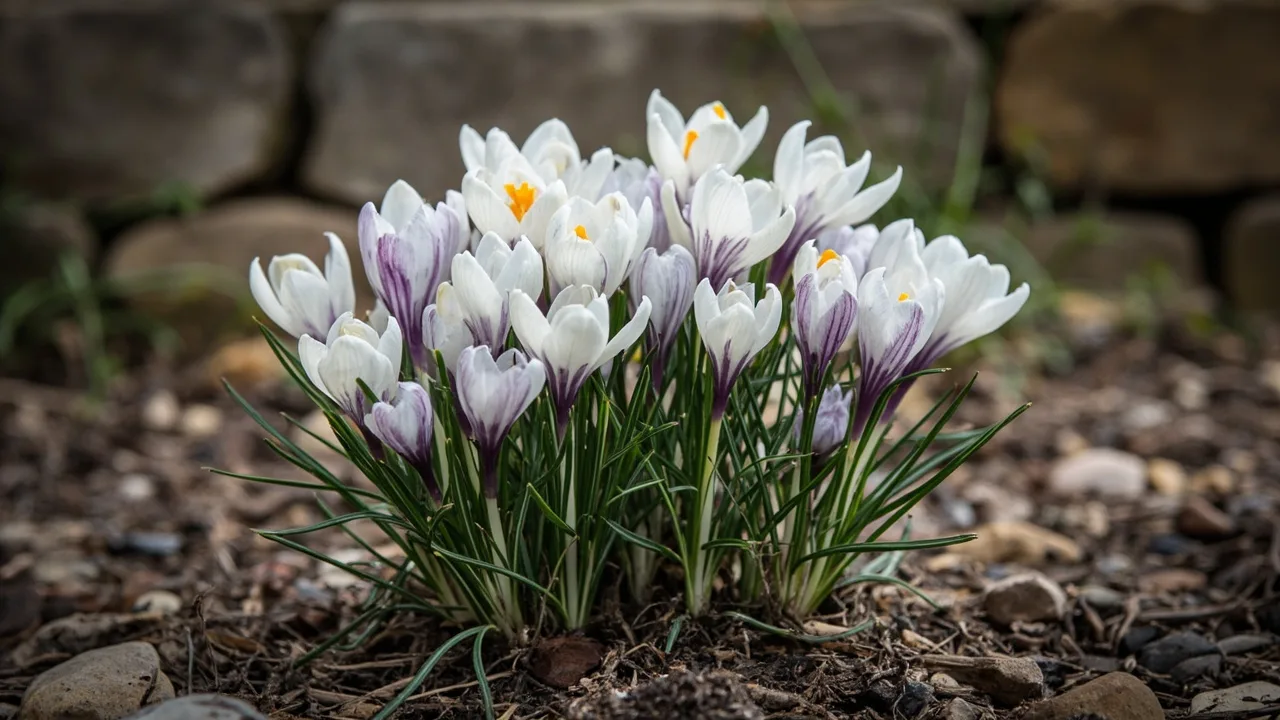
The flowers are goblet-shaped, 4–6 cm tall, with pointed perianth segments. Colour varies across forms: most garden plants are pale lilac to deep violet, with conspicuous darker violet feathering on the outer three segments; a few forms are nearly white. The throat is pale and glabrous, and the branched style is bright orange, which is particularly noticeable on a sunny day when the goblet is fully open. Individual flowers last several days in cool weather, opening with light and closing again at night or in heavy cloud.
Growing Conditions
Across southern and western Britain Crocus laevigatus succeeds in open ground given the right soil; in cold inland or northern gardens it is safer in an alpine trough, raised bed or cold frame where winter wet can be controlled. A position at the base of a south- or west-facing wall, beside a sunny path, or in a well-built rock garden suits it best, because the corms bake in summer and remain relatively dry in winter.
Light is the most important factor: the plant needs several hours of direct sun a day, particularly during the winter flowering window. Beneath deciduous shrubs that leaf out in summer is also acceptable, as long as the corms are not deeply overshadowed in midwinter. Deep, year-round shade produces leafy growth and few or no flowers.
Soil must be sharply drained. A gritty or sandy loam is ideal; heavy clay rots the corms in a wet UK winter, especially during a mild, damp spell when growth has already started. Improving heavy ground with coarse grit and well-rotted garden compost helps, but for clay sites a raised bed, rock garden pocket or container is a safer choice. The species tolerates neutral to slightly alkaline substrates. A top-dress of grit or fine gravel 1–2 cm deep around the neck of each corm sheds winter rain and reduces basal rot.
Unlike many autumn-flowering crocus species, C. laevigatus tolerates summer moisture better than its relatives, a useful trait for the wetter parts of the UK and a reason it can be grown in maritime gardens where Crocus cancellatus or Crocus pulchellus would struggle.
Planting and Care
Plant new corms in late summer, ideally August or September, so they have time to make roots before pushing up the first flowers. Set them 8–10 cm deep (roughly three times the height of the corm) and 5–8 cm apart in small groups of five to fifteen for a naturalistic effect. In pots use a free-draining mix such as John Innes No. 2 with one third by volume of coarse grit; plant at the same depth, slightly closer, and top-dress with grit. Move pot-grown plants into a cold frame or rain-shadow in winter if the garden is on heavy ground.
Watering is rarely needed after establishment. Autumn-flowering crocus receive most of their moisture from the season itself, and summer rainfall in the UK is generally sufficient. Container-grown specimens dry out faster and benefit from a soak during prolonged summer drought, but the compost should be allowed to dry again between waterings.
Feeding is light. A single spring application of a slow-release bulb fertiliser, or a top-dressing of well-rotted garden compost, is plenty. Over-rich feeding produces lush leaves at the expense of flowers and can encourage the soft growth that rots in winter.
Pruning is minimal. Leave the foliage to die back naturally through late spring — the leaves replenish the corm for the following season — and only tidy once the foliage has yellowed. Removing green leaves weakens the plant and reduces flowering the next year.
Propagation is straightforward by division. Lift congested clumps in late summer when dormant, separate the cormlets and replant the largest pieces immediately at the same depth. Seed can be sown in autumn for species-true stock, but seedlings take three to four years to reach flowering size and will not come true to a named form.
Seasonal care centres on summer dryness and winter drainage. In a wet site, a pane of glass or a cloche propped over the clump from October to March keeps the worst of the rain off without shading the flowers. In spring, mark the position before surrounding plants leaf out, so the clump is not accidentally disturbed.
Common Problems
Corm rot
The principal disease risk in UK conditions. Caused by Botrytis and Fusarium species in damp, poorly drained soil, corm rot shows as yellowing, collapsing foliage followed by a soft, often pink-tinged corm that pulls away easily from the base. Improve drainage with grit and organic matter, top-dress the neck of the corm with gravel, and avoid replanting into ground that has just hosted a rotting clump. Pot-grown plants in saturated compost are particularly vulnerable; bring containers into a cold frame for the worst of the winter.
Rodents
Mice, voles and squirrels will dig up and eat crocus corms. Crocus vernus hybrids are the worst-affected; C. laevigatus is generally less damaged but still vulnerable, especially in newly planted sites. Plant corms slightly deeper than the minimum recommended, lay a square of chicken-wire over the planting until the ground has settled, or interplant with Crocus tommasinianus, which is usually ignored by squirrels. Squirrels also graze flowers and buds once they emerge in late winter; a cold frame is the most reliable physical control for a small collection.
Nematodes
In commercial crocus production, root-knot and stem nematodes (Ditylenchus destructor) are reported pests. They are uncommon in UK garden settings but can be introduced on corms sourced from continental suppliers; the symptom is stunted, distorted growth above a damaged corm. Buy from reputable UK growers and rotate the planting site if a problem is suspected.
Poor flowering
A healthy clump that produces leaves but few flowers is usually short of light, planted too deeply, or growing in a pocket that has become shaded by surrounding vegetation. Lift and replant in a sunnier position, raise the corms to the correct depth and top-dress with grit to encourage a stronger bud set for the following autumn.
Popular Varieties
Crocus laevigatus 'Fontenayi' is the best-known selection in UK cultivation. It has rich violet outer segments with conspicuous darker feathering, a paler lilac interior and reliable flowering from late October through December. The name refers to the historic Fontenay-aux-Roses collection in France. It is offered by UK specialist bulb nurseries including Broadleigh Bulbs and Pottertons, and is the form most likely to be encountered under a labelled pot.
Crocus laevigatus var. boryi is a pale, often later-flowering form with white to very pale lilac flowers and a yellow throat, typically in flower from December into January. It is sometimes listed by nurseries and in older literature as a separate species, Crocus boryi, which Kew's Plants of the World Online treats as a distinct taxon native to western and southern Greece and Crete; both names remain in use in UK catalogues, so it is worth checking the botanical label before ordering.
Other named forms circulate among specialist growers and the Alpine Garden Society — collections from Crete, Andros and Tinos are prized for their variability — but they are not widely available through mainstream UK plant retail and should be sought from specialist alpine nurseries or society seed exchanges.
Sources and Further Reading
- Royal Horticultural Society: Crocus laevigatus (smooth crocus) plant profile, https://www.rhs.org.uk/plants/4904/crocus-laevigatus/details, accessed 2026-07-22.
- Royal Horticultural Society: Crocus laevigatus 'Fontenayi' plant profile, https://www.rhs.org.uk/plants/91656/crocus-laevigatus-fontenayi/details, accessed 2026-07-22.
- Royal Horticultural Society: How to grow crocuses, https://www.rhs.org.uk/plants/crocus/growing-guide, accessed 2026-07-22.
- Alpine Garden Society encyclopaedia: Crocus laevigatus, http://encyclopaedia.alpinegardensociety.net/plants/Crocus/laevigatus, accessed 2026-07-22.
- Kew Science, Plants of the World Online: Crocus boryi, https://powo.science.kew.org/taxon/urn:lsid:ipni.org:names:436484-1, accessed 2026-07-22.
- Broadleigh Bulbs: Crocus laevigatus 'Fontenayi', https://broadleighbulbs.co.uk/wp/crocus-laevigatus-fontenayi/, accessed 2026-07-22.
- Pottertons Nursery: Crocus laevigatus 'Fontenayi', https://www.pottertons.co.uk/shop/bulbs/crocus-autumn/crocus-laevigatus-fontenayi-aut, accessed 2026-07-22.
Pests and Diseases
| Problem | Symptoms | Management |
|---|---|---|
| Slugs and snails | Irregular holes in leaves and damage to flower buds before or during opening. | Use slug pellets, beer traps, or copper tape barriers around the planting area. |
| Vine weevil | Notched leaf margins above ground and root damage causing wilting below ground. | Apply nematodes to soil in autumn or use systemic insecticides on potted plants. |
| Crocus virus | Mottled, streaked, or distorted leaves and flowers with reduced vigor. | Remove and destroy infected plants; control aphid vectors to prevent spread. |
| Bulb rot | Soft, mushy bulbs with a foul odor, often accompanied by yellowing foliage. | Ensure well-drained soil and avoid waterlogging; remove affected bulbs immediately. |
For step-by-step help, read Dealing with Slugs and Snails. Or browse the full plant problem solver to diagnose an issue by symptom.
Recommended Products
GardenWizz earns a commission from qualifying purchases made through affiliate links on this page (including links within the article) — as an Amazon Associate, and from Thompson & Morgan via the Awin network. This does not affect the price you pay. See our disclaimer for details.