Hank Small
Cypripedium Hank Small
The Gardening Year
Best months in UK gardens · full planting calendar →
🖨 Printable care card (PDF)At a Glance
| Botanical name | Cypripedium Hank Small |
|---|---|
| Common name(s) | Hank Small |
| Family | Orchidaceae |
| Plant type | perennial (terrestrial orchid with short robust rhizome) |
| Height × Spread | 15–60 cm × 20–30 cm |
| Position | — |
| Soil | leaf-mould rich, moist, free-draining |
| Flowering | May–June |
| Toxicity | — |
| Native range | Northern Hemisphere, including most of Europe and Africa (Algeria), Russia, China, Central Asia, Canada the United States, Mexico, and Central America |
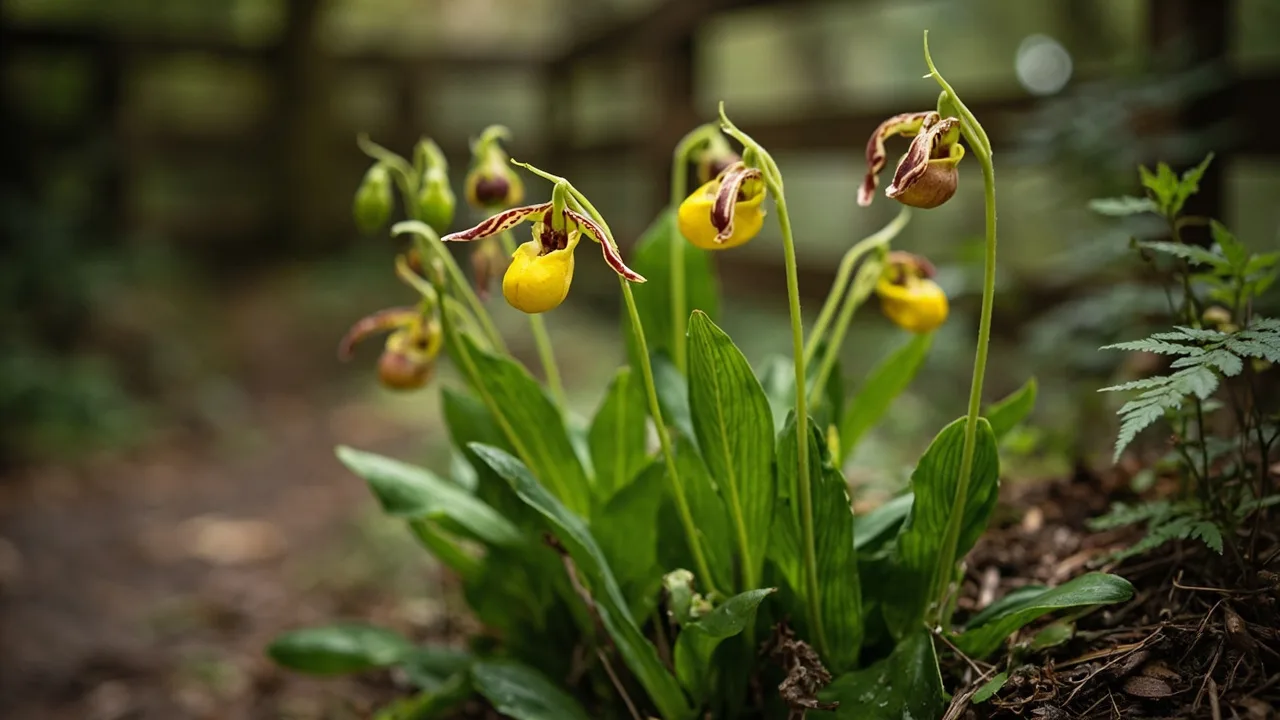
A hardy lady's slipper orchid for shaded UK gardens, Cypripedium Hank Small gx carries a clear yellow pouch backed by long, twisted, cinnamon-burgundy petals on stems around 30-45 cm tall. Raised in 1991 by Carson Whitlow, it is a primary hybrid between C. parviflorum and C. henryi and is one of the easier slipper orchids to establish in cool British conditions, provided the soil drains sharply and the rhizome is planted only just below the surface.
Overview
Cypripedium Hank Small gx is a man-made grex (a hybrid group, denoted by "gx" after the name) registered in 1991 by the American hybridiser Carson Whitlow. The name is the RHS-accepted grex for the cross Cypripedium parviflorum x Cypripedium henryi, and the plant is sold across Europe as part of the Frosch® "Jewels of the shaded garden" range of hardy slipper orchids. The parent task title in our editorial system reads "Cypripedium hank", but the accepted grex is Cypripedium Hank Small; this article uses the accepted name throughout.
The plant is a clump-forming terrestrial orchid that grows from a short, fleshy rhizome. Each spring it pushes up a leafy stem and, on a mature plant, one or occasionally two distinctive slipper-shaped flowers. The pouch is the clear, saturated yellow inherited from C. parviflorum, while the long, often spiralled lateral petals and the dorsal sepal take the deeper rose to burgundy tones of C. henryi. The effect is a flower that is visible from several metres across a shaded border without looking gaudy.
For UK gardeners, Hank Small is a useful introduction to hardy slipper orchids. It is one of the smaller, more garden-tolerant grexes, has a long record of cultivation in British woodland collections and sits on the Royal Horticultural Society's Award of Garden Merit list. It is not a beginner's houseplant orchid and it is not a wild-collected plant: commercial stock is raised from seed or by meristem (laboratory) propagation under CITES-permitted nurseries.
Appearance
The rhizome sits only just below the soil surface and produces a tight cluster of upright stems rather than a spreading mat. Stems reach 30-45 cm at flowering, with strong plants occasionally nudging 50 cm in especially good seasons. Foliage is held alternately up the stem: broadly oval to elliptic, prominently ribbed, soft to the touch and a clear, slightly blue-toned green. Leaves are usually around 8-15 cm long and clasp the stem at the base without a true stalk. By late summer the foliage yellows and dies back naturally; the plant then goes fully dormant through the winter.
Flowers are borne singly at the stem tip, with two flowers on one stem occasionally seen on well-established clumps. The most conspicuous feature is the inflated, slipper-shaped labellum (pouch), which is a clean, rich yellow often marked with a faint reddish flush around the opening. Above and behind it sit the dorsal sepal and two lateral petals, which are noticeably longer than the pouch, often gently twisted, and coloured in deep rose, cinnamon or maroon-brown. The dorsal sepal leans forward over the pouch, giving the flower a hooded, sculptural outline. Individual blooms last two to three weeks in cool weather and carry a faint, sweet fragrance that is strongest on still, warm days.
Fruit is a slender, few-seeded capsule that follows pollination in late spring. It is not ornamental and most UK growers remove spent flowers before seed sets, both to direct energy back into the rhizome and because raising Cypripedium from seed requires specialist laboratory conditions.
Growing Conditions
Light is the first decision. Hank Small performs best in bright, dappled shade or light woodland shade, the kind of position found beneath a high canopy of beech, ash, oak, birch or hazel. A north- or east-facing border, the shaded side of a shrub planting, or a dedicated woodland bed all work well. Full sun scorches the leaves and bleaches the flowers; deep, dark shade produces leafy growth with little or no flowering. A site that catches gentle morning sun and is shaded from late-midsummer afternoon sun is ideal.
Soil is the second decision, and the one most often got wrong. The rhizome must have air around it; the root run must never sit in winter water, yet it must not dry out completely in summer. A workable mix for heavier UK soils is roughly 45 percent loam, 45 percent coarse grit or perlite, and 10 percent fine bark or well-rotted leaf mould, worked into the top 10-15 cm. On free-draining sandy or chalky ground the plant is generally easier to please than on clay, and a light annual mulch of leaf mould is usually enough. The plant prefers near-neutral conditions, around pH 6.5-7.0, and does not require the acidic soil associated with rhododendrons or blueberries.
Established plantings benefit from a sheltered position out of cold winter wind, although the rhizome itself is reliably hardy across the UK and needs no winter protection. Good air movement around the foliage reduces the risk of fungal problems in damp springs, and a site that is not crowded by greedy surface roots (under conifers or close to mature maple, for example) will repay the small extra effort of siting it well.
Planting and Care
Plant dormant rhizomes in autumn, ideally from late September into October, while the soil is still warm and workable. Container-grown plants from specialist nurseries can be planted at any time the ground is workable and the plant is not in active flower, but spring planting after the last frost is also acceptable. The single most important rule is shallow planting: set the rhizome horizontally with the white, fleshy roots spread radially and cover with no more than 2-3 cm of soil. Burying it deeper is the most common reason for failure.
Space plants about 25-30 cm apart, marking the position because the dormant rhizome disappears completely below ground in winter. Water in well at planting and keep the root zone evenly moist through the first growing season without saturating it. A light mulch of leaf mould in late spring helps keep roots cool and conserves moisture; avoid mounding mulch against the emerging shoots.
Watering through the year should be responsive rather than scheduled. The plant wants steady moisture during active growth in spring and early summer, then a drier rest as the foliage dies back. Do not let the rhizome desiccate in a hot, dry August, but do not waterlog a dormant clump in a wet November either. Where tap water is hard, rainwater is preferable, but the plant is not as sensitive to alkalinity as some of its Asian relatives.
Feeding should be restrained. A single light application of a low-nitrogen, organic feed in early spring, or simply an annual top-dressing of leaf mould, is enough. High-nitrogen lawn or rose feeds push soft, leafy growth at the expense of flowers and can predispose the rhizome to rot. Pruning is essentially limited to removing spent flower stems and tidying dead foliage in late autumn; the plant does not need shaping. Propagation is by careful division of vigorous, multi-stem clumps in early autumn, accepting that divided plants often rest for a year or two before flowering resumes.
Common Problems
Rhizome rot is the principal killer and almost always traces back to drainage. The soil holds too much winter water, or the rhizome has been buried too deeply. Prevention is far easier than cure: improve drainage before planting, plant shallowly, and avoid frost pockets and compacted ground. Once rot is established there is no reliable chemical treatment, and affected material is best removed and the site re-prepared before replanting.
Slug and snail damage on emerging shoots in early March and April is a real and recurring problem in damp UK gardens, where the soft new growth is highly palatable. Pet-safe slug controls, beer traps or hand-picking on damp evenings are the standard responses. A circle of coarse grit around the emerging shoots is also a useful physical barrier.
Failure to flower usually reflects one of four causes: the rhizome was planted too deep, the plant is being overfed with nitrogen, the summer was too dry, or the plant is simply a recent division that needs another year to settle. Time and correct siting usually resolve the issue.
Leaf scorch shows as brown, papery patches on the leaf surface in midsummer and indicates too much direct sun. The fix is to move the plant or to provide taller, lateral shade from a neighbouring shrub or hedge.
Virus infection (notably Cymbidium mosaic virus and Odontoglossum ringspot virus) is occasionally seen in Cypripedium and is best avoided by buying only from reputable, CITES-compliant nurseries that propagate from seed or meristem culture, and by not sharing cutting tools between plants without sterilising them. There is no cure; infected plants should be destroyed.
Finally, a legal note. All Orchidaceae are listed under CITES Appendix II, and the genus Cypripedium in particular is the subject of significant wild-collection pressure in parts of its native range. In the UK, commercially propagated plants from reputable EU and UK nurseries are sold as artificially propagated with the correct paperwork, but wild-collected plants are illegal to buy or sell. Always buy from a specialist who can confirm propagation method and provide CITES documentation on request.
Popular Varieties
Cypripedium Hank Small is itself a grex rather than a single clone, and a small number of distinct clonal selections have been named within it.
- 'Weißkirchen': a vigorous, large-flowered selection with an especially clear yellow pouch and well-defined burgundy striping on the petals. Widely circulated in European collections and a reliable first choice for a new planting.
- AGM clone (the standard Hank Small gx plant): the unnamed but Award of Garden Merit-listed stock plant sold by Frosch and other European suppliers, and the form most UK gardeners grow. It sets the benchmark for flower form, plant vigour and garden tolerance.
- Frosch® Exclusive Perennials stock: the branded Frosch range includes Hank Small as one of the "Jewels of the shaded garden" series alongside Cypripedium 'Gisela', 'Ingrid', 'Michael' and 'Emil'. The Frosch plants are propagated by meristem culture, which gives predictable, virus-clean stock.
Where a gardener wants the Hank Small flower form in a slightly different colour or growth habit, the related Frosch grexes 'Gisela' (larger, pinker flowers) and 'Michael' (paler yellow, more robust on heavier soils) are the most natural UK alternatives within the same cultivation group.
Sources & Further Reading
- orchids.org/grexes/cypripedium-hank-small, accessed 2026-07-24 — primary hybrid record: grex name, originator C. Whitlow, year 1991, parentage Cyp. parviflorum x Cyp. henryi.
- rhs.org.uk/plants/117068/cypripedium-hank-small-gx/details, accessed 2026-07-24 — RHS plant record for Cypripedium Hank Small gx.
- rhs.org.uk/plants/pdfs/agm-lists/agm-orchids.pdf, accessed 2026-07-24 — RHS Award of Garden Merit orchids list (October 2022 revision), confirming Hank Small gx AGM status.
- cypripedium.de/English/plants/hank-small-e.html, accessed 2026-07-24 — Frosch® Exclusive Perennials plant page, including height (30-40 cm), flowering time and hardiness note.
- cypripedium.de/English/planting/planting.html, accessed 2026-07-24 — Frosch planting and soil-mix guidance.
- plantdelights.com/products/cypripedium-hank-small, accessed 2026-07-24 — Plant Delights Nursery description, including the 18-inch (45 cm) flowering stem height and the "rich, deep yellow pouch" flower detail.
- kew.org/read-and-watch/slipper-orchids-close-to-the-edge, accessed 2026-07-24 — Kew summary of the IUCN Red List assessment showing around 79 percent of temperate Northern Hemisphere slipper orchid species are threatened, providing context for growing nursery-propagated hybrids.
- planthealthportal.defra.gov.uk/trade/imports/imports-from-the-eu/cites-guidance/, accessed 2026-07-24 — DEFRA / UK Plant Health Information Portal guidance on CITES Appendix II listing for Orchidaceae.
Pests and Diseases
| Problem | Symptoms | Management |
|---|---|---|
| Slugs and snails | Irregular holes chewed in young leaves and seedlings, often accompanied by silvery slime trails. | Use physical barriers like copper tape or crushed eggshells, and apply iron phosphate pellets around the base. |
| Grey mould (Botrytis) | Fuzzy grey-brown fungal growth on dying flowers, leaves, or stems, particularly in humid conditions. | Improve air circulation, remove affected plant parts immediately, and avoid wetting foliage when watering. |
| Root rot | Yellowing, wilting, or collapsing foliage despite moist soil, indicating waterlogged roots. | Ensure soil is well-drained and fertile; avoid overwatering and ensure pots have adequate drainage holes. |
| Vine weevil | Notched edges on leaves during the day and root damage causing sudden wilting at night. | Apply systemic insecticides to the soil in autumn or use biological controls like nematodes. |
| Powdery mildew | White, powdery fungal spots appearing on leaves and stems, potentially causing distortion. | Spray with a fungicide at first sign of infection and ensure good air circulation around the plant. |
For step-by-step help, read Dealing with Slugs and Snails and Treating Powdery Mildew. Or browse the full plant problem solver to diagnose an issue by symptom.
Recommended Products
GardenWizz earns a commission from qualifying purchases made through affiliate links on this page (including links within the article) — as an Amazon Associate, and from Thompson & Morgan via the Awin network. This does not affect the price you pay. See our disclaimer for details.