Ladies' Eardrop
Fuchsia denticulata
The Gardening Year
Best months in UK gardens · full planting calendar →
🖨 Printable care card (PDF)At a Glance
| Botanical name | Fuchsia denticulata |
|---|---|
| Common name(s) | Ladies' eardrop |
| Family | Onagraceae |
| Plant type | shrub |
| Height × Spread | 1–3 m × — |
| Position | Partial shade |
| Soil | Moist, fertile, well-drained soil |
| Flowering | June–July |
| Toxicity | — |
| Native range | Bolivia and Peru |
Fuchsia denticulata is an evergreen to semi-deciduous shrub in the family Onagraceae, native to the Andean cloud forests of Peru and Bolivia. In the UK it is grown as a specialist ornamental for conservatories, glasshouses and very sheltered gardens, valued for its slender tubular flowers and glossy, finely toothed leaves rather than for hardiness. Unlike the familiar hardy Fuchsia magellanica and its hybrids, this species is frost-tender and behaves more like a subtropical specimen than a border shrub.
Overview
Fuchsia denticulata belongs to a genus of around 100 species distributed across Central and South America, with a handful of New Zealand species. Most Fuchsia species sold in UK garden centres are hybrids of F. magellanica bred for border hardiness, and this can mislead gardeners who encounter F. denticulata in a specialist catalogue. It is an Andean cloud-forest plant, adapted to cool, humid, lightly shaded conditions and to soils that stay evenly moist without becoming waterlogged. Its preference for those conditions explains both its appeal as a conservatory specimen and its poor performance in dry, exposed or frosted positions outdoors.
In UK cultivation it sits firmly in the "specialist" category. It is not a plant for a windy Northumberland border or a sun-baked south-facing wall in midsummer; it is a plant for a shaded, humid glasshouse, a frost-free porch or, in the mildest coastal and south-western districts, a sheltered wall position where winter temperatures only briefly dip below freezing. The species is uncommon in general retail trade, and is most often sourced from specialist fuchsia nurseries or botanical plant sales.
Appearance
The habit is arching and somewhat scandent, with slender, occasionally reddish young stems that can sprawl or be tied in against a support. Mature plants in the ground reach 1–2 m tall with a similar or wider spread, while container-grown specimens stay more compact. The stems are noticeably brittle and respond best to gentle handling when training or pruning.
Leaves are opposite or in whorls, elliptical to lanceolate, and 3–8 cm long. They are glossy mid- to deep green with finely toothed (denticulate) margins, and it is this feature that gives the species its name. Foliage persists through the year under glass, though outdoor plants may drop some leaves during a cold winter and regrow them in spring.
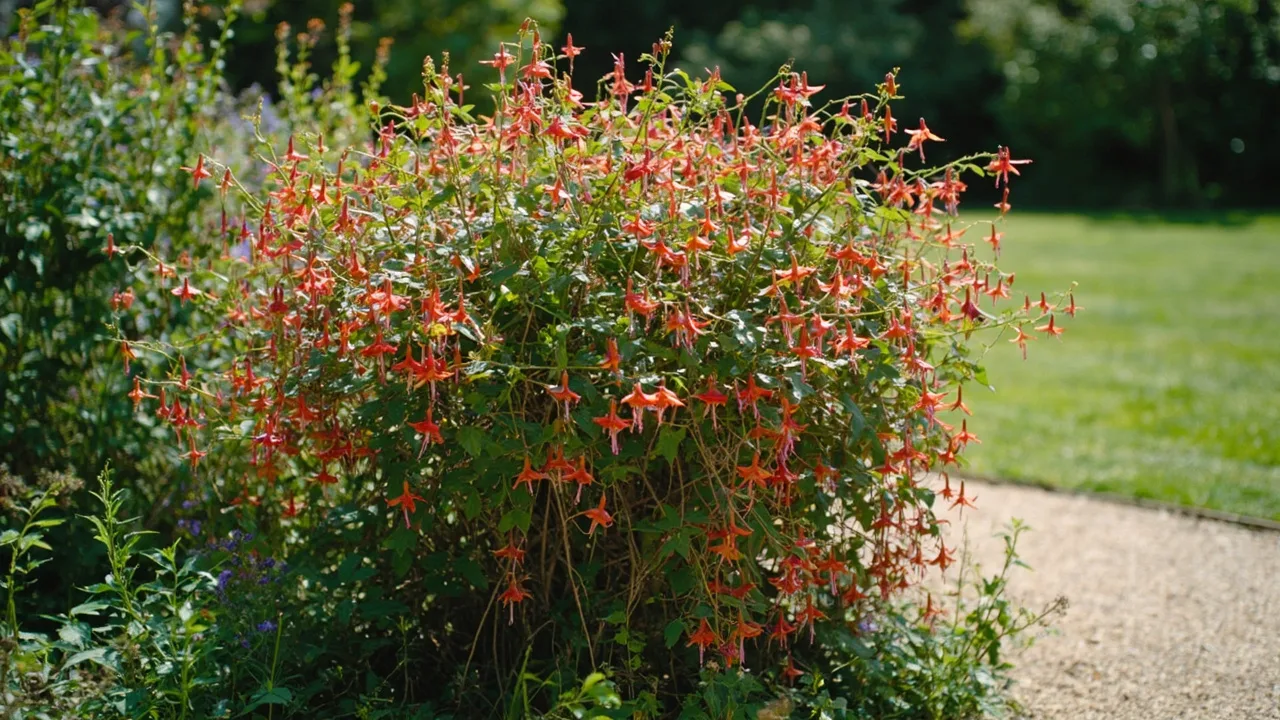
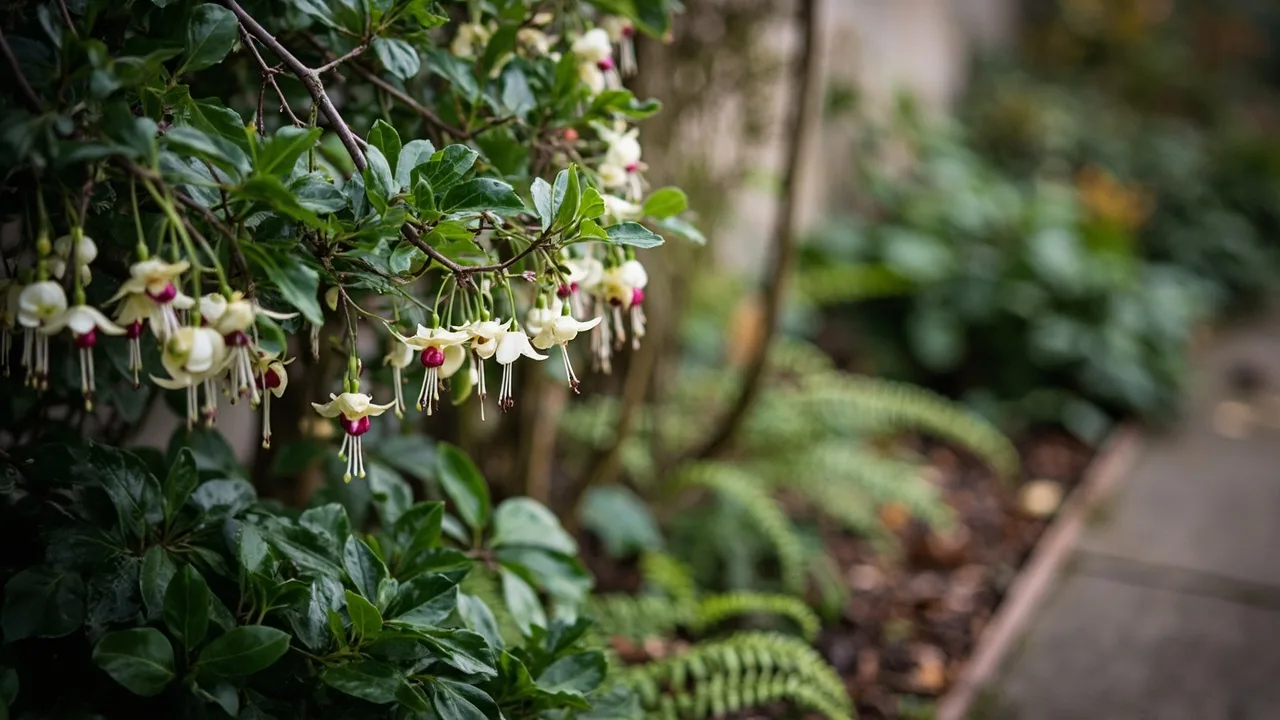
Flowers are pendulous and borne in loose terminal panicles or small clusters. The tube is narrow and elongated, and the sepals reflex back from it, both in shades of red or coral. The petals are smaller and may be orange-red, vermilion or pink depending on the form. The eight stamens and the long style protrude well beyond the petals, dangling beneath each bloom — the characteristic Fuchsia feature and one of the species' most recognisable traits. Where pollination succeeds, plants set small dark purple to black berries; these are ornamental rather than edible.
Growing Conditions
Light should be bright but filtered. A position that receives gentle morning sun and is shaded from harsh midday and afternoon sun suits the species well. Deep, dry shade beneath evergreen conifers tends to produce lush foliage at the expense of flowers, while direct midday sun scorches both leaves and flower buds.
Soil needs to be humus-rich, moisture-retentive and free-draining. A loam-based mix such as John Innes No. 2 or No. 3, opened up with leaf mould and a little grit, suits container plants. In the ground, incorporate generous organic matter and ensure the site does not sit waterlogged in winter. Slightly acidic to neutral pH is ideal; strongly alkaline conditions are tolerated but not preferred.
Moisture must be even. The species resents both severe drought and prolonged saturation. Under glass, water whenever the upper centimetre of compost begins to dry, and reduce watering in winter without ever letting the rootball dry out hard. Humidity should be moderate to high; this is one of the principal reasons the plant is grown in a conservatory rather than in a dry living room.
Temperature is the limiting factor for outdoor cultivation. As an Andean cloud-forest plant, F. denticulata prefers cool rather than hot summers and mild winters with a minimum in the region of 7–10 °C. In the very mildest UK microclimates — Scilly, parts of the south-west coast, inner London, and a handful of other frost-sheltered pockets — it may survive outdoors against a south- or west-facing wall, particularly with a thick mulch over the root zone. In most of the country it requires glass or a frost-free porch for the winter months.
Planting and Care
Plant in late spring once night temperatures are reliably above 10 °C and the risk of late frost has passed; in most UK districts this means late May to mid-June for outdoor positions. Container plants under glass can be repotted at any point during active growth, with spring being the most convenient time. Before planting, fork in leaf mould or well-rotted garden compost, and check that the site drains freely.
Watering should be regular and consistent through the growing season, with a reduction in winter. Under glass, water in the morning so foliage dries before evening, and avoid leaving pots sitting in saucers of water. Feeding is straightforward: a balanced liquid fertiliser at half strength every two to four weeks from April to September supports steady growth and repeat flowering; little and often is preferable to heavy occasional doses.
Pruning is light. After flowering, tidy wayward stems and remove any dead or damaged material. Harder shaping, where needed, is best done in early spring before new growth accelerates. Wear gloves when cutting, as Fuchsia sap can irritate sensitive skin.
Overwintering is the chief practical concern. In most UK districts, move containers into a frost-free greenhouse, conservatory or bright porch by October or early November, before night temperatures regularly fall below 7 °C. Outdoors-grown plants in mild districts benefit from a thick mulch of bark or leaf mould over the root zone and from being sited against a south- or west-facing wall that radiates stored warmth.
Propagation is by softwood cuttings taken in late spring or early summer. Non-flowering side shoots of about 5–8 cm root readily in a free-draining cutting compost under a humid propagator at 18–21 °C. Pot on once rooted and grow on under glass through their first winter.
Seasonal care follows the calendar of the structured month fields: plant outdoors in May–June after frost; feed from April to September; shape in March–April and tidy lightly after flowering; take softwood cuttings in May–July; and move plants under glass or apply a protective mulch in October–November.
Common Problems
Glasshouse pests are the most frequent issue. Whitefly and aphids colonise soft new growth under glass; red spider mite (two-spotted spider mite) thrives in the dry, warm conditions of a centrally heated conservatory. Inspect leaf undersides weekly, use biological controls such as Encarsia formosa for whitefly and Phytoseiulus persimilis for red spider mite where compatible, and raise humidity to discourage the latter.
Outdoor pests to monitor include capsid bug, which distorts young leaves and flower buds, and fuchsia gall mite (Aculops fuchsiae). Gall mite is more commonly reported on F. magellanica hybrids than on this species, but F. denticulata is not immune. Distorted new growth, swollen shoot tips and roughened flowers warrant close inspection; affected material should be removed and disposed of, and the grower should seek current advice from the Royal Horticultural Society before assuming a clean plant.
Diseases include fuchsia rust (Puccinia fuchsiae), seen as orange pustules on leaf undersides in late summer, and grey mould (Botrytis cinerea) in damp, poorly ventilated glasshouse conditions. Verticillium wilt can affect plants in poorly drained substrates, causing sudden wilting and dieback. Improving air movement, avoiding overhead watering late in the day, removing affected foliage and quarantining new stock are the standard preventive measures.
Physiological symptoms are common and usually point to cultural causes rather than disease. Winter leaf drop under glass typically indicates that the compost has dried too far or that temperatures have dipped lower than expected. Sudden flower-bud loss is most often linked to underwatering or low humidity. Yellowing lower leaves in summer are usually a sign of nitrogen deficit or waterlogging rather than age.
Popular Varieties
Fuchsia denticulata has a limited range of named selections in general UK cultivation, and the species itself is uncommon enough that the bulk of available material is raised from wild-collected or open-pollinated stock rather than clonal cultivars. Gardeners seeking distinct forms should buy from specialist fuchsia nurseries that propagate named accessions and label their stock carefully.
Where named forms are offered, they tend to differ in flower colour intensity — from coral-red through to a deeper vermilion — and in habit, with some selections more upright and others more trailing. Because availability of named F. denticulata cultivars in the UK is genuinely limited and the trade names in circulation are not widely documented in mainstream horticultural references, this section is reported conservatively. Gardeners who want a plant of known provenance should buy from a specialist nursery and retain the label with the plant's accession details.
For gardeners who want a similar look in conditions where F. denticulata will not thrive, the hardy hybrids Fuchsia 'Mrs Popple', Fuchsia 'Tom Thumb' and Fuchsia 'Hawkshead' give a comparable flower form in border-hardy plants, although their growth habit and foliage are quite different. These are not substitutes in any strict sense and should be chosen on their own merits rather than as a stand-in for the Andean species.
Pests and Diseases
| Problem | Symptoms | Management |
|---|---|---|
| Whitefly | Small white-winged insects that flutter up from the undersides of leaves when disturbed, leaving sticky honeydew and sooty mould on foliage below. | Use yellow sticky traps to monitor populations and apply biological control with the parasitoid Encarsia formosa under glass; inspect new stock before introducing it to the conservatory. |
| Aphids | Clusters of small soft-bodied green or black insects on soft new growth and shoot tips, causing distorted leaves and sticky honeydew. | Squash small colonies by hand or wash off with a strong jet of water; encourage natural predators such as hoverflies and ladybirds, and only treat with insecticidal soap if infestations persist. |
| Red spider mite (two-spotted spider mite, Tetranytus urticae) | Fine pale stippling on upper leaf surfaces and fine webbing across leaf undersides in hot, dry indoor conditions; leaves turn bronze and may drop prematurely. | Raise humidity around the plant and improve ventilation; introduce the predatory mite Phytoseiulus persimilis as a biological control under glass, or apply a miticide where compatible with other controls. |
| Capsid bug | Distorted young leaves and flower buds with small brown or tattered holes, typically appearing in late spring on outdoor plants. | Tolerance is usually sufficient on established plants; cut back damaged shoots in early summer as new growth quickly replaces them and remove ground debris where the bugs overwinter. |
| Fuchsia gall mite (Aculops fuchsiae) | Severely distorted and swollen new shoot tips, galled flower buds and roughened or proliferating flowers. | Prune out and destroy affected growth immediately; follow current Royal Horticultural Society guidance before assuming stock is clean, and quarantine any new fuchsia purchases before introducing them to the collection. |
| Fuchsia rust (Puccinia fuchsiae) | Orange-brown pustules on the undersides of leaves with corresponding yellow patches above, typically appearing in late summer under humid conditions. | Remove and destroy affected leaves promptly, improve air circulation around the plant, avoid overhead watering late in the day, and dispose of heavily infected plants rather than composting them. |
| Grey mould (Botrytis cinerea) | Fuzzy grey fungal growth on fading flowers, damaged tissue and dense shaded growth, especially in damp poorly ventilated glasshouses. | Improve air movement and ventilation, remove dead and damaged material promptly, avoid overhead watering late in the day, and reduce humidity spikes in the glasshouse. |
| Verticillium wilt | Sudden wilting and dieback of shoots despite adequate moisture, often on one side of the plant, with dark streaking visible inside cut stems. | Remove and destroy affected plants, improve drainage and avoid replanting susceptible subjects in the same compost or border; source fresh stock from specialist fuchsia nurseries with clean propagation. |
For step-by-step help, read Controlling Aphids Naturally. Or browse the full plant problem solver to diagnose an issue by symptom.
Recommended Products
GardenWizz earns a commission from qualifying purchases made through affiliate links on this page (including links within the article) — as an Amazon Associate, and from Thompson & Morgan via the Awin network. This does not affect the price you pay. See our disclaimer for details.