Wild Geranium
Geranium maculatum
The Gardening Year
Best months in UK gardens · full planting calendar →
🖨 Printable care card (PDF)At a Glance
| Botanical name | Geranium maculatum |
|---|---|
| Common name(s) | wild geranium |
| Family | Geraniaceae |
| Plant type | perennial |
| Height × Spread | 30–60 cm × 30–100 cm |
| Position | Full sun, Partial shade |
| Soil | moderately fertile, moist but well-drained; rich, loamy with abundant organic matter; tolerates clay, loam, sand |
| Flowering | April–June |
| Toxicity | — |
| Native range | eastern North America |
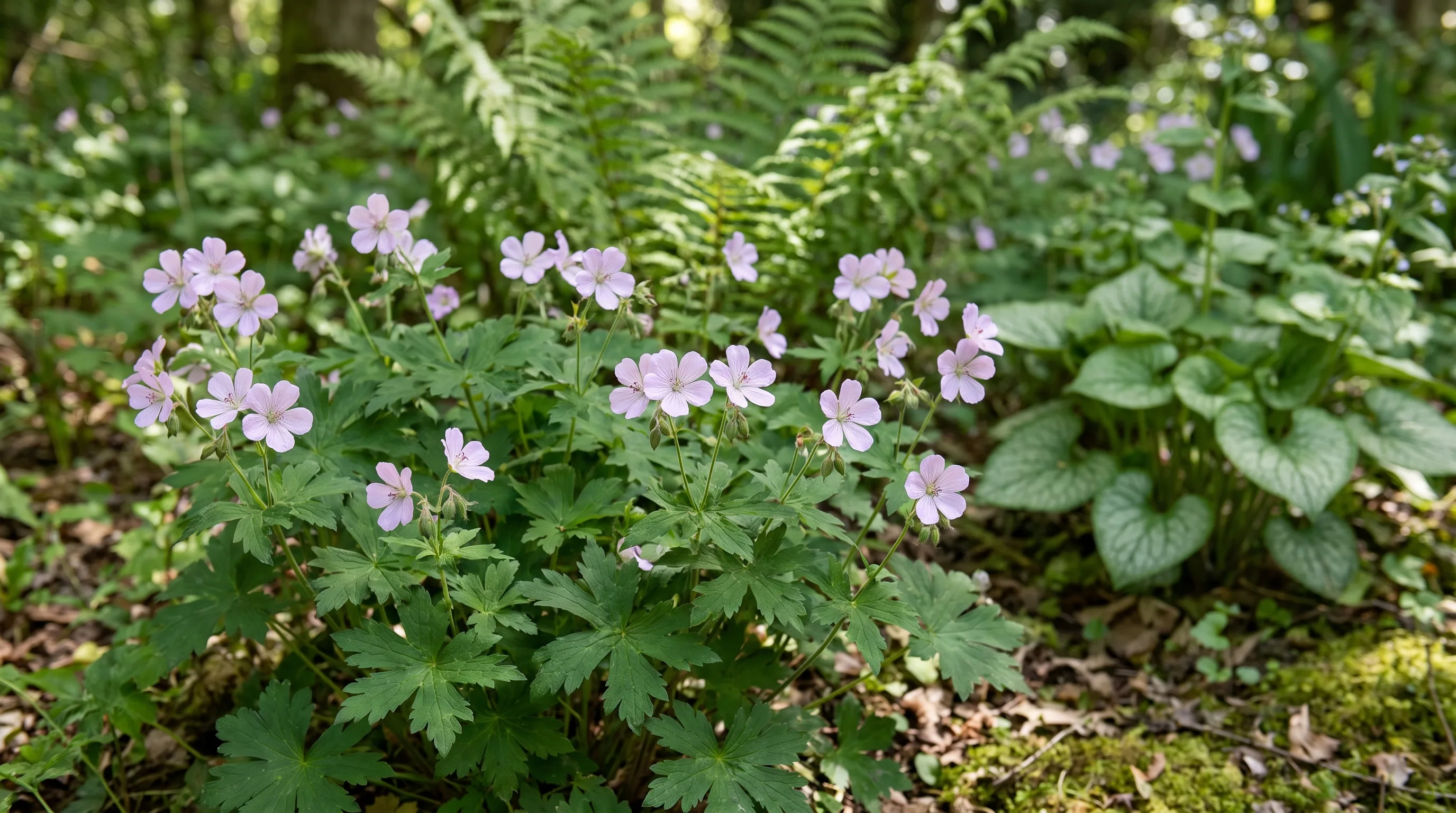
Geranium maculatum, commonly called spotted cranesbill, is a clump-forming herbaceous perennial valued for its spring flowers, handsome lobed foliage and ability to grow in dappled shade. Native to eastern and central North American woodland, it adapts well to humus-rich British borders and informal planting beneath deciduous shrubs.
Overview
Spotted cranesbill is a true geranium in the family Geraniaceae, not a tender Pelargonium used for summer bedding. In its native range it belongs to the ground flora of deciduous woods, woodland margins and shaded banks. That origin makes it particularly useful in UK gardens where spring sun reaches the soil beneath trees before the canopy closes, followed by cooler shade in summer.
The plant grows from thick, slowly creeping rhizomes and develops into a substantial but well-behaved clump. Short rhizomatous growth allows neighbouring plants to knit together over two or three seasons without the aggressive spread associated with some ground-cover plants. It suits the front or middle of a shady border, a woodland garden, an informal wildlife planting or the ground beneath open deciduous shrubs. Repeated groups create a more natural effect than isolated specimens.
Flowers open during an important period for early pollinators. Solitary bees, bumblebees and hoverflies visit them in May and June, while the foliage may support moth larvae. Later, the distinctive seed capsules disperse seed and can provide food for seed-eating birds. The species combines well with ferns, Brunnera macrophylla, pulmonarias, hostas, heucheras, tiarellas, epimediums, aquilegias and spring bulbs. Its stems can also be cut for small, loose arrangements.
The names “cranesbill” and “geranium” refer to the long, beaked fruit, whose outline resembles a bird’s bill. “Spotted” reflects the brownish-purple blotching sometimes visible on the wild form’s leaves. Alumroot, another historical common name, refers to the astringent rhizome. Although the plant has a history of ethnobotanical use in North America, that history should not be treated as a recommendation for modern self-medication.
Appearance
Fresh shoots rise in spring to form a softly textured mound. The branching stems are slender and lightly hairy, carrying leaves and loose flower clusters above the crown. Established plants generally reach 45–60 cm in height and spread 30–45 cm, although moisture, light and soil fertility influence their final proportions.
Each leaf is broadly rounded in outline, usually 7–15 cm across, and divided deeply into three to five palmate lobes. The lobes have toothed margins and give the plant a bold yet informal texture. Foliage is mid- to dark green; wild populations may show brownish-purple marbling or blotches, whereas many selected forms are plain green. The leaves make an attractive foil for finer ferns and the heart-shaped foliage of brunneras.
Open, saucer-shaped flowers are borne in loose, branched clusters above the leaves. Each bloom has five rounded, usually unnotched petals and measures about 2.5–4 cm across. The typical colour is pale pink to lilac-pink, though naturally occurring forms may be deeper pink or white. Flowering normally begins in late April or May and continues into early July, with the strongest display in May and June. Removing spent stems after the main flush can prompt fresh foliage and sometimes a lighter second display.
After pollination, a five-part capsule develops around a long central beak. As it ripens, its segments spring upwards and catapult the seeds away from the parent. This mechanism is characteristic of cranesbills and gives the plant ornamental interest beyond flowering. In autumn the top growth dies back, leaving the perennial rhizomes dormant below ground until spring.
Growing Conditions
Partial shade most closely matches the species’ natural habitat. A position with gentle morning sun, dappled light or spring sunshine followed by summer shade usually produces strong foliage and a reliable floral display. Full shade is tolerated, although flowering may be reduced in very dark sites. Full sun is possible in much of the UK if the soil remains evenly moist; on dry, exposed ground the foliage may scorch or become vulnerable to mildew.
The ideal soil is fertile, humus-rich and moisture-retentive while still draining freely. Loam improved with leaf mould or well-rotted garden compost is particularly suitable. Slightly acidic to neutral conditions are preferred, but the species accommodates a reasonably broad pH range. Very chalky soil may lead to chlorosis, while compacted clay or a permanently wet planting hole can damage the crown and roots.
Consistent moisture is important during spring growth and flowering. The plant dislikes prolonged drought but should not stand in waterlogged ground. Before planting in heavy soil, incorporate organic matter over a broad area and improve drainage rather than creating a small, enriched sump. In light soil, a surface mulch reduces evaporation and supports the cool root conditions associated with woodland ground.
Shelter from cold, drying winds helps to prevent desiccation, especially on exposed eastern sites. Beneath shallow-rooted trees, competition for water can be more limiting than shade itself, so plants may need supplementary watering during dry springs and summers. Avoid placing them immediately against a large trunk; the outer canopy, a woodland edge or the north or east side of shrubs generally offers better soil and light.
For naturalistic planting, allow neighbouring perennials to overlap without smothering the spring shoots. The cranesbill’s midsummer foliage can be refreshed by cutting back, while companions such as ferns and hostas continue the display. In a wildlife border, retain a proportion of seedheads where self-seeding and food value are welcome.
Planting and Care
Plant in March or April as active growth begins, or in September and October while the soil is still warm. Container-grown specimens may be planted at other times if the ground is workable, unfrozen and not waterlogged, but spring and early autumn reduce watering stress. Prepare a hole as deep as the root ball and somewhat wider, loosen circling roots, and set the crown level with the surrounding soil. Firm gently and water thoroughly.
Space plants about 30–45 cm apart according to the desired speed of cover. A closer spacing gives a joined display sooner, whereas wider spacing leaves room for companion plants. Mulch around, but not directly over, the crown with leaf mould or compost. During the first growing season, water deeply whenever the upper soil begins to dry. Established clumps usually need additional water only during prolonged dry spells, particularly under trees or in full sun.
An annual spring top-dressing of leaf mould or well-rotted garden compost normally supplies sufficient nutrients. Rich, high-nitrogen fertiliser is unnecessary and can encourage soft foliage at the expense of flowers. On very poor soil, apply a modest balanced organic feed as growth starts. Renew the mulch after watering, keeping it clear of emerging shoots.
For seasonal care, remove spent flowers if seed is not wanted. Cut back flower stems and tired foliage in July or August after the main bloom; use clean secateurs to take the old growth down near the crown without damaging new basal leaves. Fresh foliage usually follows, and a light repeat flowering is possible. This herbaceous perennial does not require woody pruning. Leave healthy growth through autumn if it still contributes to the border, then clear collapsed material before new shoots emerge.
Division is the simplest and most dependable method of propagation. Lift congested clumps every three or four years in March or April, or in September or October. Split the rhizomatous crown into pieces with several healthy buds and sound roots, discard any dead central material, replant promptly at the original depth and water well. Division both renews older plants and preserves named cultivars.
Seed can be collected as capsules begin to ripen, before they spring open. Sow fresh seed in autumn so winter cold can help break dormancy; germination may nevertheless be slow and uneven. Seedlings will vary and should not be expected to reproduce a named cultivar exactly. Basal softwood cuttings taken in spring offer another propagation method, though division is usually easier for home gardeners.
Common Problems
Geranium maculatum is generally healthy when grown in cool, moisture-retentive but freely drained soil. Most problems result from environmental stress rather than a persistent pest or disease.
Slugs and snails may chew holes in tender shoots during damp spring weather, especially in deeply shaded gardens. Damage is often cosmetic once the clump is established. Reduce hiding places close to the crown, inspect plants after dark and use barriers or a suitable wildlife-conscious control where attacks threaten young plants.
Powdery mildew can appear as a pale, dusty coating during dry weather, particularly where plants are crowded or roots compete with trees. Remove badly affected foliage, improve air movement and water the soil thoroughly rather than repeatedly wetting the leaves. Mulching and avoiding drought stress are more effective long-term measures than treating symptoms alone.
Container-grown plants can occasionally suffer root damage from vine weevil grubs. Symptoms include poor growth, wilting despite moist compost and roots eaten below the crown. Check the root ball if a potted plant declines unexpectedly. Biological controls based on appropriate beneficial nematodes can be used under the temperature and timing conditions stated on the product.
Yellow leaves may indicate waterlogging, root disturbance, drought or unsuitable alkaline conditions. Check drainage and soil moisture before feeding. Amend the surface with leaf mould and, if necessary, move the plant in spring or autumn to a more suitable site. Sudden collapse in saturated soil suggests crown or root decay; remove damaged tissue and improve drainage before replanting sound divisions.
Deer and rabbits often leave established foliage alone, but local pressure varies and young shoots can still be browsed. Self-sown seedlings may appear around mature clumps because the capsules propel seed. Remove unwanted seedlings while small, or deadhead before capsules ripen if a tidy planting is preferred.
Popular Varieties
The species itself is the most widely recognised form and remains a strong choice for naturalistic woodland planting. Named cultivars are less commonly offered in Britain than cultivars of several other hardy geranium species, so availability can vary between specialist nurseries. The following are documented selections rather than invented garden names.
- ‘Espresso’ is selected for its dark, coffee-brown to bronze-purple spring foliage, which contrasts strongly with lilac-pink flowers. Leaf colour is generally best with some useful light rather than dense shade. It makes a distinctive front-of-border plant among green-leaved woodland perennials.
- ‘Elizabeth Ann’ combines bronze-brown foliage with soft lavender-pink flowers. Its dark leaves extend the season of interest beyond the main flowering period and provide an effective contrast with pale spring bulbs, brunneras and silver-patterned pulmonarias.
- ‘Album’ is a white-flowered form of the species. It is useful for brightening shaded borders and for planting with ferns, hostas and other foliage plants. As with other white forms, confirm the plant’s identity with a reputable nursery because naming in the trade can vary.
- ‘Chatto’ is a pale-flowered selection associated with plantsmanship and woodland-style planting. It may be difficult to source, so gardeners should verify current nursery listings rather than substitute a similarly named cranesbill from another species.
Choose by foliage colour and flower shade, but give every selection the same basic woodland conditions: humus-rich soil, reliable moisture without waterlogging and partial shade. Divide named plants rather than raising them from seed if their distinguishing traits are to be retained.
Pests and Diseases
| Problem | Symptoms | Management |
|---|---|---|
| Vine weevil | Notches on leaf margins and root damage causing wilting or collapse. | Apply a systemic insecticide drench in autumn to control larvae. |
| Powdery mildew | White, dusty fungal growth on leaves and stems. | Improve air circulation and treat with a fungicide if severe. |
| Downy mildew | Yellowing leaves with fuzzy grey-purple growth underneath. | Avoid wetting foliage and remove affected leaves promptly. |
| Capsid bug | Distorted, blistered new growth and stippled leaves. | Use insecticidal spray or encourage natural predators like ladybirds. |
| Geranium sawfly | Skeletalised leaves with only veins remaining. | Hand-pick larvae or apply a biological control such as nematodes. |
For step-by-step help, read Treating Powdery Mildew. Or browse the full plant problem solver to diagnose an issue by symptom.
Recommended Products
GardenWizz earns a commission from qualifying purchases made through affiliate links on this page (including links within the article) — as an Amazon Associate, and from Thompson & Morgan via the Awin network. This does not affect the price you pay. See our disclaimer for details.