Blood Iris
Iris sanguinea
The Gardening Year
Best months in UK gardens · full planting calendar →
🖨 Printable care card (PDF)At a Glance
| Botanical name | Iris sanguinea |
|---|---|
| Common name(s) | Blood Iris |
| Family | Iridaceae |
| Plant type | perennial |
| Height × Spread | 30–90 cm × 10–50 cm |
| Position | Full sun, Partial shade |
| Soil | well-drained, neutral to acid loam |
| Flowering | May–July |
| Toxicity | Harmful if eaten |
| Native range | temperate regions of eastern Asia (Russia, Mongolia, China, Japan, Korea) |
The Blood Iris (Iris sanguinea) is a hardy, late-spring-flowering herbaceous perennial that earns its common name from the deep, blood-red to violet-purple tones of its flowers. A member of the Iridaceae family, it is one of the most moisture-tolerant irises in cultivation and an excellent choice for the damp corners of British gardens where other irises struggle. Although frequently grouped in garden centres with the closely related Iris sibirica (under the umbrella name "Siberian Iris"), Iris sanguinea is a distinct species native to damp meadows, riverbanks and marshy ground across eastern Asia, from Siberia south to Korea, Japan and northern China. In UK gardens it behaves as a fully hardy, low-maintenance perennial that rewards a sunny spot with reliable, if relatively brief, late-spring colour.
Overview
Iris sanguinea forms an upright, slowly spreading clump of narrow, grass-like leaves and produces tall, slender flower stems in late spring and early summer. It is one of the easiest irises to grow in Britain: more tolerant of damp soil than bearded irises, more cold-hardy than many Mediterranean species, and far less prone to the rhizome rots that plague Iris germanica in wet British winters. The species sits within the broader "Siberian iris" group used in horticulture — a name that properly belongs to Iris sibirica but is routinely applied by nurseries to several closely allied species, including I. sanguinea, I. clarkei and I. typhifolia. Gardeners should be aware that plants sold as "Siberian Iris" may be any of these; I. sanguinea is reliably identified by its hollow, unbranched stems and by the red-violet flush at the base of the falls.
For UK planting schemes, the Blood Iris is useful in three situations in particular: as a vertical accent in the middle of an herbaceous border, as a marginal planting beside a pond or stream, and as a component of naturalistic meadow and prairie plantings where its fine foliage blends well with ornamental grasses. Once established, it asks for very little: a late-autumn cut back, a division every three to five years, and a place in full sun.
Appearance
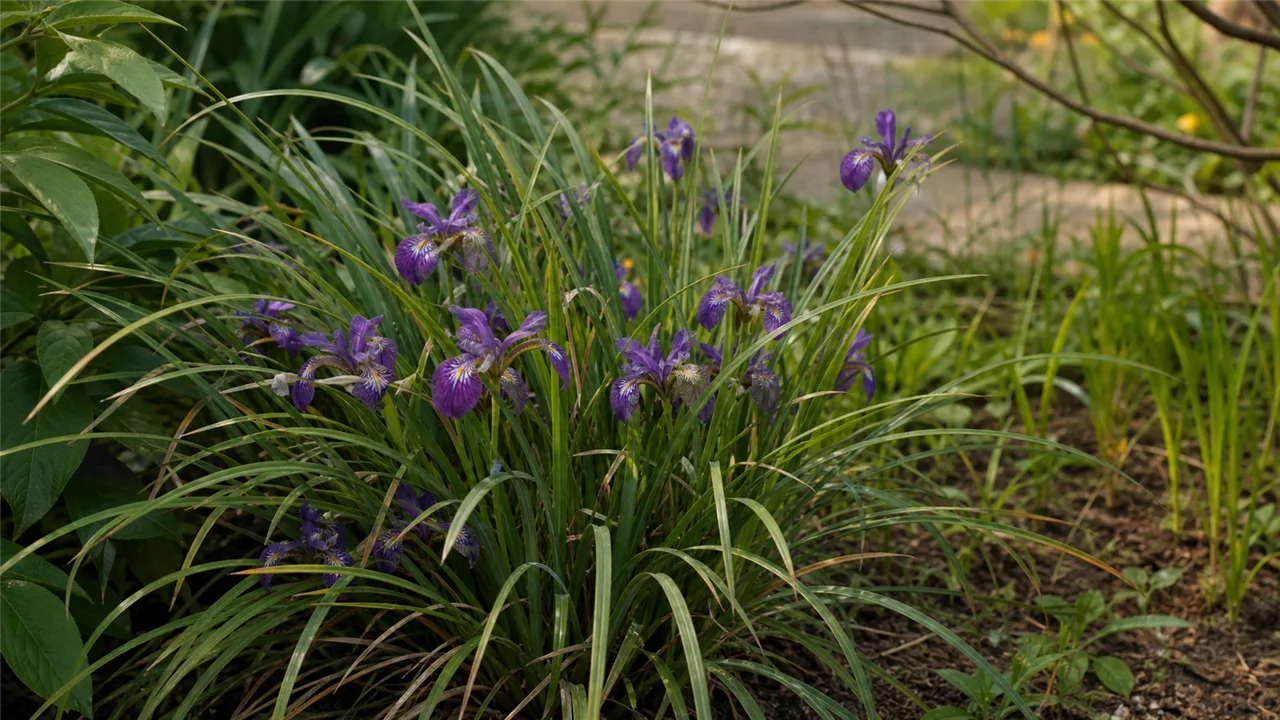
The plant grows from a slender, creeping rhizome that sits at or just below the soil surface. From this rhizome arise dense tufts of narrow, sword-shaped leaves, each 30–70 cm long and 5–10 mm wide, held in a stiff, upright to slightly arching fan. The leaves are a clean, medium green through the growing season, taking on yellow and tan tones in autumn before dying back to ground level for the winter.
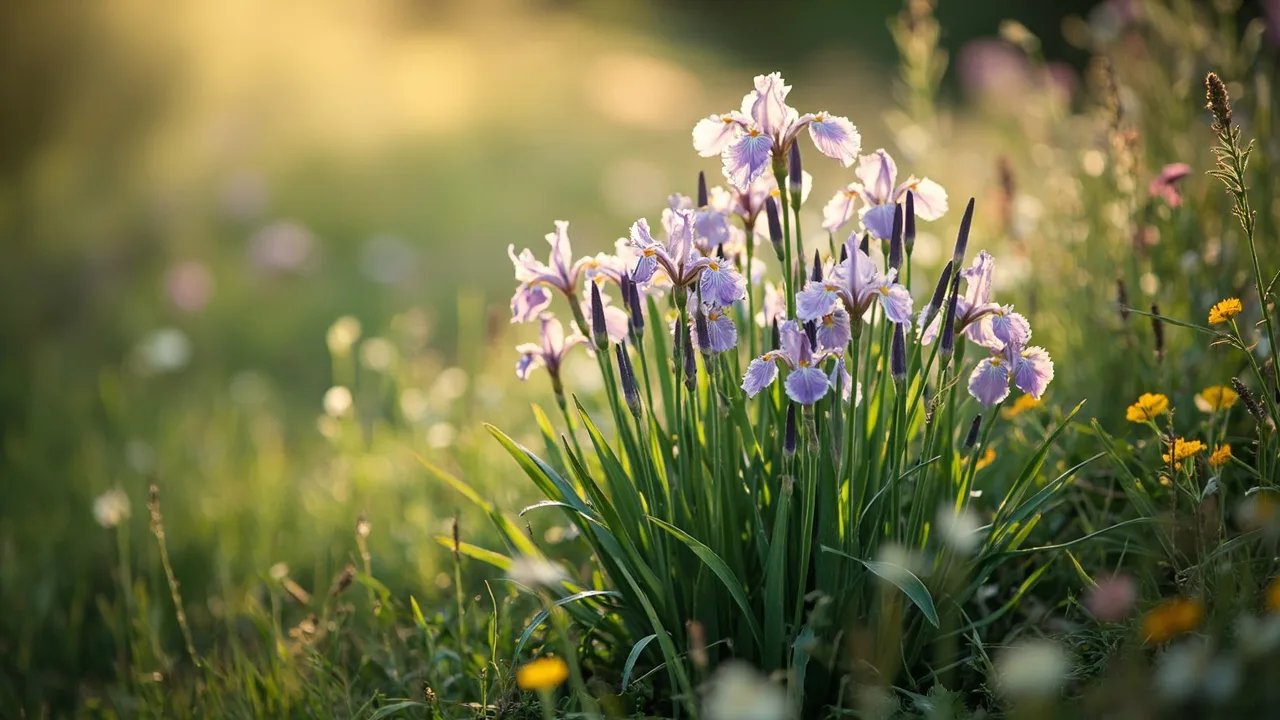
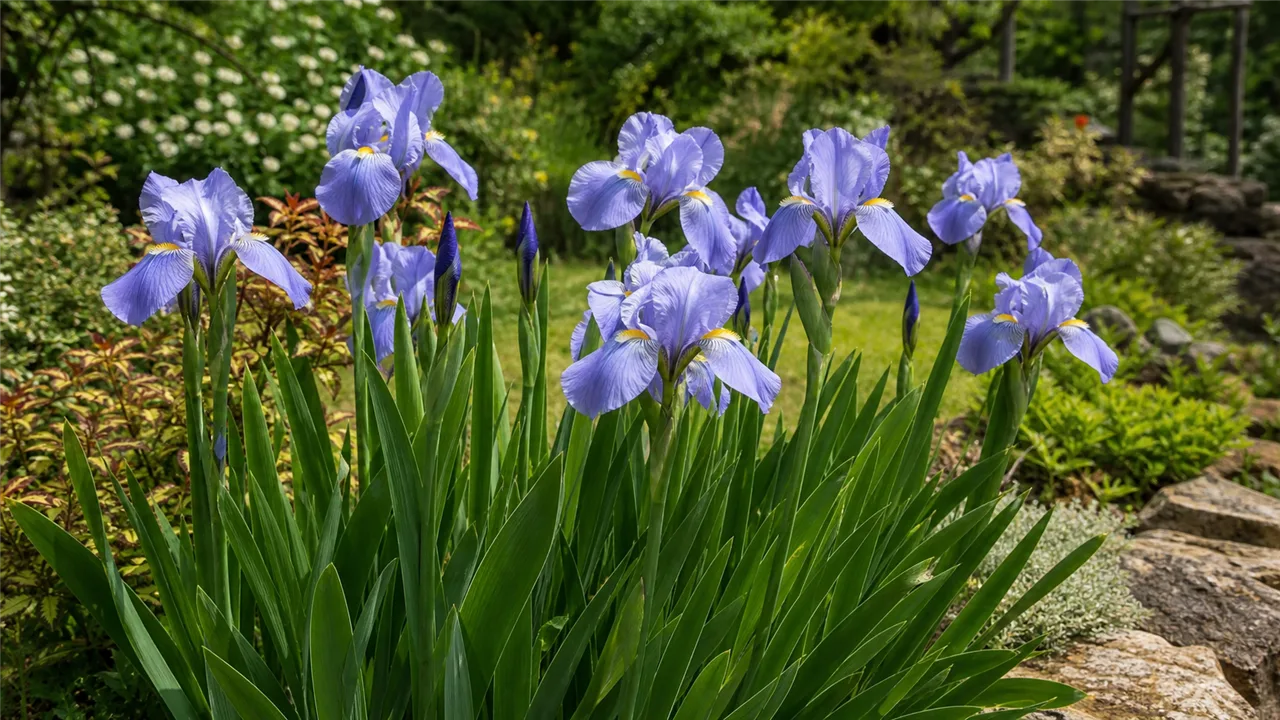
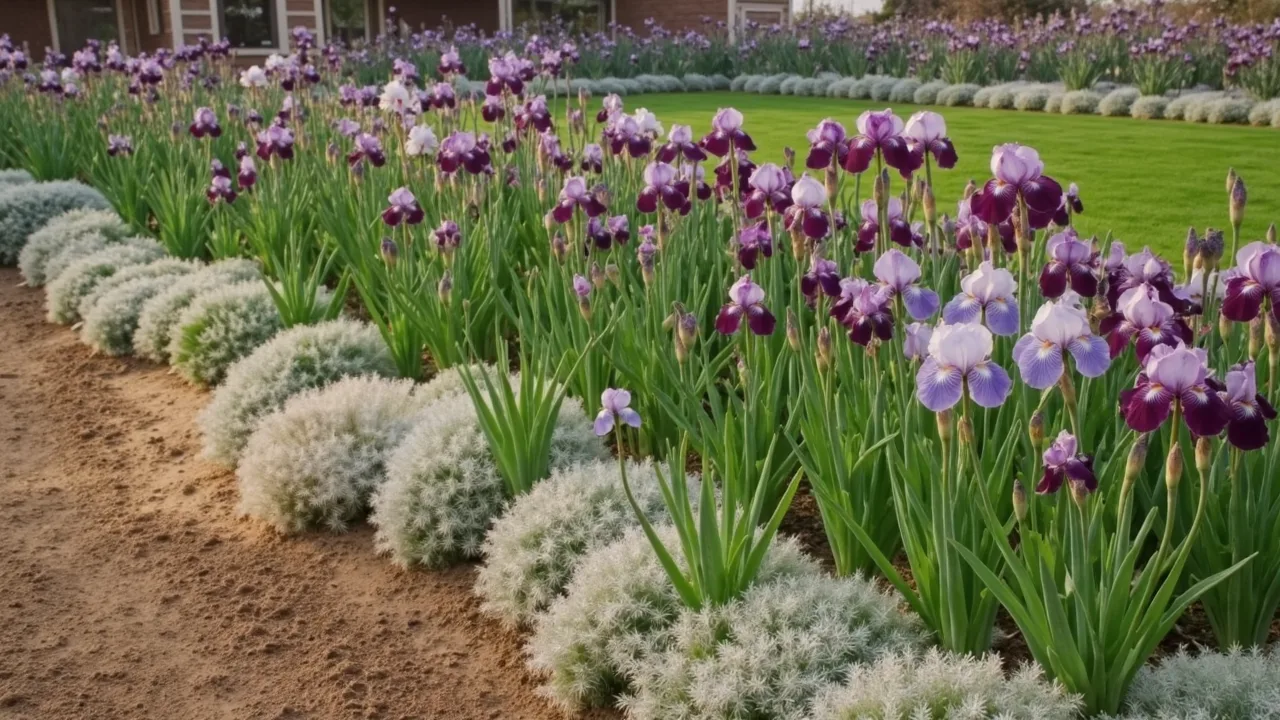
In late May and June, flowering stems rise above the foliage to 60–90 cm tall. Each stem is slender, round in cross-section, and largely unbranched, typically carrying two to three buds that open in succession over a week or more. The flowers follow the classic iris form: three upright "standards" and three broader, drooping "falls," with the falls marked at their base by a white or pale signal patch veined with violet. In the wild-type I. sanguinea, the falls are a deep, saturated red-violet to crimson-purple, distinctly more red-toned than the cooler blue-violet flowers of true I. sibirica — hence the common name.
After flowering, slender seed capsules develop along the stem. These ripen through summer, split open in early autumn, and shed brown, papery seeds. The foliage persists for several weeks after the flowers have finished, then yellows and collapses as the plant enters dormancy.
Growing Conditions
Iris sanguinea is one of the most accommodating irises for UK conditions. It is fully cold-hardy across mainland Britain, including northern England, upland Wales and lowland Scotland, and it tolerates exposed positions better than many rhizomatous irises. The one environmental weakness to avoid is winter waterlogging combined with cold — prolonged saturation of a heavy clay in midwinter can lead to rhizome rot (see Common Problems).
Sunlight. Flowers are most freely produced in full sun (six hours or more of direct summer sun), but the plant tolerates light or partial shade, particularly in the south of England. In heavier shade, flowering becomes sparse and the clump may need dividing more frequently.
Soil. The Blood Iris prefers a moist but well-drained loam and is notably more tolerant of damp conditions than bearded irises, succeeding in clay-loam, sandy loam and improved clay soils. It is one of the few irises that performs well at the edge of a pond or in a bog garden, provided the rhizome itself is not submerged. Soil pH should be mildly acidic to neutral, in the range pH 5.5–7.0. Improve heavy clay with well-rotted organic matter before planting to prevent winter surface waterlogging around the rhizome.
Position. Use it in the middle of an herbaceous border, in clumps of three to five plants for visual impact, at pond margins, in a damp meadow, or naturalised in light grass. It associates well with ornamental grasses (Stipa, Molinia, Deschampsia), late-spring perennials (Geranium, Astrantia, Salvia nemorosa) and moisture-loving plants such as Ligularia, Rodgersia and Astilbe. A sheltered site is not essential, but staking is rarely needed even on exposed sites thanks to the slender, wiry stems.
Planting and Care
When to plant. Container-grown plants can be put in at any time of year when the ground is workable, but autumn (September–November) and early spring (March–April) are best, allowing roots to establish before the main growing season. Bare-root rhizomes are typically available in autumn and should be planted as soon as received.
Spacing and depth. Space plants 30–45 cm apart. Unlike bearded irises, the rhizome of I. sanguinea should be planted 2–3 cm below the soil surface, with the roots spread downward and the upper surface covered by soil — this is the opposite of the bearded-iris rule and the most common cause of failure for gardeners transferring their bearded-iris habits to this species.
Watering. Water regularly through the first growing season to establish. Once established, the plant is moderately drought-tolerant in normal garden soil but flowers more freely in consistently moist conditions. During extended dry spells in late spring and early summer, soak deeply once a week rather than sprinkling lightly.
Feeding. Iris sanguinea is not a heavy feeder. A single light application of a balanced general fertiliser (such as growmore or blood, fish and bone) in early spring is sufficient. Avoid high-nitrogen feeds and fresh manure, both of which encourage soft, rot-prone growth.
Cut back. Cut the foliage to ground level in late autumn (October–November) once it has yellowed, or in early spring (March) before the new growth emerges. Cutting back in autumn is tidier; cutting back in spring allows the foliage to provide winter cover for beneficial insects. Do not cut back during the growing season, as the leaves are needed to build the rhizome for the following year's flowers.
Dividing. Lift and divide established clumps every three to five years in early autumn (September–October), immediately after flowering has finished and while the soil is still warm. Use two forks back-to-back to prise the clump apart, discard the oldest, woodiest centre, and replant vigorous outer sections at the correct depth. Division rejuvenates flowering — clumps left longer than five years typically run out of steam and produce few flower stems. It is also the simplest method of propagation; seed can be sown in autumn but will not come true to type in mixed plantings.
Seasonal summary (UK). March: new growth emerges; apply spring feed. April–May: foliage develops. Late May–June: flowering. July–August: seed pods ripen; water in dry spells. September–October: divide if needed. October–November or March: cut back dead foliage.
Common Problems
Rhizome rot (bacterial soft rot). The most serious problem, caused by Erwinia bacteria in wet, poorly drained conditions. Affected rhizomes turn soft, foul-smelling and cream-to-brown, and the leaves yellow and collapse. Prevention is far easier than cure: plant at the correct depth, improve drainage on heavy soils, avoid fresh manure, and cut back cleanly with sterilised tools. Destroy badly affected plants; do not compost.
Iris borer. A caterpillar that tunnels down through the leaves into the rhizome, leaving notched leaf tips, water-soaked streaks and a rotted core. Less common in the UK than in North America, but reported here on established clumps. Remove and destroy affected leaves and rhizomes in autumn when the borer larvae descend to pupate in the soil.
Leaf spot and rust. Fungal diseases that produce brown spots or orange pustules on the foliage, more prevalent in wet summers. Usually cosmetic rather than fatal. Improve air circulation by dividing congested clumps, remove and destroy affected leaves, and clear all foliage at the cut-back stage to reduce overwintering spores.
Slugs and snails. Young spring growth can be nibbled, particularly in damp, shaded sites. Protect emerging shoots with slug controls if damage is severe; established clumps are largely tolerant.
Failure to flower. Almost always due to one of three causes: too much shade, planting too deep, or an over-mature undivided clump. Lift, divide, replant at the correct depth in a sunnier position, and flowering should resume the following year.
Popular Varieties
Named cultivars of Iris sanguinea in their own right are few, and the species is most often sold and grown simply on the merits of the wild type — a deep red-violet to crimson-purple flower on a tall, slender stem. The cultivars that do exist are mostly colour breaks within the same grassy, upright form.
- I. sanguinea 'Snow Queen' — the most widely available cultivar; a clean white-flowered form with a faint yellow signal at the base of the falls. Provides a sharp contrast to the purple-blue forms in the border and is the only I. sanguinea cultivar offered by most general UK perennial nurseries.
- I. sanguinea 'Kobold' — a more compact selection, typically 40–50 cm tall, useful at the front of a border or in smaller gardens where the full-size species is too tall. Availability in the UK is patchy and confined to specialist iris growers.
Beyond these, many plants sold in the UK as "Siberian Iris" — I. sibirica cultivars such as 'Caesar's Brother', 'Perry's Blue', 'Ruffled Velvet' and 'Silver Edge' — are closely related but distinct species. The two can be told apart at flowering time by the colour of the falls (red-violet in I. sanguinea, blue-violet in I. sibirica) and by the spathes — the bracts enclosing the flower buds — which are brown-tinged in I. sanguinea and green in I. sibirica. The two species also cross freely, and a number of garden hybrids (sold under the "Siberian Iris" umbrella) are available from specialist suppliers; these combine the colour range of I. sibirica with the vigour and moisture tolerance of I. sanguinea, but they do not come true from seed and should be propagated by division.
Pests and Diseases
| Problem | Symptoms | Management |
|---|---|---|
| Iris leaf spot | Small, circular brown or purple spots appear on the leaves, often merging to cause yellowing. | Remove and dispose of infected foliage at the end of the year and avoid wetting leaves when watering. |
| Bacterial soft rot | The base of the plant and rhizome become soft, mushy, and emit a foul smell. | Cut away affected tissue with a disinfected knife, let wounds dry, and ensure well-drained soil conditions. |
| Iris rust | Orange or yellow pustules form on the leaves, leading to general yellowing and decline. | Pick off lightly infected leaves to slow spread and clear all leaf debris annually to reduce overwintering spores. |
| Ink disease | Black, inky patches develop on the bulb scales or rhizome, often causing rot. | Dispose of affected plants immediately and rest the soil from bulbous irises for several years. |
| Iris virus | Young leaves show mottling, streaking, or distortion, reducing plant vigour and flower quality. | Remove and destroy infected plants to prevent spread to neighbouring healthy irises via tools or contact. |
Or browse the full plant problem solver to diagnose an issue by symptom.
Recommended Products
GardenWizz earns a commission from qualifying purchases made through affiliate links on this page (including links within the article) — as an Amazon Associate, and from Thompson & Morgan via the Awin network. This does not affect the price you pay. See our disclaimer for details.