Twin-Spined Cactus
Mammillaria geminispina
The Gardening Year
Best months in UK gardens · full planting calendar →
🖨 Printable care card (PDF)At a Glance
| Botanical name | Mammillaria geminispina |
|---|---|
| Common name(s) | Twin-spined cactus |
| Family | Cactaceae |
| Plant type | succulent |
| Height × Spread | 10–50 cm × 10–50 cm |
| Position | Full sun |
| Soil | standard cactus compost |
| Flowering | June–November |
| Toxicity | — |
| Native range | central Mexico |
Overview
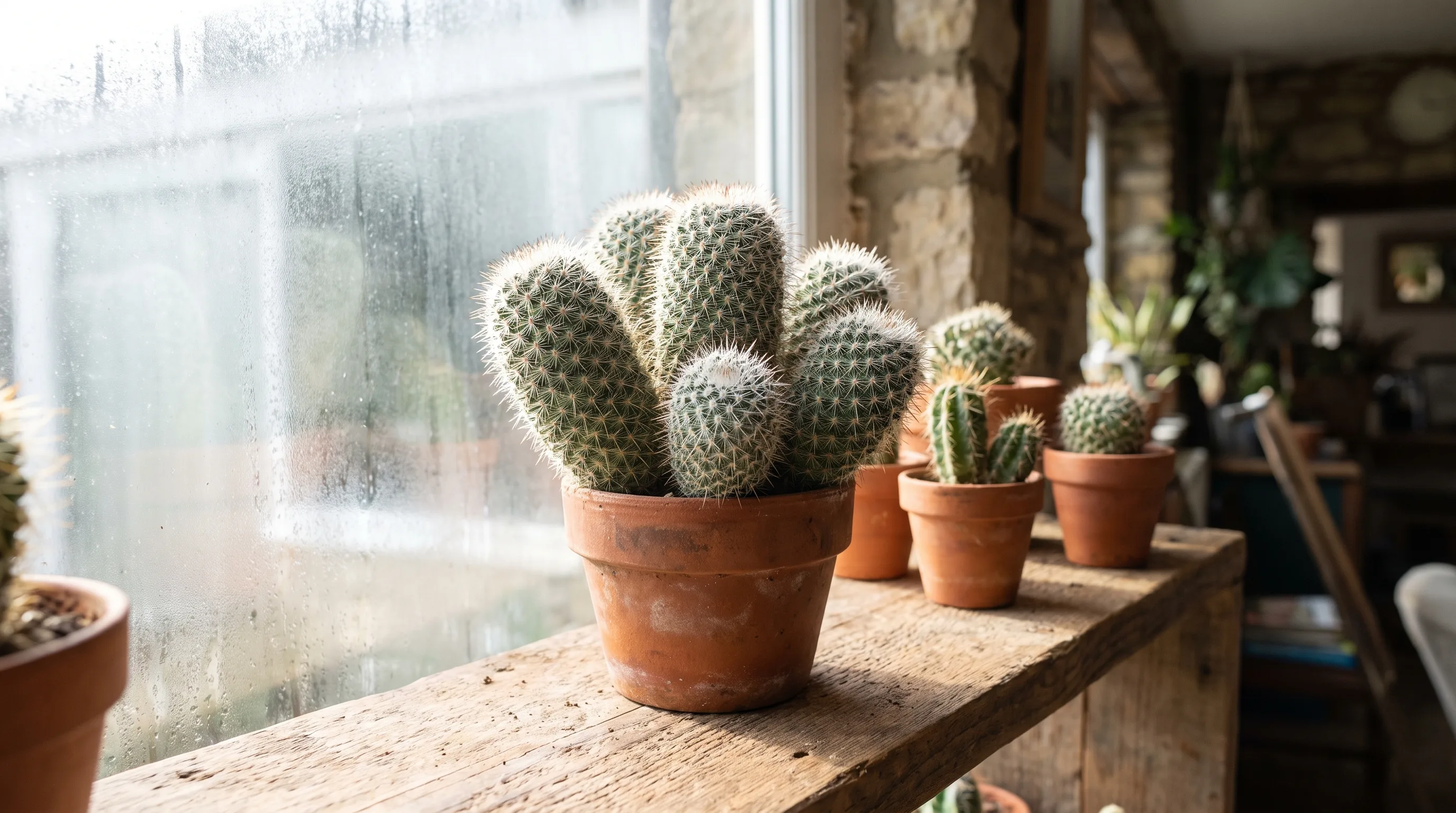
Mammillaria geminispina is a small, globular cactus from the semi-arid highlands of central Mexico, widely grown in the United Kingdom as a long-lived houseplant or greenhouse specimen. Its common name — the twin-spined cactus — refers directly to the species epithet geminispina, from the Latin gemini (twin) and spina (spine), a nod to the paired central spines that bristle from each areole. In UK garden-centre trade the densest white-spined forms are often sold under the name "white lady cactus". The species belongs to the large genus Mammillaria in the family Cactaceae and is one of the more forgiving species for beginners, flowering reliably once its winter rest is respected.
In the UK the plant is grown almost exclusively under glass or indoors. It is not reliably frost-hardy, and the Royal Horticultural Society has not published a hardiness rating for it; GardenWizz holds its hardiness as not established for outdoor cultivation. The plant carries a hardiness rating shown only in the badge — the value is held in the structured field, not stated in the prose.
Appearance
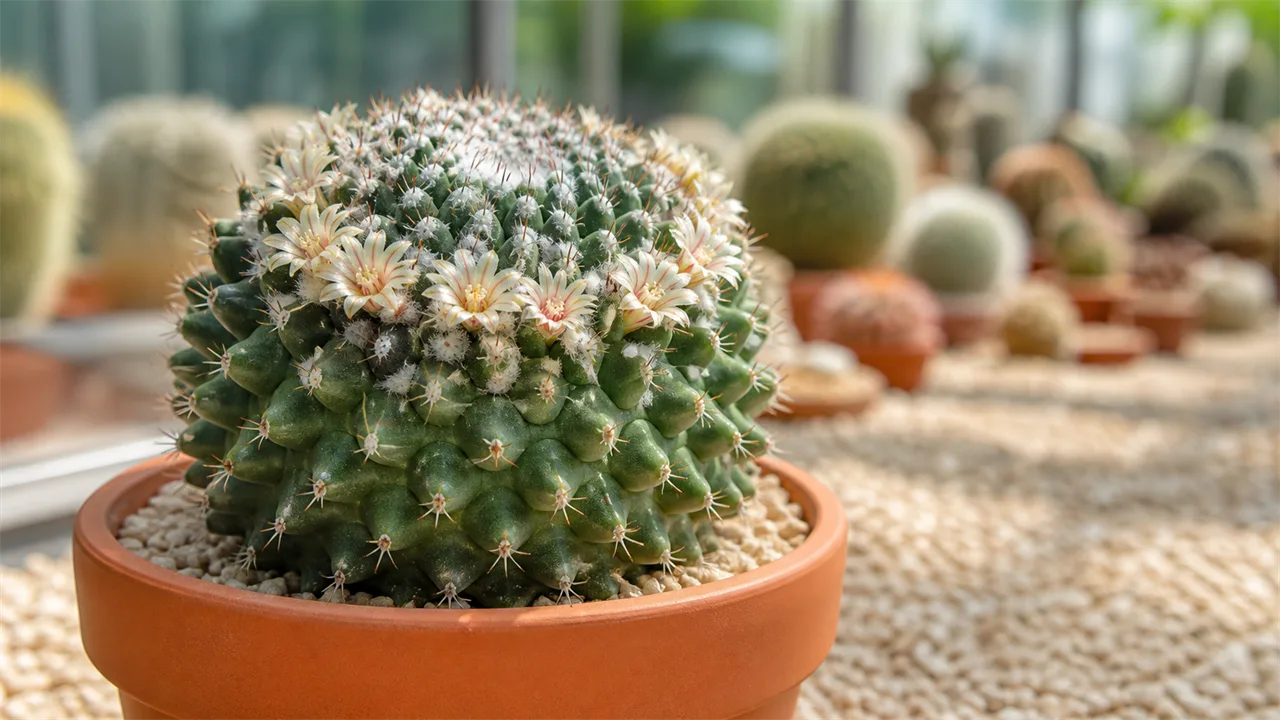
Mammillaria geminispina forms a small, solitary or slowly clumping globular stem that eventually becomes short-cylindrical on older plants. A mature stem reaches roughly 8–15 cm tall by 6–10 cm across, with offsets forming at the base after several years. The stem itself is a glossy, dark green, firm to the touch, and slightly woolly at the growing apex.
The surface is divided into short, conical tubercles arranged in spirals — the "nipple-like" projections that give the genus its name. Each tubercle carries an areole at its tip from which the spines emerge. The defining feature of the species is the spination:
- Central spines: usually two per areole (occasionally one or four), stiff, pure white, and conspicuously long. On vigorous plants they reach 1.5–2.5 cm and may exceed 4 cm, often curving gently outward to give the plant its twin-spined silhouette.
- Radial spines: around 16–20 per areole, fine, white, and bristle-like, 5–10 mm long, pressed flat against the tubercles and partly obscuring the green stem beneath.
Together these produce a dense, chalk-white pincushion that hides most of the green stem in well-grown specimens. Plants grown in too little light lose this tight globular habit and stretch instead — a fault to watch for.
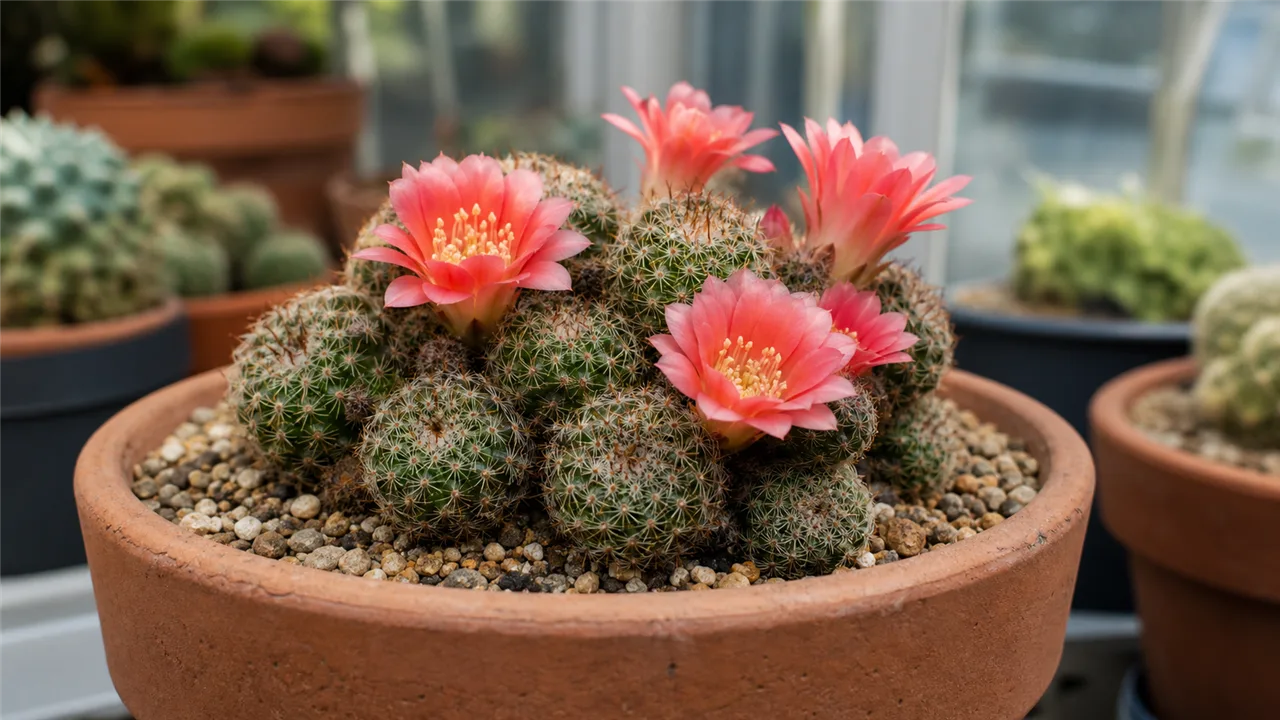
Flowers are small, diurnal, and funnel-shaped, 1.5–2 cm across, in deep carmine-pink to paler pink shades depending on the clone. They appear in a ring around the crown of the stem in late winter and spring (February–April in UK cultivation, occasionally into May) and last several days each. After pollination, or simply as a matter of course in cultivation, small club-shaped red to pinkish berries protrude from the tubercles and persist on the plant for months.
Growing Conditions
Mammillaria geminispina wants bright light all year. A south- or east-facing windowsill is the classic UK site; in a greenhouse give it the brightest bench and apply light shade only on the hottest midsummer afternoons to prevent scorch. Light shade outdoors in high summer is also useful when the plant is stood outside for the season.
Temperature is straightforward in summer — anything from roughly 20 °C up to 30 °C with good air movement is fine. Winter is the critical period. To flower well the following spring the plant needs a genuinely cool, dry rest at around 5–10 °C with maximum light. A frost-free porch, an unheated greenhouse with a heater set to keep frost out, or a bright spare room suits. Avoid temperatures below about 2 °C: highland plants in habitat see light frosts, but container-grown plants in damp UK compost are not reliably tolerant of it.
Average UK household humidity is acceptable; avoid closed terraria or steamy kitchens. The substrate must be very free-draining. A reliable mix is roughly half loam-based John Innes No. 2, with a quarter grit and a quarter pumice or crushed Leca. Pure peat-based houseplant compost holds too much water and rots the roots quickly. Use a terracotta pot with generous drainage holes — the porous clay helps the compost dry between waterings. Pot-bound plants flower best, so re-pot only every two to three years, moving up one pot size at most.
Seasonal placement in the UK: many growers move the plant outdoors onto a sunny patio from late May or June, once night temperatures stay reliably above about 10 °C, and bring it back under cover in early September. Acclimatise gradually to stronger light to avoid scorch.
Planting and Care
Watering is the most important practical skill. From late spring through summer water generously, then allow the compost to dry out before watering again. From early autumn reduce gradually, and over winter keep the plant almost dry — an occasional light drink on a mild day to prevent the stem from shrivelling is plenty. Resume normal watering as flower buds appear in late winter.
Feeding is light. A half-strength high-potash liquid feed (tomato fertiliser or a dedicated cactus feed) once a month during the active growing season, roughly May through September, is sufficient. Do not feed during the winter rest.
Re-potting is best done in late spring as new growth starts. Wear thick gloves and wrap the stem in a strip of newspaper or kitchen roll to handle it safely — the central spines are sharp. Tease away old compost, inspect the roots, cut out anything soft or dead, and settle the plant into dry fresh mix. Hold off watering for seven to ten days so any root breaks can callus over.
Propagation is straightforward. Mature clumping plants produce offsets at the base that can be detached with a clean sharp knife in spring, allowed to dry and callus for a few days, then potted up into dry cactus mix and misted sparingly until roots form. Seed propagation is also possible: surface-sow on a moist gritty mix at about 21 °C, keep humidity high until germination, then grow the seedlings on slowly with careful watering for the first year.
Pruning is not required for this species beyond the occasional removal of dried berries or dead tissue. Dividing mature clumps during re-potting doubles as propagation.
Common Problems
Root and stem rot is the most common cause of loss, almost always from cold-wet compost in winter. The base of the stem softens and darkens, and the plant may collapse suddenly. Fusarium and Phytophthora species are typical culprits in damp substrates. Prevention is far easier than cure: use a free-draining mix, keep the plant dry in winter, and never let the pot sit in water. If caught early, cut healthy stem tissue above the rot, dust the cut with sulphur, and re-root as for an offset.
- Mealybugs are the single most damaging indoor pest on Mammillaria. The white, cottony insects hide between the tubercles and at the apex, sucking sap and stunting growth; heavy infestations colonise the roots. Treat with a systemic insecticide containing acetamiprid, or dab individual pests with a cotton bud dipped in 70 per cent isopropyl alcohol. Quarantine new plants for a few weeks before placing them near established specimens.
Red spider mite (Tetranychus urticae) is a problem in warm, dry summer conditions, especially on indoor plants. Fine yellow speckling on the stem and fine webbing in severe cases are the signs. Raise humidity briefly by misting, then treat with a miticide or release predatory mites (Phytoseiulus persimilis) in a greenhouse.
Sciarid flies (fungus gnats) are more annoying than fatal, though the larvae can damage seedlings. Let the surface dry between waterings, use sticky traps, and treat larvae with a Steinernema feltiae nematode drench or a Bacillus thuringiensis israelensis product.
Etiolation (pale, thin, weak growth stretching toward the light) is caused by insufficient light, or a warm-watered winter rest. Move the plant to a brighter position; stretched growth will not shorten and is best removed and re-rooted if severe.
Sun scorch appears as bleached, yellowish patches on the stem after sudden exposure to strong sun. Acclimatise gradually when moving plants outdoors in summer.
Lack of flowers is almost always a missed cold-dry winter rest, or a plant that is still too young — typical flowering begins at three to four years old, once the stem reaches about 5 cm across.
Popular Varieties
Few formally registered cultivars of Mammillaria geminispina are available, and most plants in UK trade are sold simply as the type species. Three forms are widely recognised by collectors and appear under informal trade names:
- Mammillaria geminispina (the type form): the standard plant with paired pure-white central spines and a fine white web of radial spines; the most commonly offered form in UK garden centres and specialist nurseries.
- "White lady" form: a denser-spined, brighter-white selection in which the central spines are particularly long and crowded, giving an almost fully white appearance; widely sold under this trade name in the UK but not formally registered as a cultivar.
- Long-spined form: occasional plants offered as "long-spined", in which the central spines exceed 4 cm and curve markedly outward; the species' namesake feature taken to its extreme.
For collectors building a small grouping of similar globular cacti, the species pairs naturally with related Mammillaria such as M. bombycina (silken pincushion), M. hahniana (old lady cactus), and M. elongata (lady-finger cactus), which share cultivation requirements.
Pests and Diseases
| Problem | Symptoms | Management |
|---|---|---|
| Mealybugs | White, cottony wax masses appear in stem joints and around the base of the plant. | Isolate the plant and dab infested areas with a cotton bud dipped in methylated spirits. |
| Root mealybugs | Plant shows signs of decline, stunting, or yellowing despite adequate light. | Repot into fresh sterile compost and treat the root ball with a systemic insecticide drench. |
| Root rot | Stems become soft, mushy, and discoloured brown or black at the base. | Ensure well-draining cactus compost and allow soil to dry completely between waterings. |
| Vine weevil | Semi-circular notches on stem edges and larvae feeding on roots in the pot. | Use nematode treatments in spring and autumn or apply a systemic insecticide to the compost. |
| Scale insects | Small, immobile brown or white bumps attached firmly to the stem surface. | Scrape off visible scales and spray with horticultural oil or insecticidal soap. |
Or browse the full plant problem solver to diagnose an issue by symptom.
Recommended Products
GardenWizz earns a commission from qualifying purchases made through affiliate links on this page (including links within the article) — as an Amazon Associate, and from Thompson & Morgan via the Awin network. This does not affect the price you pay. See our disclaimer for details.