Moth Orchid 'Ariadne'
Phalaenopsis × ariadne
The Gardening Year
Best months in UK gardens · full planting calendar →
🖨 Printable care card (PDF)At a Glance
| Botanical name | Phalaenopsis × ariadne |
|---|---|
| Common name(s) | Moth orchid 'Ariadne' |
| Family | Orchidaceae |
| Plant type | perennial (monopodial epiphyte or lithophyte) |
| Height × Spread | 30–60 cm × 30–60 cm |
| Position | Partial shade |
| Soil | orchid compost / chopped bark |
| Flowering | January–December |
| Toxicity | — |
| Native range | Asia, New Guinea, and Australia |
A Phalaenopsis hybrid that has been on British windowsills since the late-Victorian era, 'Ariadne' remains the most reliably reblooming moth orchid in the AGM list — and one of the longest-cultivated. It is a man-made cross, raised primarily from Phalaenopsis aphrodite with influence from P. stuartiana, and was first registered with the Royal Horticultural Society in 1896. More than a century later, the same hybrid is still sold as a flowering gift plant in UK supermarkets and garden centres, and still earns its place on the kitchen bench.
Overview
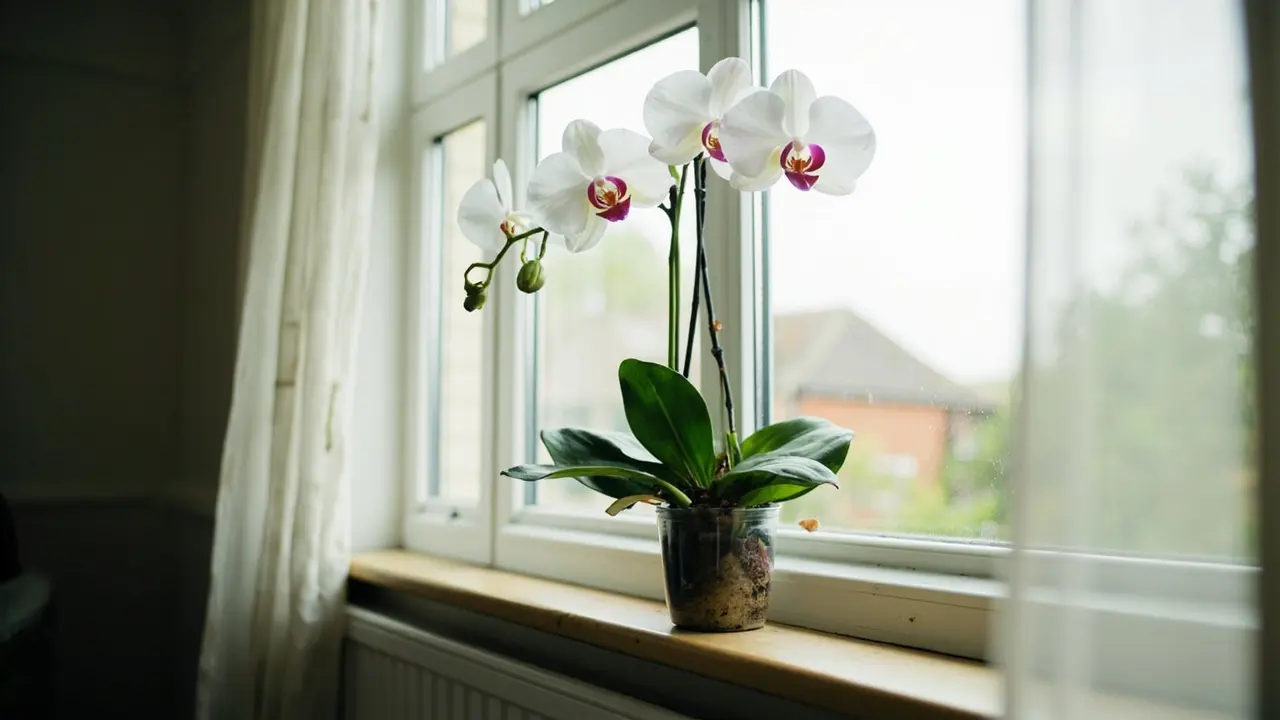
Phalaenopsis 'Ariadne' is an indoor flowering orchid bred for the British home rather than the greenhouse bench. It is one of a small group of moth-orchid hybrids to hold the Royal Horticultural Society's Award of Garden Merit, listed in the RHS AGM ornamentals and orchid lists as a tender indoor plant (no outdoor hardiness rating, since orchids grown as houseplants sit outside the RHS outdoor hardiness system). Flowers are typically white through pale pink, 7–10 cm across, with the characteristic broad lateral petals and a pigmented lip that gave the genus its common name. Blooms last six to ten weeks on the spike, and with care the plant can rebloom from the same spike two or three times before a fresh shoot is needed.
Appearance
The plant forms a single, flattened rosette of leathery strap-shaped leaves arranged in two opposite ranks. Mature flowering-sized specimens carry four to six leaves, each 15–30 cm long, oblong-elliptic, thick and fleshy, mid- to deep green. Roots are thick and silvery-green, branching freely over the pot rim and through the bark; healthy roots have a green tip when wet and a white velamen sheath when dry, and they photosynthesize — which is one reason clear pots are commonly used.
The flower spike is long, arching, often branched, and emerges from between the leaves. Individual flowers follow the classic Phalaenopsis shape: two larger lateral petals, three narrower sepals, and a three-lobed lip (labellum) at the base, often flushed with pink or yellow and marked with red on the side lobes. In the 'Ariadne' lineage the colour range is white through pale blush, with the lip more strongly tinted. Inflorescences carry several flowers at a time and can rebloom from the same spike in the same year. Overall plant spread is typically 30–60 cm at maturity, with the spike adding another 30–60 cm above the foliage.
Growing Conditions
Moth orchids are warm-growing, low-light forest plants from Southeast Asia, and 'Ariadne' inherits those preferences. The RHS growing guide for the genus recommends daytime temperatures of 19–30 °C and a night minimum of 16–19 °C, with a minimum of 16 °C cited by BBC Gardeners' World as the safe lower threshold. In practical UK terms, a comfortably heated living room is ideal; an unheated spare bedroom in winter will be too cold and may trigger bud drop.
Light should be bright but indirect. Direct midday sun through a south-facing window scorches the leaves within a few days; an east-facing windowsill, or a shaded south window set back from the glass, is the safe choice. The leaf colour is a useful indicator: dark green suggests too little light, while a mid-green leaf with a faint reddish edge is the level that produces reliable flowering.
Humidity is the other regular stumbling block. Central heating drives indoor relative humidity below 30 % in most UK homes in winter, well under the 50–70 % the plant prefers. Standing the pot on a tray of damp pebbles, grouping plants together, or misting the air (not the flowers) in the morning all help. Bathrooms and kitchens are naturally humid alternatives if the light is sufficient.
The substrate must be coarse and free-draining. A medium-grade pine-bark mix with perlite and a little charcoal is the standard; standard multipurpose compost stays too wet and quickly suffocates the roots.
Planting and Care
Pot. Use a clear or opaque pot with substantial drainage holes. Clear pots let the green photosynthetic roots work; opaque pots are fine if the bark is genuinely free-draining. Pot size should be just big enough to contain the roots — over-potting keeps the substrate wet for too long.
Repotting. Repot every two to three years in fresh bark, ideally just after flowering or as new roots are emerging (typically late spring). Soak the new bark in water for an hour beforehand. Slide the plant out, tease off the old medium, trim any dead or mushy roots back to firm white or green tissue, and settle the plant into the new pot with the crown level with the surface — never buried. If roots have been damaged, wait two to three days before watering so the cuts callus; otherwise water straight through.
Watering. Water thoroughly when the substrate is almost dry — roughly once a week in summer and every 10–14 days in winter. Use rain or room-temperature (tepid) tap water, ideally low in dissolved salts; let chlorinated tap water stand for 24 hours before use. Run water through the pot, let it drain completely, and never leave the plant standing in water. The bark should be moist, not soggy.
Feeding. Apply a weak balanced orchid fertiliser (such as 20-20-20 at half the label rate) every second watering in the growing season (spring through autumn). Flush with plain water once a month to prevent salt build-up on the roots. Reduce or pause feeding in winter when growth slows.
Pruning and after-flowering. Spikes stay green for months. Do not cut a green spike unless it has turned brown. To encourage a side-branch and a second flush, cut the spike just above the second or third node from the base once the last flower has dropped. If the spike has yellowed to the base, cut it off at the crown and let the plant rest until a new shoot appears.
Rebloom trigger. A drop in night temperature of roughly 5 °C for several weeks in autumn — the natural cooling in an unheated room — helps initiate a new flower spike. Once the spike is visible and growing, return to normal warm conditions.
Propagation. Home growers do not propagate moth orchids from seed; meristem propagation is a commercial laboratory process. The practical home option is to wait until a keiki (a baby plant) forms on a spent spike, then pot it on once it has roots around 5 cm long. 'Ariadne' is also widely available as a mature plant from UK nurseries and supermarkets, which is the simplest route for most readers.
Seasonal care. Spring and summer are the active growing months — water and feed regularly, repot if needed. Autumn cooling is the natural rebloom trigger. Winter is the flowering peak; keep the plant away from cold draughts and avoid moving it once buds have set, as sudden changes cause bud drop.
Common Problems
Overwatering and root rot. The single most common cause of decline. Yellowing lower leaves, limp roots, and a sour-smelling substrate are the classic signs. Mushy brown roots are rotting; hollow papery roots are under-watered. Unpot, remove all soggy bark, cut back to firm white or green roots, and repot in fresh dry bark. Withhold water for a few days to let cuts callus.
Crown rot. Water trapped between the leaves can rot the crown, killing the plant. Always water at the substrate level, tip the pot to drain any water from the crown, and keep the plant in gentle air movement.
Mealybugs. White, cottony colonies tucked into leaf axils and the crown. Dab with a cotton bud dipped in 70 % isopropyl alcohol, then follow up with a horticultural soap or neem-oil spray if the colony persists.
Scale insects. Small brown or tan bumps on leaves, often with sticky honeydew and secondary black sooty mould. The RHS lists diaspid scale as a glasshouse-and-houseplant problem on orchids. Wipe off with an alcohol-dipped cloth and repeat weekly until clear.
Bud drop. A sudden change in temperature, a cold draught, or moving the plant once buds have set will cause buds to drop before opening. Keep the plant in one spot from the moment the spike emerges.
Cold damage. Foliage becomes water-soaked then blackens at temperatures below roughly 12 °C. The plant is fully tender in the UK — never place it outside, and keep it well clear of single-glazed windows on winter nights.
Popular Varieties
Five reliable AGM-listed Phalaenopsis hybrids available in UK garden centres, supermarkets, and specialist orchid nurseries:
- Phalaenopsis 'Ariadne' gx — the white-to-blush lineage covered in this article; AGM, widely available, the most reliably reblooming of the group.
- Phalaenopsis 'Be Tris' gx — AGM-listed, larger flower with broad pink segments and a darker lip; tolerates a slightly cooler room.
- Phalaenopsis 'Donauwelle' gx — AGM-listed, white ground with a strong magenta lip and contrasting colour break; popular for its distinctive flower.
- Phalaenopsis 'Birdie' gx — AGM-listed, compact habit with smaller flowers on a shorter spike; suits a kitchen windowsill.
- Phalaenopsis 'Pink' (the trade form grown from 'Ariadne' stock) — same AGM lineage, sold widely as a flowering gift plant with a deeper pink lip.
Stick to AGM-listed hybrids and named clones from reputable UK suppliers rather than unlabelled supermarket plants; the named hybrid will reliably rebloom, while an unlabelled plant may be a mixed seedling that takes two to three years to flower.
Sources & Further Reading
- Royal Horticultural Society — How to grow Phalaenopsis (moth orchids): https://www.rhs.org.uk/plants/phalaenopsis/growing-guide, accessed 2026-07-23.
- Royal Horticultural Society — AGM Plants December 2024 — Ornamental (Phalaenopsis Ariadne gx listed): https://www.rhs.org.uk/plants/pdfs/agm-lists/agm-ornamentals.pdf, accessed 2026-07-23.
- Royal Horticultural Society — Orchids AGM List (Ariadne gx listed as a tender indoor orchid): https://www.rhs.org.uk/plants/pdfs/agm-lists/agm-orchids.pdf, accessed 2026-07-23.
- Royal Horticultural Society — Top tips for growing orchids at home: https://www.rhs.org.uk/plants/types/houseplants/top-tips-for-growing-orchids-at-home, accessed 2026-07-23.
- OrchidRoots — Phalaenopsis Ariadne registration record (registered 1896, parentage A Hybrid aphrodite × stuartiana): https://orchidroots.com/display/summary/orchidaceae/100030324/, accessed 2026-07-23.
- BBC Gardeners' World — How to care for orchids: https://www.gardenersworld.com/house-plants/how-to-care-for-orchids/, accessed 2026-07-23.
- Pumpkin Beth — Phalaenopsis — Moth Orchids: https://pumpkinbeth.com/2021/04/phalaenopsis/, accessed 2026-07-23.
Pests and Diseases
| Problem | Symptoms | Management |
|---|---|---|
| Root rot | Leaves become soft, wrinkled and yellow while roots turn brown, mushy or black. | Ensure excellent drainage in bark-based compost and avoid letting the pot sit in standing water. |
| Mealybugs | White, cottony fluff appears in leaf axils and on stems, often accompanied by sticky honeydew. | Wipe affected areas with a cloth dampened with methylated spirit or apply insecticidal soap. |
| Scale insects | Small, immobile brown or white bumps attach to leaves and stems, causing yellowing spots. | Scrape off visible scales manually and treat with a systemic insecticide if infestation persists. |
| Leaf tip burn | Brown, dry patches develop at the tips or edges of leaves due to environmental stress. | Maintain consistent humidity above 50% and avoid direct exposure to cold draughts or radiators. |
| Vine weevil | Notched edges on leaves indicate adult feeding, while larvae damage roots causing wilting. | Use nematode treatments in the compost during warmer months to control soil-dwelling larvae. |
Or browse the full plant problem solver to diagnose an issue by symptom.
Recommended Products
GardenWizz earns a commission from qualifying purchases made through affiliate links on this page (including links within the article) — as an Amazon Associate, and from Thompson & Morgan via the Awin network. This does not affect the price you pay. See our disclaimer for details.