Alpine Primrose
Primula alpicola
The Gardening Year
Best months in UK gardens · full planting calendar →
🖨 Printable care card (PDF)At a Glance
| Botanical name | Primula alpicola |
|---|---|
| Common name(s) | Alpine Primrose |
| Family | Primulaceae |
| Plant type | perennial (herbaceous perennial with long-stalked, oblong or oval leaves in a basal rosette, and erect stems bearing terminal umbels of nodding, fragrant, funnel-shaped flowers in summer) |
| Height × Spread | 15–50 cm × 10–50 cm |
| Position | Full sun, Partial shade |
| Soil | deep, fertile reliably moist soil |
| Flowering | June–August |
| Toxicity | — |
| Native range | Bhutan and southeastern Tibet |
Overview
Primula alpicola, the Himalayan primrose, is an elegant herbaceous perennial from the mountains of south-eastern Tibet and western China, long grown in British gardens for its slender, candelabra-like flowering stems and its tolerance of cool, damp, shaded conditions. Despite its alpine-sounding name, it is a plant of moist meadows, streamsides and open woodland rather than of true rock crevices, and it is in shaded borders, bog gardens and the dappled margins of ponds and streams that it performs most reliably in the United Kingdom. It is a member of the Primulaceae and one of around 500 species in the genus Primula, many of which have been used for centuries to brighten damp corners of the garden in late spring and early summer. In British gardens the species has been cultivated since at least the early twentieth century and is valued for its delicate, often pendent flowers carried well above the foliage on fine, wiry stems. Mature clumps reach 30 to 45 cm in height when in flower, with the foliage rosette itself typically 15 to 20 cm across. The plant is fully hardy across most of the UK and is straightforward to grow where soil and shade conditions are appropriate, making it a dependable choice for the shaded or damp areas that defeat many other flowering perennials.
| Botanical name | Primula alpicola |
|---|---|
| Common name | Himalayan primrose; sometimes called the moonlight primrose |
| Plant type | Herbaceous perennial (semi-evergreen rosette) |
| Hardiness | Held in the structured field; rendered by the badge |
| Sunlight | Partial to dappled shade; tolerates more light in reliably moist soils |
| Soil type | Moist but well-drained, humus-rich, slightly acidic to neutral |
| Flowering season | Late spring to mid-summer (May to July, peaking in June) |
| Mature size | 20 to 45 cm tall in flower; rosette 15 to 20 cm across |
The briefest cultural summary is this: plant in humus-rich, moisture-retentive soil in shade, keep the ground damp through the growing season, divide every few years, and deadhead spent flower stems. Beyond that, P. alpicola is undemanding and long-lived, and a settled clump will slowly build into a sizeable colony in a congenial site.
Appearance
Primula alpicola forms a basal rosette of soft, mid-green leaves from which the flowering stems rise in late spring. The leaves are broadly lanceolate to oval, 5 to 15 cm long, with a softly hairy surface and a slightly wrinkled texture; they are held more or less flat or gently arched, giving the plant a tidy, low clump from which the flowers appear to float on slender stalks. The rosette is semi-evergreen in mild winters, persisting through the cold months though often looking rather tired by late February.
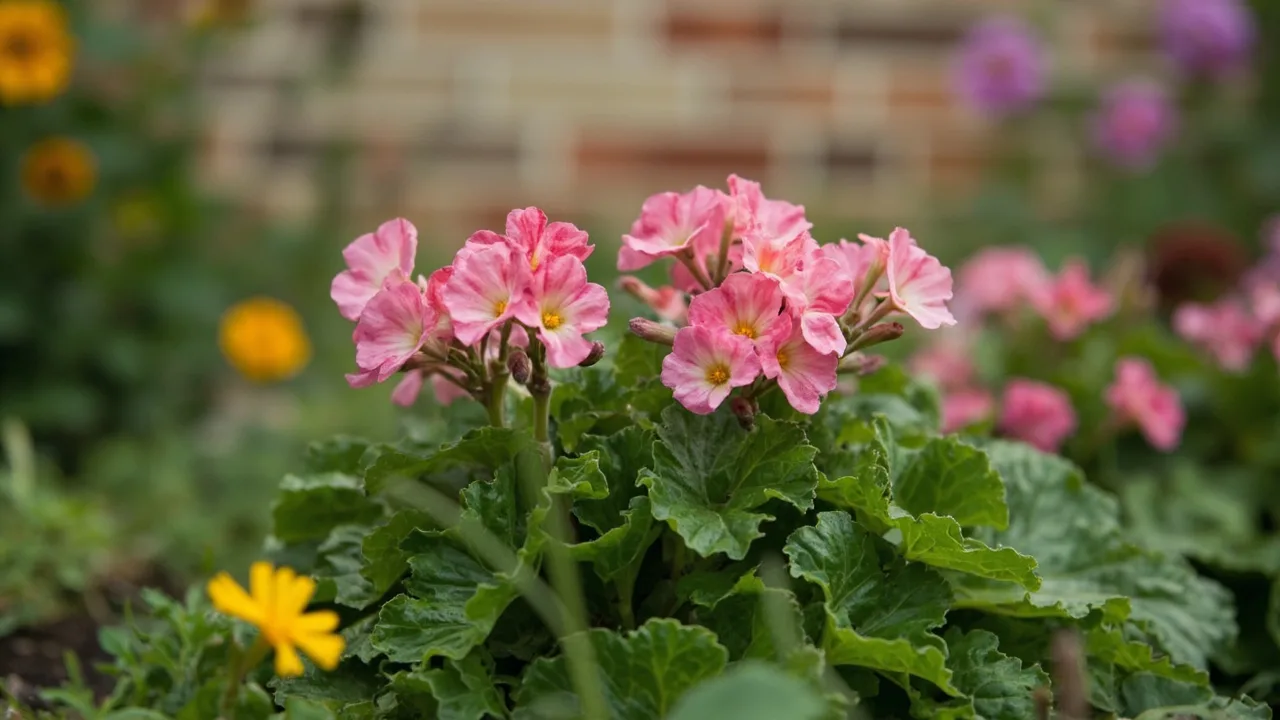
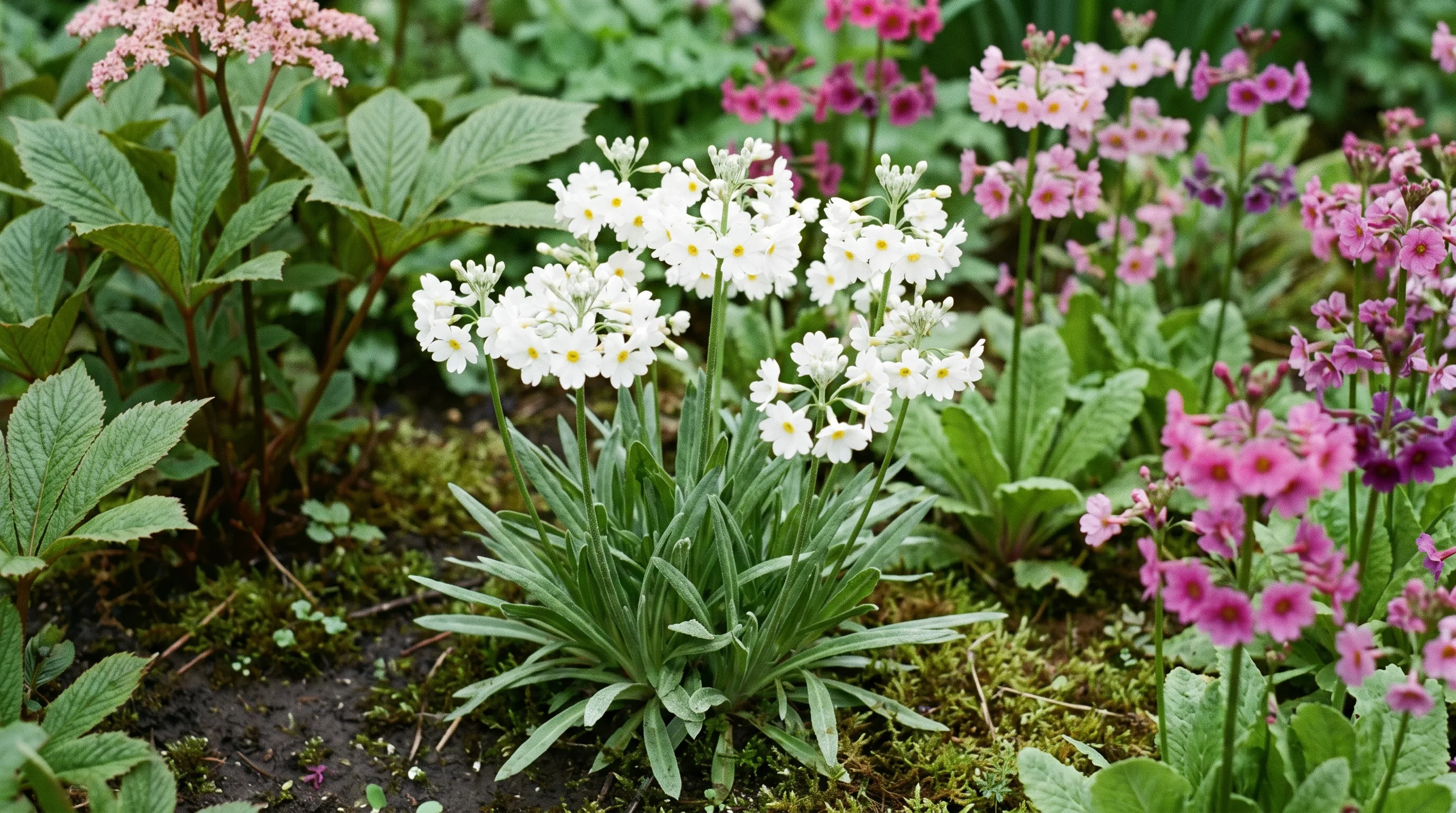
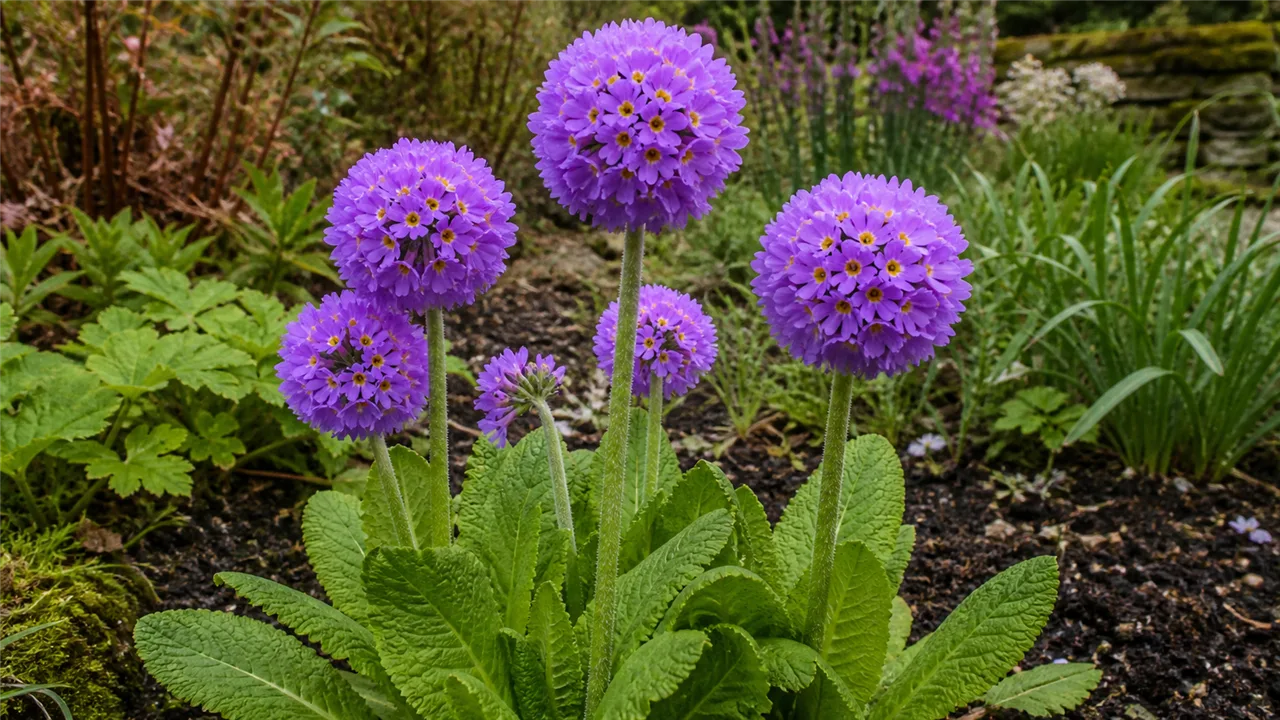
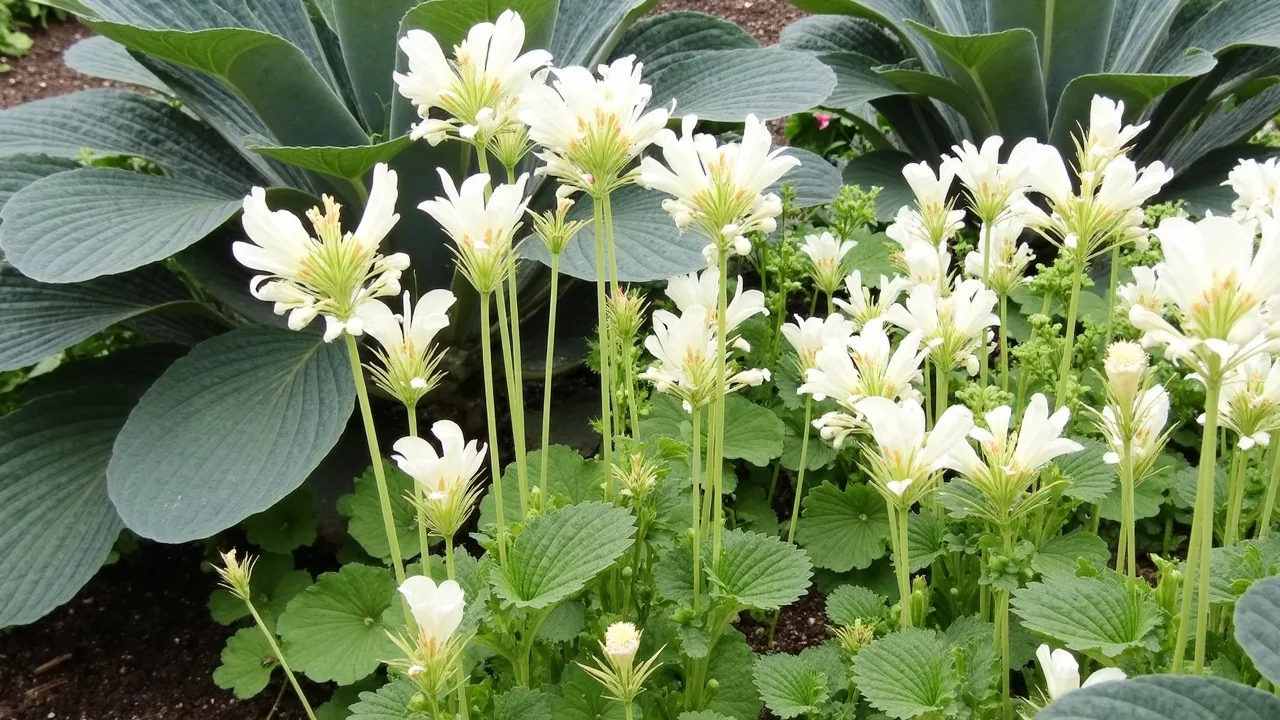
The flowers are borne in loose, tiered umbels rather than the tight spherical heads of some Asiatic primulas: a single stem carries several rings of outward-facing to gently pendent blooms, each flower typically 2 to 3 cm across with a funnel-shaped tube and five shallowly notched petals. A conspicuous feature is the distinct eye at the centre of the flower — a small boss at the mouth of the tube that gives the open bloom a slightly pinched, pinched-waist look and is characteristic of the species. Flower colour ranges across white, cream and pale yellow through to lilac, mauve and a soft violet-purple, depending on the variety. The wild type, P. alpicola var. alpicola, is usually a soft lilac-mauve with a yellow eye, while the white and pale yellow forms are derived botanical varieties selected over many decades of garden cultivation.
Flowering stems are slender, lightly hairy and rise to between 20 and 45 cm, depending on the vigour of the plant and the richness of the soil. Tall stems can arch outwards as the flowers open, so the plant as a whole has a relaxed, slightly irregular outline rather than a stiffly upright habit. The effect in a shaded border is of small luminous bells held just above the foliage, especially in the white and yellow forms, which catch what light there is. After flowering the stems carry small, rounded seed capsules; in favourable conditions a degree of self-seeding occurs around the parent plant, though seedlings do not usually come true to the parent colour and may need to be rogued if a uniform display is desired.
Growing Conditions
Primula alpicola performs best in cool, sheltered positions out of direct midday sun, in soil that remains reliably moist through the growing season but is not waterlogged in winter. A humus-rich loam with a slightly acidic to neutral pH is ideal; sandy or chalky soils are tolerated only if heavily improved with organic matter and kept watered in dry spells. On heavy clay the plant will grow if drainage is reasonable, but winter wet sitting around the crown can cause losses; a raised bed, a slope, or generous incorporation of leaf mould and grit will usually bring such ground into condition.
The species is hardy across most of the United Kingdom, including northern England, lowland Scotland and the milder parts of upland Britain; the structured hardiness rating for this plant is held in the database and is shown by the hardiness badge. Gardeners in the coldest, wettest parts of Scotland and at exposed upland sites may lose plants in a severe winter, particularly on heavy ground, and a coarse, free-draining mulch of leaf mould or bracken around the crown in late autumn is a worthwhile precaution in such places. Cold drying winds are tolerated less well than cold alone; a sheltered woodland edge or a border backed by shrubs gives noticeably better results than an exposed site.
Shade is the other major requirement. P. alpicola grows naturally at altitude on the shady sides of stream valleys and in wet meadowland, and in the garden it responds to similar conditions — dappled shade under deciduous trees, the cool side of a border shaded for part of the day, or a north- or east-facing aspect that receives morning sun only. Full sun is tolerated in cool, moist northern and western gardens, particularly where the soil never dries out; in warmer southern and eastern districts full sun is usually too harsh and the foliage scorches. The plant associates naturally with other moisture-loving perennials — Astilbe, Hosta, Ligularia, Rodgersia, Trollius, Caltha and the larger Primula species such as P. japonica and P. florindae — and is a good candidate for the margins of a wildlife pond or stream, where its roots can reach moisture without sitting in stagnant water.
Planting and Care
When to plant. Container-grown plants can be put in at any time of year when the soil is workable and the ground is moist, but autumn and spring are the most reliable seasons. Autumn planting allows roots to establish before winter, while spring planting gives the plant a full growing season to settle before facing its first cold winter.
Soil preparation. Dig in generous quantities of well-rotted leaf mould, garden compost or bark to at least a spade's depth; the aim is a soil that holds moisture but does not become sour. If the ground is heavy, work in coarse grit or sharp sand as well, and on the most badly drained sites consider planting on a low mound or in a raised bed.
Watering. Keep the soil consistently moist through the growing season. Newly planted specimens need regular watering in their first spring and summer; established clumps tolerate short dry spells but will not thrive through a prolonged drought and may go prematurely dormant in very dry conditions.
Feeding. A light dressing of well-rotted leaf mould or a balanced general fertiliser in early spring is sufficient. Heavy feeding produces lush soft growth at the expense of flower and is best avoided.
Deadheading. Remove spent flower stems at the base once the last flowers have faded, both to keep the plant tidy and to prevent excessive self-seeding where a uniform display is wanted. Some gardeners prefer to leave a few stems to set seed for natural increase.
Cutback. Tidy tired or tattered foliage in late autumn or, alternatively, in early spring as new growth starts; cut back to the fresh basal rosette and remove any dead or damaged leaves. This is the only "cutback" event appropriate for this class of plant — there is no annual woody pruning.
Dividing. Lift and divide established clumps every two to three years in early autumn or immediately after flowering, replanting the divisions at the same depth in refreshed soil. Regular division keeps the clumps vigorous and is the easiest means of propagation; large divisions re-establish readily in a damp corner of the border.
Propagation. Beyond division, sow fresh seed in autumn in a gritty, humus-rich seed compost and overwinter outside, pricking out the seedlings once they are large enough to handle; flowering typically follows in the second or third year. Cuttings are not normally used, as the plant does not produce stems suitable for striking.
Seasonal care in the UK. The cultural year is short and simple: cut back and tidy in October or November (or defer to February in mild districts), watch for slug damage on the emerging young leaves in March and April, water through any prolonged dry spell in May and June, deadhead in June and July as the last flowers fade, and divide in September or October once the plant has finished its season's growth.
Common Problems
The most significant pest is the slug and snail complex, which damages the soft young leaves and can chew the flowering stems in damp springs. Protection in the form of organic slug pellets, hand-picking in the evening, or barriers of crushed eggshell or coarse grit around young clumps will usually keep damage within tolerable bounds; the worst-affected plants are those growing in dense ground cover that harbours the molluscs.
Vine weevil is a particular problem in containers, where the grubs feed on the roots and can cause sudden collapse of an apparently healthy plant. Inspect pots in late summer and autumn and treat with a biological control based on Steinernema kraussei nematodes, or use a container compost containing the relevant insecticide where this is acceptable. Aphids occasionally cluster on the young flower stems in late spring but rarely reach damaging levels; a strong spray of water or the encouragement of natural predators is normally sufficient.
Among fungal problems, Ramularia primula leaf spot can produce pale brown spots with darker margins on the leaves in damp conditions; improve air circulation, remove and destroy affected leaves, and avoid overhead watering. Grey mould (Botrytis cinerea) affects plants in crowded, still, damp conditions and can cause the flowers to ball and fail to open — thin overcrowded clumps and remove spent flowers promptly. Glasshouse red spider mite may trouble plants in pots kept under glass during the summer, causing a fine pale speckling on the foliage; raise humidity and consider a biological control.
The most common cultural complaint is yellowing leaves during the growing season, which usually points to one of three causes: soil that is too dry, soil that is poorly drained and sour, or a position that is sunnier than the plant tolerates. A lack of flowers is most often the result of clumps that have become congested and need dividing, or of a position in deeper shade than is ideal; the species does still flower in light shade but produces a heavier display with some dappled sun.
Popular Varieties
Three named varieties of Primula alpicola are generally available from UK nurseries specialising in primulas and woodland plants, corresponding to the principal colour forms of the species.
Primula alpicola var. alpicola — the typical wild form, with soft lilac-mauve pendant flowers and a yellow eye; the most widely planted of the three forms and a reliable garden plant in shaded, moist borders. Reaches 30 to 45 cm in flower.
Primula alpicola var. alba — the white-flowered form, with creamy-white blooms and a pale yellow eye; particularly effective in shade, where the white flowers show up strongly against darker foliage. The same vigour and size as the type.
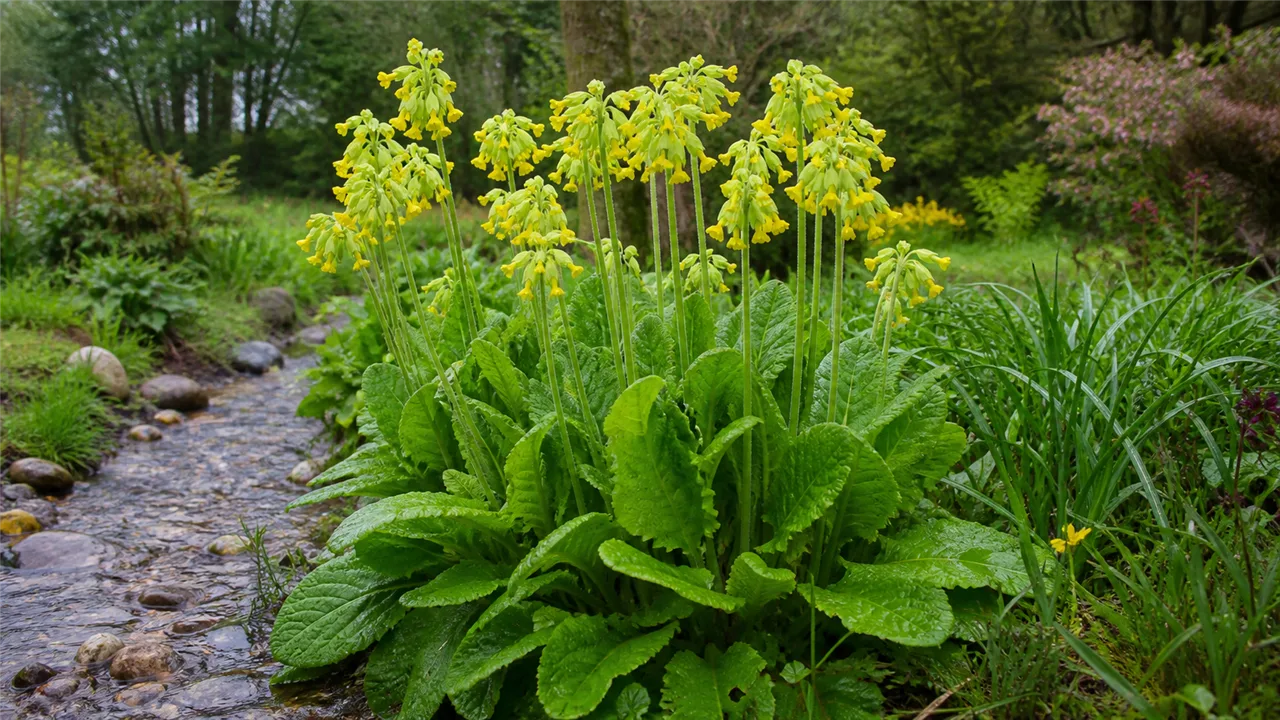
Primula alpicola var. luna — the pale yellow form, sometimes sold under the common name "moonlight"; a softer yellow than the brighter Asiatic candelabra primulas, and a useful partner to the white and lilac forms in mixed plantings.
Beyond these named varieties, mixed-colour seed strains raised from open-pollinated plants are also sold and produce a proportion of white, yellow and lilac-flowered seedlings. The plant is generally bought as one of the three named varieties above or as a colour mixture; named cultivar selections are limited, and the species is more often encountered as a variety or as seed-raised stock than as a clonal cultivar. The taxonomy of Primula alpicola has been stable in horticultural use for many decades and the varieties have been recognised in the standard horticultural literature for much of that time.
Pests and Diseases
| Problem | Symptoms | Management |
|---|---|---|
| Primula rust | Clusters of tiny, cup-like spore-producing structures appear on the underside of leaves. | Remove and destroy infected leaves immediately; avoid fungicides to protect biodiversity. |
| Primula leaf spot | Dark, water-soaked spots develop on foliage, potentially causing leaves to yellow and decay. | Improve air circulation and avoid wetting foliage when watering to reduce humidity around the plant. |
| Slugs and snails | Irregular holes chewed in leaves and silvery slime trails visible on soil or foliage. | Use physical barriers like copper tape or hand-pick pests at night; avoid chemical slug pellets where possible. |
| Root rot | Leaves turn yellow, wilt, and the plant collapses due to waterlogged, poorly drained soil. | Ensure planting in well-drained soil and avoid overwatering, especially during winter months. |
For step-by-step help, read Dealing with Slugs and Snails. Or browse the full plant problem solver to diagnose an issue by symptom.
Recommended Products
GardenWizz earns a commission from qualifying purchases made through affiliate links on this page (including links within the article) — as an Amazon Associate, and from Thompson & Morgan via the Awin network. This does not affect the price you pay. See our disclaimer for details.