Fulvous Rhododendron
Rhododendron fulvum
The Gardening Year
Best months in UK gardens · full planting calendar →
🖨 Printable care card (PDF)At a Glance
| Botanical name | Rhododendron fulvum |
|---|---|
| Common name(s) | Fulvous Rhododendron |
| Family | Ericaceae |
| Plant type | shrub (evergreen) |
| Height × Spread | 2–8 m × 2.5–4 m |
| Position | Partial shade |
| Soil | moist but well-drained, leafy, humus-rich acid soil |
| Flowering | March–May |
| Toxicity | Harmful if eaten |
| Native range | northern Myanmar and China (southwest Sichuan, southeast Xizang, western Yunnan) |
Overview
Rhododendron fulvum, the hairy rhododendron, is a large evergreen shrub from the cool, moist uplands of western China and the eastern Himalaya, first described in 1917 by I. B. Balfour and W. W. Smith from material gathered in Yunnan. It belongs to subsection Taliensia, a group of large-leaved, felted-leaved rhododendrons introduced to British cultivation by the plant-hunters of the early twentieth century, and it sits comfortably alongside R. taliense and R. bureavii in the larger woodland garden. In British horticulture it is valued as much for its distinctive foliage as for its flowers, and is reliably hardy across most of the UK given a sheltered site and acid soil.
In UK cultivation the species is best treated as a specimen shrub for a sheltered acid border or woodland edge, where its year-round evergreen structure and reliable mid-spring display make it a focal point. It is too large for the smallest town garden but earns its place in larger suburban plots, country gardens and the gardens of the west and north, where cool, moist summers suit it.
Appearance
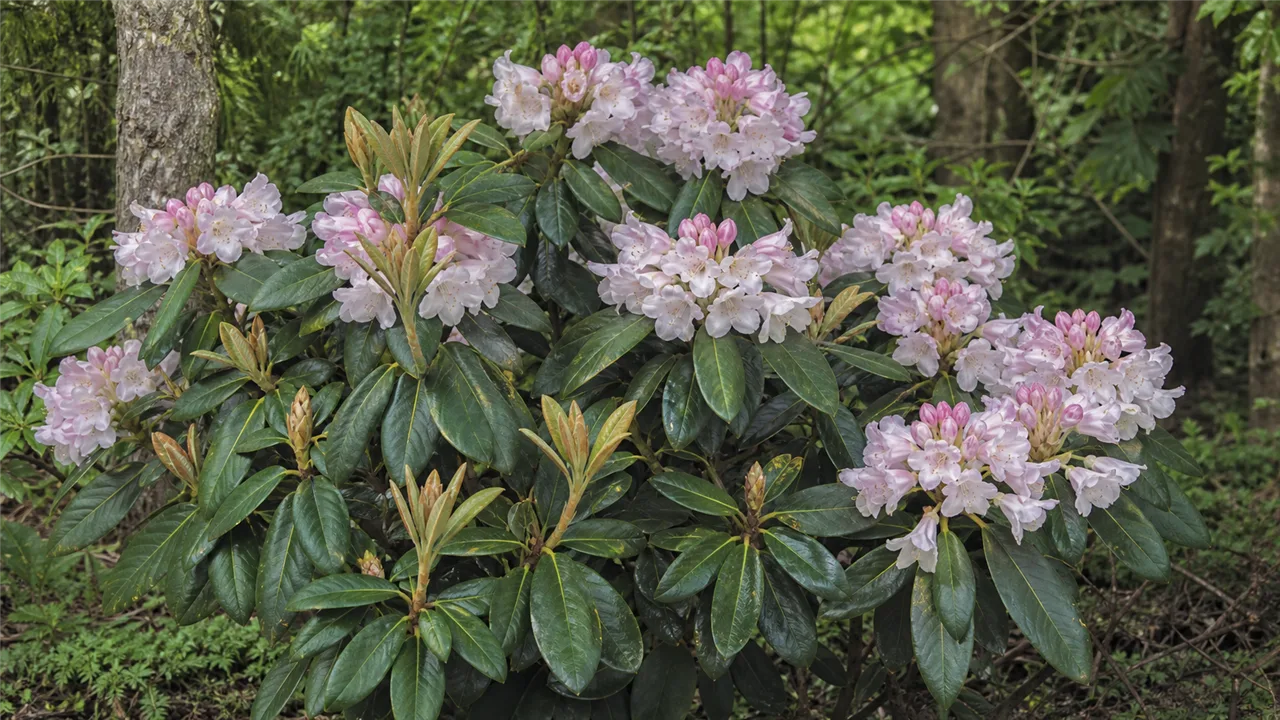
Rhododendron fulvum is a strong-growing, broadly upright to spreading evergreen shrub that typically reaches 3–6 m in height with a similar spread after twenty or thirty years in UK gardens; in the mildest west-coast gardens it can approach small-tree proportions. The habit is open and rounded, with stout, ascending branches that carry the foliage in well-spaced rosettes at the tips.
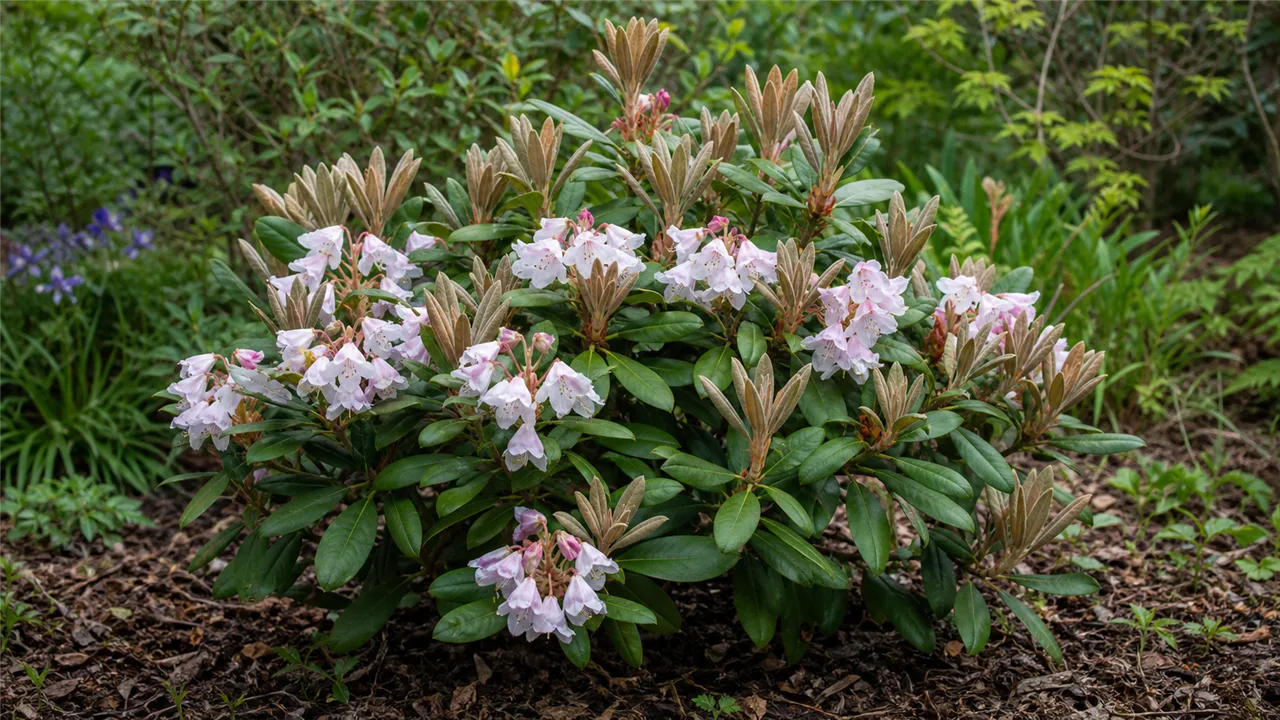
The leaves are the species' most distinctive feature. They are elliptical to oblong, leathery, and around 8–20 cm long by 3–7 cm wide, with a glossy, deep green upper surface. The underside is densely covered with a continuous, closely felted indumentum that varies from pale buff through cinnamon to a deep rusty or tawny brown; this warm, coppery underside gives the species its common name and the specific epithet fulvum (Latin: tawny). The indumentum is most pronounced on young foliage and remains a striking feature throughout the year, particularly when the wind turns the leaves.
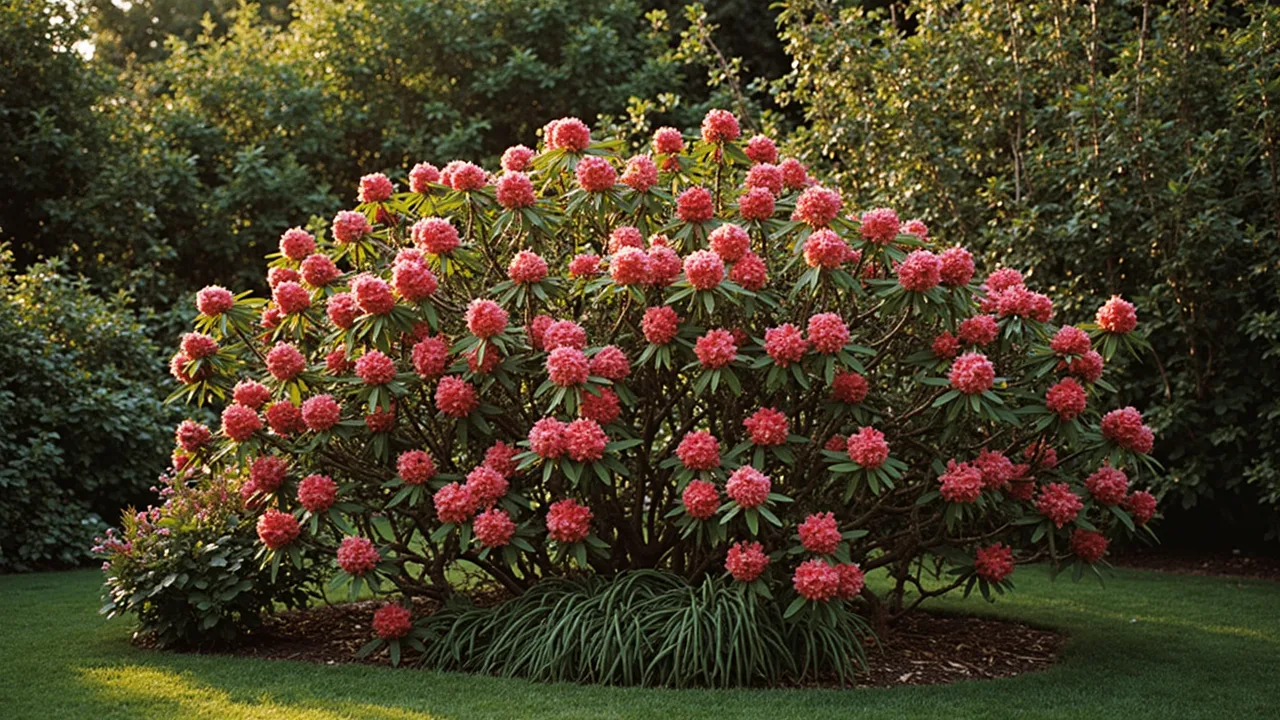
The flowers are carried in upright to slightly loose terminal trusses of 8–15 blooms. Individual flowers are funnel- to bell-shaped, 35–50 mm across, with five slightly wavy lobes, and range from pure white through blush pink to a soft lilac-pink, often with a faint deeper flush or small spots on the upper lobe. Flowering is mid- to late spring in the UK, generally April in the south and into May further north.
The bark on mature stems is smooth and grey-brown, peeling in thin flakes on older specimens, and new growth is often tinged with bronze before hardening off. Old, leggy plants show long bare stems with foliage only at the tips, which argues for careful siting and minimal pruning from the outset.
Growing Conditions
Rhododendron fulvum demands reliably acid soil and protection from cold drying wind. It performs best in dappled shade beneath tall deciduous trees, at the edge of a woodland, or on the shaded side of an open border. Heavy shade restricts flowering; full sun scorches the foliage and bleaches the indumentum.
Soil must be moist but sharply drained, humus-rich and distinctly acidic, ideally within pH 4.5–6.0. On naturally acid soils in the west and north of the UK — over granite, sandstone or peat — R. fulvum thrives with little intervention. On neutral or limy soils, including much of the chalk and limestone belt of southern England, the plant cannot survive long-term without sustained intervention: raised beds of ericaceous compost, large containers, or wholesale soil replacement are the only realistic options. The species is sensitive to waterlogging, which causes rapid collapse through root rot, so a free-draining yet moisture-retentive substrate is essential.
Aspect should be sheltered from the prevailing wind, particularly cold east winds in late winter and spring. Avoid frost pockets and low-lying ground. Inland and northern sites that experience hard winters can grow R. fulvum well provided wind exposure and root-zone drainage are managed, as the species tolerates cold when its roots are not wet.
The plant carries an RHS hardiness rating, displayed by the GardenWizz badge. In practical UK terms, established plants tolerate typical winters in all but the most exposed upland and far-northern sites when sited with care.
Planting and Care
When and how to plant. Container-grown R. fulvum can be planted at any time of year when the soil is workable, but the preferred windows are mid-autumn (October to mid-November) and mid- to late spring (April to early May). Dig a hole at least twice the width of the rootball and no deeper, so the plant sits at the same depth as it did in the container; rhododendrons are shallow-rooted and deep planting is a common cause of failure. Backfill with the excavated soil improved with leafmould or well-rotted bark, firm gently, water in thoroughly, and mulch with a 5–8 cm layer of acidic organic matter, kept clear of the stem.
Watering and feeding. Water regularly through any dry spell for the first two growing seasons, soaking the rootball. Once established, additional watering is rarely needed. Apply an ericaceous fertiliser in late winter or early spring. Avoid lime, bonemeal and any general fertiliser containing calcium carbonate, which raise soil pH and induce chlorosis.
Mulching. Renew the acidic mulch each spring, aiming for a continuous 5–8 cm layer over the whole rooting area. Leafmould, pine bark, conifer needles and well-rotted bracken are all suitable; avoid mushroom compost, which is alkaline, and thick layers of fresh manure, which scorch surface roots.
Pruning. Routine pruning is minimal. Deadhead spent trusses as soon as flowering finishes, breaking them out at the base without damaging the new growth bud below. Remove any dead, damaged or crossing stems in late spring. Hard pruning into old wood is tolerated less well than in many larger rhododendrons; if renovation is required, do it in stages over two or three years, cutting back into the framework rather than to ground level.
Propagation. Propagate by semi-ripe cuttings taken in late summer (July to early September), using current-season wood that has just firmed at the base. Treat with a rooting hormone and strike in a 50:50 mix of peat-free ericaceous compost and sharp perlite under mist or in a closed propagator with bottom heat at around 18–20 °C; rooting typically takes 8–14 weeks. Layering of low branches in autumn is reliable but slow. Seed germinates freely on damp ericaceous compost after a cold period of 4–6 weeks, but seedlings are variable and any desirable forms must be propagated vegetatively.
Seasonal care in the UK. In early spring, top up the mulch and watch for late frost on opening buds. As flowering finishes in May or early June, deadhead and water if dry. In high summer, soak during prolonged dry spells. In autumn, plant new specimens and refresh the mulch. In winter, protection is unnecessary except in the most exposed sites.
Common Problems
The most reliable indicator of an unhappy Rhododendron fulvum is chlorosis: leaves yellowing while the veins remain green, particularly on new growth. In almost all cases this is caused by soil pH being too high, which prevents uptake of iron and manganese. Correct by applying chelated iron as a foliar spray and a soil drench, by mulching with acidic organic matter, and, if the problem persists, by moving the plant into a raised bed of ericaceous compost.
Rhododendron leafhopper is a frequent pest: a pale green, wedge-shaped insect that feeds on foliage and transmits the fungus that causes bud blast. Control the leafhopper with systemic insecticide or by regular syringing in dry summer weather, and remove and burn any flower buds that blacken and remain on the plant through winter. Bud blast is best prevented by controlling the leafhopper and improving air movement around the plant.
Vine weevil is a serious pest of container-grown and occasionally open-ground rhododendrons. Adult beetles notch leaf margins in summer; the more damaging larvae feed on roots and can kill a plant outright in a single season. In containers, use Steinernema kraussei nematodes in late summer and early autumn; in open ground, encourage natural predators and consider a nematode drench where infestations are known.
Powdery mildew appears as a grey-white bloom on the leaf surface in still, humid late summers, particularly on plants in dry shade. Improve air movement, avoid overhead watering, and apply a suitable fungicide if severe. Phytophthora root rot is less common but devastating on poorly drained sites; there is no chemical cure, and affected plants must be removed with the surrounding soil before replanting. Rhododendron lace bug produces pale stippling on the upper leaf surface and dark frass beneath; it is generally a problem only on plants in full sun or under stress. Rabbits and deer browse the foliage and young stems in rural gardens; a 1 m high wire fence is the only reliable long-term protection.
Popular Varieties
True Rhododendron fulvum is most often sold as seedling-raised stock, and named selections are uncommon in general garden centres; specialist rhododendron nurseries are the most reliable source of any forms.
Rhododendron taliense is the closest relative of R. fulvum and shares its strongly felted foliage, but tends to be slightly smaller in leaf and flower; the two species complement each other well in a woodland planting. Rhododendron bureavii is another felted-leaved Taliensia species with white to pink flowers and a richly indumented underside, often grown alongside R. fulvum for textural contrast.
Among established hybrids with a substantial, large-leaved habit suited to similar woodland-edge conditions, Rhododendron 'Sir Charles Lemon' (a pre-1900 hybrid, sometimes attributed to R. arboreum parentage) is a classic large-flowered plant with creamy white to pale pink trusses and a similar overall stature. Rhododendron 'Loderi' hybrids, derived from R. fortunei and R. griffithianum, are scented large-flowered shrubs of comparable size at maturity and make excellent flowering partners at the back of a woodland border, though they prefer slightly more sun than R. fulvum to flower freely.
Availability of named R. fulvum selections varies year to year; specialist UK rhododendron nurseries such as Glendoick, Burncoose and Millais list the species and offer a small number of sister species and hybrids from year to year.
Pests and Diseases
| Problem | Symptoms | Management |
|---|---|---|
| Bud blast | Flower buds turn brown and die before opening, often showing black fungal bristles. | Remove and destroy infected buds promptly; avoid wetting foliage to reduce spore spread. |
| Powdery mildew | White powdery fungal growth appears on leaves, buds, and shoots, potentially causing discoloration. | Improve air circulation and prune for light penetration; apply fungicide if severe. |
| Vine weevil | Notches appear on leaf margins while larvae damage roots, causing wilting or plant collapse. | Use nematode treatments in soil during warm months or apply systemic insecticides. |
| Silver leaf | Leaves develop a silvery sheen on the underside and stems may show fungal fruiting bodies. | Cut out and burn infected branches well below the visible symptoms; avoid planting near infected trees. |
| Rhododendron leafhopper | Brightly coloured adults leap from foliage; nymphs leave white cast skins on leaf undersides. | Monitor for egg-laying damage to buds; control is often unnecessary as feeding rarely harms plant vigour. |
| Honey fungus | General decline, wilting, and dieback of branches, potentially with white fungal growth at the base. | Improve drainage and soil aeration; remove infected plants and roots completely to prevent spread. |
For step-by-step help, read Treating Powdery Mildew. Or browse the full plant problem solver to diagnose an issue by symptom.
Recommended Products
GardenWizz earns a commission from qualifying purchases made through affiliate links on this page (including links within the article) — as an Amazon Associate, and from Thompson & Morgan via the Awin network. This does not affect the price you pay. See our disclaimer for details.