Snowy Rhododendron
Rhododendron niveum
The Gardening Year
Best months in UK gardens · full planting calendar →
🖨 Printable care card (PDF)At a Glance
| Botanical name | Rhododendron niveum |
|---|---|
| Common name(s) | Snowy Rhododendron |
| Family | Ericaceae |
| Plant type | shrub (evergreen) |
| Height × Spread | 2–6 m × 4–8 m |
| Position | Partial shade |
| Soil | moist but well-drained, leafy, humus-rich acid soil |
| Flowering | March–May |
| Toxicity | Harmful if eaten |
| Native range | northeastern India (including Sikkim), Bhutan, and southern Tibet in China |
Rhododendron niveum (the snow rhododendron, more often sold in Britain as the purple rhododendron) is one of the most striking large-flowered rhododendrons a UK gardener with acidic soil can grow. Native to the eastern Himalayas and introduced to British horticulture in the mid-nineteenth century, it remains a connoisseur's plant rather than a garden-centre staple: large, slow to settle, and demanding of the right site. Given those conditions, it produces some of the deepest purple-blue trusses found anywhere in the genus, carried on a substantial evergreen shrub that anchors a woodland border for several decades.
Overview
Rhododendron niveum belongs to subsection Taliensia, a group of large-leafed rhododendrons prized for their bold foliage and felted undersides as much as for their flower colour. In the wild it occurs across the Himalayas — Bhutan, Tibet, Nepal, Sikkim and Arunachal Pradesh — typically between 2,500 m and 4,000 m altitude, where it grows on open slopes and at the margins of mixed forest. Plants from these high-altitude provenances are notably cold-tolerant and dislike heat, which makes them well suited to the cooler, wetter parts of the UK and more demanding in the drier south-east.
The species was described by Joseph Dalton Hooker in 1849 from Sikkim material, and reached British gardens through the great nineteenth-century plant-collecting expeditions to the Himalaya. It remains popular among rhododendron enthusiasts and in the woodland collections of Cornish, Welsh, Scottish and west-coast estates, where the combination of mild summers, high rainfall and naturally acidic soil suits it best. In a small suburban garden it is usually too large; on the acid soil of a sheltered woodland edge it can be magnificent for forty years or more.
As with most Ericaceae, R. niveum is mildly toxic if any part is ingested, and the foliage should not be used for stock fodder. The plant is otherwise benign to wildlife: the spring flowers are valuable to early bumblebees, and the dense evergreen structure provides winter shelter for small birds.
Appearance
R. niveum makes a large, vigorous, upright-rounded evergreen shrub eventually reaching 3–5 m in height and similar spread after many years. Growth is slow in the first three to five years while the root system establishes, then accelerates into a sturdy, well-branched specimen. The crown is more open and tree-like in shaded woodland conditions, denser and more rounded in good light.
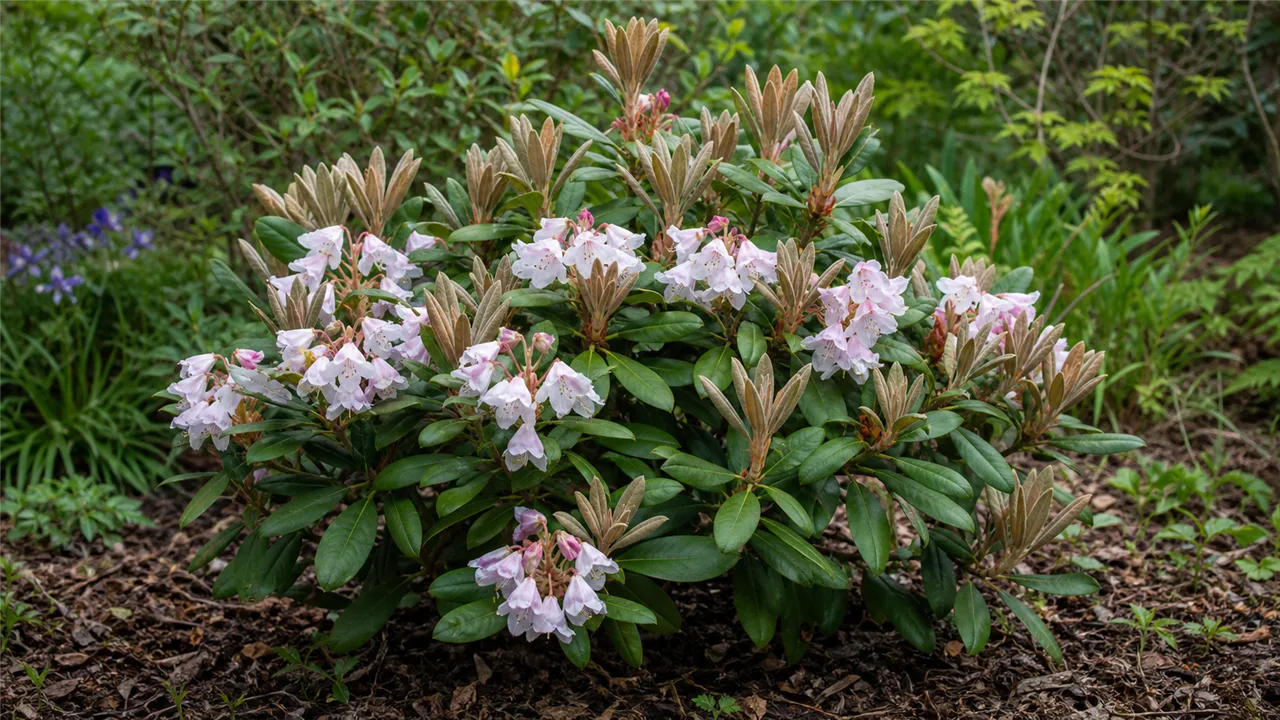
Young stems are a notable feature: thick, pale buff to tawny, and covered in a dense woolly indumentum that persists for two or three years before maturing to smooth grey-brown bark. The leaf buds are large and conspicuous through winter, again clothed in felted down.
The leaves are oblong-lanceolate, dark matte green above and 10–20 cm long on mature plants. The upper surface is slightly bullate (puckered between the veins), giving the foliage a substantial, leathery texture. The underside is the diagnostic feature: a thick, persistent fawn to buff indumentum, soft to the touch and one of the most attractive in the genus. This felted underside is the source of the species name niveum ("snowy"), referring to the pale covering rather than to the flowers.
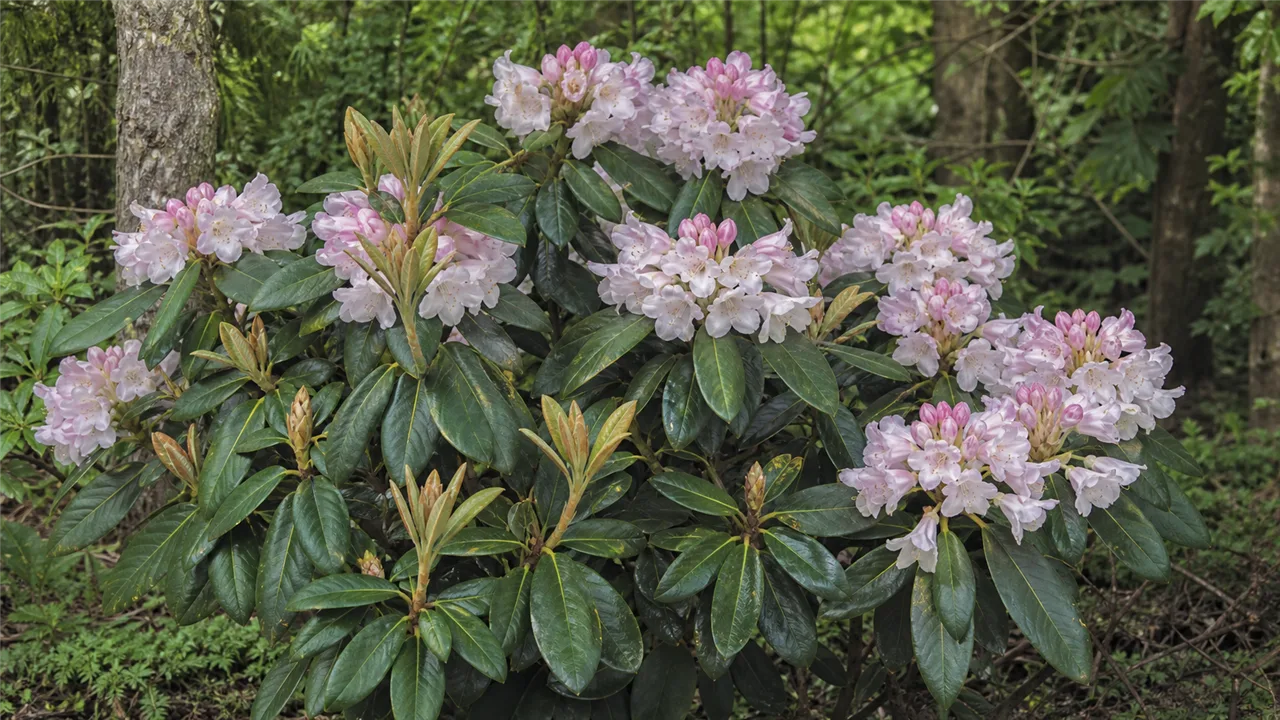
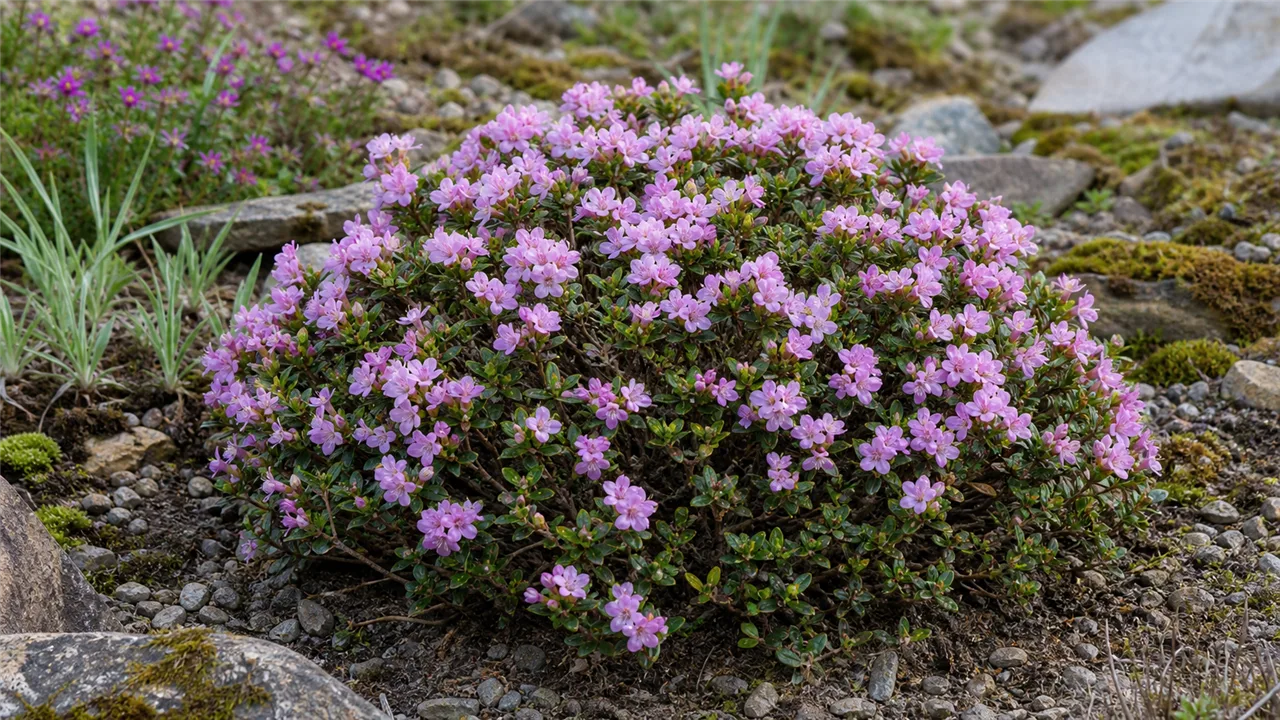
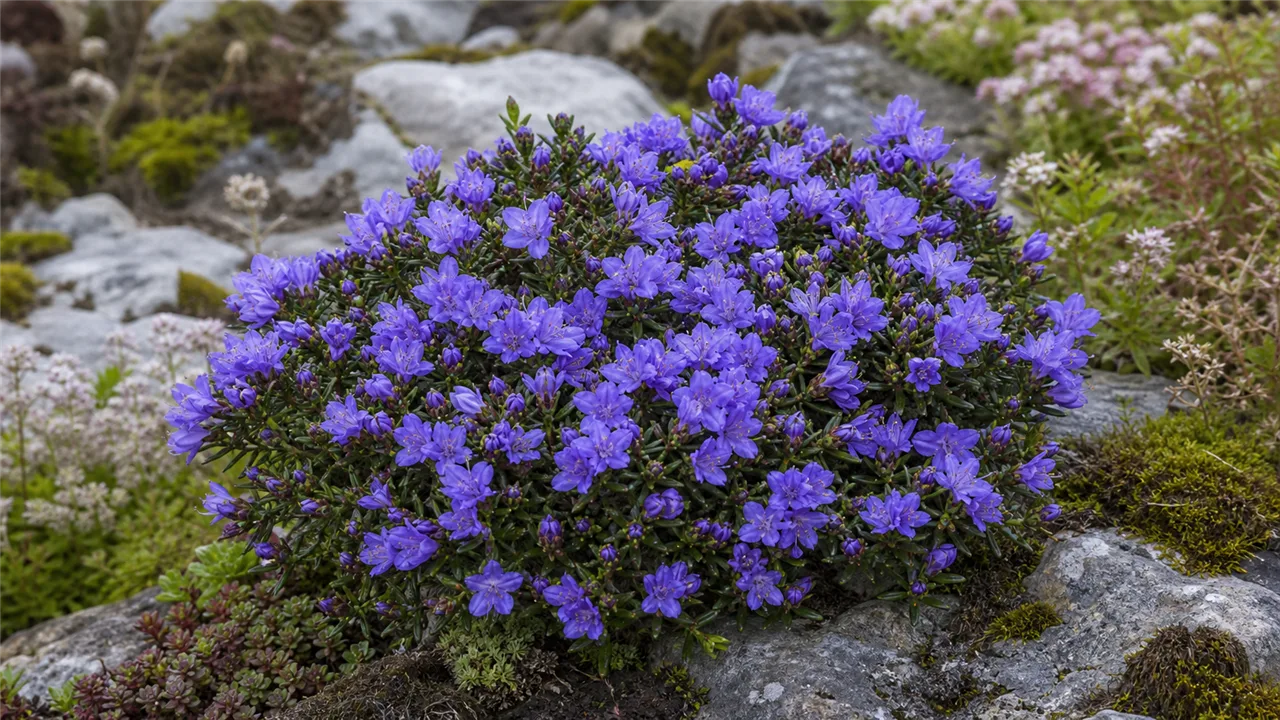
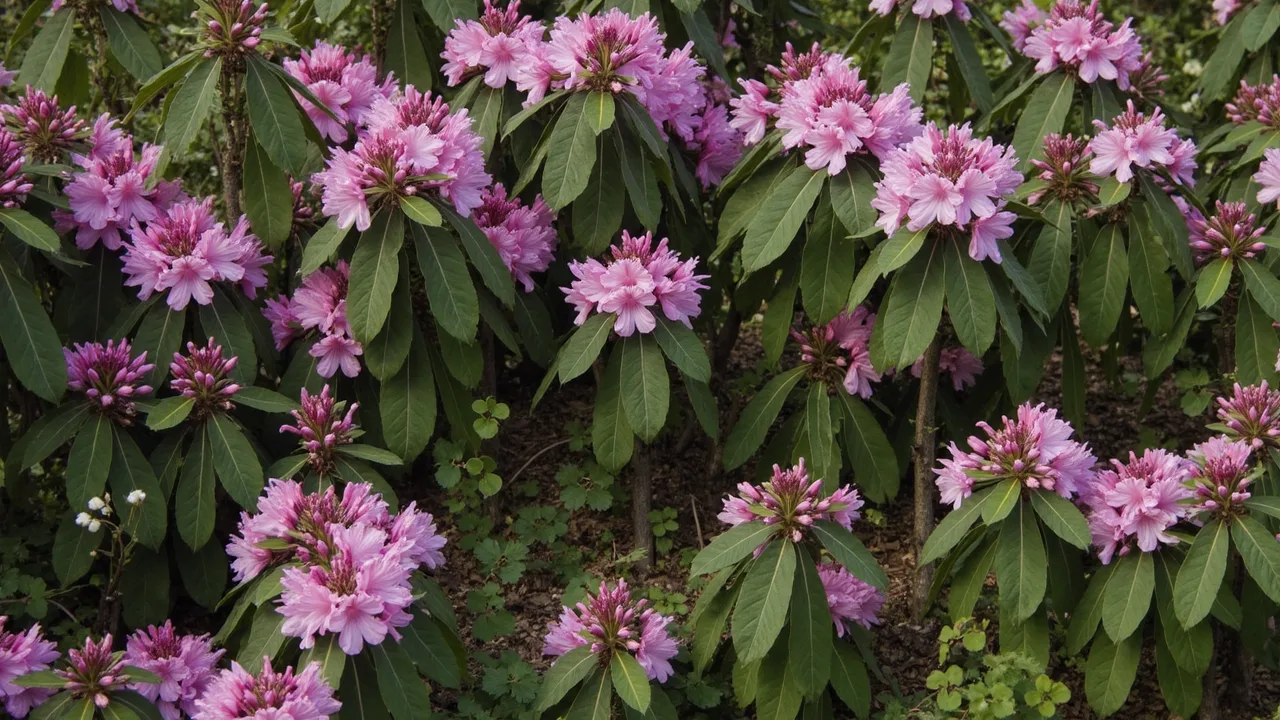
Flowering is the plant's main event. The trusses appear in mid to late spring, typically April in the south and west, late April to mid-May further north and in Scotland. Each truss is a rounded dome 12–15 cm across, carrying 15–20 individual flowers on a stout, indumented stalk. Individual blooms are tubular to funnel-shaped, 3–4 cm long, opening from tight buds through a clear deep purple-violet to lilac-purple, sometimes paler at the throat, with a few faint markings inside. The colour is remarkably consistent across the species, deeper and more reliably blue-purple than many of the named hybrids. Deadheading carefully — snapping the old truss off just above the new growth without damaging the dormant buds — improves the following year's display and tidies the plant.
The seed capsules are woody and persist through winter, attractive to some, untidy to others. Named cultivars are propagated from cuttings or grafts; species seed sets freely but seedlings vary.
Growing Conditions
The single most important requirement is acidic soil. R. niveum will not thrive in neutral or chalky ground: in alkaline conditions it develops interveinal chlorosis from iron lockout, fails to flower well, and slowly declines. Aim for pH 4.5–6.0, ideally rich in organic matter and free-draining yet moisture-retentive. A sandy loam over acidic parent material is ideal; a heavy clay is workable if improved with copious ericaceous organic matter and given sharp drainage at the base of the planting hole.
The second requirement is shelter. R. niveum comes from altitudes where drying winter winds are rare and summers are cool. In the UK it performs best in dappled shade, ideally under a high canopy of oak, pine or birch where it receives filtered light. Deep shade reduces flowering and makes the plant leggier; full sun scorches the leaves and bleaches the indumentum. A north- or east-facing aspect, or the sheltered side of woodland, is usually ideal. Cold, desiccating winter wind is damaging — exposed east-facing sites in inland Britain brown leaf margins by March.
The plant is not drought-tolerant and resents drying out, especially in its first five years. A deep annual mulch of pine bark, composted bracken or oak/beech leaf mould (7–10 cm thick, kept clear of the stem) conserves moisture, buffers soil temperature and slowly acidifies the upper root zone.
In the UK, R. niveum is reliably hardy across most of the country given a sheltered site, earning a place in collections from Cornwall to Perthshire. It dislikes hot, dry summers and performs poorly in the south-east unless given shade, mulch and irrigation through July and August. Woodland gardens in the west country, Wales, the Lake District and Scotland, and damp Scottish glens are its natural British homes.
Planting and Care
When to plant. Container-grown specimens can be planted at any time of year when the ground is workable and the plant can be watered, but spring (March–April) and early autumn (September–October) are best. Spring planting gives the longest establishment season before the first winter; autumn planting works well in mild regions where the soil stays warm through October.
Site preparation. Dig a hole at least twice the width of the root ball and the same depth. If the underlying soil is poor or alkaline, backfill with a 50:50 mix of leaf mould and composted pine bark, or a proprietary ericaceous compost. On heavy clay, incorporate sharp grit and bark into the backfill. Soak the root ball for an hour before planting if it has dried out.
Planting. Tease out circling roots on container-grown plants. Set the root ball so the top sits flush with the surrounding soil — rhododendrons are surface-rooters and must not be buried deep. Backfill, firm gently, water thoroughly, and apply a 7–10 cm mulch of pine bark or chipped bracken over the root area, kept clear of the stem.
Watering. Water deeply once a week through the first growing season, more often in dry spells. Established plants benefit from a soak during extended dry summer periods; a lack of water in July and August is the most common cause of poor flower bud initiation for the following spring.
Feeding. Not a heavy feeder — an annual spring mulch of leaf mould or composted bark is usually sufficient. If growth is weak or leaves are pale, apply a half-strength liquid ericaceous fertiliser in late spring after flowering. Avoid high-nitrogen feeds, which produce soft leafy growth prone to wind damage and reduce flowering.
Pruning. Little routine pruning is required; the plant grows naturally into a well-shaped shrub and resents hard cutting into old wood. The only regular work is careful deadheading: as the trusses fade in late May or June, snap or twist off the spent flower head just above the new growth, taking care not to damage the dormant buds immediately behind it. Wayward, crossing or damaged branches can be removed in late spring after flowering. Overgrown specimens can be rejuvenated by staged hard pruning over two or three years, cutting selected main stems back to 30–60 cm in April — recovery is slow but reliable.
Propagation. Species plants come true from seed, sown fresh on the surface of a moist ericaceous mix in a cold frame in autumn. Named cultivars must be propagated vegetatively — semi-ripe cuttings (10–15 cm, July, with a heel) root slowly under mist with bottom heat. Grafting onto R. ponticum is the commercial method but is rarely attempted by amateurs.
Seasonal care. Watch for late frosts at bud-burst in April and May: a sharp frost can damage swelling buds. If forecast, throw a couple of layers of horticultural fleece over the canopy overnight. Keep the mulch topped up in early spring and water deeply once a week in dry summers rather than little and often. In autumn, clear fallen leaves if they form a dense smothering layer; otherwise leave them to break down.
Common Problems
Rhododendron leaf spot (Septoria azaleae and related fungi): small brown to purplish spots on leaves, occasionally with yellow halos. Usually cosmetic and rarely serious — improve air circulation by selective pruning of surrounding vegetation, remove and bin affected leaves, and avoid overhead watering in the evening.
Powdery mildew (Erysiphe spp.): a fine white bloom on the upper leaf surface in warm, humid late summers. Improve airflow, avoid drought stress, and if persistent treat with a sulphur-based or potassium bicarbonate spray. Less common on R. niveum than on some hybrids.
Vine weevil (Otiorhynchus sulcatus): the adult notches leaf margins in a characteristic scalloped pattern; the larvae, white with brown heads, feed on roots and are particularly damaging in container-grown plants. In open ground, predation by birds usually keeps populations in check. In pots, apply a biological control — the parasitic nematode Steinernema kraussei — in September or early October when soil temperatures are above 5 °C.
Chlorosis (yellowing between green veins): almost always a sign of alkaline soil or waterlogged roots. Test the soil pH around the plant; if above 6.0, treat with sequestered iron (chelated iron) as a foliar feed and soil drench, and renew the acidic mulch annually. Long term, chlorosis on chalky ground indicates the wrong site — the plant will not recover fully and may need to be moved.
Flower blight (Botrytis cinerea): brown patches on opening flowers in damp springs. Remove affected trusses promptly; improve airflow; avoid overhead watering onto open flowers.
Bud blast and frost damage: tight brown buds in spring often indicate a late frost after bud-burst. The following year, fleece the plant on forecast frost nights from mid-March onwards.
Honey fungus (Armillaria): occasionally recorded on older specimens in woodland settings; no chemical cure — remove affected plants with as much root as possible and leave the ground fallow before replanting.
All parts of R. niveum are toxic if ingested (the genus contains grayanotoxins) and the foliage is unpalatable to grazing stock.
Popular Varieties
The species itself is so distinct and consistent that the majority of plants sold in the UK are seed-raised and offered simply as Rhododendron niveum. A small number of established crosses use it as a parent, and named selections circulate among collectors.
- R. niveum (species, seed-raised) — the default form, deep purple-violet trusses and a strong buff indumentum.
- R. `Cinnandense` — a hybrid of R. cinnabarinum × R. niveum, registered in the early twentieth century; narrow, tubular, somewhat pendulous flowers in a contrasting orange-red to cinnabar, distinct in habit and colour from the species.
- R. `Swinhoe` (also seen as R. swinhoei, a closely related species sometimes grouped with R. niveum in subsection Taliensia) — white to pale pink flushed flowers on a similarly large shrub, useful as a foil for R. niveum in a woodland planting.
- R. `Tyermannii` — a hybrid involving subsection Taliensia species including R. niveum relatives, with large pale flowers and the felted foliage characteristic of the group.
Note that availability of R. niveum cultivars is limited in general nurseries; specialist rhododendron growers (including several in Cornwall, Wales and Scotland) are the most reliable source. For most UK gardeners, the species itself planted as a single specimen in a woodland edge is the most rewarding choice — a substantial, long-lived shrub that, given an acid soil and a sheltered site, performs reliably for a generation.
Pests and Diseases
| Problem | Symptoms | Management |
|---|---|---|
| Vine weevil | Notched leaf margins on young growth and root damage causing wilting or collapse. | Apply nematodes to soil in autumn or use systemic insecticides for severe infestations. |
| Powdery mildew | White, dusty fungal growth on leaves and shoots, often causing distortion. | Improve air circulation and apply a fungicide if infection is heavy. |
| Rhododendron bud blast | Flower buds turn brown and fail to open, often appearing shrivelled. | Remove affected buds and avoid wetting foliage when watering. |
| Pieris lacebug | Silver or bleached patches on the upper leaf surface with black specks underneath. | Spray with a suitable insecticide in spring when nymphs are active. |
| Rhododendron petal blight | Flowers become water-soaked, brown, and rot before or during opening. | Remove fallen flowers to reduce spore load and ensure good drainage. |
| Silver leaf | Leaves develop a silvery sheen on the underside and branches may die back. | Prune out infected wood well below the visible symptoms and burn it. |
For step-by-step help, read Treating Powdery Mildew. Or browse the full plant problem solver to diagnose an issue by symptom.
Recommended Products
GardenWizz earns a commission from qualifying purchases made through affiliate links on this page (including links within the article) — as an Amazon Associate, and from Thompson & Morgan via the Awin network. This does not affect the price you pay. See our disclaimer for details.