King Rhododendron
Rhododendron rex
The Gardening Year
Best months in UK gardens · full planting calendar →
🖨 Printable care card (PDF)At a Glance
| Botanical name | Rhododendron rex |
|---|---|
| Common name(s) | king rhododendron |
| Family | Ericaceae |
| Plant type | tree |
| Height × Spread | 5–12 m × — |
| Position | Partial shade |
| Soil | moist but well-drained, acid soil enriched with leaf mould |
| Flowering | March–May |
| Toxicity | Harmful if eaten |
| Native range | China, India, and Myanmar |
Rhododendron rex is a bold-leaved evergreen shrub or small tree from the cool, moist montane forests of south-western China, prized in British gardens for the sheer scale of its foliage and for its loose late-spring trusses of bell-shaped flowers. It belongs to subsection Falconera, a group of rhododendrons known for exceptionally large leaves backed by a distinctive felted underside, and it is among the most architectural of all rhododendrons that can be grown outdoors in the milder parts of the United Kingdom. First described from cultivated material by H. Léveillé in 1914 and introduced to Western gardens through George Forrest's early twentieth-century seed collections from Yunnan, it remains a connoisseur's plant, sought by collectors of bold-foliage rhododendrons and by anyone with the space and acid soil to do it justice.
Overview
Rhododendron rex is endemic to a relatively small area of south-western China, chiefly northern Yunnan with outlying records in south-western Sichuan and south-eastern Xizang (Tibet). In the wild it grows in cool, moist montane forest, often as part of rhododendron-dominated thicket above the cloud line, where its large leaves make the most of consistently humid air and shelter from drying wind. The Chinese folk name 大叶杜鹃 (large-leaf rhododendron) reflects exactly what strikes a gardener encountering it for the first time: the leaves are among the largest of any rhododendron considered hardy in the British Isles.
In cultivation in the UK it is best treated as a specimen plant for a woodland garden or a large acid border. Given time, shelter, and a cool root run, it forms a broad, often umbrella-like dome of stout branches clothed year-round in dramatic foliage. It is not a plant for a small urban courtyard or a quick-fix flowering shrub for a new border; it is a long-term statement plant for gardens with the right soil and the right climate.
Appearance
The habit is that of a large evergreen shrub or small tree, typically reaching 3–7 m in height in British cultivation and occasionally taller in favoured sites, with a broad, often umbrella-like crown carried on stout branches. The silhouette is heavy and architectural rather than airy.
The leaves are the defining feature. They are elliptic to oblanceolate, 20–45 cm long and 8–18 cm wide, leathery, and dark glossy green on the upper surface. The underside is covered with a dense, persisting fawn to silvery-grey indumentum — the felted, hairy tomentum that is characteristic of subsection Falconera and that gives the group much of its winter presence. The petiole is stout and 2–4 cm long. Even out of flower, a well-grown specimen reads as a piece of living sculpture.
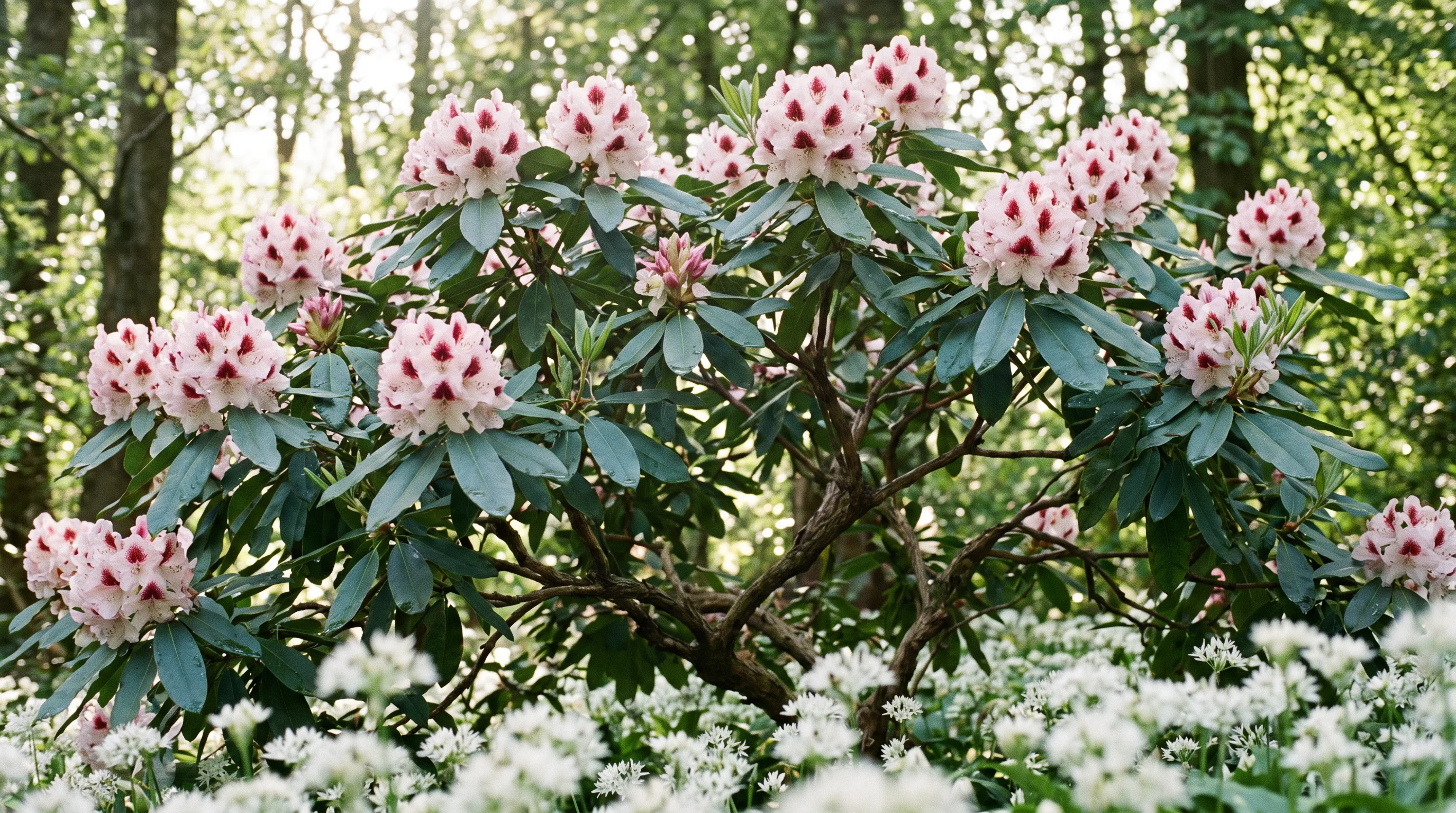
The flowers appear in late spring, generally from late April through June in UK conditions, in loose trusses of 15–25 bell-shaped (campanulate) blooms. Colour is variable: typically white to cream, flushed or heavily marked with pink, crimson, or deep rose, and often carrying a basal blotch. Individual flowers are 5–7 cm across, held above the foliage in a way that the truss as a whole is conspicuous from a distance. The buds themselves are large and conical with prominent bracts, a useful identification feature before they open.
After flowering, large woody capsular seed heads develop, 2–4 cm long and covered in rusty indumentum when young, ripening through late summer and into autumn. These can be left in place for their structural effect or removed if a tidier look is preferred.
Growing Conditions
Rhododendron rex performs best in dappled shade, ideally with shelter from cold drying wind and protection from strong early morning sun, which can scorch the large emerging leaves in spring. A position under high deciduous canopy, or on the sheltered side of woodland, suits it well; an exposed east-facing site is the worst choice in most British gardens. The plant tolerates gentle morning sun only where the soil stays reliably cool and moist at the root.
The soil must be acid (pH 4.5–6.0), humus-rich, and moist but well-drained. A typical ericaceous loam improved with leaf mould and well-rotted coniferous bark gives the cool, open, organic root run the species needs. It will not tolerate lime-induced chlorosis, so any site with chalk or alkaline drift must be avoided or fully replaced with imported acid mix. Reliable moisture through the growing season is essential; the large leaf area flags readily in dry air, and a deep mulch of leaf mould or pine bark makes a real difference in a dry summer.
Climate matters as much as soil. The mild, moist regions of the UK — south-west England, Wales, western Scotland, coastal Ireland, and the western Highlands — are where R. rex settles in most happily. It struggles in cold continental inland gardens, where late frosts and dry winters combine to damage the emerging foliage and desiccate the indumentum. A sheltered woodland site in such regions can succeed, but growth is generally slower and flowering less reliable than in the wetter west.
Planting and Care
Plant container-grown specimens in late spring (May–June) or early autumn (September), into a pre-moistened planting pit at least twice the diameter of the rootball. Tease out any circling roots at the edge of the pot before backfilling with ericaceous compost, and water in thoroughly to settle the soil around the rootball. Allow 2–4 m of space for a specimen planting; these are large plants and reward room to develop their natural dome.
Watering through the first two summers is important, particularly on lighter soils, and a 5–8 cm mulch of leaf mould or pine bark applied each spring and kept clear of the trunk helps conserve moisture and keep the root run cool. Feeding should be light: a single ericaceous feed after flowering is plenty, and high-nitrogen spring doses should be avoided because they force soft growth that scorches easily.
Pruning is minimal. Remove any dead, damaged, or crossing wood immediately after flowering, and deadhead spent trusses carefully so as not to damage the new growth emerging below them. The species resents hard cutting back into old wood and is not a candidate for renovation pruning; if a specimen outgrows its site, replacement is usually a better option than hard reduction.
Propagation is most reliable from seed, surface-sown on a moist ericaceous compost and given light. Semi-ripe heel cuttings with bottom heat and rooting hormone can be taken in late summer but are slow and uncertain. Layering of a low shoot is reliable but slow. Long-term container culture is not practical — the root volume and leaf area are too large for the UK pot regime, and specimens kept in pots for years rarely thrive.
Common Problems
Rhododendron lace bug (Stephanitis rhododendri) is the most frequent foliage pest on evergreen rhododendrons in southern England. It produces silvery mottling on the upper leaf surface and dark tar-spot faecal deposits on the indumentum underneath; on R. rex the damage is more conspicuous than on smaller-leaved species because each lesion is read against a larger canvas. The rhododendron leafhopper (Graphocephala fennahi) is itself a minor nuisance and is also the vector of bud blast (Pycnostysanus azaleae), a fungal infection that enters via leafhopper egg-laying wounds and turns buds black and rigid so that they fail to open. Pick off and burn affected buds; controlling the leafhopper in late summer reduces infection the following spring.
Vine weevil (Otiorhynchus sulcatus) is a borderline threat: notched leaf margins in summer are the typical above-ground sign, while root and stem-base larvae can kill container-grown plants. Open-ground specimens are usually large enough to tolerate low-grade attack, but anything in a pot needs monitoring. Honey fungus (Armillaria spp.) is uncommon on Rhododendron generally, but stressed specimens on poor sites can be affected; sudden wilting followed by dieback is the warning sign. Powdery mildew occasionally appears on shaded, airless sites and is best addressed by improving airflow and removing affected leaves.
The most serious threat is Phytophthora root rot. Phytophthora cinnamomi and, less commonly, P. ramorum (the latter notifiable in the UK) cause plant collapse, bark shedding at the collar, and darkened roots. Avoid over-wet or compacted sites, and buy only from reputable, plant-health-passported stock. Lime-induced chlorosis — yellowing between the veins on alkaline soils — is not a disease but a soil problem, addressed by switching to ericaceous compost and applying sequestered iron until the plant is re-established in suitably acid ground.
Popular Varieties
Rhododendron rex is primarily grown in the UK as the wild species, and named selections remain scarce in general nursery trade. The clone R. rex 'Quartz' — a white-flowered form with the species' characteristic large, indumented leaves — is one of the few selections with reasonable availability, though stocks vary year to year. Gardeners wanting a specific flower colour should check current supplier lists rather than rely on a particular clone being in production.
For collectors building a group of subsection Falconera rhododendrons with comparable bold foliage, the obvious companion species are R. fictolacteum, R. galactinum, R. hodgsonii, and R. coriaceum. All share the large leaf, persisting indumentum, and architectural presence that makes the subsection worth growing. Mature specimens can be seen in several British reference collections, including the Royal Botanic Garden Edinburgh, Bodnant Garden in Conwy, and Brodsworth Hall in South Yorkshire — all useful places to view established plants in UK conditions before committing to a purchase.
Pests and Diseases
| Problem | Symptoms | Management |
|---|---|---|
| Powdery mildew | White powdery fungal growth on leaves, buds, and shoots, sometimes causing leaf distortion or discolouration. | Tolerate unless severe; improve air circulation and avoid overhead watering to reduce humidity. |
| Bud blast | Flower buds turn brown, shrivel, and fail to open due to fungal infection often vectored by leafhoppers. | Remove and destroy infected buds promptly if practical; encourage natural enemies of leafhoppers. |
| Vine weevil | Notched edges on leaves above ground and root damage below ground, leading to wilting or plant collapse. | Use nematode treatments in the soil during warm weather or apply biological controls like Steinernema carpocapsae. |
| Rhododendron leafhopper | Small jumping insects that suck sap from leaves, causing stippling and potentially transmitting bud blast fungus. | Monitor for activity; encourage natural predators and remove heavily infested foliage if necessary. |
| Pieris lacebug | White lacy patches on the upper leaf surface with black specks of excrement on the underside. | Encourage predatory insects like ladybirds; severe cases may require targeted insecticidal soap application. |
For step-by-step help, read Treating Powdery Mildew. Or browse the full plant problem solver to diagnose an issue by symptom.
Recommended Products
GardenWizz earns a commission from qualifying purchases made through affiliate links on this page (including links within the article) — as an Amazon Associate, and from Thompson & Morgan via the Awin network. This does not affect the price you pay. See our disclaimer for details.