Royal Azalea
Rhododendron schlippenbachii
The Gardening Year
Best months in UK gardens · full planting calendar →
🖨 Printable care card (PDF)At a Glance
| Botanical name | Rhododendron schlippenbachii |
|---|---|
| Common name(s) | Royal azalea |
| Family | Ericaceae |
| Plant type | shrub |
| Height × Spread | 1–5 m × 4–8 m |
| Position | Partial shade |
| Soil | Moist but well–drained, Acid |
| Flowering | May–June |
| Toxicity | Harmful if eaten |
| Native range | Korean Peninsula, Northeast China, Japan, Russian Far East |
A deciduous azalea that carries its flowers before the leaves, Rhododendron schlippenbachii is widely regarded as one of the most ornamental of all the species azaleas. Native to Korea, Manchuria and Japan, it has been grown in British collections for well over a century and rewards a sheltered, lime-free corner with a brief but spectacular display of large, pale pink flowers each spring.
Overview
Rhododendron schlippenbachii belongs to the heather family, Ericaceae, and sits within the azalea group of the genus Rhododendron (subgenus Tsutsusi, section Sciadorhodion). The Royal Botanic Gardens, Kew, lists its native range as the temperate regions of the Russian Far East, northern China, the Korean peninsula and Japan. The species was named by the Russian botanist Carl Maximowicz in 1871 after Baron Alexander von Schlippenbach, the Russian naval officer who collected it on the Korean coast in the 1850s.
In British gardens the royal azalea is grown as a specimen shrub for a sheltered woodland edge or acid border, where its early flowers and good autumn colour justify the careful siting that the species demands. Like most deciduous azaleas it is tolerant of more sun than the large-leaved evergreen rhododendrons, provided the soil beneath never dries out, but it flowers most freely where roots are kept cool and the crown is shaded from the strongest midday light.
Appearance
A mature royal azalea in UK cultivation is an upright, rounded, deciduous shrub with a somewhat open framework. Heights of around 1.2–1.8 m after ten to fifteen years are typical, with a similar spread; in long-established, sheltered plantings on suitable ground the same plant can eventually reach 4–5 m, but such sizes are unusual outside the warmer, wetter west of the country.
The leaves are the most distinctive feature of the species. They are clustered in a loose whorl towards the ends of the current season's shoots, obovate in outline and noticeably larger than the foliage of most other azaleas, often 5–10 cm long and 3–6 cm wide. When they first emerge the young leaves carry a bronze or purplish-red tint that fades to mid-green through the summer, and they turn yellow, orange and red before falling in autumn.
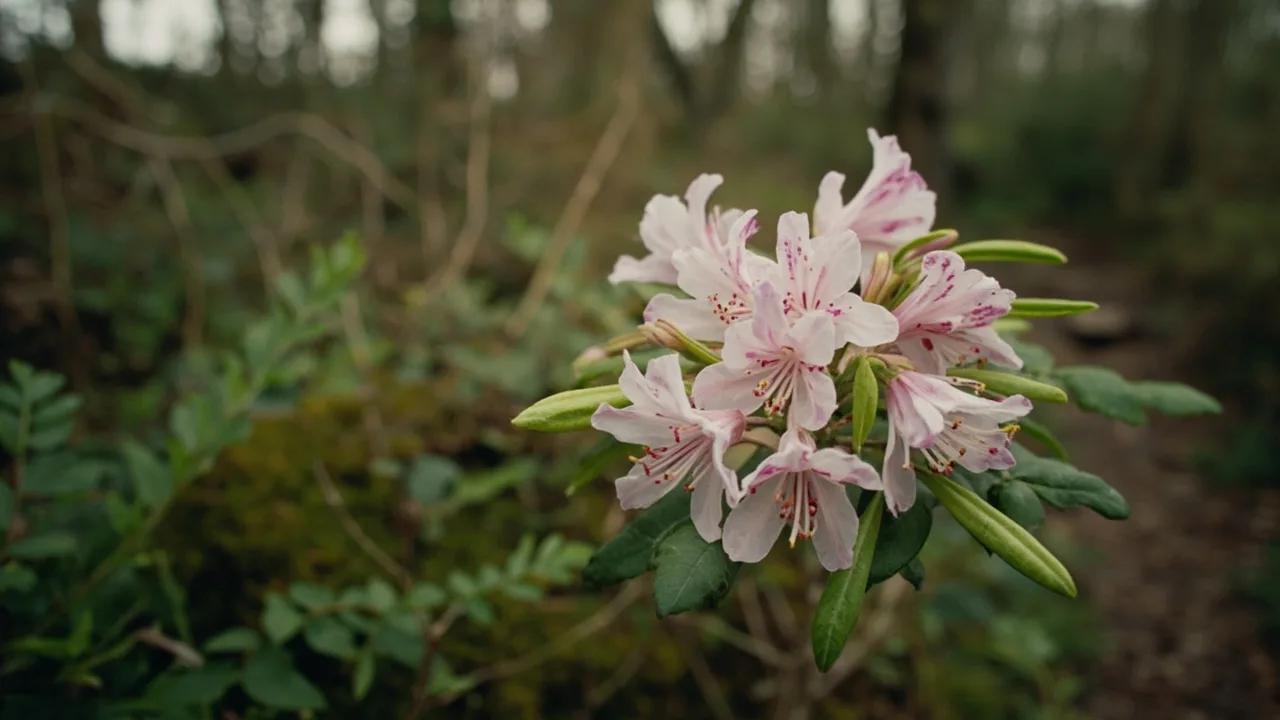
Flowers open in late April or May, usually just as the new leaves are unfolding. Each truss carries three to six broadly funnel-shaped blooms, 5–8 cm across, in a soft clear pink that varies between plants from almost white to a deeper rose. The upper petals are usually marked with a scattering of brownish or crimson spots. A light, sweet fragrance is detectable on a calm day, especially in warmer springs. Flower buds form during the previous summer and are particularly vulnerable to damage from late frosts and from cold drying winds.
Growing Conditions
Royal azalea performs best in a position that mimics the deciduous woodland edge of its natural range: dappled shade beneath taller trees, or a border that receives morning sun and shade through the hottest part of the day. Full sun is acceptable where the soil can be kept reliably moist, but in practice this is difficult to sustain on lighter UK soils in a dry summer. Deep, dry shade under evergreens produces leggy growth and poor flowering.
Soil is the single most important factor. The species needs a moist but well-drained, humus-rich substrate that is distinctly acidic — broadly pH 5.0–5.5 is the usual target range quoted for the genus. On neutral or chalky ground the leaves turn yellow between the veins (chlorosis) and the plant slowly declines. Where the native soil is unsuitable, raised beds filled with ericaceous compost, or large containers of the same, are the usual remedies.
Drainage matters as much as moisture. Royal azalea will not tolerate sitting in cold, waterlogged ground over winter, particularly on heavy clay, because its fine root system is highly susceptible to root-rot fungi. Incorporating coarse organic matter and grit at planting, planting on a slight mound, or choosing a naturally sloping site all help. A 5–8 cm mulch of leaf mould, pine needles or bark, renewed each spring, keeps roots cool, conserves moisture and slowly feeds the soil.
In common with other rhododendrons, the royal azalea is shallow-rooted and benefits from a sheltered position out of cold east winds, which both desiccate the evergreen winter bud and damage the soft young growth in spring. A back-drop of taller shrubs, a wall, or the lee side of a woodland fringe is ideal.
Planting and Care
Container-grown plants can be planted at any time the ground is workable and the soil is not frozen or waterlogged, although autumn (September to early November) and early spring (March to April) give the best establishment. Lift a hole at least twice the width of the rootball and no deeper, so that the plant finishes with the root flare just at or fractionally above the surrounding soil surface. Water the hole before planting, set the plant in, backfill with the same soil improved with leaf mould or well-rotted ericaceous compost, firm gently and water in well.
Watering through the first two growing seasons is the single biggest determinant of success. Soak thoroughly once a week rather than sprinkling lightly every day, and continue this regime through any subsequent dry spring or summer while flower buds are setting. Established plants in moisture-retentive soil need little supplementary watering except in prolonged drought.
Feeding should be modest. A single annual application of a slow-release ericaceous fertiliser in late winter or early spring, scattered over the root area and watered in, is generally sufficient. Avoid high-nitrogen lawn or vegetable fertilisers, which produce soft growth susceptible to aphids and frost damage. A top-dressing of leaf mould or pine bark each spring feeds the soil and helps maintain acidity.
Pruning is rarely required. The species flowers on wood formed the previous year, so any shaping or removal of damaged or crossing stems is best carried out immediately after flowering, in late May or early June. A tired, leggy plant can be rejuvenated by cutting one or two of the oldest stems back to near ground level each year after flowering; new shoots from the base will replace them over the following two to three seasons.
Propagation is straightforward from semi-ripe cuttings taken in mid to late summer: short shoots of the current season's growth, wounded at the base and set in a 50:50 mix of peat-free ericaceous compost and perlite under a closed propagator, will root in six to ten weeks. Layering of a low shoot in autumn is slower but reliable, and the species can also be raised from fresh seed sown on the surface of a moist ericaceous compost and kept cool.
Common Problems
The most common cause of failure in UK gardens is unsuitable soil. Where the substrate drifts towards neutral, leaves yellow between the veins (chlorosis) and growth becomes stunted. The remedy is long-term: lift and replant into an ericaceous bed, grow in a container, or apply chelated iron as a temporary correction while addressing the underlying pH.
Late frosts are the second most frequent problem. Buds that have begun to swell from late February onwards are vulnerable to a sharp frost in April or early May, and the resulting damage shows as brown, blasted buds that fail to open. A sheltered site, fleece thrown over the plant on nights when frost is forecast, or siting the shrub where overhanging branches give some protection all reduce the risk.
Rhododendron lacebug (Stephanitis rhododendri) is the most widespread foliar pest. The upper leaf surface becomes finely mottled and pale, while the underside carries dark, tar-like spots of insect frass and the small pale adults themselves. The pest favours dry, sunny conditions and is less of a problem on plants growing in cool, humid shade. Control is by spraying the undersides of the leaves with a systemic insecticide, or by encouraging natural predators in a mixed planting.
Other sap-feeding pests include rhododendron whitefly, which lifts off in clouds when foliage is disturbed, and the azalea bark scale, which appears as small, white, waxy tufts on the stems. Honeydew and sooty mould follow on from all of these. Predatory insects, careful timing of sprays, and avoiding drought stress all help.
Fungal diseases are less common on a well-sited plant but worth watching for. Rhododendron bud blast (a fungal infection spread by the rhododendron leafhopper) blackens buds in winter and prevents flowering. Powdery mildew can mark the leaves in dry late summers. Petal blight (Ovulinia azaleae) turns open flowers brown and slimy; it is more common after wet springs in the south and west. Remove and bin affected material rather than composting it.
Root and collar rot (Phytophthora and related fungi) is the most damaging disease of all. It appears as sudden wilting and dieback even when the soil is moist, with reddish-brown discoloration visible beneath the bark at the soil line. There is no effective chemical cure; improving drainage, avoiding over-deep planting and replacing affected stock on a fresh site are the only options.
Popular Varieties
The species itself is the form most commonly offered by UK nurseries and is the most reliable choice for a British garden. Burncoose Nurseries in Cornwall lists the type form with pale rose-pink flowers in profusion, at around £22 for a three-litre plant. Kevock Garden Plants in Scotland also lists the species, although it is frequently out of stock, reflecting the species' slow growth from cuttings and the limited UK production.
A handful of clonal selections exist in international cultivation but are rarely seen in British retail lists. 'Sid's Royal Pink' is a more compact selection with deeper pink flowers and reliable autumn colour, distributed by several North American specialist nurseries but seldom listed in the UK. White- and deeper-pink colour breaks occur in wild populations and turn up occasionally as grafted plants from continental or Japanese nurseries; both are uncommon and command premium prices.
Because the species comes reasonably true from seed and hybridises readily with other members of section Sciadorhodion (notably R. quinquefolium and R. albrechtii), a number of deliberate crosses have been made over the past century. These hybrids are more often encountered in specialist collections than in general garden centres, but they are worth seeking out from rhododendron specialists if a smaller, more flower-laden plant is wanted.
For most UK gardeners, a well-grown seedling of the species itself remains the best introduction to the genus, and a far better garden plant than many of the more fashionable evergreen hybrids. Given the right soil, the right light and a little patience, a royal azalea will outlive the gardener who plants it.
Pests and Diseases
| Problem | Symptoms | Management |
|---|---|---|
| Powdery mildew | White powdery fungal growth appears on leaves, buds, and shoots, potentially causing distortion. | Improve air circulation and avoid overhead watering; tolerate mild infections or apply fungicide if severe. |
| Bud blast | Flower buds turn brown, shrivel, and fail to open due to fungal infection. | Remove and destroy infected buds promptly to prevent spread; ensure good drainage and hygiene. |
| Vine weevil | Notches on leaf margins above ground and root damage below, leading to wilting or collapse. | Use nematode treatments in autumn for larvae or apply systemic insecticides to control adults. |
| Silver leaf | Leaves develop a silvery sheen on the underside and stems may show fungal fruiting bodies. | Prune out infected branches well below the visible symptoms and destroy them immediately. |
| Pieris lacebug | Small white speckling on leaf surfaces with black tar-like spots of excrement underneath. | Encourage natural predators like ladybirds or apply horticultural oil during dormant periods. |
| Honey fungus | General decline, wilting, and dieback of branches with white fungal growth at the base. | Improve soil drainage and remove infected plants; chemical control is rarely effective. |
For step-by-step help, read Treating Powdery Mildew. Or browse the full plant problem solver to diagnose an issue by symptom.
Recommended Products
GardenWizz earns a commission from qualifying purchases made through affiliate links on this page (including links within the article) — as an Amazon Associate, and from Thompson & Morgan via the Awin network. This does not affect the price you pay. See our disclaimer for details.