Dog Rose
Rosa rugosa
The Gardening Year
Best months in UK gardens · full planting calendar →
🖨 Printable care card (PDF)At a Glance
| Botanical name | Rosa rugosa |
|---|---|
| Common name(s) | Dog Rose |
| Family | Rosaceae |
| Plant type | shrub (Deciduous) |
| Height × Spread | 100–150 cm × — |
| Position | Full sun, Partial shade |
| Soil | moderately fertile, humus-rich, moist but well-drained; tolerant of poor soil and dry conditions; pH Acid, Alkaline, Neutral |
| Flowering | March–August |
| Toxicity | Fruit are ornamental - not to be eaten. Wear gloves and other protective equipment when handling. |
| Native range | eastern Asia, in northeastern China, Japan, Korea and southeastern Siberia |
Dog rose brings the loose, flower-filled character of a British hedgerow into a garden, followed by red hips that extend its value well beyond early summer. This vigorous native shrub suits wildlife hedges, informal boundaries and larger naturalistic borders where its arching, prickly growth has room to develop.
Overview
Rosa canina is a British native rose of hedgerows, scrub, woodland edges and cliff tops. Its natural range extends across Europe into north-west Africa and western Asia, but in the UK it is an immediately recognisable part of the countryside. A mature plant makes a large, informal shrub rather than a neat bedding rose, and its stems can scramble through neighbouring woody plants.
The species is especially useful in a wildlife-friendly garden, mixed native hedge or loose country boundary. Its open flowers give pollinating insects easy access, its dense prickly stems provide shelter and nesting cover, and its hips are eaten by birds and small mammals. It can be combined with hawthorn, blackthorn, hazel, guelder rose and spindle to create a varied hedge rather than a dog-rose monoculture.
The plant is vigorous and may reach roughly 3m in ordinary garden conditions, so its eventual spread must be considered before planting. It is well suited to rural gardens, community wildlife areas and substantial plots, but less suitable beside a narrow path, children's play area or frequently used doorway because the curved prickles catch clothing and skin. In a small garden, a single plant trained into an existing hedge is usually more manageable than a freestanding thicket.
Appearance
Long, green shoots arch outwards and become woody with age. They bear stout, backward-curving prickles that help the rose hook into surrounding vegetation. The deciduous leaves are pinnate, usually divided into five and sometimes seven oval leaflets. Each leaflet is mid-green, approximately 1.5-4cm long and edged with fine teeth, producing a light texture that fits naturally among other hedgerow shrubs.
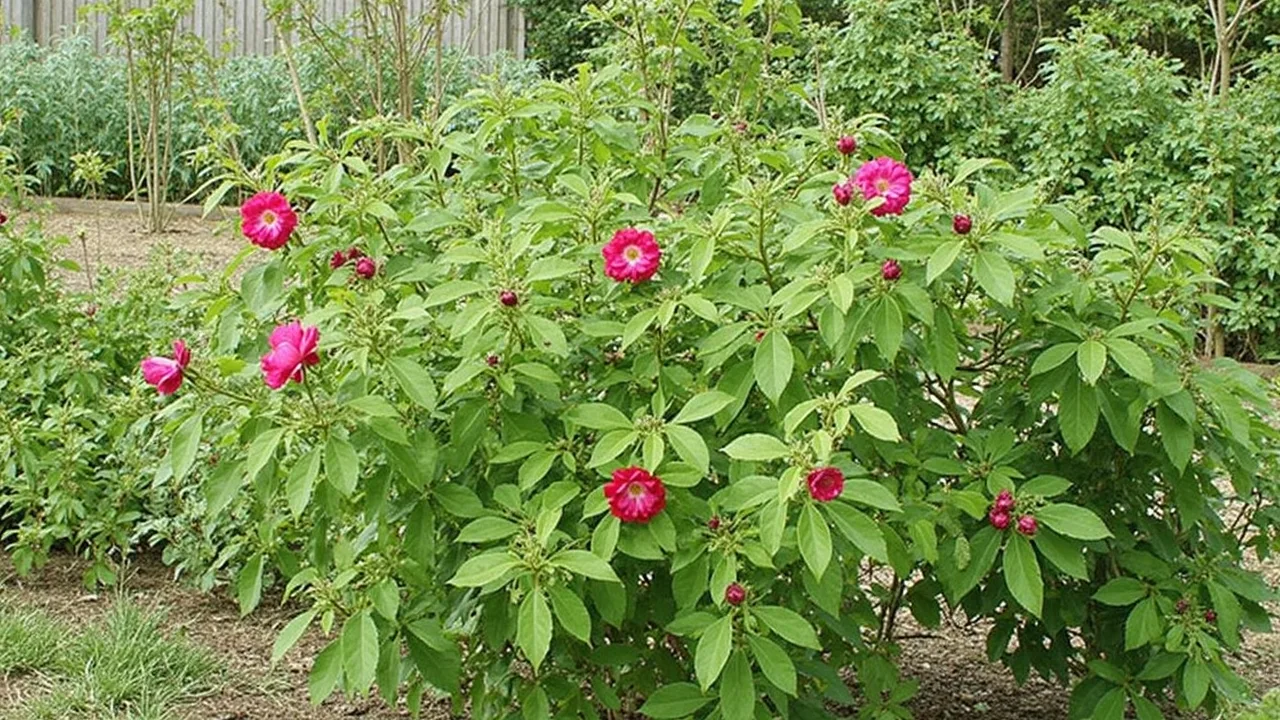
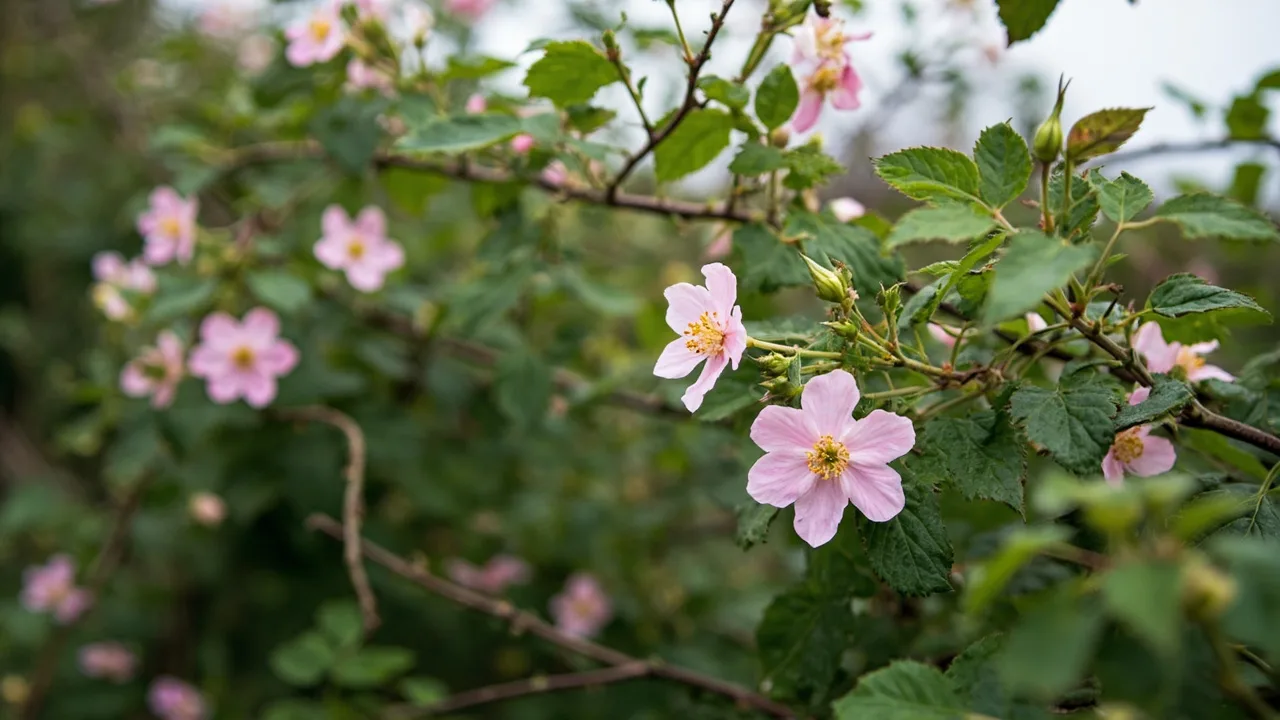
The single flowers are usually 4-6cm across and have five petals. Their colour varies from almost white through shell pink to a clearer pale pink, often with a conspicuous cluster of yellow stamens at the centre. Peak flowering is in May and June in much of Britain, although local climate and exposure can move the display and a few flowers may continue into July.
After pollination, oval or slightly pear-shaped hips develop. These mature to scarlet-orange or red, commonly measuring 1.5-2cm long. Colour becomes prominent in September and October, and undisturbed hips can persist into winter. The sequence moves from spring foliage to early-summer flowers and autumn fruit.
Dog rose can be confused with other wild roses. Arching stems, hooked prickles, pale single flowers and red oval hips help with recognition, but British wild roses hybridise and can be difficult to identify with certainty.
Growing Conditions
Full sun gives the most abundant flowers and hips, although dog rose tolerates light or dappled shade. In southern England, some afternoon shade can reduce stress on a dry site without preventing flowering. Deep shade encourages looser growth and fewer blooms, so a hedge should not be planted directly beneath a dense evergreen canopy if wildlife value and fruiting are priorities.
The preferred soil is moderately fertile, humus-rich, moist and well drained. Established plants are adaptable and can grow in clay, loam, sandy ground and soils ranging from mildly acidic to chalky, which helps explain their widespread occurrence across Britain. Persistent waterlogging is unsuitable because oxygen-starved roots decline, while extremely dry, shallow soil can restrict establishment and reduce flowering. Improve compacted ground over a broad area with garden compost or leaf mould rather than creating a small, rich planting pocket that holds water.
This is a robust choice for exposed and maritime gardens. It can form part of a field-edge hedge or informal windbreak, although young whips still need firm planting and protection from rocking until rooted. Allow at least 1.5-2.5m of eventual lateral space for an individual shrub unless it will be managed as part of a hedge. Avoid crowding it against delicate perennials, where its arching shoots may overwhelm smaller plants and make maintenance difficult.
Dog rose is reliably suited to all UK regions, with the plant's formal hardiness information held in the structured badge. Regional differences mainly affect growth and flowering time rather than winter survival: plants in mild southern and coastal districts generally start earlier, while exposed northern and upland sites may flower later. A sheltered but sunny position can improve flowering in cold districts, provided air can circulate through the shrub.
Planting and Care
Bare-root dog-rose whips are best planted while dormant, from October to March, whenever the soil is neither frozen nor waterlogged. Container-grown plants can be set out at other times, but autumn or early spring reduces watering pressure. Soak a dry bare-root plant before planting, dig a hole wide enough to spread the roots without bending them, and return the excavated soil around the roots. Set the plant at its previous soil mark, firm carefully and water thoroughly.
For a mixed native hedge, approximately three plants per metre in a staggered double row gives useful density while leaving room for growth. Dog rose should be only one component alongside suitable native shrubs. A rabbit guard may be needed on exposed rural sites, but it must not rub against the stem. Keep a weed-free circle around each new plant and apply a 5-8cm mulch of well-rotted compost, leaf mould or composted bark, leaving a clear gap around the stem.
Water newly planted whips during dry spells throughout their first growing season and check them again during drought in the second. A slow, thorough soaking is more useful than frequent surface sprinkling. Established plants are generally drought tolerant in ordinary British soils and seldom need routine watering. Feeding is also modest: an annual late-winter mulch is normally sufficient in open ground, and excess high-nitrogen fertiliser can produce soft, congested growth at the expense of flowers.
Prune in January or February, after birds have had access to the autumn hips. Wear stout gloves, eye protection and long sleeves. First remove dead, damaged, diseased and badly crossing stems, cutting to healthy wood. On an established shrub, take roughly one in three of the oldest stems out at the base to encourage replacement growth without stripping the whole plant. Make smaller cuts about 5mm above an outward-facing bud and slope the cut away from it. Avoid shearing every shoot into a tight outline, as this destroys the species' graceful habit and can remove flowering wood.
Seasonal care is simple. Check ties and guards in spring, water young plants in dry summer weather, leave developing hips in place through autumn, and clear diseased fallen rose leaves rather than allowing them to accumulate. The expected calendar is flowers in May and June, ripe hips in September and October, and pruning in January and February. The shrub has no sowing event in the garden calendar because it is managed as a woody shrub.
Propagation is possible from semi-ripe cuttings in late summer or hardwood cuttings in autumn. Seed propagation is slower and variable: seed extracted from ripe hips needs a prolonged sequence of warm and cold conditions and may take two years to germinate. Seed-raised plants do not provide the uniformity of a named clone, but that variation is appropriate for many wildlife hedges. Dog rose has also traditionally been used as rootstock for grafted roses, although grafting is specialist work rather than necessary care for a garden specimen.
Common Problems
Dog rose is usually resilient when grown with adequate light and air movement, but it can develop the same problems as other roses. Regular inspection is preferable to routine spraying, particularly in a wildlife planting where insects and hips are part of the reason for growing it.
Rose black spot produces purple-brown or black leaf blotches, often with diffuse or feathery margins, followed by yellowing and early leaf fall. The fungus survives on infected material and spreads in wet conditions. Remove affected fallen leaves, put them in household or council green-waste disposal as locally permitted rather than a cool home compost heap, and mulch in spring to reduce rain splash from the soil. Open congested growth during winter pruning and water at ground level. Fungicides labelled for roses are available, but repeated treatment is rarely desirable in a native wildlife hedge; current product instructions and the RHS black spot guidance should be checked before use.
Rose aphids cluster on soft shoot tips and flower buds in late spring. They may distort young growth and leave sticky honeydew, but a vigorous dog rose generally tolerates modest numbers. Ladybirds, hoverfly larvae and birds often provide control. Aphids can be rubbed off or dislodged with water where localised; broad-spectrum insecticides risk harming the beneficial insects attracted by the open flowers.
Rose slugworm, the larvae of a sawfly, grazes the upper or lower surface of leaves and leaves a skeletonised, scorched-looking patch. Examine the reverse of damaged leaves in early summer and remove larvae by hand on a small plant. Established shrubs usually recover from light damage, so intervention is unnecessary unless defoliation is extensive.
Powdery mildew and rose rust may appear where airflow is poor or plants are stressed. Mildew makes a pale, floury coating on young leaves and shoots; rust creates orange pustules, particularly beneath the leaves. Thin congested stems, avoid drought stress during establishment and remove badly affected material. Persistent annual disease can indicate that the plant is too shaded or crowded for the site.
Physical management is often the greater issue. Long prickly shoots can snag passers-by, and suckering or self-seeded growth may spread into adjacent beds. Site the shrub away from narrow routes, cut unwanted basal growth cleanly, and remove stray seedlings while young. Before hard hedge work, check carefully for active bird nests; nesting birds and their nests are protected by law.
Popular Varieties
Dog rose is normally offered in Britain as the seed-raised species Rosa canina, especially in bare-root native-hedging bundles. Current authoritative public listings do not establish three dependable, garden-worthy cultivars for recommendation, so names should not be manufactured simply to fill a list. Seedlings naturally vary in flower colour, vigour and prickle density, but those variations are not named varieties.
For a genuine dog rose, choose responsibly sourced Rosa canina with healthy roots and a clear nursery label. Bare-root whips are economical for hedging, while a container-grown species plant is convenient for planting a single specimen. Provenance can matter in ecological schemes, so locally sourced native stock may be preferable where a conservation plan specifies it.
Gardeners wanting a broader native-style hedge can create variety through companion species rather than supposed dog-rose cultivars. Hawthorn contributes dense structure and spring blossom; blackthorn flowers early and bears sloes; hazel adds catkins and nuts; guelder rose provides white flower clusters and red fruit; and spindle supplies striking autumn colour. Each should be selected for the site's soil, available space and local ecological objectives.
Sources & Further Reading
- Royal Horticultural Society: Rosa canina (S), dog rose, accessed 22 July 2026.
- Royal Horticultural Society: Rose black spot - symptoms and control, accessed 22 July 2026.
- Royal Horticultural Society: Rose pruning guide, accessed 22 July 2026.
- Royal Horticultural Society: Plant a bare-root mixed wildlife hedge, accessed 22 July 2026.
- Woodland Trust: Dog rose (Rosa canina), accessed 22 July 2026.
- BBC Gardeners' World: How to grow and care for dog rose, accessed 22 July 2026.
Pests and Diseases
| Problem | Symptoms | Management |
|---|---|---|
| Rose rust | Orange or black spore pustules appear on the undersides of leaves and distorted stems. | Prune out infected growth immediately and collect fallen leaves in autumn to reduce overwintering spores. |
| Rose black spot | Distinctive black spots with fringed edges develop on leaves, causing them to yellow and drop. | Improve air circulation, remove affected foliage, and avoid wetting the leaves when watering. |
| Powdery mildew | A white, dusty fungal growth covers young shoots, leaves, and buds, often causing distortion. | Ensure good air circulation and prune out affected growth; avoid overhead watering to keep foliage dry. |
| Rose dieback | Stems become discoloured, shrivel, and die back from the tips, often following physical damage or frost. | Prune affected wood back to healthy tissue at an angle and disinfect tools between cuts. |
| Aphids | Clusters of small green or black insects cluster on new growth, causing leaves to curl and sticky honeydew. | Encourage natural predators like ladybirds or blast off infestations with a strong jet of water. |
| Scale insects | Small, brown, limpet-like structures encrust the stems and branches, weakening the plant. | Scrape off visible scales by hand or use a horticultural oil spray during dormancy. |
For step-by-step help, read Controlling Aphids Naturally, Treating Powdery Mildew and Tackling Black Spot on Roses. Or browse the full plant problem solver to diagnose an issue by symptom.
Recommended Products
GardenWizz earns a commission from qualifying purchases made through affiliate links on this page (including links within the article) — as an Amazon Associate, and from Thompson & Morgan via the Awin network. This does not affect the price you pay. See our disclaimer for details.