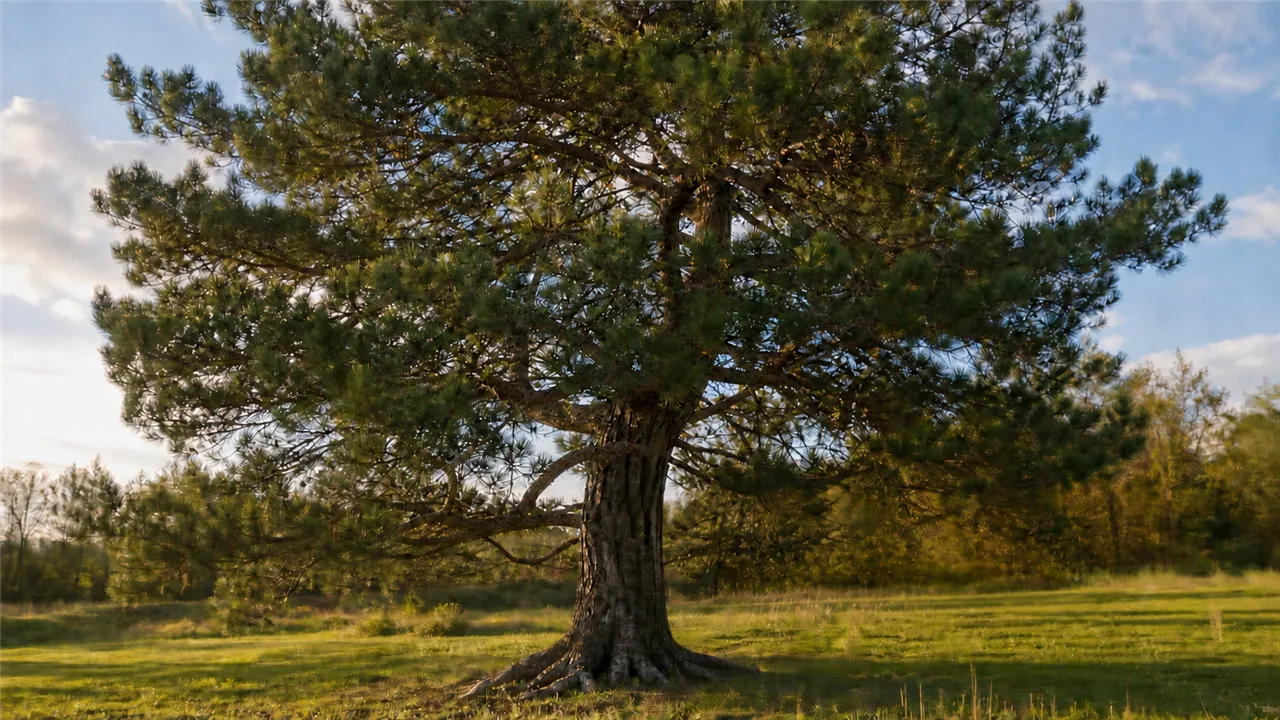
Whitebeam
Sorbus aria
The Gardening Year
Best months in UK gardens · full planting calendar →
🖨 Printable care card (PDF)At a Glance
| Botanical name | Sorbus aria |
|---|---|
| Common name(s) | Whitebeam |
| Family | Rosaceae |
| Plant type | tree (Deciduous) |
| Height × Spread | 15 m × 8 m |
| Position | Full sun, Partial shade |
| Soil | Moderately fertile, humus-rich, well-drained; tolerant of chalk and limestone |
| Flowering | May–June |
| Toxicity | Fruit are ornamental, not to be eaten. Seeds contain small amounts of cyanoglycosides. |
| Native range | Europe, Maghreb and western Asia |
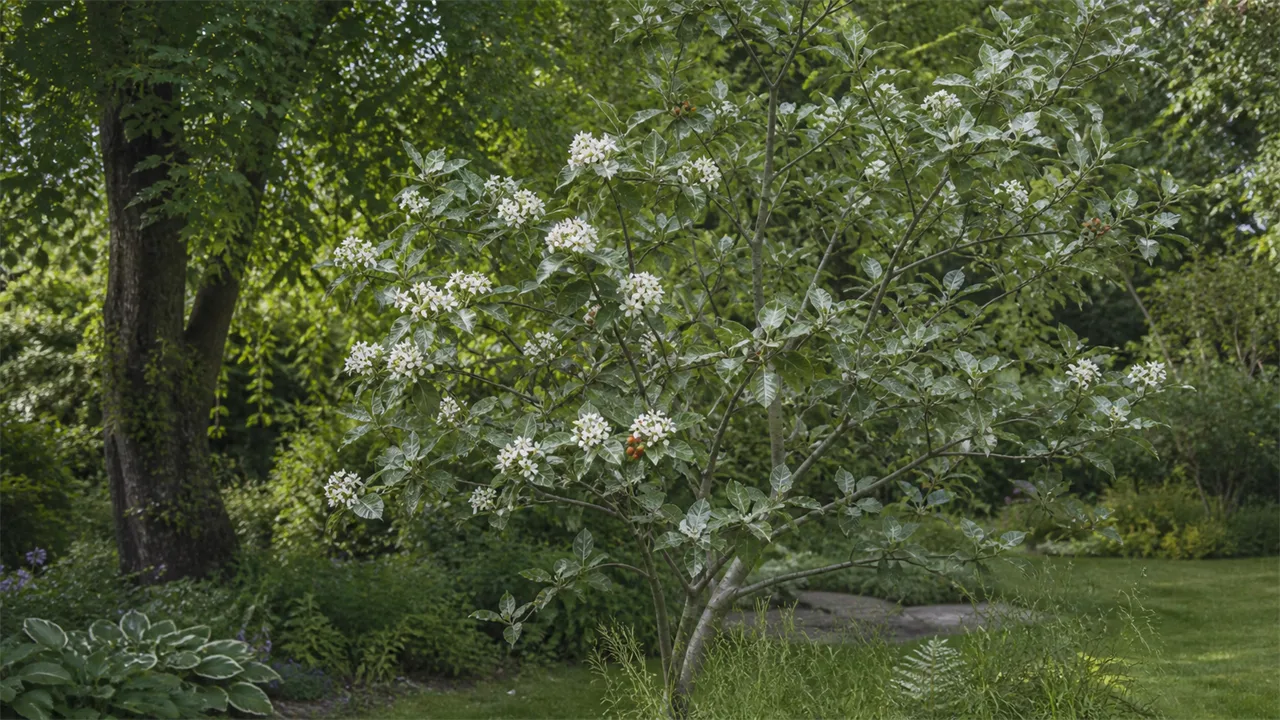
The common whitebeam is one of the most handsome native trees a British garden can grow. With its silver-backed leaves, clouds of creamy spring blossom, and generous clusters of scarlet autumn berries, Sorbus aria earns its keep in every season without ever becoming a chore. Tough, undemanding, and at home on thin chalk soils where many other trees sulk, it is a natural choice for a specimen lawn planting, a mixed native hedge, or a windbreak in an exposed coastal or hill-edge garden.
Overview
Whitebeam is a medium-sized deciduous tree belonging to the rose family (Rosaceae) and the large, predominantly northern-hemisphere genus Sorbus. In the wild it occurs across much of temperate Europe and is genuinely native to the southern half of Britain, where it is characteristic of chalk and limestone downland, woodland edges, and rocky cliff slopes. It was first described formally by Linnaeus in 1753 as Crataegus aria and has carried the name Sorbus aria since the late eighteenth century; the genus Sorbus is now understood to include the rowans, whitebeams and greengage-related species in a broad sense.
The species is valued in British gardens for its tolerance of thin, alkaline soils, its wind-firm crown, and the year-round ornamental interest of its silver-and-green foliage. It carries an RHS Award of Garden Merit (AGM) and is widely planted as a street and park tree, in native hedging mixtures, and as a specimen. Ecologically, its May flowers feed a wide range of pollinating insects and its late-season berries are an important winter food source for thrushes, fieldfares, redwings and waxwings.
Appearance
Whitebeam makes a broadly conical to rounded crown, typically reaching 15–25 m in height with a spread of 8–12 m, though garden specimens are usually smaller and can be kept compact by formative pruning in the first few years. The trunk is straight when the tree has room to develop, with smooth, pale grey bark that becomes finely fissured and a little darker with age.
The leaves are the tree's signature. They are ovate to elliptic, 6–14 cm long, with shallow, irregular lobing confined to the upper third of the leaf blade — a useful diagnostic against the pinnate leaves of the closely related rowans (Sorbus aucuparia and allies). The upper surface is a clean dark green and only sparsely hairy; the underside is densely clothed in white to silvery-grey felted hairs. In a breeze the foliage flashes silver and green, an effect strong enough to have earned the species its common name. Autumn colour is warm: leaves turn russet-bronze to orange-brown before falling, usually in late October or November.
Flowers appear in April and May in dense, slightly downy clusters (corymbs) 5–10 cm across. Each individual flower is five-petalled, creamy white, and around 1–2 cm across. They are followed by pomes — berry-like fruits — that ripen from green through yellow to bright orange-red, 8–12 mm across, often speckled with pale lenticels. Heavy crops ripen in September and October and frequently persist well into winter, sometimes lasting until February on untroubled trees.
Growing Conditions
Whitebeam is one of the few trees that genuinely thrives on the thin, alkaline, free-draining soils that run across much of southern England. In the wild it is a classic component of chalk and limestone grassland, and it grows equally well in free-draining loam and even in stony sandy soils provided summer drought does not run too deep. It dislikes heavy, slow-draining clay, where roots sit cold and wet through winter, and it will struggle in low-lying frost pockets where late spring frosts can scorch young growth.
It performs best in full sun, which gives the strongest growth, densest crown, and heaviest berry crops, but it tolerates light dappled shade from larger trees without complaint. Once established it is notably drought-tolerant — a useful trait given the drier summers increasingly common across the south and east of the UK — and it copes well with exposed sites, including coastal locations where salt-laden winds strip the leaves of fussier species. Cold tolerance is excellent: it is fully hardy across the UK (RHS hardiness rating H6, roughly equivalent to USDA zones 5–7) and is not damaged by ordinary British winters.
Soil pH can range from mildly acid (around 6.0) through to strongly alkaline (above 8.0) without ill effect, which is part of why whitebeam works so well as a substitute for more demanding ornamental cherries or birches on chalk.
Planting and Care
Plant bare-root whitebeam between November and March, while dormant, exactly as for any other field-grown tree. Container-grown stock can go in at any mild, moist time of year but autumn and early spring remain best because the roots establish quickly into warm soil without the strain of supporting full summer foliage.
Prepare a planting pit at least twice the width of the root ball and the same depth. Loosen the sides and base of the pit with a fork so that new roots can push out, but do not add compost or fertiliser to the backfill unless the soil is exceptionally poor — whitebeam evolved on thin substrates and grows poorly in over-rich conditions, often producing soft, sappy growth that is vulnerable to canker. Position the tree at the same depth it grew at in the nursery; the dark mark on the lower trunk is a reliable guide. Drive in a short stake at a 45° angle on the windward side and secure with a flexible tree tie. Water thoroughly to settle the soil around the roots and apply a 5–8 cm organic mulch (bark, well-rotted leaf mould or composted wood chip) over a 1 m circle, keeping it clear of the trunk itself.
For the first two growing seasons, water deeply once a week during dry spells; after that the tree is essentially self-sufficient. Feeding is rarely needed — a light top-dressing of general-purpose fertiliser in early spring is plenty if growth is obviously slow. Pruning is minimal: remove any dead, damaged or crossing branches in late autumn or winter, and shorten any strongly vertical shoots that threaten to spoil the crown shape. Avoid hard pruning in late winter when sap is rising, as cuts can bleed. Propagation is straightforward from seed: collect ripe berries in October, stratify them in damp sand for 16–18 weeks at around 4 °C, and sow in a cold frame the following spring. Cultivars do not come true from seed and must be grafted onto seedling Sorbus aria rootstocks or budded in late summer.
Seasonal care is light. Watch for aphids on the youngest leaves in late spring, and tidy up fallen berries on paved areas if the tree overhangs a path, as the squashed fruit can stain.
Common Problems
Whitebeam is generally a healthy, low-input tree. The diseases worth knowing about are the same ones that affect apples, pears and other Sorbus species, since the genus sits firmly inside the family Rosaceae.
Fireblight (Erwinia amylovora) is the most serious potential problem. Infected shoots blacken, wilt and curl into the characteristic "shepherd's crook" shape, and ooze a sticky bacterial slime in warm, humid weather. There is no chemical cure: cut affected wood back at least 30 cm into clean tissue below the visible dieback, sterilising secateurs between cuts with methylated spirit or a 10% bleach solution, and burn or bin (do not compost) the prunings. Notify the plant health authority if fireblight is confirmed on a commercial holding.
Apple canker (Neonectria ditissima) causes sunken, discoloured lesions on stems and twigs, often with rings of callus tissue around the wound. Prune affected wood out in dry weather, cutting back to healthy tissue well below the lesion.
Whitebeam sawfly (Trichiosoma species) lays eggs on the leaves in late spring and the gregarious grey-green larvae can defoliate branches within days. Check the undersides of leaves from mid-May onwards and pick off colonies by hand; a soft soap spray or a treatment based on Bacillus thuringiensis will control smaller outbreaks without harming pollinators.
Aphids, scale insects and powdery mildew may appear occasionally but rarely cause more than cosmetic damage on a vigorous, well-sited tree.
Popular Varieties
Several named cultivars of Sorbus aria are widely available from UK nurseries. They all share the silver-backed foliage of the species, differing mainly in vigour, leaf size, and crown shape.
Sorbus aria 'Lutescens' is the most widely planted form and the one most often recommended for garden use. Its young leaves emerge almost entirely silver, gradually greening on top as the season progresses, which gives a stronger, longer-lasting silver effect than the species. It makes a smaller, more regularly conical tree, typically 8–12 m tall, and is the form usually offered as the AGM-holding whitebeam in garden centres. It tolerates pruning well and is suitable for street and avenue planting.
Sorbus aria 'Majestica' has noticeably larger leaves — up to 20 cm long — with broader, more prominent lobes. The silver underside is bold and the overall impression is of a more substantial, broad-headed tree. It is a vigorous cultivar that can exceed 15 m in good soil and is best given room as a specimen lawn tree.
Sorbus aria 'Aurea' is a slower-growing, more compact selection whose young foliage carries a distinct golden tint before maturing to the usual green above and silver below. It is a useful tree for smaller gardens and for plantings where the brighter spring foliage will lift a darker corner, although it is less widely stocked than 'Lutescens' and may need ordering from a specialist nursery.
Other selections sometimes offered include 'Decaisneana' (large, broadly oval leaves), 'Globosa' (a dense, rounded crown suited to larger containers or formal settings), and seedling batches sold under the species name for native planting schemes and farm woodland. Where a particularly uniform hedge or avenue is needed, growers often plant cell-grown or pot-grown seedlings raised from a single superior parent, though these are usually sold simply as Sorbus aria rather than under a cultivar name.
Cultivars and Varieties
| Cultivar | Height | Flower | Notes | AGM |
|---|---|---|---|---|
| 'Lutescens' | — | — | RHS AGM (H6) | ✓ |
| 'Majestica' | — | — | RHS AGM (H6) | ✓ |
Pests and Diseases
| Problem | Symptoms | Management |
|---|---|---|
| Fireblight | Shoots and branches suddenly wilt, turn black, and curve into a shepherd's crook shape. | Prune out infected wood well below the visible symptoms during dry weather, disinfecting tools between cuts. |
| Apple canker | Sunken, discoloured lesions appear on branches and trunk, often oozing sap or cracking. | Cut out cankers with a sharp knife to healthy tissue and apply wound paint to prevent reinfection. |
| Aphids | Clusters of small soft-bodied insects on new growth, causing leaf curling and sticky honeydew. | Encourage natural predators like ladybirds or use a strong jet of water to dislodge them. |
| Scale insects | Small, immobile, bump-like pests attach to stems and leaves, weakening the tree over time. | Scrape off heavy infestations by hand or apply horticultural oil in winter when dormant. |
| Red spider mite | Fine webbing on leaves accompanied by stippling, yellowing, and premature leaf drop. | Water the base of the tree to increase humidity and introduce predatory mites if infestation is severe. |
| Honey fungus | White fungal growth under bark at the base of the trunk and general decline in vigour. | Improve drainage and avoid deep mulching near the stem; remove severely infected trees to protect neighbours. |
For step-by-step help, read Controlling Aphids Naturally. Or browse the full plant problem solver to diagnose an issue by symptom.
Recommended Products
GardenWizz earns a commission from qualifying purchases made through affiliate links on this page (including links within the article) — as an Amazon Associate, and from Thompson & Morgan via the Awin network. This does not affect the price you pay. See our disclaimer for details.
Related Plants
Browse all →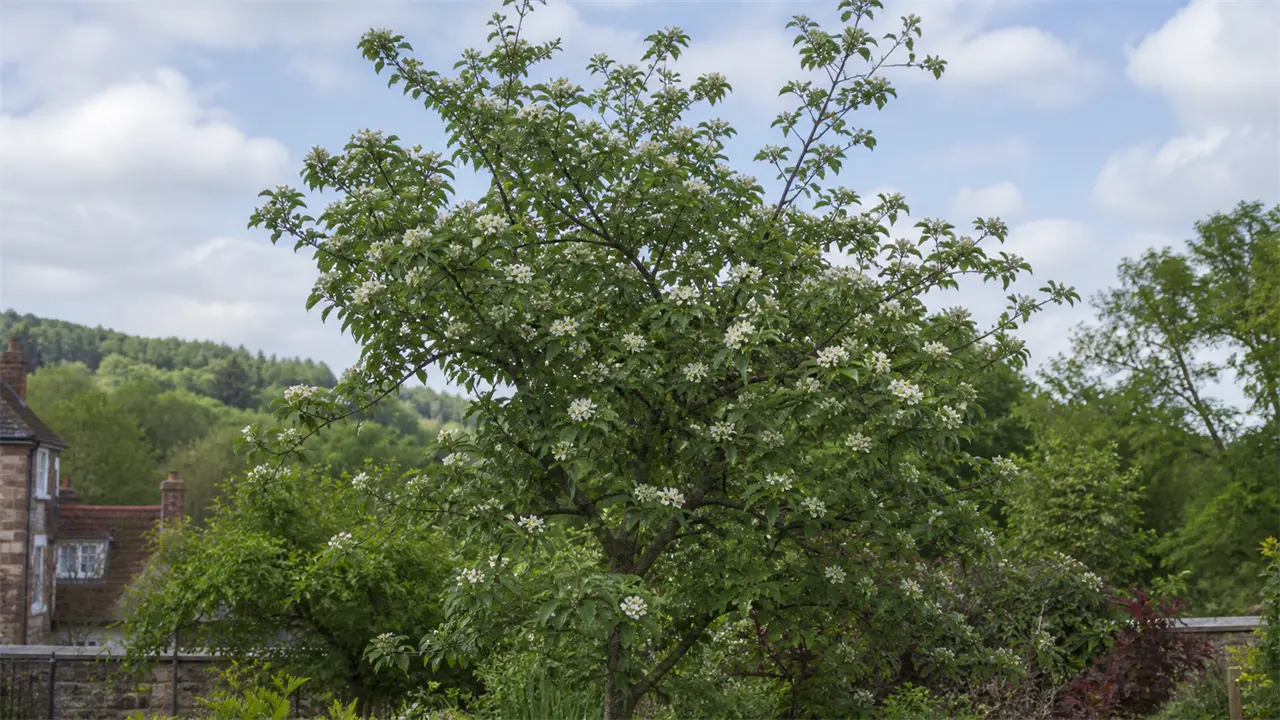
Wild Service Tree (Sorbus torminalis)
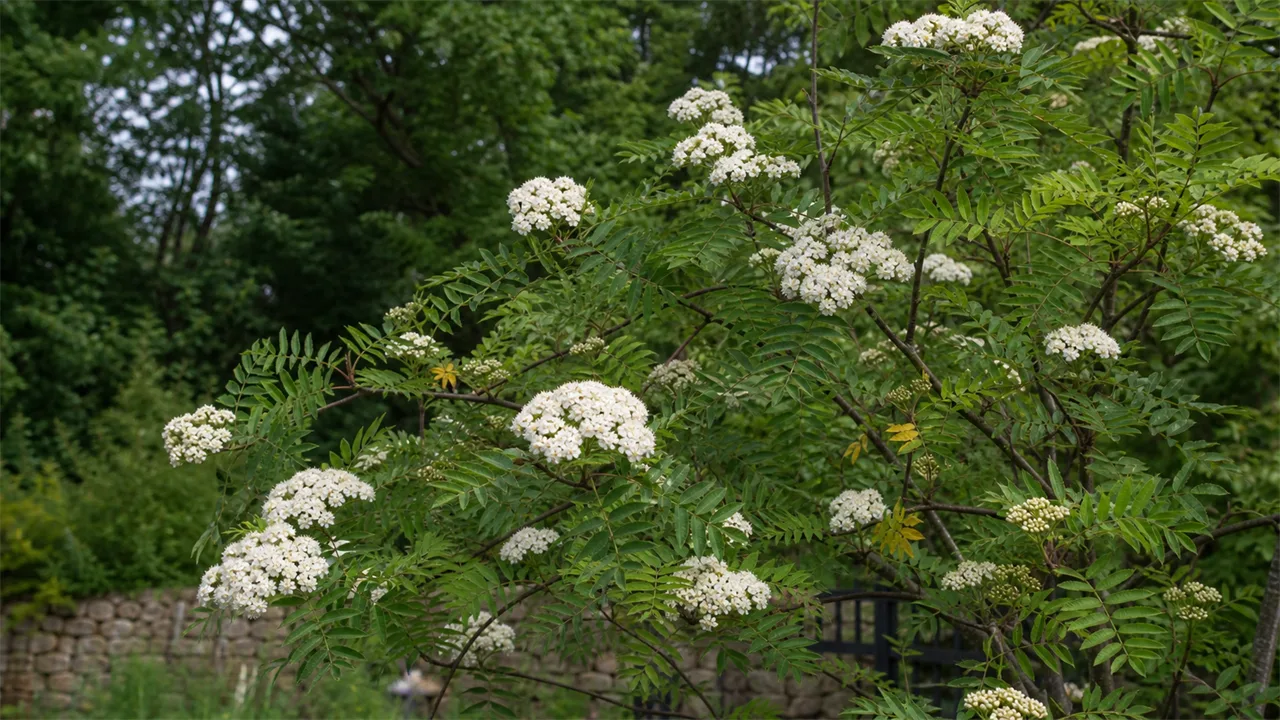
Rowan (Sorbus aucuparia)
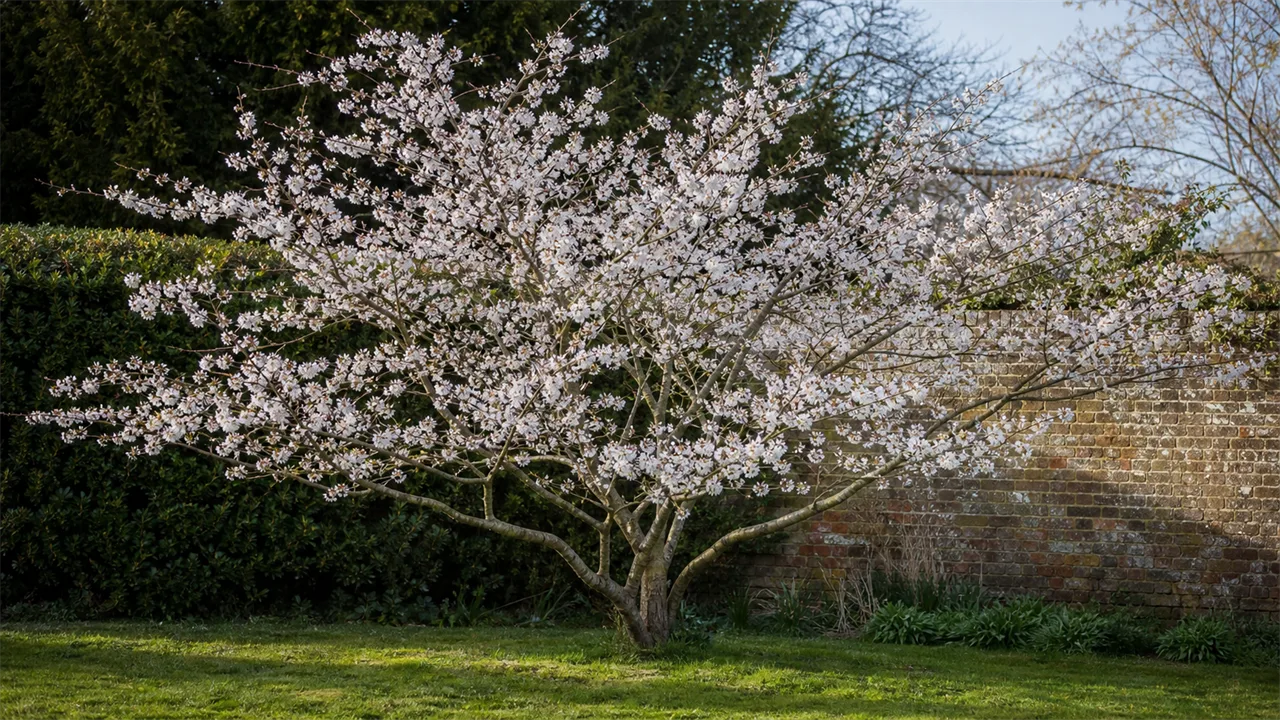
Fuji Cherry (Prunus incisa)