Rowans And Mountain Ashes
Sorbus
The Gardening Year
Best months in UK gardens · full planting calendar →
🖨 Printable care card (PDF)At a Glance
| Botanical name | Sorbus |
|---|---|
| Common name(s) | Rowans and Mountain Ashes |
| Family | Rosaceae |
| Plant type | tree (Deciduous) |
| Height × Spread | 20 m × 4–8 m |
| Position | Full sun, Partial shade |
| Soil | moisture-retentive, humus-rich, well-drained soil; fertile, well-drained soil enriched with organic matter; Chalk Clay Loam Sand; Acid or Alkaline or Neutral pH |
| Flowering | May–June |
| Toxicity | Fruit are ornamental not to be eaten. Potentially harmful. |
| Native range | cool-temperate Northern Hemisphere; Europe, Africa, Asia |
Sorbus, the rowan and whitebeam genus, is one of the most useful groups of small ornamental trees for UK gardens. The genus gives gardeners a long season of interest — creamy spring blossom, finely cut or silver-backed summer foliage, vivid autumn berries and, in many species, strong leaf colour before the leaves fall. Several species are native to Britain, the trees fit comfortably into gardens of modest size, and the flowers and fruit sustain bees, hoverflies and winter birds in equal measure.
Overview
Sorbus is a genus of deciduous trees and large shrubs in the family Rosaceae, the rose family. It is widely distributed across the temperate Northern Hemisphere and is well represented in Britain and Ireland, where the native rowan (Sorbus aucuparia), whitebeam (Sorbus aria), wild service tree (Sorbus torminalis) and a cluster of apomictic whitebeam endemics form a natural part of the native woodland flora. The genus is grown ornamentally for its spring flowers, foliage and prolific autumn and early-winter berries; some species are also valued for timber and, in traditional use, for fruit that is processed rather than eaten raw.
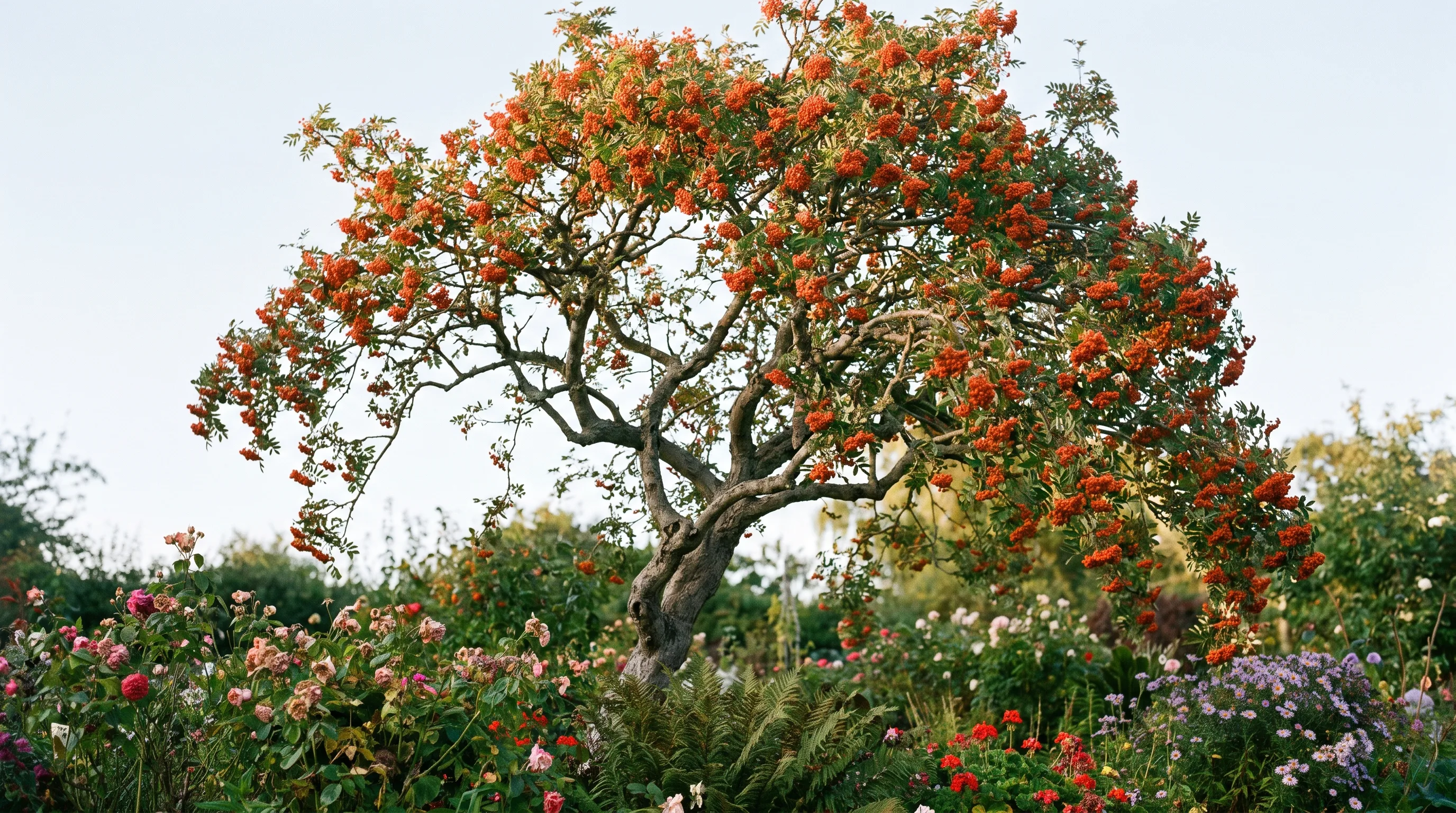
The garden value of Sorbus lies in the combination of a manageable size, multi-season interest and wildlife value. Most species reach 6–10 m in a typical UK garden, and several stay considerably smaller, which makes them useful where a flowering cherry or birch would be too large. White blossoms in late spring sit above fresh green or silver foliage; pinnate rowan leaves or rounded whitebeam leaves develop yellow, orange or russet autumn tints; and clusters of red, orange, pink, yellow or white berries ripen from late summer and persist, in many cases, well into winter.
Appearance
The genus divides visually into two leaf-form groups. The rowans have pinnate (compound) leaves made up of paired leaflets along a central stalk, often with a terminal leaflet, giving the foliage a feathery, ash-like outline. The whitebeams have simple, rounded to oval leaves that are usually green above and pale, felted or distinctly silver-grey beneath; the two-toned leaf is one of the strongest ornamental features of the whitebeam group and the source of the common name.
Flowers are small, creamy white and borne in showy flat or domed clusters (corymbs) in late April, May or early June, depending on species and season. The individual flowers have five petals and are typical of the rose family, attracting bees and a wide range of pollinating flies. They are followed by small pomes — berry-like fruits technically close to those of apples and hawthorns — that ripen through summer and reach full colour from late August into October. Colour ranges from the brilliant scarlet of S. aucuparia through the orange, pink, yellow and white berries of selected rowan cultivars and several whitebeam species.
Bark is generally smooth and grey when young, becoming shallowly fissured on older specimens of the larger tree-form species. Form is usually upright to broadly conical when young, opening into a rounded crown with age. Several species develop strong autumn leaf colour — burnt orange in S. aucuparia, russet in S. commixta, buttery yellow in some whitebeams — adding a second season of display before the berries are fully exposed.
Growing Conditions
Sorbus prefers a position in full sun or light, dappled shade. Strong sun ripens wood and improves berry set, while a sheltered site with good air movement reduces the risk of fireblight, which can be a problem in humid, still corners. Most garden forms are happy in any reasonably fertile, moisture-retentive but well-drained soil; the genus dislikes prolonged waterlogging and very thin, dry, impoverished ground.
Soil pH tolerance is broad. S. aucuparia is naturally a plant of more acidic soils and prefers acid to neutral ground, with yellowing leaves on chalk. Whitebeams, by contrast, are notably chalk- and limestone-tolerant and are among the best small flowering trees for gardens on alkaline soil. S. torminalis and many of the apomictic native whitebeam endemics sit between the two and tolerate a wide pH range. Improving poor ground with organic matter before planting is worthwhile; mulching after planting helps even out moisture.
Allow space for the mature crown. Even modest species reach 5–7 m across at maturity, and the larger species can spread to 8 m or more. Avoid exposed coastal sites for the more delicate rowan foliage, and avoid deeply shaded north-facing walls for the whitebeam group, which flowers and fruits poorly in heavy shade. Sorbus establishes well from container-grown stock and is generally undemanding once settled.
Planting and Care
Plant container-grown trees during the dormant season, from October through to early spring, whenever the ground is workable and not frozen or waterlogged. Bare-root plants establish best if moved in late autumn, before the soil cools. Stake taller standards on exposed sites for the first two to three growing seasons, position the stake low on the rootball to allow the trunk to flex, and remove the stake once the root system has anchored. Water thoroughly at planting and apply a generous mulch of compost or bark over the root area, keeping the mulch clear of the trunk itself.
Watering matters most in the first two growing seasons. Soak deeply during dry spells rather than sprinkling lightly, and continue to water container-grown and recently planted stock through any extended summer drought. Once established, Sorbus is largely self-sufficient on reasonable garden soil. Feed lightly in spring with a balanced general-purpose fertiliser if growth is poor; on fertile ground, an annual mulch is usually sufficient.
Pruning is minimal. Sorbus forms a good shape on its own and resents heavy routine cutting, which can encourage vigorous watershoots and let in canker. The only pruning normally needed is to remove dead, damaged or crossing branches in late winter, and to take out any reverted shoots on grafted cultivars. Avoid heavy pruning during the main growing season, when the wound sites can attract silver leaf and bacterial infections. Inspect established trees once a year for signs of disease and remove affected material cleanly, disinfecting tools between cuts.
Propagation is by seed for the species, although many of the British endemic whitebeams are apomictic and come largely true. Named cultivars are grafted onto seedling rootstocks of S. aucuparia (for rowan cultivars) or S. aria / S. intermedia (for whitebeam-style cultivars), typically in late winter or early spring by a specialist nursery. Semi-ripe cuttings can be rooted in summer under mist with bottom heat, but grafting remains the reliable commercial method for cultivars.
Common Problems
Sorbus can be affected by fireblight (Erwinia amylovora), a bacterial disease that causes shoot tips to wilt and blacken as if scorched, particularly in warm, humid summers. Infected shoots should be cut back well into clean wood and the prunings destroyed; tools should be disinfected between cuts. Scab, canker and silver leaf are all reported on Sorbus, and good garden hygiene — pruning in dry weather, removing fallen affected material and avoiding unnecessary wounding — keeps the risk low.
Aphids colonise the soft shoot tips of rowans in late spring and early summer; they are usually controlled by natural predators and rarely need treatment. Sawfly larvae can defoliate individual trees in some years, particularly in rural and woodland-edge settings; small infestations can be picked off by hand, and birds take a heavy toll. Stress from drought, poor soil or root disturbance makes all of these problems worse, so attention to siting and aftercare is the most effective prevention.
On the safety side, fallen berries can be slippery on paths and paving, and the berries themselves can be mildly gastrointestinal irritants if eaten raw and in quantity. Gardeners with inquisitive children or pets should clear dropped fruit from play areas. Although some Sorbus fruits are traditionally used after processing (for example, in country wines and jellies), an unidentified tree should not be treated as edible; use only correctly named stock and follow established recipes.
Popular Varieties
Several Sorbus taxa are widely available in UK nurseries and offer a useful range of mature sizes, leaf forms and berry colours:
- Sorbus aucuparia — the common rowan, native to Britain and the most familiar species. A small to medium tree reaching 8–10 m, with pinnate leaves, broad heads of white flowers in late spring and heavy crops of bright scarlet berries from August into autumn, often after good yellow-orange leaf colour. Tough, hardy and reliable in most of the UK.
- Sorbus aria — the common whitebeam, a native tree of chalk and limestone areas. Reaches 8–12 m with a broadly conical crown, simple oval leaves that are grey-felted beneath, and clusters of orange-red berries in autumn. Excellent on alkaline soils where rowans struggle.
- Sorbus torminalis — the wild service tree, native to southern England and parts of Wales. Slower-growing, reaching 10–15 m, with maple-like lobed leaves that colour richly in autumn and brown speckled berries. A handsome specimen tree for larger gardens.
- Sorbus commixta — a Japanese rowan frequently offered by UK nurseries, valued for its finely divided pinnate foliage and reliable autumn colour in shades of orange, red and purple, followed by bright red berries. Generally reaches 6–8 m and is a popular alternative to S. aucuparia in smaller gardens.
- Sorbus 'Joseph Rock' — a well-known upright rowan selection, reaching around 8 m, with pinnate foliage that develops strong autumn tints and abundant clusters of creamy yellow berries that persist well into winter. Long established in UK cultivation and widely available from specialist nurseries.
- Sorbus 'Chinese Lace' — a more compact rowan cultivar with finely cut, almost fern-like pinnate leaves, good red autumn colour and orange-red berries. Typically reaches 4–5 m, making it suitable for smaller gardens and courtyards.
Pests and Diseases
| Problem | Symptoms | Management |
|---|---|---|
| Scab (Venturia/Fusicladium) | Dark olive-green or black lesions on leaves causing premature yellowing and defoliation. | Rake up fallen leaves in autumn to reduce overwintering spores and improve air circulation. |
| Fireblight (Erwinia amylovora) | Blossoms wilt, shoots shrivel into a shepherd's crook, and bark shows reddish-brown staining. | Prune out infected wood well below visible symptoms during dry weather and disinfect tools. |
| Aphids | Clusters of small soft-bodied insects on new growth causing leaf curling and sticky honeydew. | Encourage natural predators like ladybirds or use a strong jet of water to dislodge them. |
| Powdery mildew | White powdery fungal growth on leaves and shoots, potentially stunting new growth. | Avoid overhead watering and prune for good air circulation; apply sulphur-based fungicide if severe. |
| Slugs and snails | Irregular holes chewed in young leaves and seedlings, often accompanied by slimy trails. | Use physical barriers like copper tape or lay down iron phosphate pellets to protect young plants. |
For step-by-step help, read Controlling Aphids Naturally, Dealing with Slugs and Snails and Treating Powdery Mildew. Or browse the full plant problem solver to diagnose an issue by symptom.
Recommended Products
GardenWizz earns a commission from qualifying purchases made through affiliate links on this page (including links within the article) — as an Amazon Associate, and from Thompson & Morgan via the Awin network. This does not affect the price you pay. See our disclaimer for details.