Japanese Rowan
Sorbus commixta
The Gardening Year
Best months in UK gardens · full planting calendar →
🖨 Printable care card (PDF)At a Glance
| Botanical name | Sorbus commixta |
|---|---|
| Common name(s) | Japanese rowan |
| Family | Rosaceae |
| Plant type | tree |
| Height × Spread | 7–18 m × 4–8 m |
| Position | Full sun, Partial shade |
| Soil | moist but well-drained acid or neutral soil |
| Flowering | May–June |
| Toxicity | Fruit are ornamental not to be eaten |
| Native range | central and eastern China, Korea, Japan, and Sakhalin |
Quick answer: Sorbus commixta is a compact, broadly conical deciduous tree from Japan, Korea and Sakhalin, widely grown in the UK for its glossy pinnate foliage, creamy-white spring flowers and outstanding fiery autumn colour, followed by dense clusters of orange-red berries. It is one of the most reliable rowans for small gardens, succeeds on most reasonable soils, and has produced several named cultivars of which 'Embley' holds an RHS Award of Garden Merit.
Overview
Sorbus commixta is one of the best Asian rowans for UK gardens, valued for its compact, broadly conical habit, finely cut ash-like foliage and one of the most reliable autumn displays of any ornamental tree. The species was introduced to British cultivation from Japan in the late nineteenth century and has since become a staple of small-garden and urban-tree planting, where it fulfils the same role as the native Sorbus aucuparia but on a more manageable scale and with stronger autumn colour.
The species sits within the Asian group of rowans, which has recently been reclassified by some authorities into the segregate genus Micromeles. Horticulturally the tree is still traded as Sorbus commixta across the UK nursery trade and on the RHS Plant Finder, and the name is retained here for clarity. Plants sold under the old name remain identical in the garden.
In the UK the tree behaves as a hardy deciduous ornamental. It leafs out in April, flowers in late May or early June, carries its berries through summer and into autumn, and turns a reliable mix of yellow, orange, red and purple before leaf fall. Mature specimens reach 7-10 m in height, with a spread of 4-7 m, making the species well suited to gardens of almost any size.
Appearance
The tree develops a compact, broadly conical crown with a clear central leader and ascending main branches. Mature bark is smooth and pale grey-brown, with prominent lenticels on younger growth. The winter buds of the species and several of its cultivars are sticky and dark, a useful identification feature in the dormant season.
The leaves are pinnate and ash-like, typically 15-25 cm long, with 11-17 narrow, lance-shaped leaflets arranged in opposite pairs along a central rachis. Each leaflet is glossy dark green above and slightly paler beneath, with a finely serrated margin. The overall impression is of a more delicate, finely cut leaf than the native rowan, and this texture is one of the species' main ornamental assets through the growing season.
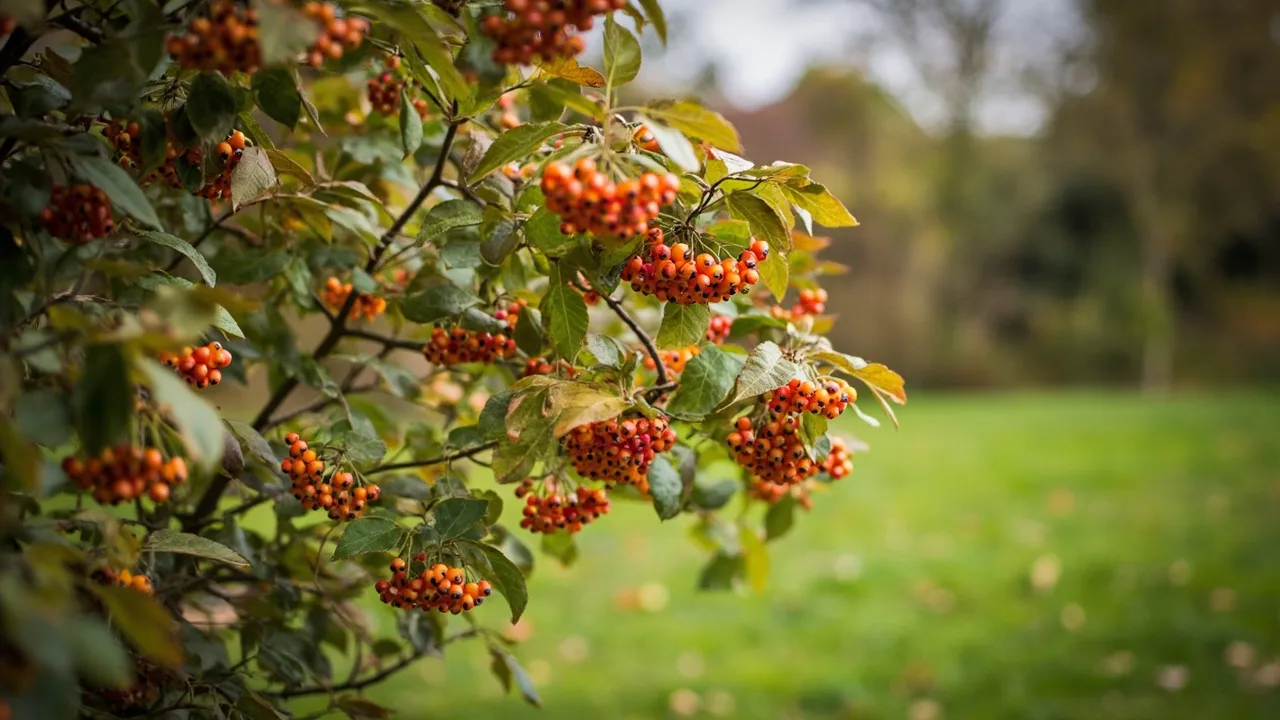
Flowers appear in late May or early June in broad, flattened corymbs 8-15 cm across, crowded with small creamy-white five-petalled blooms. The flowers are followed by rounded berries (technically pomes) about 8-10 mm in diameter, which ripen from green through yellow to a bright orange-red by September. The berries are borne in heavy, drooping clusters and persist on the tree well into autumn, often after the leaves have dropped.
Autumn colour is the principal reason the species is widely planted. The leaflets turn a graduated palette of yellow, orange, scarlet and finally a deep red or purple, often with all colours present on the same leaf. The display peaks slightly later than that of the native rowan, typically in mid to late October across most of lowland Britain.
Growing Conditions
Sorbus commixta grows well in any moderately fertile, humus-rich soil that stays moist but does not waterlog. It is tolerant of clay, loam and lighter sandy soils provided drainage is reasonable, and it accepts a wide pH range from mildly acid to mildly alkaline. Like most rowans it is shallow-rooted and benefits from a generous surface mulch of leaf mould or well-rotted garden compost in the first three to five years after planting.
Choose a position in full sun or light partial shade. The autumn colour is consistently more vivid in full sun, and the crown stays denser and more symmetrical than in heavier shade. Shelter from strong, cold east winds reduces scorch of the young spring foliage in exposed sites, but the tree is otherwise tolerant of exposed garden positions.
The species is hardy across the UK and grows successfully from the south of England to the cooler gardens of northern England and central Scotland. Coastal positions are tolerated provided the soil is not saline, and the tree performs reliably in urban gardens where air quality is poor, as it is more tolerant of pollution than many other small ornamental trees. Container cultivation is possible in a large pot of loam-based compost, but the tree will always do better in open ground and should be regarded as a permanent open-ground subject.
Planting and Care
Plant bare-root specimens between November and March while dormant, or container-grown stock at any time of year so long as the ground is workable and the tree can be watered in. Prepare a planting hole at least twice the width of the root ball and no deeper, loosen the base, and set the tree at the same depth it was growing in the nursery. Backfill with the excavated soil improved with a bucket of leaf mould or well-rotted garden compost, firm gently, water in thoroughly, and stake on the windward side using a low, short stake that supports the lower trunk without rigidly tying the upper crown.
Watering is most important in the first two growing seasons. Soak thoroughly once a week during dry spells rather than sprinkling lightly, and continue until the tree has put on at least 30 cm of new growth in a single season. Once established, S. commixta is moderately drought-tolerant and rarely needs supplementary watering except on very free-draining soils after prolonged dry weather.
Feeding is generally unnecessary on reasonable garden soil. A single annual mulch of leaf mould or garden compost in March is usually sufficient, and high-nitrogen feeds should be avoided as they encourage soft late growth that is vulnerable to fireblight. On thin, sandy soils a slow-release organic fertiliser in early spring can be applied for the first three years only.
Pruning is minimal. The tree naturally forms a well-shaped crown and needs only the removal of crossing, damaged or dead wood in late summer or early autumn, avoiding heavy cuts in late winter or early spring when the wound tissue is most vulnerable to entry by fireblight bacteria. If a specimen outgrows its position, shorten selected laterals in late summer rather than topping the leader.
Propagation is straightforward from seed, which requires a period of cold stratification. Collect ripe berries in October, clean off the flesh, and sow outdoors in a seedbed where they will germinate the following spring. Cultivars do not come true from seed and must be propagated by chip-budding or grafting onto Sorbus aucuparia rootstocks, which is work for a specialist nursery.
Seasonal care follows the rhythm of a hardy deciduous tree. In March and April, top-dress with compost and watch for aphid colonies. In May and June, check for fireblight strikes after warm, humid weather. In July and August, water young trees during drought and remove sucker growth from the rootstock. From September onwards, watch the berries colour. From November to February the tree is dormant and requires no intervention.
Common Problems
Fireblight is the most serious disease of Sorbus commixta, as it is for all rowans and other members of the Rosaceae family. The bacterium Erwinia amylovora causes young shoots to wilt, blacken and crook at the tip in a characteristic "shepherd's crook" shape, often with a milky bacterial ooze on warm humid days. The RHS advises prompt pruning back to at least 30 cm below visible symptoms in dry weather, sterilising secateurs between cuts, and removing badly affected specimens to prevent spread to neighbouring apples, pears, hawthorns and cotoneasters. The UK Plant Health Authority has detailed guidance on the disease and current regulations.
Aphid colonies frequently build up on the young foliage in late spring, particularly the rosy apple aphid and related species. Heavy infestations cause leaf curl, honeydew and sooty mould on lower branches. Natural predators usually gain control within two to three weeks; if the damage is unacceptable, a winter wash of plant oil and a spring application of soft soap are usually sufficient.
Silverleaf (Chondrostereum purpureum) can infect rowans through pruning wounds, particularly cuts made in autumn or winter. The disease causes a silver sheen on the foliage and a dark stain in the heartwood. To reduce risk, prune only in late summer when the tree is least vulnerable, paint larger wounds with a wound-sealant product, and remove and burn any affected wood.
Crown gall and bacterial canker are occasionally reported on stressed specimens, especially on poorly drained or compacted sites. Improving soil drainage, avoiding mechanical damage to the trunk, and selecting clean nursery stock are the most effective long-term controls. There is no reliable chemical cure once a tree is systemically infected.
Birds, especially thrushes and waxwings, take the berries heavily in late autumn and can strip a tree in a few days. This is rarely a problem for the tree itself, and the bird interest is one of the species' attractions in a wildlife garden. Squirrel damage to young bark is occasional and can be deterred with tree guards for the first five years after planting.
Popular Varieties
Sorbus commixta 'Embley' is the most widely planted cultivar in the UK and holds the RHS Award of Garden Merit. It is more upright in habit than the species, with a slender, conical crown reaching 7-8 m at maturity, and it sets heavier crops of bright red berries. The autumn colour is reliably brilliant scarlet, and 'Embley' is the form most UK nurseries stock as a default.
Sorbus commixta 'Ravensbill' is distinguished by its curiously curved, blue-black winter buds, which give the dormant tree a striking silhouette. In leaf it closely resembles the species, with the same pinnate foliage and orange-red berries, and it reaches a similar mature size of 7-8 m. The cultivar is widely available from specialist tree nurseries.
Sorbus commixta var. sachalinensis is the Sakhalin form of the species, occasionally offered by specialist nurseries. It tends to be slightly more vigorous than the type, with larger leaflets and a more open crown, and is useful where a taller specimen (8-10 m) is required. The autumn colour is as fiery as the species.
Sorbus commixta subsp. randaiensis is a Taiwanese subspecies, rare in cultivation but valued by collectors for its particularly fine autumn colour and slightly smaller mature size (5-6 m). It is only available from a handful of specialist UK nurseries and is best ordered well in advance.
The closely related Sorbus ulleungensis 'Olympic Flame' (formerly sold as S. commixta 'Olympic Flame') is worth mentioning here as it is regularly confused with S. commixta in trade. It is a compact, broadly conical tree with long, tapered, glossy dark green leaves, reliably brilliant orange-red autumn colour and a more uniform crown than the species, and it makes an excellent alternative where space is at a premium.
Sources & Further Reading
- Source: rhs.org.uk/plants/17548/sorbus-commixta/details, accessed 2026-07-22
- Source: rhs.org.uk/plants/67651/sorbus-commixta-embley/details, accessed 2026-07-22
- Source: rhs.org.uk/plants/273106/sorbus-commixta-ravensbill/details, accessed 2026-07-22
- Source: rhs.org.uk/disease/fireblight, accessed 2026-07-22
- Source: fowa.org.uk/blog/tree-of-the-month-sorbus-commixta, accessed 2026-07-22
- Source: gardensillustrated.com/plants/trees/sorbus-rowan-whitebeam-trees, accessed 2026-07-22
Pests and Diseases
| Problem | Symptoms | Management |
|---|---|---|
| Fireblight | Shoots and branches suddenly wilt, turn black, and curl into a shepherd's crook shape. | Prune out infected wood well below the visible symptoms during dry weather, disinfecting tools between cuts. |
| Apple canker | Sunken, discoloured lesions appear on stems and branches, often oozing sap or cracking. | Cut out cankers with a sharp knife to healthy tissue and apply wound paint to prevent reinfection. |
| Aphids | Clusters of small soft-bodied insects on new growth, causing leaf distortion and sticky honeydew. | Encourage natural predators like ladybirds or use a strong jet of water to dislodge them. |
| Pear blister mite | Leaves develop raised, blister-like patches that may turn reddish or brown as the season progresses. | Apply an oil-based spray in late winter before bud burst to smother overwintering eggs. |
| Honey fungus | General decline, yellowing leaves, and white fungal growth or black cords at the base of the trunk. | Improve drainage and avoid wounding roots; severe cases may require removal to prevent spread. |
For step-by-step help, read Controlling Aphids Naturally. Or browse the full plant problem solver to diagnose an issue by symptom.
Recommended Products
GardenWizz earns a commission from qualifying purchases made through affiliate links on this page (including links within the article) — as an Amazon Associate, and from Thompson & Morgan via the Awin network. This does not affect the price you pay. See our disclaimer for details.