Ash-Coloured Speedwell
Veronica cinerea
The Gardening Year
Best months in UK gardens · full planting calendar →
🖨 Printable care card (PDF)At a Glance
| Botanical name | Veronica cinerea |
|---|---|
| Common name(s) | Ash-coloured speedwell |
| Family | Plantaginaceae |
| Plant type | perennial (evergreen, mat-forming perennial useful as a ground cover) |
| Height × Spread | 50 cm × — |
| Position | Full sun |
| Soil | well-drained |
| Flowering | June |
| Toxicity | — |
| Native range | Turkey and Lebanon/Syria |
Veronica cinerea is an evergreen, mat-forming speedwell from the mountains of Turkey and the eastern Mediterranean, recognised by the Royal Horticultural Society with an Award of Garden Merit for its carpet of ash-grey foliage and a long flush of small, dark-eyed, purple-blue flowers in early summer. Where a sunny, sharply drained pocket of soil can be offered, it earns its place as a refined ground-cover plant for the rock garden, scree bed, alpine trough or the gaps between paving stones, where it asks for very little but rewards a tidy eye with a quiet display every June.
Overview
Veronica cinerea Boiss. & Bal. sits within the Plantaginaceae, the family into which the old Scrophulariaceae speedwells were regrouped under the modern APG classification. The name cinerea refers to the ash-grey cast of the small, tightly packed leaves, the feature that gives the plant both its botanical epithet and its English common name, ash-coloured speedwell. Although it remained a connoisseur's plant for much of the late twentieth century, it is now listed in the RHS Plant Finder and is offered by a small number of UK alpine and specialist nurseries.
The species is native to the sub-alpine zone of Turkey, particularly the mountain massifs of Cappadocia and adjacent ranges, with outlying populations in Lebanon and Syria. In those habitats it grows in thin, gritty soils over limestone and igneous rock, fully exposed to sun, drying out between summer storms and lying under a protective blanket of snow in winter. Replicating those broad conditions in cultivation is the central practical task; treat it as a true alpine plant, not as a border perennial, and it gives very little trouble.
Appearance
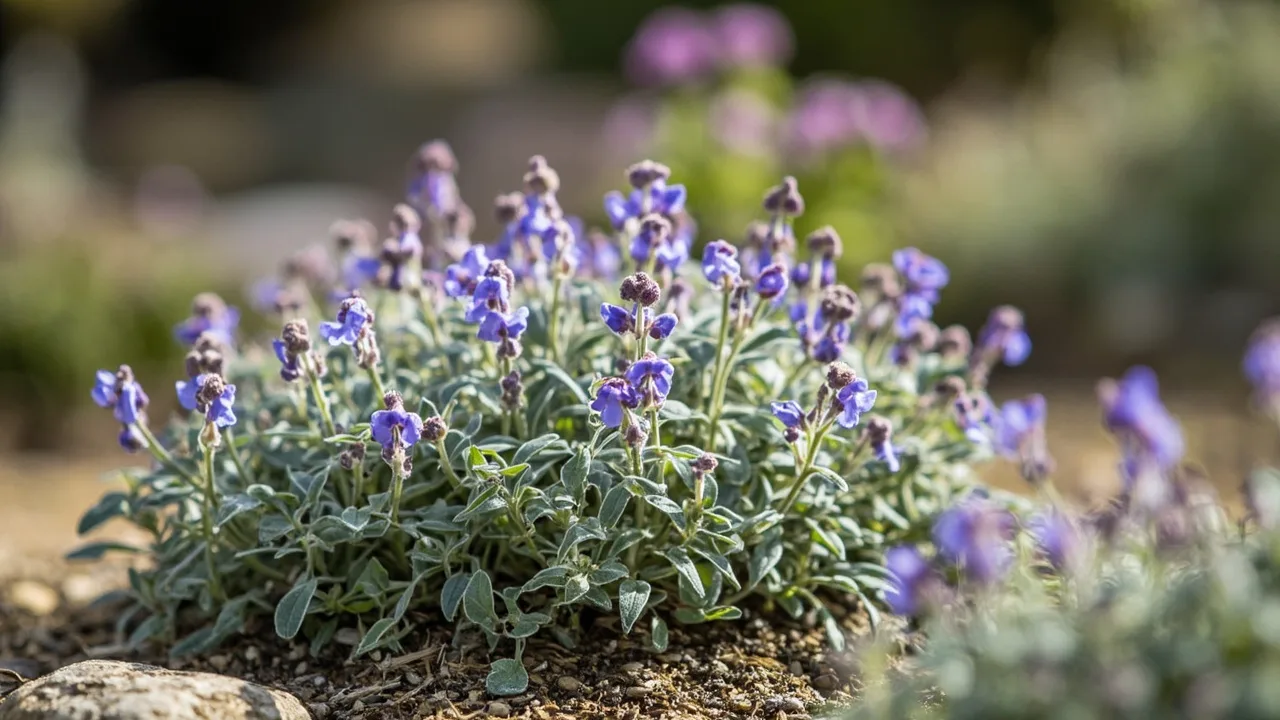
A mature Veronica cinerea makes a dense, low mat no more than a small coin-stack tall, typically 5–10 cm high, that creeps steadily outwards by short, semi-woody stems rooting where they touch the ground. Over several years a single plant will form a hummock 25–40 cm across, occasionally wider where the soil suits it. The leaves are the defining feature: tiny, narrowly oblong or elliptic, about 5–12 mm long, held close to the stem in opposite pairs and densely set so the shoots look almost braided. Their colour is a soft, pale grey-green washed with a dusty ash tone that gives the whole cushion a quiet, silvery cast in winter as well as summer. A very fine covering of short hairs adds to that ashen appearance.
The flowers appear in early summer, usually from the first or second week of June in southern England and roughly a week or ten days later in the north. They are carried in short, few-flowered terminal racemes that barely rise above the foliage, the typical four-lobed speedwell shape with two narrower upper lobes and two broader lower lobes, almost always a clear purple-blue shading to a slightly paler throat, with darker violet lines running into a tiny pale eye at the centre. Individual blooms are modest, around 8–10 mm across, but they are produced in such numbers across the entire cushion that the plant becomes a low pool of blue at peak. With deadheading and a late-summer tidy, a secondary, lighter flush often follows into early August.
Growing Conditions
Full sun is non-negotiable for Veronica cinerea. A south- or south-east-facing aspect, ideally open to the sky all day, keeps the cushion compact, free-flowering and properly silvered. Half-day sun grows a looser, greener mat that sprawls and flowers poorly; full shade spells slow disappearance. In coastal and southern gardens any open, well-lit position works; inland and northern growers should favour the warmest, most sheltered alpine pocket they have, such as the top of a stone retaining wall or a south-facing raised bed.
The second essential is drainage. V. cinerea tolerates a wide pH range but insists on sharp drainage; a lean, gritty mix suits it far better than a rich border loam. In a rock garden or scree, plant into a mix of loam, leaf-mould or garden compost and sharp grit in roughly equal parts, with extra grit beneath the rootball to keep water moving away. On heavy clay a raised bed, an open-topped alpine trough or the lee side of a deep stone crevice is essential; a damp root-run in winter is the most common cause of loss. Salt is not an issue inland, but a very acid peaty bed is unsuitable; aim for neutral to slightly alkaline.
Feeding is best left alone. The plant evolved on poor, stony ground and resents fertility: rich soil produces lush, leafy, soft growth that flowers poorly and dies back in winter. A scattering of coarse grit or a top-dressing of very well-rotted garden compost in early spring is the most that is needed; do not use slow-release fertilisers or rich mulches against the cushion.
Planting and Care
Plant in spring, usually from mid-March to early May, or in early autumn by mid-September so that the cushion is well rooted before the first hard frost. Water the pot thoroughly, tease out the roots only if they are tightly coiled, set the crown just proud of the surrounding soil, and backfill with the gritty mix above. Firm gently, water once to settle, and then leave the plant alone except in prolonged dry spells during its first growing season. Space neighbours at least 25–30 cm apart so the mat can spread without being smothered by more vigorous alpines.
Watering is straightforward. Established plants resent wet feet and thrive on benign neglect; they need supplementary water only in a long, dry summer and even then a single soak every fortnight is plenty. Container-grown plants in troughs and pans are an exception and need careful watering: soak the pot, then let it dry to the touch before watering again, and never allow the pot to stand in a saucer of water through autumn and winter.
Pruning is more a matter of tidying than shaping. After the main flush has finished in July, trim the spent flower stems back to the cushion with sharp, clean scissors and gently tease out any dead patches from the centre. Avoid cutting into the woody lower stems, which often fail to re-shoot; instead, work the outer growth back into the gap and mound a little fresh gritty compost around the bare area to encourage rooting. A second tidy in late August can prompt a lighter second flush and keeps the mat fresh.
Propagation is by soft cuttings, division or, very carefully, by seed. Soft cuttings of 2–3 cm taken in late spring or early summer from non-flowering shoots root readily in a 50:50 mix of sharp grit and peat-free compost under a covered pot; bottom heat of about 18–20 °C speeds things up. Mature clumps can also be divided in spring or immediately after flowering, teasing the cushion apart into small, rooted portions and potting each on individually. Seed is occasionally offered and germinates after a cold period of about six weeks; surface-sow on a gritty, moist seed compost in late winter and keep cool and well-lit.
Common Problems
Crown rot in winter is by far the most common loss and almost always points back to drainage or to a thick mulch settled over the cushion. If a plant browns off in the centre after a wet winter, lift it, shake the wet soil from the roots, take a few healthy cuttings from the outer edge and reset them in a fresh, gritty mix in a drier part of the bed; the original is rarely worth saving.
Aphids can colonise the soft flower stems in late spring, distorting the developing buds. Black bean aphid and the green peach aphid are the usual culprits; a strong spray of water, encouragement of ladybirds and hoverflies, or a single soap-based treatment once the flowering is finished is normally enough. Inspect before treating rather than spraying routinely, particularly during the flowering period when pollinators are on the plant.
Vine weevil grubs are an occasional problem in containers, especially in peat-based composts; adult beetles nibble characteristic notches in the leaves, and the c-shaped grubs chew the roots. Switching to a mineral, loam-based compost, hand-picking grubs when repotting, and applying a biological nematode treatment in late summer are the standard responses. Spreading mats are particularly vulnerable, so keep a watchful eye on pot-grown plants.
Powdery mildew can affect Veronica cinerea in dry, shady positions, coating the foliage in a dusty white film. Improve airflow, water at the base of the plant rather than over the cushion, and remove affected shoots; the standard fungicides are effective but rarely necessary if the plant is grown in the sunny, open site it prefers.
Finally, straggly growth and sparse flowering almost always point back to culture: too much shade, too rich a soil, or a forgotten spring tidy. Lift, divide, and replant into a grittier mix in a brighter spot before assuming the plant is at fault.
Popular Varieties
Veronica cinerea is offered in UK trade predominantly as the wild species, with named cultivars appearing only intermittently. The following are the forms most often encountered; always confirm the full binomial on the label.
- Veronica cinerea — the wild-collected species from Turkey and the Levant, an evergreen mat of ash-grey leaves and purple-blue flowers in early summer; the form against which all selections should be compared, and the safest choice for a first planting.
- Veronica cinerea 'Nana' — a compact, very tight-growing selection reported in European alpine nursery lists, with shorter cushions and slightly smaller leaves; useful where space is at its tightest, such as a small trough or a crevice planting.
- Veronica cinerea f. alba — a rarely offered white-flowered form that crops up in specialist seed lists; otherwise identical to the species in habit and cultivation. Worth seeking out for a quiet, monochromatic alpine display.
- Plants sold as Veronica 'Cinerea' — a name that occasionally appears in garden-centre catalogues, usually referring to coloured-foliage or grey-leaved speedwells of mixed parentage rather than true V. cinerea. Always check the full botanical name on the label rather than relying on the descriptive name alone.
Sources & Further Reading
- Source: POWO (Plants of the World Online) — Veronica cinerea Boiss. & Bal., accessed 2026-07-22 (https://powo.science.kew.org/taxon/urn:lsid:ipni.org:names:264718-2)
- Source: Wikipedia — Veronica cinerea (ash-coloured speedwell), accessed 2026-07-22 (https://en.wikipedia.org/wiki/Veronica_cinerea)
- Source: Royal Horticultural Society — Veronica cinerea ash-coloured speedwell, RHS record ID 18832, accessed 2026-07-22 (https://www.rhs.org.uk/plants/18832/veronica-cinerea/details)
- Source: Missouri Botanical Garden Plant Finder — Veronica cinerea profile, accessed 2026-07-22 (https://www.missouribotanicalgarden.org/PlantFinder/PlantFinderDetails.aspx?taxonid=255668)
- Source: Scottish Rock Garden Club — back-issue indices of The Rock Garden covering Veronica cinerea cultivation notes, accessed 2026-07-22 (https://www.srgc.net/)
Pests and Diseases
| Problem | Symptoms | Management |
|---|---|---|
| Aphids | Clusters of small soft-bodied insects on new growth, accompanied by sticky honeydew. | Spray off with water or apply insecticidal soap; encourage natural predators like ladybirds. |
| Vine weevil | Notched leaf margins and wilting due to larvae feeding on roots in the pot. | Apply systemic insecticide drenches or use nematode treatments in early autumn. |
| Powdery mildew | White, dusty fungal growth appears on leaves and stems, potentially causing distortion. | Improve air circulation and apply a suitable fungicide if infection is severe. |
| Slugs and snails | Irregular holes in foliage and silvery slime trails on leaves and soil surface. | Use physical barriers, iron phosphate baits, or hand-pick at night to control populations. |
| Root rot | Plant wilts and collapses despite moist soil, often with blackened, mushy roots. | Ensure well-draining soil and avoid overwatering; remove severely affected plants. |
For step-by-step help, read Controlling Aphids Naturally, Dealing with Slugs and Snails and Treating Powdery Mildew. Or browse the full plant problem solver to diagnose an issue by symptom.
Recommended Products
GardenWizz earns a commission from qualifying purchases made through affiliate links on this page (including links within the article) — as an Amazon Associate, and from Thompson & Morgan via the Awin network. This does not affect the price you pay. See our disclaimer for details.