Korean Fir
Abies koreana
The Gardening Year
Best months in UK gardens · full planting calendar →
🖨 Printable care card (PDF)At a Glance
| Botanical name | Abies koreana |
|---|---|
| Common name(s) | Korean Fir |
| Family | Pinaceae |
| Plant type | tree |
| Height × Spread | 10–18 m × 4–8 m |
| Position | Full sun, Partial shade |
| Soil | deep, neutral to slightly acidic, moist but well-drained soil |
| Flowering | — |
| Toxicity | No reported toxicity |
| Native range | South Korea |
Overview
Korean fir (Abies koreana) is a compact, slow-growing evergreen conifer native to the mountain forests of the Korean peninsula, where it grows at high altitude on well-drained slopes. Introduced to British horticulture in the early twentieth century, it has earned a quiet but devoted following among gardeners who want the structure and presence of a fir without the eventual bulk of a forest specimen. The tree is best known for producing distinctive purple-blue cones remarkably early in life, often on plants only a metre or so tall. It holds the Royal Horticultural Society's Award of Garden Merit (AGM) and has an RHS hardiness rating of H7, indicating tolerance of temperatures below −20 °C.
In a British setting, Korean fir is best treated as a long-lived specimen tree. It rewards a sunny, sheltered position and well-prepared soil with decades of tidy growth and, once mature, annual crops of upright cones. It is unfussy, low-maintenance once established, and well suited to gardens where larger conifers would eventually become unmanageable.
Appearance
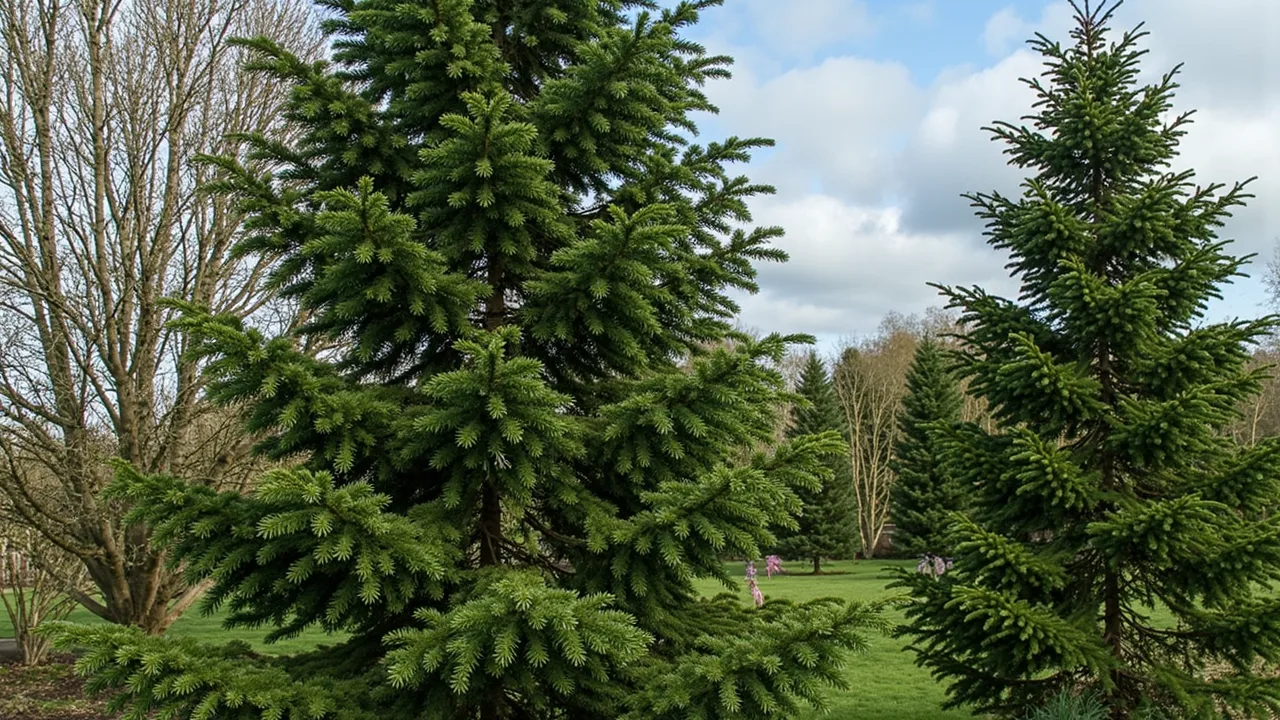
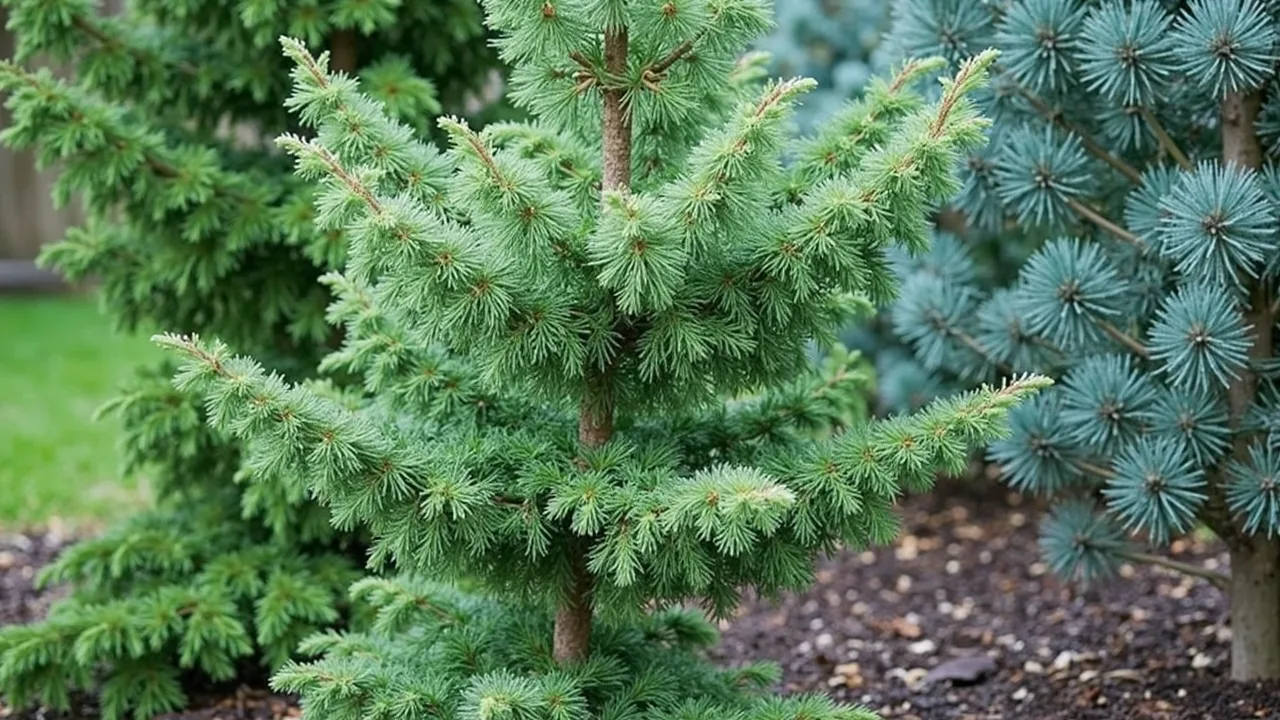
Korean fir carries the classic silhouette of a small fir: a broad conical to pyramidal crown, a straight central leader, and tiered horizontal branches that sweep gently downwards at their tips. Young plants are dense and almost formal in outline; older trees become more open, with the lower branches eventually shading the ground beneath them. In typical UK garden conditions a mature specimen will reach 4–8 m in height and 2–3 m across after twenty or thirty years, growing perhaps 15–30 cm a year in favourable soil.
The needles are short — typically 1–2.5 cm long — and arranged radially around the shoot, giving the branches a tidy, bottlebrush-like density. The upper surface of each needle is a deep, glossy dark green, while the underside carries two bright white stomatal bands. From a distance the foliage reads as a rich, slightly blue-tinged green; viewed from below or in strong sunlight, the white bands give the tree a silvery quality that is one of its quietest pleasures.
The cones are the headline feature. They appear upright on the upper branches, cylindrical, 4–7 cm long, and a vivid violet-blue when young, maturing to brown as the season progresses. Unlike many conifers, Korean fir produces these cones reliably on small plants — a five-year-old in a 10-litre pot can carry a full set. The cones do not shatter on the tree in the way that some fir cones do, and intact brown cones often persist on the branches well into the following year.
Bark on young trees is smooth and grey-brown, becoming slightly fissured at the base with age. The overall impression is of a neat, well-proportioned conifer that earns its place without dominating.
Growing Conditions
Korean fir is fully hardy across the UK and tolerates the cool, damp conditions typical of British gardens, provided the soil does not sit wet. It prefers a position in full sun or very light dappled shade. Light brings out the silvery underside of the needles and encourages the heaviest cone crops; deep shade produces a thinner, more open tree with fewer cones.
The ideal soil is moist but well-drained, slightly acidic to near-neutral, with a pH somewhere in the 5.5–7.0 range. Korean fir does well on loam and on sandy or gritty soils over a free-draining subsoil. Heavy clay and any ground that lies wet through winter are the two situations to avoid: waterlogging is the single most common cause of failure, leading to root death and dieback. On heavier ground, planting on a shallow mound of improved soil, or in a raised bed, will turn a marginal site into a workable one.
Shelter matters more than warmth. The branches are relatively flexible, but young growth can be scorched by persistent cold wind, leaving needle tips browned and tatty through the following summer. A position with good light but some shelter from the north and east — alongside a hedge, a fence, or a screen of larger trees — suits it well. Avoid siting it in a frost pocket, where late spring frosts can damage the new growth flush.
Planting and Care
The best planting windows in the UK are late spring (May to early June), once the soil has warmed, and early autumn (September to October), when the ground is still warm but rainfall is increasing. Container-grown stock can be planted at any time the ground is workable, but these two windows give the root system the longest unbroken stretch to establish before facing heat stress or hard frost.
Dig a hole at least twice the width of the rootball and the same depth, loosening the surrounding soil so young roots can push out easily. Tease out any circling roots on container-grown plants, set the tree so the top of the rootball sits level with the surrounding soil, and backfill with the excavated material — there is no need to add compost to the planting hole for Korean fir, and doing so can create a sump that holds water. Water in thoroughly, then apply a 5–8 cm mulch of leaf mould, well-rotted bark, or composted woodchip over the root area, keeping it clear of the trunk itself. Space standalone specimens 3–5 m apart to allow for mature spread.
Watering is the main job in the first two growing seasons. Keep the root area moist through any dry spell of more than a week or so, watering deeply rather than little and often. After that the tree is reasonably drought-tolerant and will only need supplementary water in prolonged drought. Renew the organic mulch each spring to conserve moisture, suppress weeds, and feed the soil slowly.
Feeding is rarely necessary on reasonable garden soil. On very hungry or sandy ground, a light top-dressing of a general-purpose fertiliser in early spring can help a struggling plant along; on richer soils it is unnecessary and may simply produce lush, more wind-sensitive growth.
Pruning should be minimal. Korean fir does not respond well to hard pruning or formal shaping — it will not regrow from old wood. The only routine work is to remove any dead, damaged, or crossing branches in late summer, cutting back to the base of the branch rather than into the main stem. The leader should be left alone unless it has been damaged, in which case a new leader can be trained in from a side shoot tied upright.
Propagation is normally from seed, although seed viability is variable and named cultivars are propagated by grafting in specialist nurseries. Home gardeners will rarely have cause to propagate their own; container-grown plants of known provenance are widely available from UK nurseries.
Seasonal care is light. In spring, top up the mulch and check for any winter dieback. In summer, water young plants during drought and watch for the first flush of cones on maturing specimens. In autumn, rake up any fallen needles if desired and clear weeds from around the trunk. Winter care is essentially a non-event, though in exposed gardens a temporary windbreak around young plants for their first winter is worthwhile.
Common Problems
Korean fir is generally a healthy and trouble-free tree in the right site, but a handful of problems are worth knowing about.
Honey fungus (Armillaria species) is the most serious potential issue, particularly on wet or previously wooded ground. It causes dieback from the crown downwards and the appearance of honey-coloured toadstools at the base of the trunk in autumn. There is no cure; prevention — choosing a free-draining site and avoiding stress — is the only effective approach.
Phytophthora root rot is closely linked to drainage. Trees on waterlogged or compacted soil turn dull, drop needles, and may die within a season. Improving drainage before planting is the only reliable prevention; affected trees rarely recover.
Needle cast fungi can cause needles to brown and drop in wet summers, particularly where air circulation is poor. Symptoms are usually cosmetic rather than fatal: rake up and dispose of fallen needles, avoid overhead watering, and give the tree more space if needed.
Woolly aphids sometimes colonise young shoots, appearing as tufts of white waxy material. They rarely cause serious damage and are easily controlled by hand or, on larger trees, by encouraging natural predators.
Wind scorch is a routine rather than a disease, but worth flagging: young plants in exposed sites develop browned needle tips after cold spring winds. Shelter during establishment prevents it entirely.
Popular Varieties
Several named cultivars of Abies koreana are widely available in the UK, mostly dwarf or slow-growing forms selected for smaller gardens, rockeries, or container use. Always buy from a reputable nursery and check the eventual size before planting.
- 'Silberlocke' — perhaps the best-known cultivar, with needles that curl strongly upwards to expose the bright white undersides. The tree therefore looks distinctly silvery from any angle, even in winter. Slower-growing than the species, reaching about 3–4 m in twenty years.
- 'Blue Emperor' — a compact, broad-conical selection with notably blue-toned foliage and reliable cone production at a young age. Suited to smaller gardens; typically reaches 2–3 m.
- 'Kohout's Ice Breaker' — a dwarf, almost nest-forming cultivar with strongly curled needles showing their silvery reverse. Very slow-growing, ideal for rock gardens or large containers, usually under 1 m after ten years.
- 'Compact Dwarf' — a dense, conical dwarf form producing the same purple-blue cones as the species but on a much smaller frame, generally 1–1.5 m at maturity.
- 'Aurea' — needles flushed golden-yellow in spring, maturing to greener tones through summer. Less commonly stocked than the green and silver forms but available from specialist conifer nurseries.
Cultivars and Varieties
| Cultivar | Height | Flower | Notes | AGM |
|---|---|---|---|---|
| 'Blauer Eskimo' | — | — | RHS AGM (H7) | ✓ |
| 'Cis' | — | — | RHS AGM (H7) | ✓ |
| 'Kohout' | — | — | RHS AGM (H7) | ✓ |
| 'Silberlocke' | — | — | RHS AGM (H7) | ✓ |
Pests and Diseases
| Problem | Symptoms | Management |
|---|---|---|
| Honey fungus | General decline, yellowing needles, and white fungal growth at the base of the stem. | Improve drainage and avoid planting in infected soil; remove severely affected plants. |
| Aphids | Clusters of small soft-bodied insects on new shoots causing distorted growth and sticky honeydew. | Wash off with a strong jet of water or treat with insecticidal soap if infestations are heavy. |
| Adelgids | Cottony white woolly masses on stems and needles, often accompanied by yellowing foliage. | Apply horticultural oil during the dormant season to target overwintering eggs. |
| Needle cast | Older needles turn brown or purple and drop prematurely, thinning the lower branches. | Ensure good air circulation and avoid overhead watering to keep foliage dry. |
| Winter desiccation | Needles turn brown and crispy, particularly on wind-exposed sides of the tree. | Plant in a sheltered position and water deeply before the ground freezes in autumn. |
For step-by-step help, read Controlling Aphids Naturally. Or browse the full plant problem solver to diagnose an issue by symptom.
Recommended Products
GardenWizz earns a commission from qualifying purchases made through affiliate links on this page (including links within the article) — as an Amazon Associate, and from Thompson & Morgan via the Awin network. This does not affect the price you pay. See our disclaimer for details.