Large-Thorned Agave
Agave macroacantha
The Gardening Year
Best months in UK gardens · full planting calendar →
🖨 Printable care card (PDF)At a Glance
| Botanical name | Agave macroacantha |
|---|---|
| Common name(s) | Large-thorned agave |
| Family | Asparagaceae |
| Plant type | succulent |
| Height × Spread | 3 m × — |
| Position | Full sun |
| Soil | sparse, gravelly soil |
| Flowering | June–August |
| Toxicity | — |
| Native range | Oaxaca and also near the town of Tehuacan in the State of Puebla, Mexico |
Agave macroacantha, the black-spined or large-thorned agave, is best grown as a container specimen in Britain: give it full sun and gritty compost outdoors in summer, then keep it bright, cool and almost dry under glass for winter. Only the mildest, sharply drained coastal or urban sites are suitable for year-round outdoor planting.
| Care point | Details |
Overview
In a British collection, Agave macroacantha is usually a patio plant rather than a border plant. It forms a neat, architectural rosette and is particularly valued for the contrast between blue-grey foliage and dark spines. The species comes from semi-arid rocky habitats in Mexico, so its main challenge in the UK is not summer drought but cold, saturated compost in winter.
The plant is monocarpic: a mature rosette flowers once near the end of its life and then dies. Offsets around the base normally carry on the clump, making a healthy plant a long-term feature even after flowering. Treat the spines as a genuine handling hazard, not decoration, and position the pot away from narrow paths and play areas.
Appearance
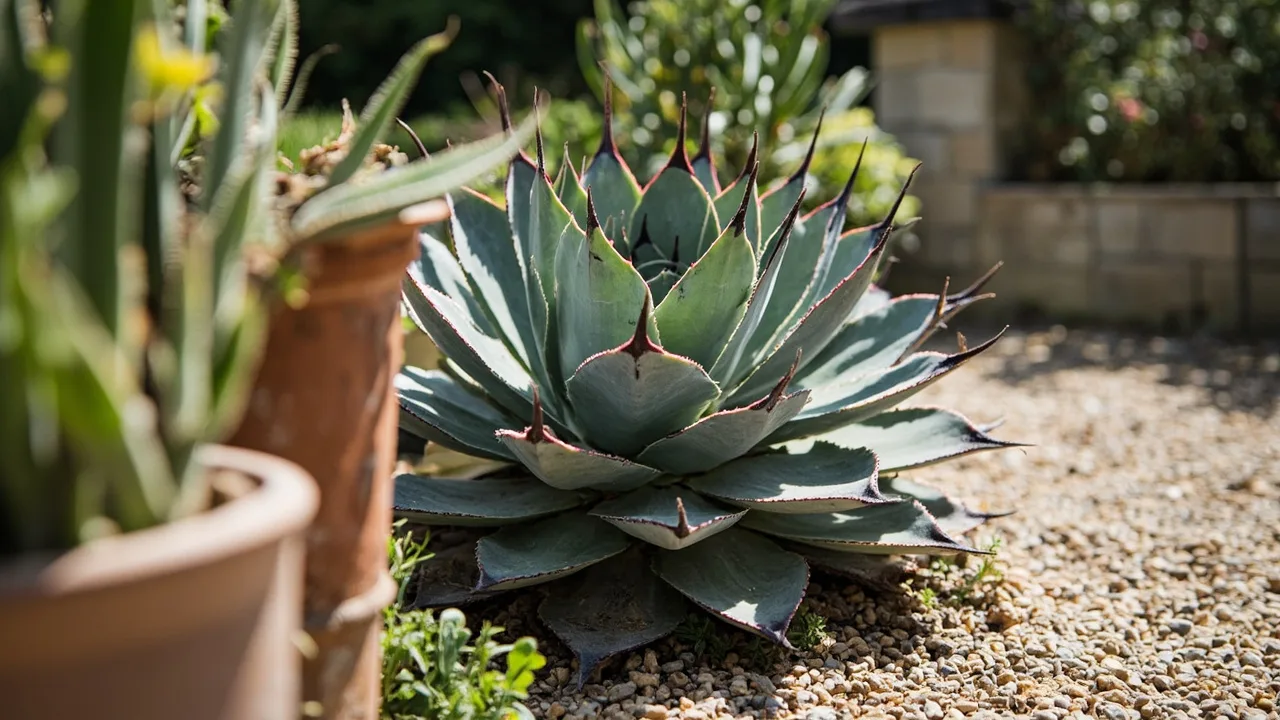
RHS describes this as a clump-forming evergreen succulent reaching about 60 cm in height and spread. A typical clump consists of several tight rosettes, each made from narrow, rigid leaves radiating evenly from the centre. Individual leaves are pale blue-green to grey-green, with small brown marginal teeth and a conspicuous dark terminal spine.
The rosette stays comparatively compact, although offsets can gradually widen the plant beyond the size of a single specimen. In good light the leaves keep their glaucous colour; low winter light indoors can make new growth greener and less strongly arranged. The terminal spines point outwards and the teeth run along the margins, so allow room around all sides when choosing a display position.
Flowering is an uncommon event in British cultivation and may take many years. A mature rosette sends up a tall, slender flowering stem in summer, carrying clusters of small greenish to purplish flowers. Once flowering is complete, that rosette dies, while basal offsets may remain. Remove the spent stem only when it has dried and can be cut safely without damaging neighbouring rosettes.
Growing Conditions
Full sun is the starting point. Give the plant at least six hours of direct light, ideally against a south- or west-facing wall or on an open patio. A bright conservatory, greenhouse or lean-to is useful in winter. Turn a container occasionally so the rosette develops evenly rather than leaning towards the glass.
Drainage matters more than rich soil. Use a terracotta pot with a drainage hole and a peat-free cactus compost amended with horticultural grit, or mix roughly equal parts peat-free multipurpose compost and grit. The exact recipe matters less than the result: water should pass through rapidly and never sit around the crown. A gravel top-dressing keeps leaves away from wet compost and reduces splashing.
Water thoroughly during active growth, then allow the compost to dry almost completely before watering again. In Britain this usually means more regular watering from late May through August, depending on heat and rainfall, but not a permanently damp pot. From September reduce frequency, and from late autumn to early spring keep the compost almost dry, giving only enough water to prevent severe shrivelling in a warm, bright greenhouse.
Feed three or four times during the growing season with a low-nitrogen fertiliser suitable for cacti and succulents. Excess nitrogen produces soft, lush growth that is less resilient and can be more prone to rot. Do not feed a plant that is cold, dormant or recently repotted.
The species is tender in ordinary UK conditions. A sheltered coastal or inner-city microclimate may allow an established plant to remain outside, but only where the soil is exceptionally free-draining and winter rain can be kept from the crown. For most gardeners, moving the container under glass before the first frost is the more reliable approach. The RHS detail page provides no H-code for this plant, so no hardiness code is supplied here.
Planting and Care
Plant container-grown specimens in spring, once the compost and plant are warming and active growth is beginning. Wear thick gloves, cover your arms and use long-handled tools when handling the rosette. Set it at the same depth as before; burying the crown invites rot. Firm the gritty mix lightly, leave a little space below the rim and wait several days before the first thorough watering if roots were disturbed.
During summer, acclimatise a greenhouse plant to outdoor sun over several days rather than moving it straight into intense light. Put the pot in full sun with shelter from prolonged heavy rain. Raise it on pot feet so drainage holes remain clear. From September, begin withholding water and return the plant under glass before frost is forecast. Keep winter ventilation good: cool, stagnant and damp conditions are a common cause of failure.
Repot only when roots fill the container or the rosette becomes unstable. This slow-growing agave tolerates being pot-bound, and a move into the next pot size is safer than a large jump that leaves excess wet compost around the roots. Repot in spring, inspect for rot, and replace damaged or exhausted compost with a fresh gritty mix. A heavy terracotta pot also helps prevent a mature clump being blown over.
Pruning is limited to removing dead or badly damaged leaves. Cut close to the base with clean secateurs, keeping hands clear of the spine and teeth. Do not strip healthy leaves merely to tidy the plant. After flowering, wait until the stem has finished and dried before cutting it down; keep children and pets away while the sharp material is being removed.
Propagation is normally by offsets. In spring or early summer, separate a well-rooted offset from the parent using a clean knife, taking some of its basal tissue where possible. Allow the cut surface to callus for several days, then pot it into a dry, gritty mix. Keep it barely moist until roots establish. Seed propagation is possible but slow, and flowering plants are not guaranteed to come true to any informal appearance selected by a grower.
Useful related guidance includes gritty compost, container growing, watering succulents, greenhouse care, full-sun plants, gravel gardens, winter protection, repotting, dealing with pests, spring gardening, and autumn gardening.
Common Problems
Crown and root rot
One common mistake is watering on a calendar through a cold, wet UK winter. Symptom: the centre softens, leaves loosen or the whole rosette collapses. Cause: saturated compost and low temperatures around the crown and roots. Fix: move the plant under cover, remove rotten tissue with a sterile blade, let the wound dry, and repot into fresh gritty compost only if viable roots remain. Prevention is more effective than rescue: keep the crown dry and drainage open.
Mealybugs
Many gardeners first notice white cottony deposits deep in the leaf axils rather than on the outer leaves. Symptom: white insects, sticky residue or distorted new growth. Cause: mealybugs shelter in the tight rosette, particularly on container plants overwintered under glass. Fix: isolate the plant, remove visible insects with a soft brush or cotton bud, and repeat inspections weekly. For severe infestations, use a product approved for ornamental plants and follow its label; avoid spraying into a cold, wet crown.
Scale insects
A simple trick is to inspect the undersides of leaves whenever the plant is brought indoors in September. Symptom: small, fixed brown or pale discs and sometimes sticky honeydew. Cause: scale insects introduced on another plant or hidden in sheltered foliage. Fix: remove accessible scales carefully, isolate the agave and repeat treatment as directed on an approved ornamental pest-control product. Good light and ventilation help, but they do not replace physical inspection.
Agave snout weevil
A collapsing plant with little warning deserves attention, although this pest is uncommon in Britain. Symptom: sudden wilting, crown damage or a plant that detaches from its roots. Cause: the agave snout weevil, Scyphophorus acupunctatus, can tunnel into the crown and introduce rot. Fix: there is no dependable home cure once the crown is extensively destroyed; isolate and dispose of badly affected material responsibly, and inspect new plants before adding them to a collection. Avoid needless wounds during repotting.
Leaf scorch
Six hours of sun is desirable, but a newly moved plant can still scorch. Symptom: pale or brown patches on exposed leaves after a sudden change in light. Cause: insufficient acclimatisation, usually after a dim winter indoors. Fix: harden off over several days and keep the plant evenly, but not excessively, watered during active growth. Scorched leaves will not recover, so protect new growth rather than cutting healthy leaves away.
Popular Varieties
No widely established named cultivars of Agave macroacantha could be verified for routine UK trade. Specialist nurseries may offer seed-grown plants of the species, and plants can vary in spine length, colour and clumping habit. Informal collector descriptions such as “long-thorned” or “black-thorned” should not be treated as registered cultivar names.
For a genuine A. macroacantha selection, check that the label gives the full botanical name and that the plant has the characteristic blue-grey leaves with dark terminal spines. Do not assume that a plant sold simply as a blue agave is this species. Availability changes between specialist nurseries, so buy by botanical identity rather than by an unverified trade description.
Sources & Further Reading
- Source: RHS: Agave macroacantha, accessed 2026-07-22.
- Source: RHS: Agave growing guidance, accessed 2026-07-22.
- Source: Oregon State Landscape Plants: Agave macroacantha, accessed 2026-07-22.
- Source: San Marcos Growers: Agave macroacantha, accessed 2026-07-22.
- Source: Urban Jungle UK: Agave macroacantha, accessed 2026-07-22.
- Source: Big Plant Nursery: Agave macroacantha, accessed 2026-07-22.
Pests and Diseases
| Problem | Symptoms | Management |
|---|---|---|
| Scale insects | Small, immobile, shield-like bumps on leaves or stems that may cause yellowing and sticky honeydew. | Isolate the plant and treat infested areas with a cotton bud dipped in methylated spirits or apply horticultural oil. |
| Root rot | Leaves become soft, mushy, and discoloured (brown or black) starting from the base of the rosette. | Ensure well-draining cactus compost and avoid watering during winter dormancy to keep roots dry. |
| Mealybugs | White, cottony fluff accumulating in leaf axils and on stems, often accompanied by sticky residue. | Wipe away visible insects with a damp cloth or alcohol swab and spray with insecticidal soap if severe. |
| Vine weevil | Notched edges on leaves above ground and wilting or collapse due to root damage below soil level. | Use nematode treatments in the soil during warm months or apply a systemic insecticide as a preventive measure. |
Or browse the full plant problem solver to diagnose an issue by symptom.
Recommended Products
GardenWizz earns a commission from qualifying purchases made through affiliate links on this page (including links within the article) — as an Amazon Associate, and from Thompson & Morgan via the Awin network. This does not affect the price you pay. See our disclaimer for details.