Maple Leaf Begonia
Begonia dregei
The Gardening Year
Best months in UK gardens · full planting calendar →
🖨 Printable care card (PDF)At a Glance
| Botanical name | Begonia dregei |
|---|---|
| Common name(s) | maple leaf begonia |
| Family | Begoniaceae |
| Plant type | perennial (semi-tuberous, forms a woody caudex at its base, not a tuber; evergreen) |
| Height × Spread | 45–100 cm × 10–100 cm |
| Position | Partial shade |
| Soil | Moist but well-drained or Well-drained; Clay Loam Sand; Acid or Neutral pH |
| Flowering | August–November |
| Toxicity | Potentially harmful. Ornamental bulbs - not to be eaten. |
| Native range | Eastern Cape and KwaZulu-Natal provinces of South Africa |
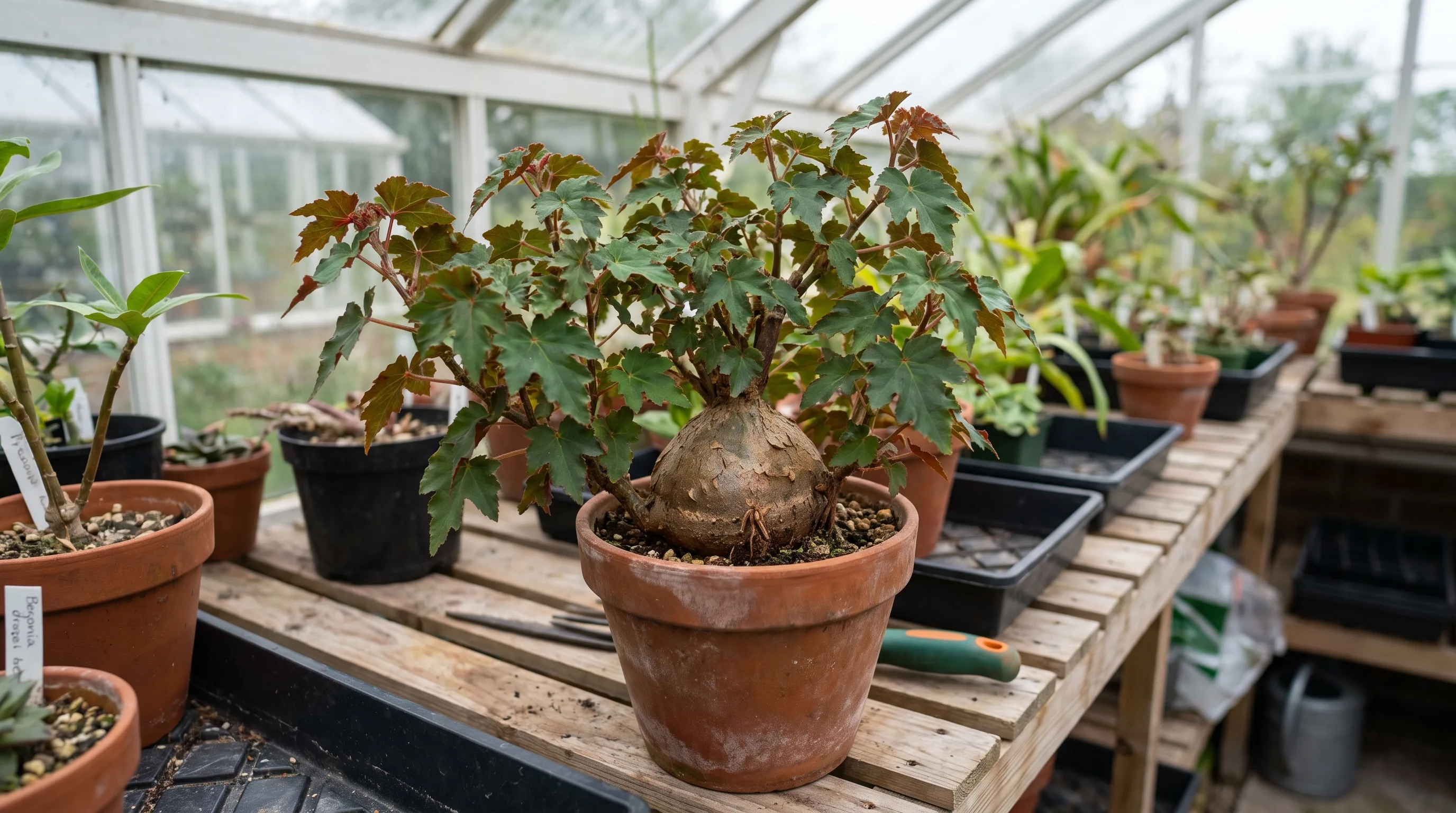
A compact, semi-tuberous begonia from the eastern coast of South Africa, Begonia dregei is grown in the UK almost exclusively as a foliage houseplant or conservatory specimen, prized for its small, maple-shaped leaves with deep red-maroon undersides rather than for its flowers. Mature plants develop a knobbly, caudex-like base that gives older specimens a distinctly bonsai character, and the species has been a quiet fixture of British glasshouse collections since the mid-nineteenth century.
Quick-Care Table
Overview
Begonia dregei belongs to the family Begoniaceae and is one of the small group of semi-tuberous, summer-growing begonias native to southern Africa. It was described by European botanists in the mid-nineteenth century from material collected in the Eastern Cape and KwaZulu-Natal, where it grows on forest margins, rocky outcrops and shaded cliffs. The species name honours Johann Franz Drège, a German plant collector who worked extensively in South Africa in the 1830s.
In its native range the plant is essentially evergreen, dying back only in the coolest, driest part of the year. In UK cultivation it behaves as a tender perennial that grows more or less continuously through spring and summer, slows in midwinter, and benefits from a slightly drier, cooler rest period between November and February. It is not hardy outdoors anywhere in the British Isles and is grown either as a houseplant, in a heated conservatory or in a heated glasshouse.
The species has a long history in British horticulture. It was an early introduction to the great Victorian glasshouse collections and has remained in cultivation ever since, partly because it is easy to grow from cuttings, and partly because its unusual leaf shape and colouring give it year-round ornamental value in conditions where flowering plants often struggle. It is sometimes referred to in older UK horticultural literature as the "minibegonia" on account of its compact habit.
Appearance
A neat, bushy plant typically reaching 25–40 cm tall in a pot, occasionally a little taller in ideal conditions. The stems are succulent, reddish when young and deepening to a dark red-maroon on mature growth. With age the plant produces a swollen, knobbly base at soil level; very old specimens can develop this into a small caudex that is sometimes displayed above the compost in the manner of a bonsai.
The defining feature is the leaf. Each blade is small, roughly 4–8 cm long, broadly ovate and shallowly lobed in a way that suggests a maple or a grape leaf, with a pointed tip and a slightly asymmetrical base where it meets the stalk. The upper surface is a bright, slightly glossy green and frequently takes on a bronze or purple flush when the plant is grown in good light; the underside is a deep red-maroon, as are the leaf stalks and young stems. It is this contrast between the green upper surface and the dark red reverse that gives the plant its main ornamental appeal.
Flowers are small, waxy and white to pale pink, around 1.5–2 cm across, and carried in loose, drooping clusters in summer and intermittently through the growing season. As is typical of the genus, male and female flowers are borne separately on the same plant, the males opening first and the females following once the males have dropped. Individual flushes are modest but, in a healthy plant, the flowering season can run from early summer well into autumn. The flowers are not the main reason for growing the species; the foliage is.
Growing Conditions
In the UK, Begonia dregei is a glasshouse, conservatory or houseplant. It will not survive a British winter outdoors except in the very mildest of urban microclimates, and even there it should be treated as a pot specimen that can be brought inside.
Light should be bright but indirect. An east- or west-facing windowsill, or a position set back from a south-facing window, suits it well. The leaf colour is strongest with some direct morning or late-afternoon sun; harsh midday sun scorches the foliage and turns the green upper surface pale and papery. Too little light, on the other hand, produces leggy growth with pale, oversized leaves and weak red pigmentation on the undersides.
Temperature should stay comfortably above the threshold the badge records for this species throughout the year, with no more than a modest drop between summer and winter. In practical terms a heated room, conservatory or glasshouse that stays warm by day and does not fall to cold by night will keep the plant in active growth all year; a slightly cooler rest through the darkest part of winter is also acceptable and may encourage better flowering the following summer.
Humidity is important. The species prefers moderate to high humidity, roughly in the 50–70% range. Brown, crisp leaf edges are the usual sign that the surrounding air is too dry, particularly in centrally heated rooms in winter. Grouping plants together, standing pots on trays of damp grit, or growing the plant in a terrarium or bottle garden all help.
Soil must be free-draining but humus-rich. A peat-free houseplant compost with a generous handful of perlite or coarse grit added — roughly one part grit to four parts compost — works well. The swollen base of the plant is prone to rotting in cold, wet compost, so good drainage is more important than high fertility.
Planting and Care
Pot-grown year-round in the UK. Repot annually in spring, just as new growth resumes, moving the plant up only one pot size at a time; B. dregei flowers better when its roots are slightly constrained. Use the free-draining mix described above and avoid deep pots, which hold too much moisture around the base.
Watering should keep the compost evenly moist during the active growing season from spring through to early autumn. Allow the top centimetre or two to dry out between waterings rather than leaving the pot standing in a saucer of water. From late autumn through winter, as growth slows, reduce watering so that the compost is only just moist and never sodden. Soft, yellowing lower leaves and a blackening stem base are the classic signs of overwatering at low temperatures.
Feeding should be modest. Apply a half-strength balanced liquid fertiliser every two to four weeks from spring through to early autumn. Once flower buds appear, switch to a low-nitrogen, high-potash feed (such as a tomato fertiliser) at the same dilution to support blooming rather than leafy growth. Withhold feed altogether in midwinter.
Pruning is minimal. Pinch out the growing tips in spring to keep the plant bushy and compact, and remove any dead or damaged leaves and spent flower stems as they appear. If the plant becomes leggy with age, the stems can be cut back hard in spring; new shoots will usually break from the swollen base.
Propagation is straightforward. Take softwood or semi-ripe cuttings of 5–10 cm in spring or early summer, trim the lower leaves, and root them in a small pot of moist, free-draining compost under a clear cover. Division of the tuberous base is also possible at repotting time. Seed can be sown but is slow and rarely worthwhile for a single plant.
Overwinter the plant on a bright windowsill or in a heated greenhouse, away from cold draughts and radiators. A shaded summer patio is a good position once night temperatures are reliably above the low teens, but bring the plant back inside well before the first cool nights of autumn.
Common Problems
Root and stem rot is the most common and most serious problem, and almost always traces back to cold, waterlogged compost. The swollen base is particularly vulnerable. The remedy is cultural: use a free-draining mix, let the surface of the compost dry between waterings, and keep the plant above the minimum winter temperature recorded in the badge.
Powdery mildew appears as white, powdery patches on the upper leaf surface in still, dry conditions. Improve airflow around the plant, raise humidity modestly, and avoid wetting the foliage when watering. Persistent infections can be treated with a suitable fungicide.
Botrytis (grey mould) shows as a fuzzy grey growth on soft stems and damaged leaves in cool, damp conditions. Remove affected material promptly, thin the canopy to improve air movement, and reduce humidity slightly during the cooler months.
Mealybug is a frequent glasshouse pest, appearing as white, cottony tufts in the leaf axils and along the stems. Small infestations can be wiped off with a cotton bud dipped in diluted rubbing alcohol; larger ones respond to a horticultural soap or a suitable systemic treatment.
Aphids colonise the soft new growth in spring, typically green or black. Knock them off with a strong water spray or treat with a horticultural soap, taking care to reach the undersides of the leaves.
Leaf yellowing and drop, especially in winter, usually indicates either cold damage or overwatering. Check the compost moisture and the night temperature before anything else.
Popular Varieties
Begonia dregei is unusual among ornamental begonias in that the species itself is the plant almost universally grown, and there are no widely available, distinct cultivars in general UK commerce. Plants sold under this name are seed- or cutting-raised stock of the wild type, and named selections of the species are scarce. Gardeners looking for variety within the same group of semi-tuberous South African begonias may consider the following related species, all of which share the same general cultivation requirements:
- Begonia dregei (species form). The small, maple-leaved plant described in this article; widely available from specialist houseplant nurseries in the UK and the form most often seen in cultivation.
- Begonia sutherlandii. A closely related semi-tuberous species from the same region of South Africa, with more pendulous stems, smaller bright green leaves and abundant orange flowers in summer. Often grown in hanging baskets in a cool conservatory.
- Begonia richardsiana. Another semi-tuberous South African species, similar in habit to B. dregei but with narrower, more elongated leaves and pink flowers. Less commonly offered but of interest to collectors of the group.
- Begonia homonyma. A semi-tuberous species from the same Eastern Cape and KwaZulu-Natal range as B. dregei and a fellow member of section Augustia. It shares the compact, caudex-forming habit and the bright green lobed foliage, but the leaves are typically smaller and more sharply toothed, and the small flowers are white flushed with pink. Listed occasionally by specialist South African bulb and begonia nurseries and grown under the same conditions as B. dregei.
For gardeners wanting something distinct in leaf shape or flower colour, the broader Begonia genus offers far more variety than B. dregei alone — the Rex-cultorum hybrids for foliage interest, or the tuberhybrida Begonia group for showy summer flowers — but as a compact, undemanding foliage plant for a bright windowsill or a steamy bathroom, B. dregei itself is hard to beat.
Pests and Diseases
| Problem | Symptoms | Management |
|---|---|---|
| Powdery mildew | A white, dusty fungal growth appears on the upper surfaces of leaves and stems. | Improve air circulation and apply a suitable fungicide if infection is severe. |
| Phytophthora root rot | Stems become soft and waterlogged at the base, leading to rapid collapse of the plant. | Ensure well-drained compost and avoid overwatering to prevent soil-borne infection. |
| Fungal leaf spots | Distinct circular or irregular brown spots develop on foliage, sometimes with yellow halos. | Remove affected leaves immediately and avoid wetting the foliage when watering. |
| Damping off | Young seedlings or cuttings collapse at the soil line and fail to establish. | Use sterile, well-drained compost and ensure good ventilation during propagation. |
| Vine weevil | Semi-circular notches appear on leaf margins while larvae damage roots underground. | Apply a systemic insecticide to the compost or use biological nematodes in late summer. |
For step-by-step help, read Treating Powdery Mildew. Or browse the full plant problem solver to diagnose an issue by symptom.
Recommended Products
GardenWizz earns a commission from qualifying purchases made through affiliate links on this page (including links within the article) — as an Amazon Associate, and from Thompson & Morgan via the Awin network. This does not affect the price you pay. See our disclaimer for details.