Rock Rose
Cistus ingwersenii
The Gardening Year
Best months in UK gardens · full planting calendar →
🖨 Printable care card (PDF)At a Glance
| Botanical name | Cistus ingwersenii |
|---|---|
| Common name(s) | Rock rose |
| Family | Cistaceae |
| Plant type | shrub |
| Height × Spread | 10–50 cm × 50–100 cm |
| Position | Full sun |
| Soil | well-drained sandy, poor to moderately fertile soil |
| Flowering | June–August |
| Toxicity | — |
| Native range | Mediterranean region, from Morocco, Spain, Italy, Greece, through to the Middle East, and also on the Canary Islands |
Cistus × ingwersenii is a low, wide-spreading evergreen shrub grown for its long display of pure white, saucer-shaped flowers held above dark, hairy foliage. It is one of the most reliable rockroses for a sunny UK border, particularly where the soil is dry and well drained.
Overview
Cistus × ingwersenii belongs to the Cistaceae, the rockrose family, and is a hybrid of south-west European origin. Plants of the World Online records the hybrid formula as C. inflatus × C. ladanifer, with the named form long circulated in horticulture as × Halimiocistus 'Ingwersenii'; the RHS lists it under Cistus × ingwersenii. Although the genus name is still debated in some references, the plant itself is consistent across UK nurseries — a compact, mat-forming shrub that earns its place at the front of a sunny border.
It is well suited to gravel gardens, rock gardens, coastal sites, banks and the driest, sunniest part of a courtyard. The plant tolerates drought once established and is generally trouble-free in the UK, which is why experienced gardeners reach for it when a sunny spot has defeated fussier flowering shrubs. For more on the wider genus, see the Cistus plant profile and the July garden calendar for the peak of its display.
Appearance
Cistus × ingwersenii forms a dense, low mound — typically around 45cm tall but spreading 90cm or more across once it has settled. The stems are clothed in linear, dark green leaves that are noticeably hairy when young, giving the foliage a soft, slightly grey-green look in strong sun. The leaves are evergreen and aromatic when crushed, releasing a faint resinous scent that is shared across the genus.
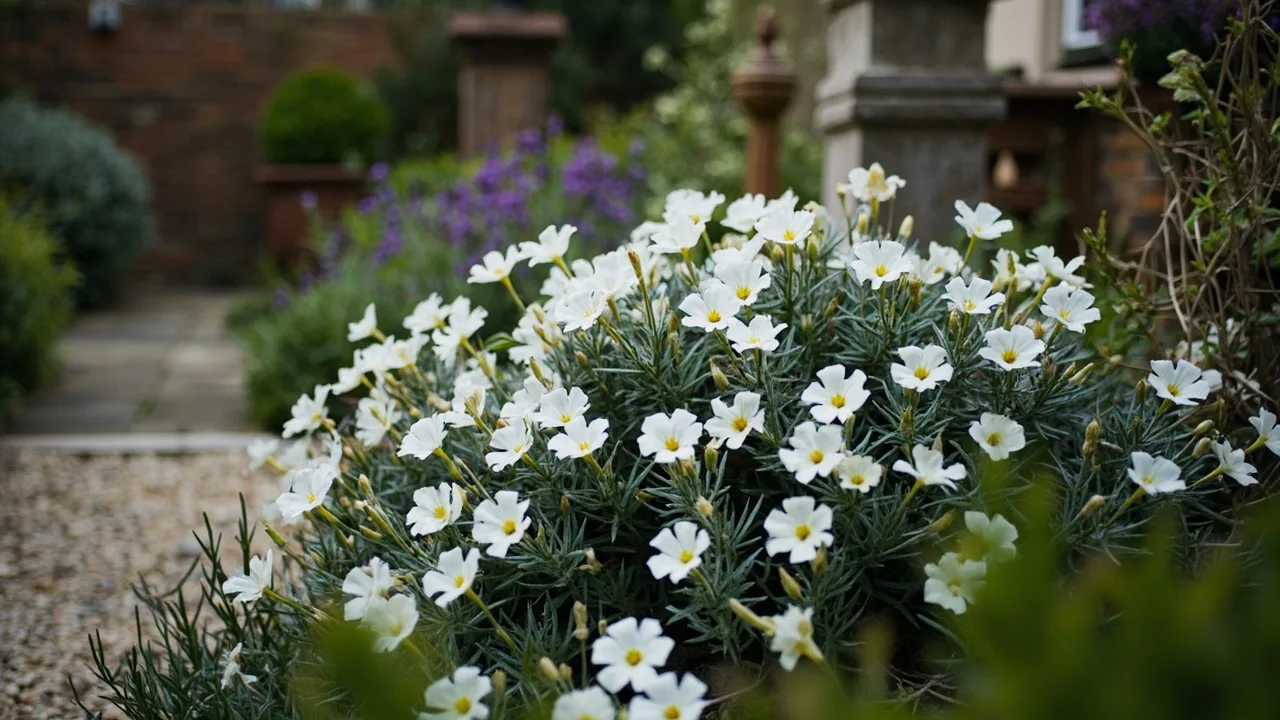
The flowers are the main reason to grow it. Each bloom is a flat, saucer-shaped, pure white flower about 3.5cm across, with a small boss of pale yellow stamens at the centre. Like all cistus, each individual flower is short-lived — often just a single day — but the plant produces them in a steady succession over many weeks. The general flowering window is late May into July, with a few outdoor seasons extending into August. The overall effect is a low, white-flecked mound that lifts gently above the dark foliage.
The spent petals drop cleanly, leaving the developing buds to continue. The plant does not need deadheading to keep flowering, although a light tidy after the main flush can keep the mound looking fresh. Mature plants develop a slightly woody framework at the base, with softer, leafy growth carried on the current season's stems.
Growing Conditions
Full sun is essential. In anything less than six hours of direct sun, the plant becomes leggy, flowers poorly and is more prone to winter damage. Choose the hottest, most open spot available, ideally with shelter from cold east and north winds. A south- or west-facing front-of-border position, a sunny bank, or a gravel garden with a stone or brick backdrop all work well.
The soil must be very free-draining. Cistus are Mediterranean plants and they resent winter wet far more than they resent cold. The ideal soil is poor to moderately fertile, gritty or sandy, and slightly alkaline to neutral; chalky ground suits them. Heavy clay, compacted soil or any spot where rainwater sits over winter will shorten the plant's life, even in a mild district. If the soil is heavy, plant on a raised bed, a low mound, or mix in generous grit and sharp sand to open the structure. The plant's roots are modest, so drainage improvement along the planting strip is more effective than deep cultivation across the whole bed.
Once established, Cistus × ingwersenii is reliably drought-tolerant in the UK and rarely needs supplementary watering between April and September. Container-grown plants dry out faster and benefit from a soak during prolonged dry spells. Do not feed heavily; rich soil or high-nitrogen fertiliser produces soft, leafy growth that flowers poorly and is more vulnerable to cold. The RHS suggested locations for this plant include coastal, cottage and informal, rock, city and courtyard, gravel, and low-maintenance gardens — a useful indicator of how it performs in typical UK settings.
Planting and Care
Plant in late spring, after the worst of the UK frosts have passed, so the shrub has the whole growing season to establish before its first winter. Container-grown plants can go in at any time when soil is workable, but a May or early June planting is generally the safest. Dig a hole at least twice the width of the rootball, set the plant so the crown sits level with the surrounding soil, backfill with the excavated soil, and firm gently. Water in thoroughly, then keep the soil just moist — not wet — for the first six to eight weeks.
After the first year, watering is rarely needed unless the plant is in a container or the site is exceptionally dry. Feeding is usually unnecessary; a light spring mulch of well-rotted garden compost is enough on poor soils. Avoid mounding compost against the stems, which can trap moisture and encourage rot at the crown.
Pruning should be light and timed. Follow RHS pruning group 9: after the main flowering flush in July, remove only dead, damaged or unwanted growth, and lightly trim back the current season's shoots to keep the mound tidy. Never cut into old, leafless wood — cistus do not reliably regrow from old growth, and hard pruning is the most common reason a healthy-looking plant fails the following spring. The older the plant, the less it should be cut.
Propagation is straightforward from semi-hardwood cuttings taken in mid- to late summer. Choose a healthy, non-flowering side shoot, trim below a leaf joint, remove the lower leaves, and root it in a 50:50 mix of peat-free compost and grit under a covered propagator. Root development is usually swift in warm conditions, and potted cuttings can be overwintered in a cold frame before planting out the following spring.
The seasonal routine is simple: plant in late spring, water through the first summer, leave the foliage untouched in winter, lightly trim after flowering in July, and take cuttings in August if more plants are wanted. See the drought-tolerant planting guide and the May garden calendar for related advice.
Common Problems
Winter wet and root rot
The most common reason this plant fails in the UK is waterlogged soil over winter. Symptoms include sudden collapse in spring, leaves turning yellow or brown, and blackening at the base of the stems. Improve drainage before replanting, choose a raised or mounded position, and avoid heavy mulches that trap moisture against the crown.
Cold damage and wind scorch
In cold districts or exposed sites, the evergreen foliage can scorch in hard winter winds or in a sudden hard frost after a mild spell. The plant usually recovers from the crown in spring. Site it with shelter from cold east winds and avoid frosted pockets in the garden.
Short flowering season
If the plant flowers poorly, the cause is almost always too little sun, too rich a soil, or both. Move young plants in their first two years; established plants are best replaced in a sunnier, grittier spot, because Cistus resents root disturbance once mature.
Pests and diseases
The RHS records this plant as generally pest-free and generally disease-free in UK gardens. Soft-bodied sap-feeders such as aphids occasionally appear on new growth in spring but rarely require treatment; a strong jet of water or letting natural predators work is usually sufficient. No species-specific pests or diseases are documented, so specific preventative spraying is not recommended.
Popular Varieties
Cistus × ingwersenii is itself a single, well-established selection rather than a group with many named cultivars, and the brief is to avoid inventing ones that do not exist in UK records. UK gardeners looking for a similar effect from closely related rockroses can consider the following real, widely-listed plants:
- Cistus × dansereaui 'Decumbens' — a low, wide-spreading hybrid rockrose with white flowers spotted at the base of each petal. Useful as a front-of-border alternative where × ingwersenii is unavailable.
- Cistus × hybridus 'Gold Prize' — a dense, low-growing form with golden-edged leaves and white flowers, offering a foliage contrast to the plain green of × ingwersenii.
- Cistus 'Silver Pink' — a soft pink-flowered rockrose of similar compact habit, useful in plantings where the pure white of × ingwersenii is too bright.
- Cistus salviifolius — a small, hardy white-flowered species from southern Europe that grows well on poor, dry UK soils and makes a useful companion for × ingwersenii in a gravel garden.
Always check the full botanical name on the plant label before buying, as the genus has been reclassified several times and the same plant can be sold under different names in different nurseries.
Sources & Further Reading
- Source: RHS: Cistus × ingwersenii, accessed 24 July 2026.
- Source: RHS: How to grow cistus, accessed 24 July 2026.
- Source: RHS: Cistus genus profile, accessed 24 July 2026.
- Source: Plants of the World Online (Kew): Cistus × ingwersenii Demoly, accessed 24 July 2026.
- Source: Trees and Shrubs Online: Cistus × ingwersenii, accessed 24 July 2026.
- Source: The Cistus & Halimium Website: × Halimiocistus 'Ingwersenii', accessed 24 July 2026.
Pests and Diseases
| Problem | Symptoms | Management |
|---|---|---|
| Root rot | Leaves turn yellow and drop while stems become soft and mushy at the base. | Ensure excellent drainage by planting in sandy soil and avoid overwatering. |
| Powdery mildew | A white, dusty fungal growth appears on leaves and young shoots. | Improve air circulation and prune out affected growth; apply fungicide if severe. |
| Slugs and snails | Irregular holes in leaves and silvery slime trails on foliage and soil. | Use physical barriers like copper tape or organic slug pellets around the base. |
| Winter wet damage | Foliage becomes waterlogged, turns brown, and may die back during cold spells. | Plant in a sheltered position with sharp drainage to prevent waterlogging. |
For step-by-step help, read Dealing with Slugs and Snails and Treating Powdery Mildew. Or browse the full plant problem solver to diagnose an issue by symptom.
Recommended Products
GardenWizz earns a commission from qualifying purchases made through affiliate links on this page (including links within the article) — as an Amazon Associate, and from Thompson & Morgan via the Awin network. This does not affect the price you pay. See our disclaimer for details.