Common Daisy
Bellis perennis
The Gardening Year
Best months in UK gardens · full planting calendar →
🖨 Printable care card (PDF)At a Glance
| Botanical name | Bellis perennis |
|---|---|
| Common name(s) | Common Daisy |
| Family | Asteraceae |
| Plant type | perennial (Often grown as biennial bedding plants in cultivation; habitually colonises lawns.) |
| Height × Spread | 15–20 cm × 13 cm |
| Position | Full sun, Partial shade |
| Soil | well-drained soil; Acidic / Chalky / Alkaline / Clay / Heavy / Moist / Light / Sandy |
| Flowering | March–September |
| Toxicity | No reported toxicity |
| Native range | western, central and northern Europe, including remote islands such as the Faroe Islands; SW Eurasia |
The common daisy is one of the most familiar wildflowers of the British Isles, forming the white-and-yellow studding of lawns, meadows, and churchyards from late winter through late autumn. Its tolerance of close mowing, willingness to grow in poor ground, and early-season nectar make it simultaneously a treasured native flower and a long-standing lawn weed. This entry covers the species as found in British gardens and grasslands, with notes on cultivation, problems, and the ornamental cultivars that have been bred from it for spring bedding.
Overview
Bellis perennis belongs to the family Asteraceae (the daisy or composite family) and is the best-known member of the small genus Bellis. The species is native to Europe and western Asia and is now widely naturalised in temperate regions worldwide, including throughout the British Isles. In the UK it is treated as a native wildflower and is a characteristic component of traditional short-turf grassland.
The plant is a low, rosette-forming perennial. Each rosette produces a succession of leafless flower stems that rise a few centimetres above the foliage. Because individual plants live for several years and seed freely, a single introduction will, in open ground, establish a self-perpetuating colony within a few seasons. The common daisy is also an early and reliable source of nectar and pollen, which is why bees, hoverflies, and small butterflies can be seen working a lawn whenever the sun is bright enough to open the flowers.
In cultivation the species is split into two broad uses: as a wildflower in meadow turf and lawn mixtures, and as a parent of double-flowered ornamental cultivars grown for spring bedding and containers. The species itself is rarely sold as a named garden plant, with most gardeners either tolerating it in lawns or actively removing it.
Appearance
The plant grows from a shallow, fibrous root system. The leaves arise in a basal rosette and lie flat or slightly raised against the soil. Individual leaves are spatula-shaped — narrow at the base and broadening towards a rounded, scalloped tip. They are typically 2–5 cm long, mid-green, and slightly hairy along the upper surface.
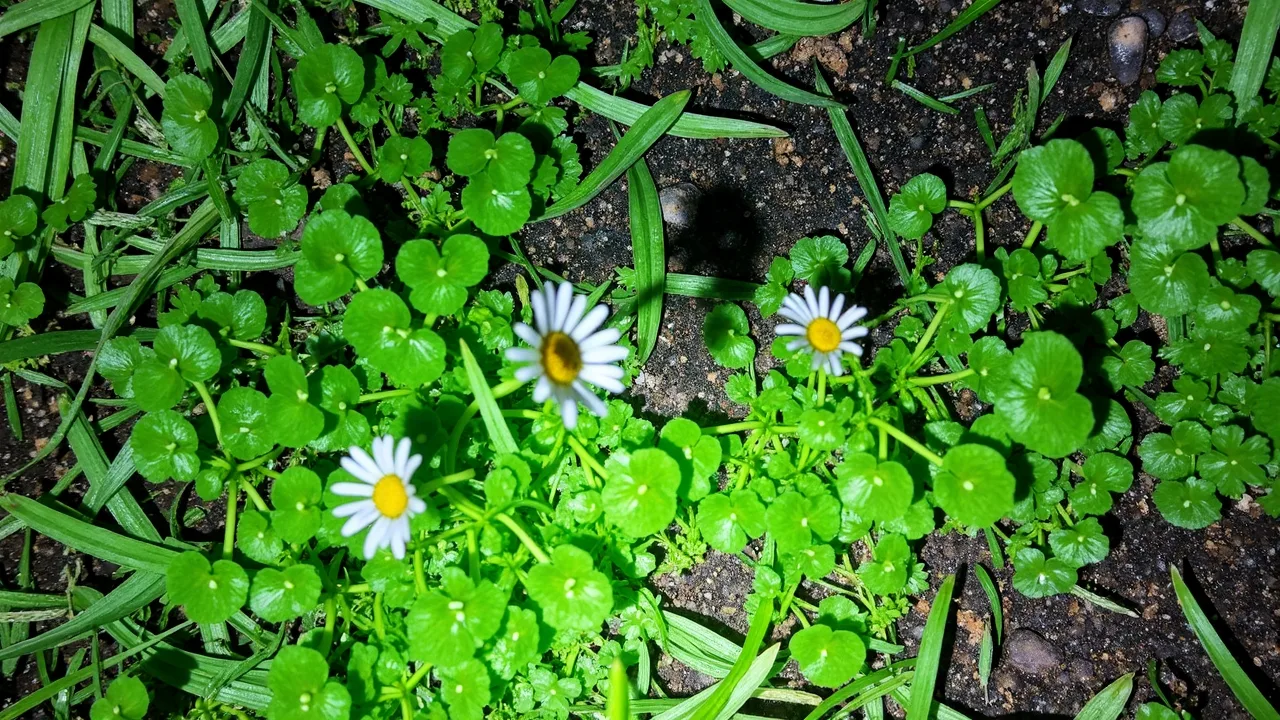
The flower heads are borne singly on unbranched, leafless stems that reach 5–20 cm above the foliage. Each head is technically a composite inflorescence rather than a single flower. The central disc is made up of many tiny tubular florets, bright yellow and tightly packed. Around the disc, a single ring of ray florets spreads outwards; in the wild type these are white above, often flushed pink or crimson on the undersides, and tipped with a slightly notched end. The whole head measures 1–2.5 cm across at full opening.
The ray florets characteristically open in bright conditions and close again in the evening or in dull weather — a habit that has long made the plant a kind of informal weather glass in cottage gardens. After pollination the disc darkens and the seed head develops as a small, rounded cluster of achenes without a feathery pappus.
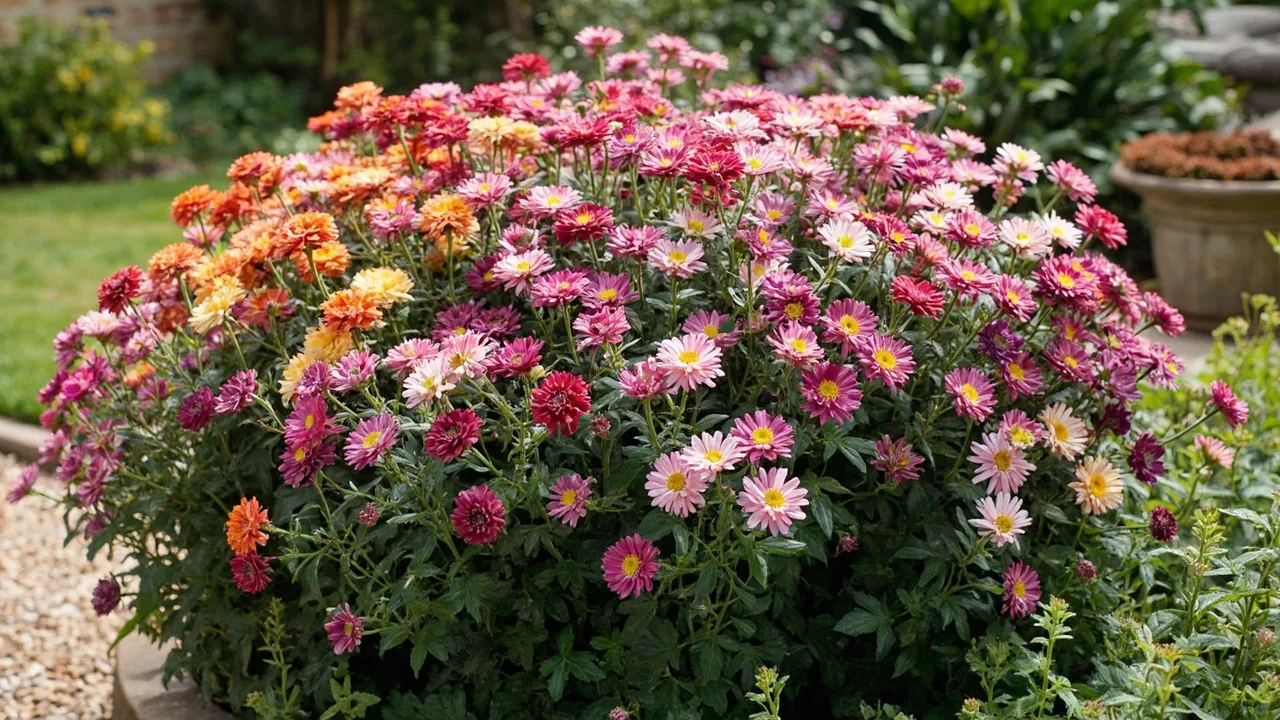
Double-flowered cultivars derived from the species carry many more ray florets packed around a reduced central disc, giving a pompom-like appearance. In these forms the rays may be white, pale pink, rose, or deep red, and the heads are noticeably larger than those of the wild plant.
Growing Conditions
Bellis perennis grows throughout the UK and is fully hardy in British winters. Established plants tolerate frost and will continue to flower through mild spells in all but the harshest conditions. The species grows actively from early spring through autumn and may persist year-round in mild winters, particularly in the south and west.
The plant performs best in full sun or dappled shade. In deeper shade flowering is reduced and the rosettes become looser. The classic British lawn is in fact an ideal habitat — the rosette habit allows the plant to escape mowing at standard heights (around 2.5–4 cm), and the open sward provides the light it needs.
Soil requirements are modest. The species prefers a moist but well-drained loam or sandy loam and grows well across a wide pH range, with a slight preference for neutral to slightly alkaline conditions. It will colonise improved garden soils, thin turf over old walls, and the compacted ground of paths and gateways. It is intolerant of waterlogged conditions, which quickly cause crown rot.
In the UK climate the main flowering season runs from March to October, with the heaviest flush in late spring (April to June). A secondary flush often occurs in early autumn after rain. In mild winters flowers can appear in any month.
Planting and Care
Sowing and planting
Seed can be sown directly outdoors in spring (March to May) or in early autumn (August to September). The seed is small and requires light to germinate, so it should be pressed into the surface of moist, finely prepared ground and not covered with more than a thin sift of compost or vermiculite. Germination typically takes 2–3 weeks at temperatures of 15–18 °C. Seedlings should be thinned to 15–20 cm apart once they are large enough to handle. Container-grown plants from garden centres can be set out at any time during the growing season.
Watering and feeding
Watering is most important in the establishment phase and during prolonged dry spells. Once established the species tolerates short droughts well, particularly when grown in open ground where roots can spread. In containers, regular watering is essential because the small root volume dries quickly.
Feeding should be light. A single spring top-dressing with a general-purpose fertiliser is sufficient; rich soils and heavy feeding encourage leafy growth at the expense of flowers and can also make plants more susceptible to mildew.
Pruning and deadheading
No pruning is required. Deadheading spent flowers encourages further blooming and reduces self-seeding where the spread of the plant is not wanted. In lawns, regular mowing at the standard height is well tolerated: the low rosette escapes the blades and continues to flower between cuts.
Propagation
Propagation is straightforward by seed, sown in spring or autumn as described above. Established clumps can also be lifted and divided in early autumn or immediately after the main flowering flush. Division is the surest way to maintain named double-flowered cultivars, which do not come true from seed.
Seasonal care
The main gardening tasks are: a light spring feed; regular deadheading through the flowering season; division of named cultivars every two to three years in autumn; and, where the species is unwelcome in lawns, hand-removal of rosettes in spring before they set seed.
Common Problems
Petal blight (Itersonilia pastinaceae)
A fungal disease that causes browning and rotting of the ray florets, particularly during damp springs. Affected flower heads collapse and turn brown. Remove and destroy affected plants and improve air circulation around remaining plants by thinning.
Powdery mildew (Erysiphe cichoracearum)
A white, powdery fungal coating on leaves and stems, typically appearing in late summer in dry, crowded conditions. Thin overcrowded plantings to improve airflow. Severe infections can be treated with a suitable fungicide, though most established plants tolerate the disease without lasting harm.
Aphids
Greenfly and related species colonise young foliage and flower stems in spring and early summer, distorting growth and excreting sticky honeydew. Small infestations can be dislodged with a strong jet of water; larger outbreaks respond to insecticidal soap.
Leaf miners (Chromatomyia syngenesiae)
The larvae of small flies tunnel within the leaves, producing visible serpentine mines that widen as the larva grows. Remove and destroy affected leaves promptly; in heavy infestations, dispose of all affected material away from the compost heap.
Crown rot
Caused by Sclerotinia and related soil fungi in waterlogged or poorly drained conditions. The plant collapses and the crown turns brown and soft. There is no cure; improve drainage and avoid overwatering, particularly in container-grown stock.
Lawn weed status
In closely mown ornamental lawns the species is generally regarded as a weed because of its prolific self-seeding and the white flowers that interrupt an otherwise green sward. In meadow turf and wildlife lawns it is valued as a native wildflower and an early nectar source. Control in ornamental lawns is by hand removal with a daisy grubber or by selective lawn herbicides; control in meadow turf is by accepting the plant as a feature.
Popular Varieties
The wild species is widely grown as an unnamed component of meadow and wildflower mixtures, and most named cultivars sold in the UK are the double-flowered forms bred for bedding and container use. The most widely available are described below.
'Tasso' series
A compact, double-flowered series bred for spring bedding. Plants reach around 12–15 cm tall and produce densely packed, pompom-like flower heads in shades of pink, rose, red, and white. The series is valued for its uniformity and long flowering period from late winter through to early summer.
'Super Envy' series
A taller, larger-flowered double series, typically reaching 15–20 cm. The flower heads are noticeably bigger than those of 'Tasso' and come in a similar colour range dominated by white and various pinks. The series is widely used in municipal bedding displays for its visual impact from a distance.
'Pomponette' series
A traditional double-flowered mix with small, rounded heads in red, pink, and white. Plants reach around 15 cm and are commonly sold as seed for mass sowing in formal bedding schemes, window boxes, and containers.
'Habanera' series
A fringed, double-flowered series with unusually long, slightly quilled ray florets that give a spidery outline to the flower heads. The mix typically includes white, rose, and red forms. Plants reach around 15–20 cm and are popular for container work where the larger, more decorative heads show to advantage.
Wild type
The unselected species remains the best choice for meadow, wildlife lawn, and naturalistic planting. It is also the only form that comes reliably true from saved seed, and is the form valued in traditional British wildflower turf.
Note on hardiness ratings: the Royal Horticultural Society does not publish a hardiness rating for Bellis perennis as a species, reflecting its long-standing status as a fully hardy native across all UK regions. No AGM (Award of Garden Merit) is currently held by the species or by any commonly sold cultivar series at the time of writing.
Pests and Diseases
| Problem | Symptoms | Management |
|---|---|---|
| Rust | Orange or brown pustules appear on the undersides of leaves. | Remove affected foliage and improve air circulation to reduce humidity. |
| Slugs and snails | Irregular holes in leaves and silvery slime trails on soil or plants. | Use physical barriers like copper tape or organic pellets to deter feeding. |
| Vine weevil | Notched leaf margins and potential root damage causing plant decline. | Check roots for grubs at planting and use biological nematodes in soil. |
| Powdery mildew | White, dusty fungal growth on leaves and stems. | Avoid overhead watering and ensure good air circulation around plants. |
| Aphids | Clusters of small soft-bodied insects on new growth causing curling. | Encourage natural predators like ladybirds or spray with a strong jet of water. |
For step-by-step help, read Controlling Aphids Naturally, Dealing with Slugs and Snails and Treating Powdery Mildew. Or browse the full plant problem solver to diagnose an issue by symptom.
Recommended Products
GardenWizz earns a commission from qualifying purchases made through affiliate links on this page (including links within the article) — as an Amazon Associate, and from Thompson & Morgan via the Awin network. This does not affect the price you pay. See our disclaimer for details.