Ladyslippers
Cypripedium dietrich
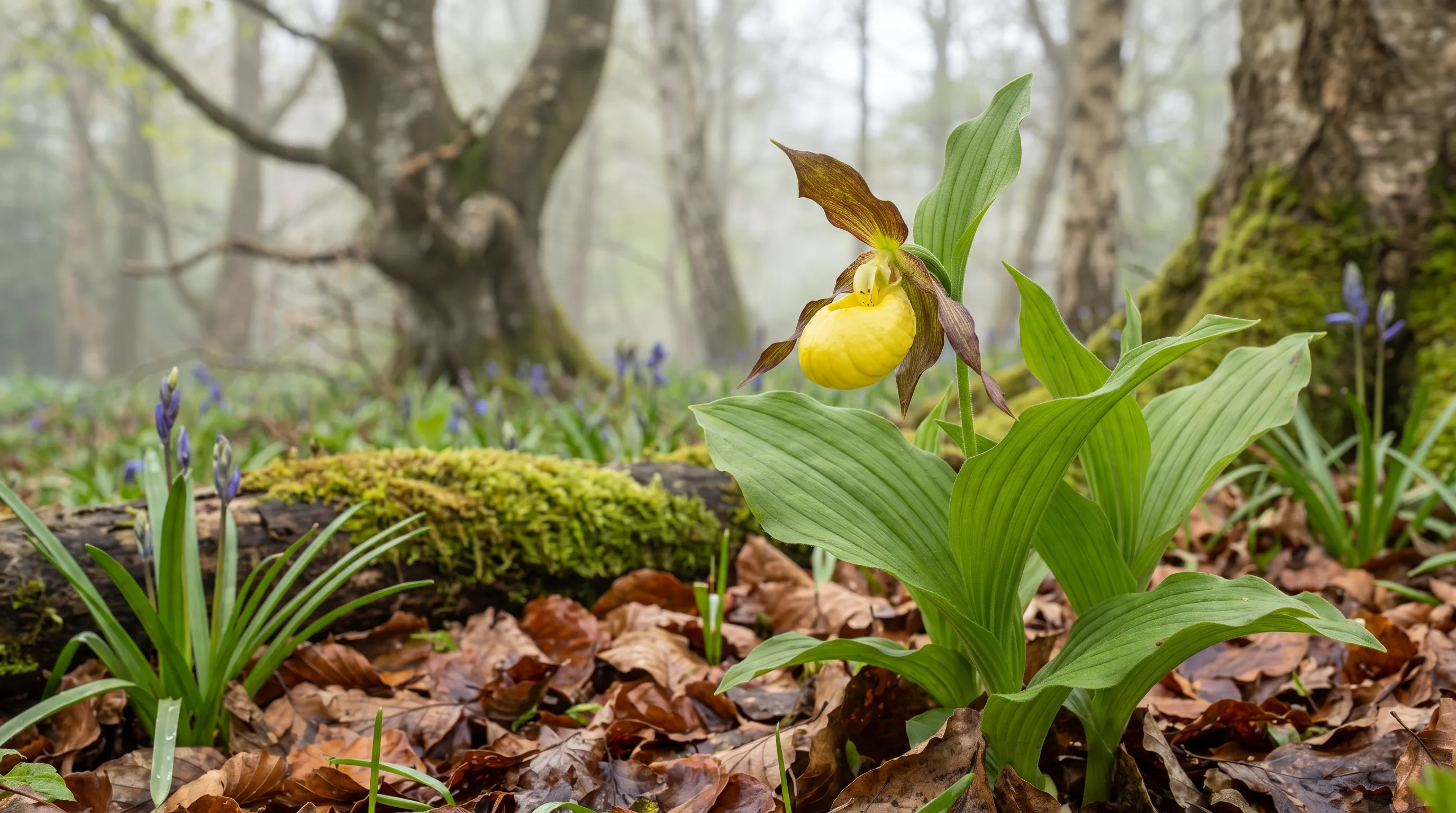
At a Glance
| Botanical name | Cypripedium dietrich |
|---|---|
| Common name(s) | ladyslippers |
| Family | Orchidaceae |
| Plant type | perennial |
| Height × Spread | 15–60 cm × 20–30 cm |
| Position | — |
| Soil | leaf-mould rich, moist, free-draining |
| Flowering | — |
| Toxicity | — |
| Native range | Northern Hemisphere, including most of Europe and Africa (Algeria), Russia, China, Central Asia, Canada the United States, Mexico, and Central America |
Cypripedium Dietrich gx is a hardy, deciduous slipper-orchid grex (a hybrid cross group), sold under the trade name Cypripedium Dietrich gx. Its parents are Cypripedium kentuckiense and Cypripedium microsaccos, and individual flowering plants are sold as clones raised from division or laboratory-propagated stock rather than raised from seed. In UK gardens it behaves as a slow, long-lived herbaceous perennial that rewards careful siting and a cool, moisture-stable root zone.
Overview
Cypripedium Dietrich gx belongs to the slipper-orchid group, whose members are recognised by their inflated, pouch-shaped lip. The grex name "Dietrich gx" covers all plants produced from the deliberate cross between C. kentuckiense and C. microsaccos, regardless of which individual seedling or selected clone the gardener has. Two commercially available clones can differ noticeably in flower colour, stem height and vigour, so a plant should be retained with its nursery label and accession reference.
In the UK, the plant is treated as a specialist woodland perennial. It emerges in spring from an underground rhizome, flowers in late spring, then dies back cleanly by late summer and rests through winter. It is not a houseplant orchid and will not thrive on a warm, dry windowsill. A sheltered, partially shaded position with steady soil moisture and good winter drainage is the basic requirement, after which the plant usually settles with minimal intervention.
The grex is one of the more accommodating Cypripedium hybrids for outdoor cultivation in Britain, but "accommodating" is a relative term. It is still a terrestrial orchid, not a border perennial, and it does not tolerate root disturbance, deep planting or summer drought. Success depends on matching its native woodland conditions rather than on feeding or pruning.
Appearance
The plant grows from a shallow rhizome that sends up one or more upright stems each spring. The leaves are broadly lanceolate, slightly pleated along their length and carry fine hairs, giving the foliage a soft, almost downy look in bright light. Each stem typically carries four to six leaves arranged alternately, with the lower leaves larger than the upper ones, and the whole clump has a tidy, vase-shaped outline before flowering.
Flowers appear in late spring, generally one or two per mature stem. The most distinctive feature is the contrast between the upper petals and the lip: the upper petals are strongly twisted and a deep burgundy-red, while the lip is a large, rounded, creamy-yellow pouch. This combination is the visual hallmark of the Dietrich gx cross and separates it from yellow-flowered or pink-flowered lady's slipper orchids. Individual clones vary in the intensity of the red and in how far the petals twist, so two Dietrich gx plants in flower side by side may look distinctly different.
The flowering stem commonly reaches 50–100 cm once established, with most garden plants settling around 60 cm. Spread is modest, usually 10–50 cm across a developing clump. After flowering, the foliage continues to photosynthesise and feed the rhizome, and it should be left intact until it yellows naturally in late summer.
Growing Conditions
Choose a position in partial shade with shelter from cold spring winds and from strong midday sun. Light from the north, east or west side of a wall, or dappled shade cast by light deciduous canopy, suits most garden sites. A position that catches gentle morning sun and is shaded during the hottest part of the day is ideal. Avoid deep, dry shade beneath evergreen conifers and avoid exposed south-facing borders where the root zone will overheat in summer.
Soil should be a loam that stays moist but never waterlogged. The RHS profile notes that the grex accepts acid, neutral or alkaline conditions, so soil pH is not usually the limiting factor. The decisive qualities are drainage through the dormant season and steady moisture through the growing season. Heavy clay should be opened up with coarse grit, bark and leaf mould, or avoided in favour of a raised bed that mimics a woodland edge.
A site beneath deciduous trees is often appropriate because winter rainfall is absorbed by dormant ground and the emerging shoots receive the increased light they need before the canopy leafs up. Companion planting should be low and unimposing; vigorous ground-cover perennials compete for moisture and make inspection of the rhizome difficult. A permanent label is essential, because the dormant plant disappears completely in winter and a misplaced fork is the most common cause of loss.
Container culture is possible in a coarse, loam-based orchid mix with generous drainage holes, but pots dry faster than beds and need close attention in summer. They also need protection from winter downpours under an open-sided canopy, because the rhizome will not survive prolonged saturation. Whatever the container, ensure the rhizome sits only just below the surface, never deep.
Planting and Care
Plant container-grown specimens in spring or early autumn while the plant is in active growth or just entering dormancy. Soak the root ball, then tease out the roots gently without breaking them. Set the rhizome so the white buds sit only 1–2 cm below the surface of the prepared medium; deep planting is one of the most common causes of failure. Firm the medium lightly without compacting it and water to settle.
Watering should be consistent rather than frequent. During active growth in spring and early summer, water whenever the upper centimetre of soil begins to dry, applying at the base rather than over the foliage. Rainwater is preferable where tap water is hard, but the grex is not strictly calcifuge and accepts ordinary mains water in most districts. As the foliage yellows in late summer, reduce watering, then keep the rhizome only just moist through winter; a pot allowed to bake dry is just as damaging as one left waterlogged.
Feeding should be modest. A weak, balanced fertiliser at quarter strength once or twice during active growth is sufficient for a plant in good soil, and a surface mulch of leaf mould is often more useful than feed. Avoid high-nitrogen lawn or tomato feeds, fresh manure and rich garden compost placed against the crown. The aim is steady, balanced growth, not lush soft foliage that rots at the base.
No routine pruning is required. Remove yellowed stems only after they have died back naturally in late summer or early autumn, cutting them close to the ground with clean secateurs. Do not cut green foliage after flowering; the leaves are still feeding the rhizome. Clear fallen debris if it is diseased, but leave a thin mulch of leaf mould over the rhizome through winter for protection and slow nutrient release.
Propagation is specialist work. Established clumps can be divided while dormant, but each division must carry a sound section of rhizome with at least one viable bud and a healthy root system. Division sets a plant back, sometimes for several seasons, and is generally worthwhile only when a clump has outgrown its space. Seed propagation requires sterile laboratory conditions because orchid seed lacks stored food and depends on symbiotic fungi. It is not a practical method for routine home gardeners.
Seasonal care follows the herbaceous perennial cycle. In February and March, watch for emerging shoots and protect them from late frost with a light fleece on cold nights. During April, May and June, maintain steady moisture as leaves and flowers develop. In July and August, prevent drought stress, especially beneath trees that draw moisture from the surface. In September and October, allow foliage to finish naturally and cut back only when stems have yellowed. Divide only established plants in cool conditions. From November to January, keep the bed well drained and avoid treading over the dormant crown.
Common Problems
Crown and rhizome rot are the principal risks and usually trace back to one of three causes: deep planting, a compacted or peat-heavy medium, or stagnant winter moisture. Shoots collapse at the base, buds fail to emerge or the foliage blackens from below. Improve drainage, reduce watering and replant at the correct depth in fresh medium if a specimen can be salvaged; badly affected plants rarely recover.
Failure to flower is common in young plants and after disturbance. The grex typically takes two to five years to reach flowering size, and a recently divided or transplanted plant may sit dormant for a season. Check light levels and moisture before adding fertiliser. Heavy feeding will not hurry a slow plant and may worsen rot problems.
Slugs and snails graze emerging shoots in spring and can destroy a season's growth overnight. Inspect from late winter onwards, remove hiding places around the crown and remove hiding places around the crown and use only products labelled for use around ornamental plants. Vine-weevil larvae damage roots in containers; unexplained loss of vigour warrants tipping the root ball and inspecting the white grubs against the root tips.
Leaf scorch, seen as bleached or brown patches on exposed foliage, usually indicates too much direct sun or hot reflected light. Move container plants to brighter shade or provide temporary screening during the hottest weeks. Yellowing earlier than the normal late-summer dieback suggests root stress, over-feeding or waterlogging rather than nutrient hunger.
Persistent colour breaking, rings or distortion on the flowers can indicate a virus. There is no cure and infected plants should be isolated to protect neighbouring orchids. Sterilise cutting tools between plants and buy new stock only from reputable specialist nurseries that maintain virus-tested propagation lines.
Popular Varieties
Cypripedium Dietrich gx is a grex rather than a single clone, so named cultivars within the cross are limited and depend on the nursery's selection programme. Gardeners are most likely to encounter the grex under the label Cypripedium Dietrich gx, occasionally with a clonal designation such as a colour form or seedling number attached. Keep that label with the plant, because flower colour and stem height can vary between selections.
Where a wider range of hardy slipper orchids is desired, established hybrid grexes such as Cypripedium 'Gisela', Cypripedium 'Philipp' and Cypripedium 'Sabine' are widely grown in UK gardens and offer a more predictable flowering performance than species stock. These are different grexes with their own parentage and should not be confused with Dietrich gx or used as substitutes in records.
When buying any slipper orchid, prioritise legally propagated nursery stock, a healthy root system and a culture sheet over flower colour alone. Avoid plants offered without a botanical name, without a propagation record or from suppliers who cannot confirm the cross. Accurate provenance is the foundation of both successful cultivation and responsible conservation of wild lady's slipper populations.
Pests and Diseases
| Problem | Symptoms | Management |
|---|---|---|
| Slugs and snails | Irregular holes chewed in young leaves and seedlings, often accompanied by silky trails. | Use physical barriers like copper tape or apply iron phosphate pellets around the base. |
| Grey mould (Botrytis) | Fuzzy grey-brown fungal growth on flowers, leaves, or stems, often causing rot. | Improve air circulation and remove affected plant parts to reduce humidity around the foliage. |
| Root rot | Yellowing, wilting foliage and soft, blackened rhizomes due to waterlogged soil. | Ensure soil is moist but well-drained and avoid overwatering, especially in winter. |
| Vine weevil | Notched leaf margins at night and damaged roots or rhizomes underground. | Apply biological nematodes to the soil in late summer or autumn to control larvae. |
| Powdery mildew | White powdery fungal spots on leaves and stems, potentially causing distortion. | Spray with a fungicide or milk solution and ensure good air circulation around plants. |
For step-by-step help, read Dealing with Slugs and Snails and Treating Powdery Mildew. Or browse the full plant problem solver to diagnose an issue by symptom.
Recommended Products
GardenWizz earns a commission from qualifying purchases made through affiliate links on this page (including links within the article) — as an Amazon Associate, and from Thompson & Morgan via the Awin network. This does not affect the price you pay. See our disclaimer for details.